
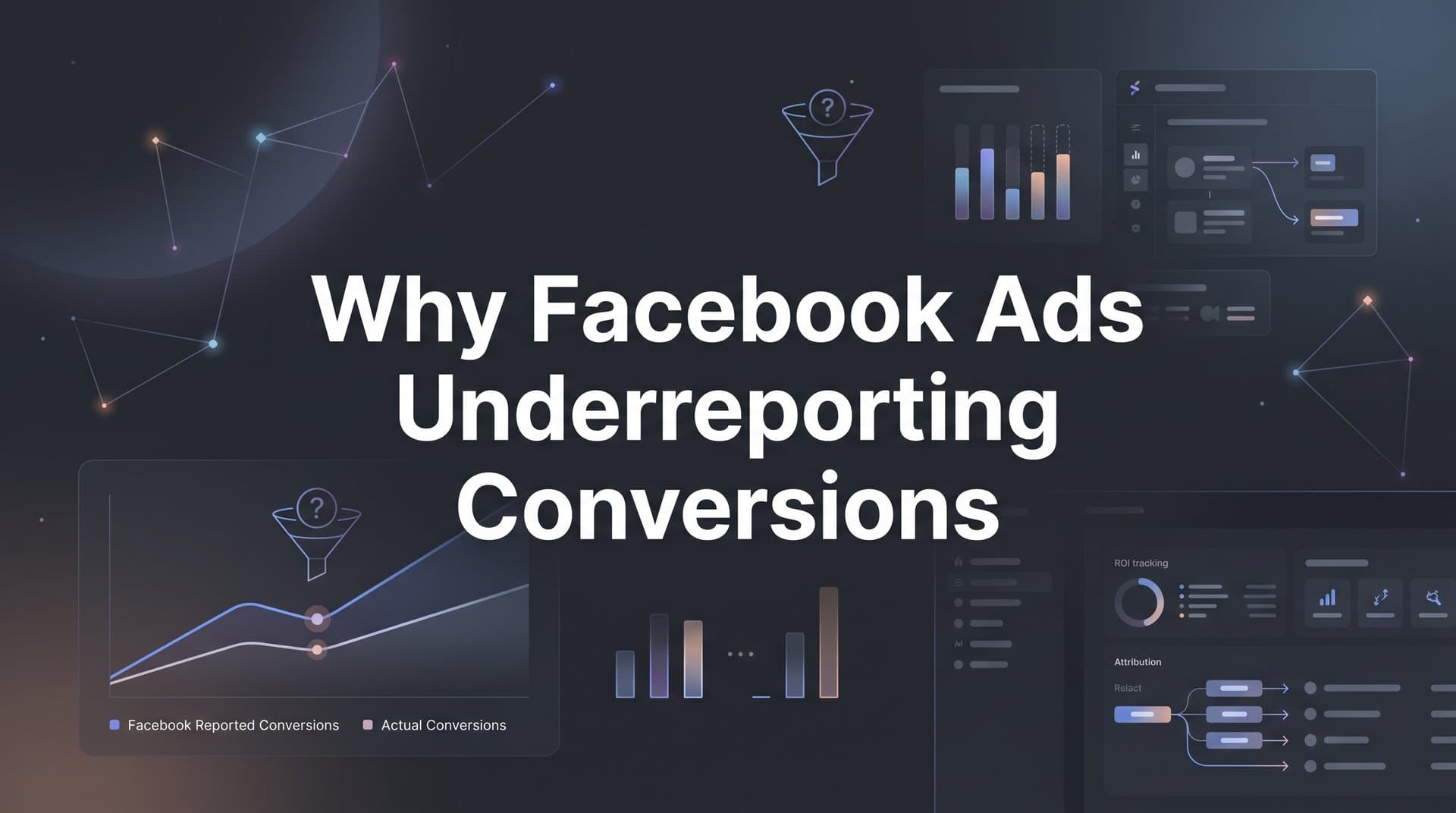
You run Facebook ads. Your CRM shows leads coming in, deals closing, pipeline growing. But when you open Ads Manager, the conversion numbers look like they belong to a completely different campaign. The gap is not small. It is not a rounding error. It is a chasm, and it is costing you real money.
This disconnect leads marketers to make decisions that actively hurt their results. Campaigns that are genuinely driving pipeline get paused because the data makes them look ineffective. Budget shifts away from channels that are working toward ones that simply appear to be working because their tracking is more intact. And perhaps most damaging of all, Facebook's own algorithm gets fed a distorted picture of who your real converters are, which degrades targeting quality over time.
The frustrating truth is that Facebook ads underreporting conversions is not a glitch. It is not something Meta will fix in the next product update. It is a structural problem built into how browser-based tracking works, compounded by privacy changes, technical failures, and the fundamental complexity of how modern buyers actually behave. Understanding why this happens is the first step toward fixing it. And the fix, when done right, does not just improve your reporting. It improves your actual campaign performance.
How Facebook Measures Conversions (And Where It Breaks Down)
Facebook's default conversion tracking is built on the Meta Pixel, a snippet of JavaScript code that lives on your website. The basic mechanic is straightforward: a user clicks your ad, lands on your site, completes an action like filling out a form or reaching a thank-you page, and the Pixel fires an event back to Facebook. Simple in theory. Fragile in practice.
The Pixel is entirely dependent on the user's browser to load and execute correctly. It is a client-side tag, which means it runs in the user's browser environment, not on your server. That distinction matters enormously because the browser environment is outside your control. If anything interrupts the Pixel's execution, whether that is a slow connection, a JavaScript conflict with another script on your page, or a browser setting that restricts third-party scripts, the event never fires. The conversion happens in the real world, but it is invisible to Facebook.
Attribution windows add another layer of limitation. Inside Ads Manager, you can set windows like 7-day click or 1-day view. These settings determine which conversions Facebook will count in its reports. A user who clicks your ad and converts eight days later simply does not exist in your Ads Manager data under a 7-day click window, even if your ad was the direct reason they came back. The conversion happened. Facebook just does not count it.
Cross-device behavior creates yet another gap. Consider a user who sees your ad on their iPhone during their morning commute, saves the page, and then signs up on their work laptop later that afternoon. Unless Facebook can definitively link those two sessions to the same person through its own identity graph, that conversion is missed. The Pixel on the laptop has no memory of the mobile ad click. Without a persistent identifier connecting the two devices, the journey breaks apart in the data. Understanding the full scope of Facebook ads reporting discrepancies is essential before you can begin to address them.
These are not edge cases. They are everyday scenarios for B2B SaaS audiences, where buyers research carefully, move between devices constantly, and rarely convert in a single linear session. The Pixel was designed for a simpler web that no longer exists.
iOS Privacy Changes and the Cookie Crackdown
If the Pixel's structural limitations were already creating blind spots, Apple's App Tracking Transparency framework made those blind spots significantly larger. Starting with iOS 14, Apple required app developers to ask users explicitly for permission to track them across apps and websites. When users are prompted, the majority opt out. This is not a small privacy-conscious minority. It represents a substantial portion of mobile users, and for many B2B SaaS audiences, iPhone users are a dominant segment.
What this means in practice is that when a user who has opted out of tracking clicks a Facebook ad and leaves the app, Meta loses the ability to follow that user's journey. The Pixel on your website cannot connect back to the ad click because the identifier that would link those two events is no longer available. The conversion may happen. Facebook just cannot see it.
Third-party cookie restrictions compound this problem across browsers. Safari's Intelligent Tracking Prevention has blocked third-party cookies for years. Firefox's Enhanced Tracking Protection does the same. These browsers represent a meaningful share of web traffic, particularly among the kind of tech-savvy professionals who make up B2B SaaS buying committees. For these users, the Pixel's ability to track behavior across sessions and domains is severely limited even without iOS restrictions in play.
The critical point here is that these changes did not just reduce tracking accuracy at the margins. They changed the structural baseline. Marketers who built their reporting and optimization strategies on Pixel data before these changes rolled out are now operating with a fundamentally different data environment. The numbers in Ads Manager are not just slightly lower than reality. They reflect a systematically incomplete picture that gets more incomplete as privacy protections expand.
Many marketers respond to this by assuming their campaigns are underperforming and making optimization decisions based on that assumption. The campaigns may actually be performing well. The tracking is what is failing. That distinction is everything when it comes to budget allocation and Facebook ads optimization strategy.
Ad Blockers, Script Failures, and the Invisible Data Loss
Beyond privacy frameworks and cookie restrictions, there is a category of data loss that is entirely invisible inside Ads Manager: the conversions that were never recorded because the Pixel never loaded at all.
Ad blocker usage is widespread, and it skews heavily toward the exact audience that B2B SaaS companies are most often trying to reach. Technical professionals, developers, and business decision-makers are among the most likely segments to run browser extensions that block tracking scripts. When the Meta Pixel script is blocked by an ad blocker, it does not fire a partial event or log a degraded signal. It fires nothing. The user could complete your entire signup flow, and Ads Manager would never know.
Page load failures create a similar problem. The Pixel fires as a JavaScript event, which means it depends on the page loading fully enough for the script to execute. On mobile devices with slower connections, or on pages with heavy JavaScript payloads, the Pixel may not finish loading before the user navigates away. This is especially common on confirmation pages where users immediately close the tab after completing an action. The conversion happened. The Pixel just did not get there in time.
JavaScript conflicts are another source of silent failures. If another script on your page throws an error before the Pixel executes, the Pixel may never fire. These conflicts are not always obvious. They do not generate alerts inside Ads Manager. They simply result in missing data that you have no way of quantifying from within the platform.
This is the most insidious aspect of client-side tracking failures: you cannot see what you are missing. Ads Manager shows you the conversions it recorded. It has no mechanism for showing you the conversions it failed to record. The gap between those two numbers is real, meaningful, and entirely hidden from view unless you have an independent ad tracking system to compare against.
Cross-Device and Cross-Channel Attribution Blind Spots
Here is the scenario that plays out constantly in B2B SaaS marketing. A prospect sees your Facebook ad on their phone while scrolling during lunch. They do not click immediately, but the brand registers. Two days later, they remember the product, search for it on Google, visit your site from a work laptop, and sign up. Google gets the conversion credit. Facebook looks like it contributed nothing.
This is not an unusual journey. It is the norm. B2B purchase decisions involve multiple touchpoints, multiple devices, and multiple channels spread across days or weeks. A single-platform pixel cannot follow a journey that spans devices and sessions. Facebook's Pixel on your website has no way of knowing that the user who arrived from a Google search was the same person who saw your Facebook ad on their phone two days ago. Without that connection, Facebook's contribution to the conversion is invisible in the data.
The cross-channel problem runs deeper than just Facebook missing credit for its role. When every platform reports conversions using its own tracking logic and attribution windows, the numbers across platforms do not add up to anything coherent. Facebook claims credit for a set of conversions. Google claims credit for an overlapping set. Your CRM shows a third number. None of these match each other, and none of them individually represent the truth.
This creates a situation where marketers are making budget decisions based on platform-reported numbers that each platform has a structural incentive to maximize. Facebook's Ads Manager is not designed to show you where Facebook underperformed. It is designed to show Facebook's best possible version of its own contribution. The same is true of Google Ads, LinkedIn, and every other platform. Trusting any single platform's self-reported numbers as the basis for cross-channel budget decisions is a reliable path to misallocated spend.
For B2B SaaS companies with longer sales cycles, this problem is amplified. A prospect who first encountered your brand through a Facebook ad might not become a closed-won deal for sixty or ninety days. The attribution window in Ads Manager will have long since closed. The deal closes, revenue hits your CRM, and Facebook gets zero credit for the awareness it created at the top of that journey.
Server-Side Tracking and the Conversion API
The root cause of most Facebook underreporting is that the Pixel lives in the browser, and the browser is an environment full of things that can block, delay, or break it. The logical fix is to move conversion tracking off the browser entirely. That is exactly what the Meta Conversion API does.
CAPI is a server-to-server integration. Instead of relying on a JavaScript tag in the user's browser to fire an event, your server sends conversion data directly to Meta's servers. The user's browser environment becomes irrelevant. Ad blockers cannot intercept a server-to-server request. iOS tracking restrictions do not apply to data you send from your own infrastructure. Cookie limitations do not factor in because you are using your own first-party data, not browser cookies, to identify and send conversion events.
The practical impact is significant. Events that the Pixel would have missed, because the user had an ad blocker, because the page loaded slowly, because the user opted out of iOS tracking, now get captured and sent to Meta. CAPI can also capture events that the Pixel was never designed to handle, including downstream CRM events like a lead reaching a qualified stage, a demo being booked, or a deal closing. These are the events that actually matter for B2B SaaS optimization, and they have never been reliably available to Facebook's algorithm through Pixel alone.
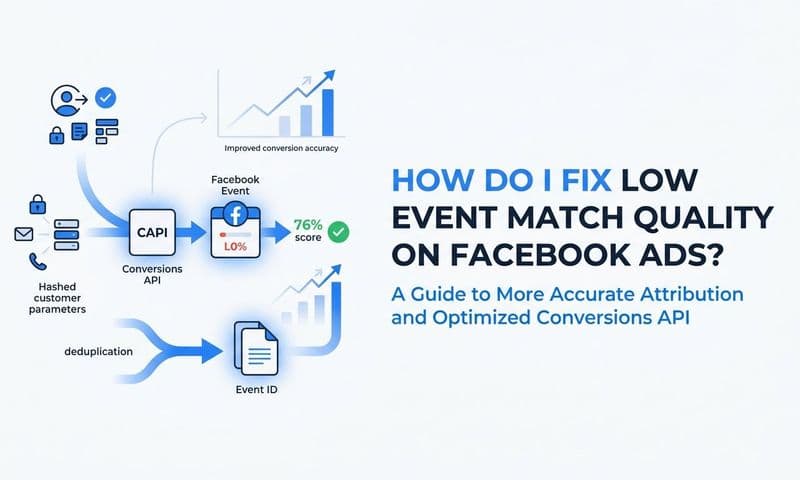
When you run CAPI alongside the Pixel with proper event deduplication configured, you get the best of both approaches. The Pixel captures what it can in real time. CAPI fills in the gaps and adds downstream events. Deduplication ensures that when both fire for the same event, Facebook counts it only once. Improving your Facebook event match quality through this combined approach directly strengthens the signal your algorithm receives.
The benefit extends beyond better reporting. Facebook's ad delivery algorithm uses conversion signals to optimize who sees your ads. When the algorithm is working from a complete, accurate set of conversion data, it builds a more accurate model of who your real buyers are. It targets more effectively. Cost per acquisition tends to improve over time as the algorithm gets better signal. When you restore signal quality through CAPI, you are not just fixing your reports. You are improving the actual performance of your campaigns.
Building a Source of Truth Beyond Ads Manager
Even with CAPI implemented, there is a fundamental problem with relying on Ads Manager as your primary source of conversion truth. Ads Manager is a platform built by Facebook to show Facebook's performance. That is not a cynical observation. It is just an accurate description of what the tool is designed to do. It is not built to give you a neutral, cross-channel view of how your marketing is actually performing.
An independent attribution platform changes that dynamic. Instead of asking Facebook how Facebook performed, you track the full customer journey using your own first-party data, server-side events, and CRM integrations. You can see which touchpoints, across all channels, contributed to each conversion. You can apply different attribution models, first-touch, last-touch, linear, or time-decay, and see how the story changes. You can connect ad spend data directly to pipeline and closed revenue, not just to leads or form fills.
This is where multi-touch attribution becomes genuinely useful for B2B SaaS teams. A prospect who saw a Facebook ad, clicked a retargeting ad, and then converted through a branded Google search represents a journey where multiple touchpoints contributed. A last-touch model gives all the credit to Google and makes Facebook look useless. A first-touch model does the opposite. Multi-touch attribution distributes credit across the journey in a way that reflects reality, giving you a more accurate picture of what each channel is actually doing.
Connecting that attribution data to your CRM and revenue data closes the loop completely. You are no longer measuring marketing performance in terms of leads or signups. You are measuring it in terms of pipeline generated, deals influenced, and revenue closed. That is the metric that actually matters for a B2B SaaS business, and it is the only metric that allows you to make confident decisions about where to allocate budget.
When your ad spend data, conversion data, CRM data, and revenue data all live in a single platform, discrepancies between what Facebook reports and what actually happened in the business become immediately visible. You can validate Facebook's numbers against ground truth. You can identify campaigns that are driving real revenue but look underperforming in Ads Manager, and protect them from budget cuts. You can also identify campaigns that look strong in Ads Manager but are not producing downstream revenue, and redirect that spend. Tools built for paid ads analytics that connect all of these data sources make this kind of validation systematic rather than manual.
Putting It All Together
Facebook ads underreporting conversions is not a mystery. It is the predictable result of browser-based tracking that breaks under real-world conditions, privacy changes that have fundamentally altered what the Pixel can see, ad blockers and technical failures that create invisible data loss, and cross-device journeys that a single-platform pixel was never equipped to follow.
The fix has two parts. First, move beyond the Pixel to server-side tracking through the Meta Conversion API. This restores the signal quality that browser-based tracking has lost, captures downstream CRM events that matter for B2B optimization, and feeds Facebook's algorithm the data it needs to find your real buyers. Second, build a source of truth outside Ads Manager using an independent attribution platform that connects every touchpoint to actual revenue.
Cometly is built for exactly this. It captures every touchpoint from first ad click through pipeline stages to closed-won revenue, giving your team a single, verified view of what is actually driving results. It connects your ad platforms, CRM, and website data in one place, feeds enriched conversion signals back to Meta and Google to improve algorithm performance, and surfaces AI-driven recommendations that help you scale what is working with confidence.
If your CRM and your Ads Manager are telling you completely different stories, the problem is not your campaigns. It is your tracking. And that is a solvable problem. Get your free demo today and start capturing every touchpoint to make budget decisions you can actually trust.