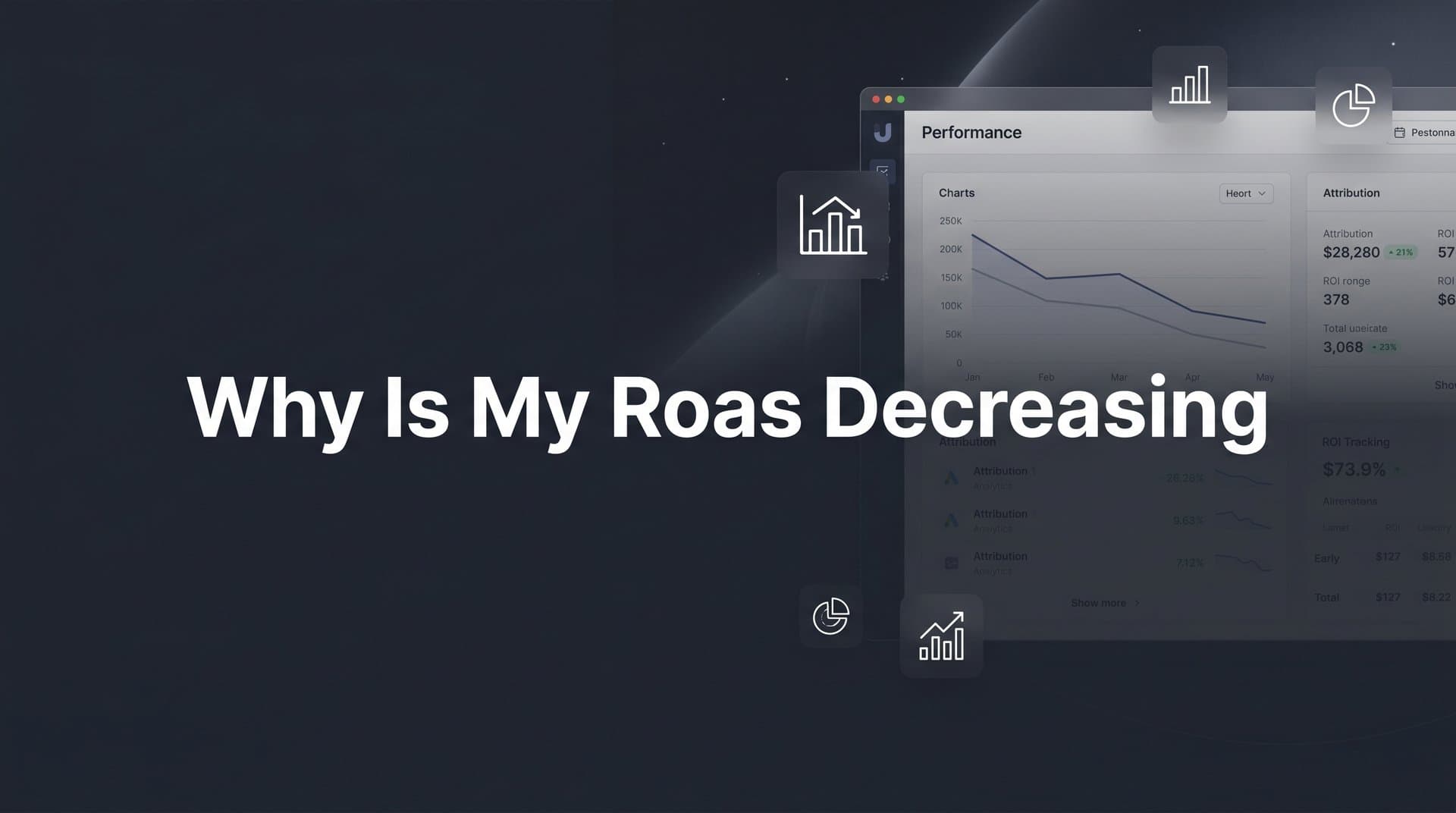
You check your dashboard on a Monday morning and the number stares back at you: ROAS is down. Not catastrophically, but enough to notice. You haven't changed your targeting, your budget is the same, and the creatives look fine. So what's going on?
This is one of the most disorienting experiences in paid media management. Declining ROAS without an obvious cause creates a kind of diagnostic paralysis: do you pause campaigns, rotate creative, increase bids, or call it a tracking glitch? Making the wrong move wastes budget and time. Making no move at all lets the problem compound.
The truth is that ROAS is a downstream metric. It reflects the health of your entire funnel, your tracking infrastructure, your audience quality, and your offer, not just how well your ads are performing in isolation. A drop in ROAS is your funnel's way of telling you something has shifted, and finding that something requires looking beyond the ad platform dashboard.
This article walks through the most common reasons ROAS declines, from audience fatigue and tracking gaps to attribution blind spots and funnel leaks. More importantly, it covers how to diagnose each one so you can respond with precision rather than guesswork. Accurate attribution isn't just a nice-to-have here: it's the foundation for any fix that actually works.
The Hidden Mechanics Behind a Falling ROAS
Before jumping to solutions, it helps to understand what ROAS is actually measuring. Return on ad spend is calculated by dividing revenue attributed to ads by the cost of those ads. That formula looks simple, but both sides of the equation are more fragile than they appear.
On the revenue side, attribution determines which conversions get credited to which ads. On the cost side, your spend is fixed and known. So when ROAS drops, the question is almost always: did revenue actually fall, or did something change in how revenue is being measured and attributed?
This distinction matters enormously. A genuine performance decline means your ads are generating fewer or lower-value conversions than before. A tracking or attribution error means the conversions are happening, but your platform isn't seeing them correctly. These two problems look identical on the surface but require completely different responses.
Ad platforms default to last-click attribution within their own ecosystem, which means they're only crediting conversions that they can directly observe within a specific window. If a user clicks a Meta ad, visits your site three more times over two weeks, and then converts via organic search, Meta may not count that conversion at all. The revenue happened, but ROAS looks lower than it should.
This is why a ROAS decline should always trigger a two-track investigation. First, verify that your tracking is intact and your conversion events are firing accurately. Second, assess whether actual performance has shifted in terms of audience quality, creative relevance, or offer strength. Conflating these two tracks leads to strategic misfires: pausing campaigns that are actually working, or spending time on creative refreshes when the real issue is a broken pixel.
The marketers who diagnose fastest are those who have visibility into the full funnel, not just what the ad platform reports. That means connecting ad data to CRM data, verifying server-side event delivery, and using attribution models that reflect how buyers actually move through the purchase journey.
Audience Fatigue, Competition, and Market Shifts
Sometimes the tracking is fine and the funnel is healthy, but ROAS still falls. In these cases, the problem is often external: your audience, your competitive environment, or broader market conditions have shifted in ways that erode the efficiency of your campaigns.
Ad fatigue is one of the most common culprits. When the same creative is shown repeatedly to the same audience segment, engagement naturally declines. Click-through rates drop, cost-per-click rises, and the volume of traffic reaching your landing page shrinks. Since ROAS depends on both the quality and quantity of that traffic, fatigue in the creative layer creates a cascade effect that shows up as a ROAS decline even when nothing else has changed.
The signal to watch for is a divergence between impressions and engagement. If your ads are being served at roughly the same volume but CTR is trending down, fatigue is a likely factor. The fix involves refreshing creative, expanding audience pools, or introducing new angles that speak to different pain points within your target segment.
Increased competition is a separate but related issue. If more advertisers are targeting the same keywords or audience segments, CPMs and CPCs rise. Your budget now buys fewer impressions and clicks than it did before, which means fewer conversion opportunities for the same spend. This is especially common in growing SaaS categories where new entrants are constantly bidding for attention.
The challenge with competition-driven ROAS compression is that it's often invisible inside your ad platform. Your ads may still be performing well relative to your own historical benchmarks, but the market has moved around you. Monitoring share of voice, watching for rising CPMs over time, and benchmarking against SaaS marketing metrics helps surface this pattern.
Seasonal demand shifts and macroeconomic changes add another layer of complexity. Buyer intent fluctuates with budget cycles, industry events, and broader economic conditions. In B2B SaaS, purchasing decisions often slow down at the end of fiscal quarters or during periods of organizational uncertainty. When intent drops, conversion rates fall even when ad delivery metrics look healthy, and ROAS follows.
Understanding these external forces doesn't make them easier to control, but it does help you avoid misdiagnosing them as internal campaign failures. Sometimes the right response is patience and creative iteration rather than structural changes to your targeting or budget allocation.
Conversion Tracking Gaps That Silently Kill Your Numbers
Here's a scenario that plays out more often than most marketers realize: your campaigns are actually working, but your tracking infrastructure is broken, so the data tells a false story. Conversions are happening, revenue is being generated, but the ad platform isn't seeing it. ROAS looks like it's declining when the real problem is a measurement gap.
This has become significantly more common as browser privacy updates have degraded pixel-based tracking. iOS privacy changes, browser-level ad blocking, and the broader shift away from third-party cookies have all reduced the reliability of client-side tracking. When a user's browser blocks or restricts the pixel from firing, that conversion event never reaches the ad platform. The sale happened, but from the platform's perspective, the ad that drove it gets no credit.
The practical consequence is that ad platforms operating on degraded pixel data are optimizing toward an incomplete picture of your conversions. Their algorithms bid based on the signals they receive, so if they're only seeing a fraction of actual conversions, they'll underbid on the audiences and placements that are genuinely driving revenue. This creates a self-reinforcing cycle: worse data leads to worse optimization, which leads to lower actual ROAS over time.
Server-side tracking and Conversion API (CAPI) integrations exist specifically to close this gap. Instead of relying on the browser to send conversion events, server-side tracking sends those events directly from your server to the ad platform, bypassing browser restrictions entirely. This means a much higher percentage of actual conversions get attributed correctly, giving the platform's algorithm the signal quality it needs to optimize effectively.
Without this infrastructure in place, a meaningful share of your conversion events simply disappears. The result is a ROAS figure that looks worse than reality, budget decisions made on incomplete data, and optimization signals that push spend toward the wrong audiences.
Duplicate or misconfigured conversion events create a different but equally damaging problem. If the same conversion is being counted multiple times, your ROAS looks artificially inflated. If events are misfiring or triggering on the wrong actions, the optimization signal becomes noise. Ad platform algorithms trained on bad conversion data will make systematically poor bidding decisions, eroding returns over time in ways that are hard to trace back to the source.
Auditing your conversion setup should be the first step in any ROAS investigation. Verify that events are firing once per conversion, that they're reaching the platform through both pixel and server-side channels, and that the values being passed are accurate and consistent. Platforms like Cometly make this easier by providing unified visibility into conversion event health across channels, so you can identify gaps before they compound into a performance crisis.
Attribution Model Blind Spots and What They Hide
Even when tracking is technically accurate, the attribution model you're using can paint a deeply misleading picture of where your ROAS is coming from. This is one of the most underappreciated sources of ROAS confusion in B2B SaaS marketing.
Last-click attribution assigns 100% of the conversion credit to the final touchpoint before a purchase. It's the default in most ad platforms because it's simple and easy to implement. But in B2B SaaS, where buyers typically engage with multiple channels over weeks or months before making a decision, last-click creates a systematic distortion. Channels that close deals get all the credit. Channels that educate, nurture, and build intent get none.
The practical result is that last-click ROAS for top-of-funnel channels, like awareness-stage paid social or content-driven display, will look terrible even when those channels are essential to the pipeline. Marketers optimizing on last-click data will naturally pull budget from these channels, which weakens the top of the funnel, reduces the volume of qualified leads entering the pipeline, and eventually causes overall ROAS to decline across all channels.
Multi-touch attribution distributes conversion credit across all the touchpoints in a customer journey based on their actual contribution to the outcome. This surfaces a more accurate picture of which channels are driving pipeline versus which ones are just present at the moment of conversion. Often, multi-touch analysis reveals that high-spend channels are generating clicks but not revenue, while lower-spend channels are quietly driving outsized value that last-click models never capture.
The natural question is: which attribution model is correct? The honest answer is that no single model is perfect, but some are far more useful than others depending on your sales cycle and business model. For B2B SaaS with longer sales cycles, a model that accounts for multiple touchpoints across an extended window is almost always more informative than last-click.
Comparing ROAS across different attribution windows or models without a consistent methodology is another common trap. If you're looking at Meta's reported ROAS using a 7-day click window and comparing it to Google's reported ROAS using a 30-day window, you're not comparing the same thing. These apples-to-oranges comparisons lead to budget allocation decisions that are more about measurement artifacts than actual performance differences.
A unified attribution platform that applies a consistent methodology across all channels gives you benchmarks you can actually trust. Cometly's B2B revenue attribution connects ad data to CRM and revenue data, so you can see which campaigns are contributing to closed-won revenue rather than just which ones are generating clicks or form fills.
Post-Click Experience and Funnel Leaks Driving Down Returns
Your ad gets the click. Now what happens? The post-click experience is where a significant portion of ROAS problems originate, and it's often the last place marketers look when performance starts to slip.
Landing page relevance is one of the most direct levers affecting conversion rates. When the message in your ad doesn't match the message on the landing page, visitors experience a disconnect that increases bounce rates and reduces the likelihood of conversion. This is especially common when campaigns are scaled quickly, with new audiences being sent to landing pages built for a different segment or stage of the funnel.
Page load speed compounds the problem. Slow-loading pages cause visitors to abandon before the page even renders, which means you're paying for clicks that never had a chance to convert. This doesn't show up as a campaign performance issue in your ad platform: it shows up as a ROAS decline that looks like an audience or creative problem.
In B2B SaaS specifically, the funnel between lead capture and closed revenue is where ROAS leaks are most severe and most commonly overlooked. A high volume of leads doesn't guarantee revenue. If MQLs are converting to SQLs at a low rate, or if SQLs are dropping off before reaching closed-won, the revenue generated per ad dollar spent is far lower than it should be. ROAS looks poor not because the ads are failing to attract leads, but because the B2B SaaS marketing funnel isn't converting them efficiently.
This is why connecting ad data to CRM data is so important for B2B SaaS marketers. Without that connection, you're measuring ROAS at the lead level rather than the revenue level. You might be running campaigns that generate plenty of MQLs but very few customers, and your ROAS calculation won't reflect that until you trace the full journey from click to closed-won.
Offer degradation is another often-overlooked factor. If a promotional offer has expired, a competitor has launched a stronger value proposition, or your product positioning has become less differentiated over time, conversion rates will fall even when everything else stays constant. The market has moved, but the campaign hasn't adapted. This shows up as declining ROAS that can look like audience fatigue or creative exhaustion when the real issue is that the offer itself is no longer compelling enough to drive action.
Auditing the post-click experience means looking at landing page analytics, tracking funnel conversion rates from lead to revenue, and regularly pressure-testing your offer against the competitive landscape. These aren't ad platform activities: they require broader visibility into the full customer journey.
How to Diagnose and Reverse the Decline with Better Data
At this point, you have a clearer picture of what can cause ROAS to fall. The next step is building a systematic approach to diagnosing which of these factors is actually at play in your specific situation, because the fix depends entirely on the cause.
Start with a full attribution audit. Before drawing any conclusions about campaign performance, verify that your conversion tracking infrastructure is working correctly. Check that every conversion event is firing once per action, that server-side tracking is in place alongside your pixel, and that conversion values are being passed accurately to the ad platform. If your tracking is broken, every other diagnostic step will be built on a false foundation.
This audit should cover all channels, not just the one where ROAS appears to be declining. Cross-channel tracking gaps often create misleading comparisons: one channel looks like it's outperforming another simply because it has better tracking coverage, not because it's genuinely driving more revenue. Using ad tracking management software helps ensure consistent measurement across every platform.
Once you've confirmed tracking integrity, move to a unified view of the customer journey. This means connecting your ad platform data to your CRM and revenue data so you can see the full path from first ad click to closed-won deal. In B2B SaaS, this connection is essential because the gap between initial engagement and revenue recognition can span weeks or months. Without it, you're making budget decisions based on proxy metrics like leads or demo requests rather than actual revenue outcomes.
A platform like Cometly is built specifically for this. It connects ad spend data to pipeline and revenue data, giving you a single source of truth that spans the entire customer journey. You can see which campaigns are generating leads, which of those leads are converting to customers, and what revenue each campaign has actually produced. This is the level of visibility required to make confident budget allocation decisions.
With accurate, unified data in hand, you can identify which channels and campaigns are genuinely underperforming versus which ones are being misrepresented by tracking gaps or attribution model limitations. From there, the strategic responses become clearer: refresh creative for fatigued audiences, expand targeting to reduce competition pressure, fix tracking gaps to restore optimization signal quality, or audit the post-click funnel to find conversion leaks.
The final step is feeding enriched, first-party conversion data back to the ad platforms themselves. When you send high-quality conversion signals through server-side channels, the platform's optimization algorithm gets better data to work with. This improves targeting accuracy, reduces wasted spend on low-intent audiences, and gradually restores ROAS without requiring you to increase your budget. It's one of the highest-leverage improvements available to B2B SaaS marketers operating in a privacy-first tracking environment.
Cometly's Conversion API integration makes this process systematic, sending enriched conversion events back to Meta, Google, and other platforms so their algorithms can optimize on real revenue signals rather than degraded pixel data. The result is better ad performance over time, grounded in the actual outcomes your campaigns are producing.
Putting It All Together
Declining ROAS is rarely caused by a single factor. More often, it's the result of several issues compounding quietly until the cumulative effect shows up in your numbers. Audience fatigue, tracking degradation, attribution blind spots, and funnel leaks can all be present simultaneously, each contributing to the overall decline in ways that are hard to separate without the right data infrastructure.
The marketers who recover fastest share one characteristic: they operate from a single source of truth for their marketing data rather than relying on native ad platform reporting alone. Native reporting shows you what the platform wants you to see, filtered through its own attribution logic and limited by its own tracking coverage. A unified attribution platform shows you what's actually happening across the full customer journey.
That's the foundation that makes every other fix possible. Once you can see which channels are genuinely driving revenue, which conversion events are being tracked accurately, and where leads are dropping out of the funnel, the path forward becomes clear. You stop guessing and start making decisions grounded in evidence.
If your ROAS is declining and you're ready to diagnose it properly, Cometly gives you the visibility to connect every ad click to actual revenue. From multi-touch attribution to server-side conversion tracking and AI-driven campaign recommendations, it's built for B2B SaaS teams who need accurate data to scale confidently. Get your free demo today and start capturing every touchpoint that's driving your growth.