Every B2B SaaS marketing team eventually hits the same wall. Budget is finite, the pipeline targets are aggressive, and there are two very different schools of thought on how to hit them. Do you cast a wide net and build demand across the market? Or do you go surgical, targeting the exact accounts that fit your ideal customer profile and working them until they close?
This is the ABM vs demand generation debate, and it plays out in planning meetings, budget reviews, and strategy decks across the industry. The problem is that most teams frame it as an either/or decision when the real challenge is more nuanced: how do you know which approach is actually driving revenue, and how do you measure the impact of either with enough confidence to double down?
Both strategies have genuine merit. Both can fill pipeline. But without the right measurement infrastructure, you end up making budget decisions based on gut instinct or incomplete data, and that is where growth stalls. This article cuts through the confusion, defines each approach clearly, explains where each fits in the B2B funnel, and lays out a practical framework for measuring both against the only metric that truly matters: revenue.
Two Philosophies, One Revenue Goal
At their core, demand generation and account-based marketing represent two fundamentally different ways of thinking about how buyers find you and how you find buyers.
Demand Generation: This is a broad, inbound-oriented approach. The goal is to build market awareness, educate potential buyers, and generate a high volume of leads across a wide audience. Demand gen programs typically include content marketing, SEO, paid social, webinars, email nurture sequences, and other tactics designed to attract buyers who are actively researching solutions or who can be made aware that they have a problem worth solving. The underlying logic is reach and volume: get your message in front of as many relevant people as possible, and let the best leads self-select through the funnel.
Account-Based Marketing (ABM): ABM flips the model. Instead of attracting whoever responds to your content, you start with a specific list of high-value target accounts and work backward. Marketing and sales teams align to identify decision-makers within those organizations, develop personalized content and outreach, and coordinate touchpoints across channels to engage the buying committee. ABM is not about volume. It is about relevance, precision, and depth of engagement with the accounts most likely to become your best customers.
The mindset difference is significant. Demand gen asks: how do we get more people interested? ABM asks: who specifically do we want as customers, and how do we get in front of them?
This distinction shapes everything downstream, from how you create content to how you measure success. A demand gen team celebrates a spike in inbound MQLs. An ABM team celebrates engagement from a named account that has been cold for three months. Both are valid signals, but they require completely different frameworks to interpret.
Here is where many B2B SaaS teams go wrong: they treat these as competing philosophies and pick one, often based on what the team has historically been good at rather than what the business actually needs. The result is either a demand gen program that generates leads that never close, or an ABM program that is too narrow to generate enough pipeline at scale.
The smarter framing is to recognize that both strategies serve the same ultimate goal: revenue. The question is not which one is better in the abstract. The question is which one, or which combination, is right for your business at this stage, and how you build the measurement infrastructure to know whether it is working.
Where Each Strategy Fits in the B2B Funnel
Understanding where each approach lives in the funnel helps clarify when to deploy each one and why they are often more complementary than competitive.
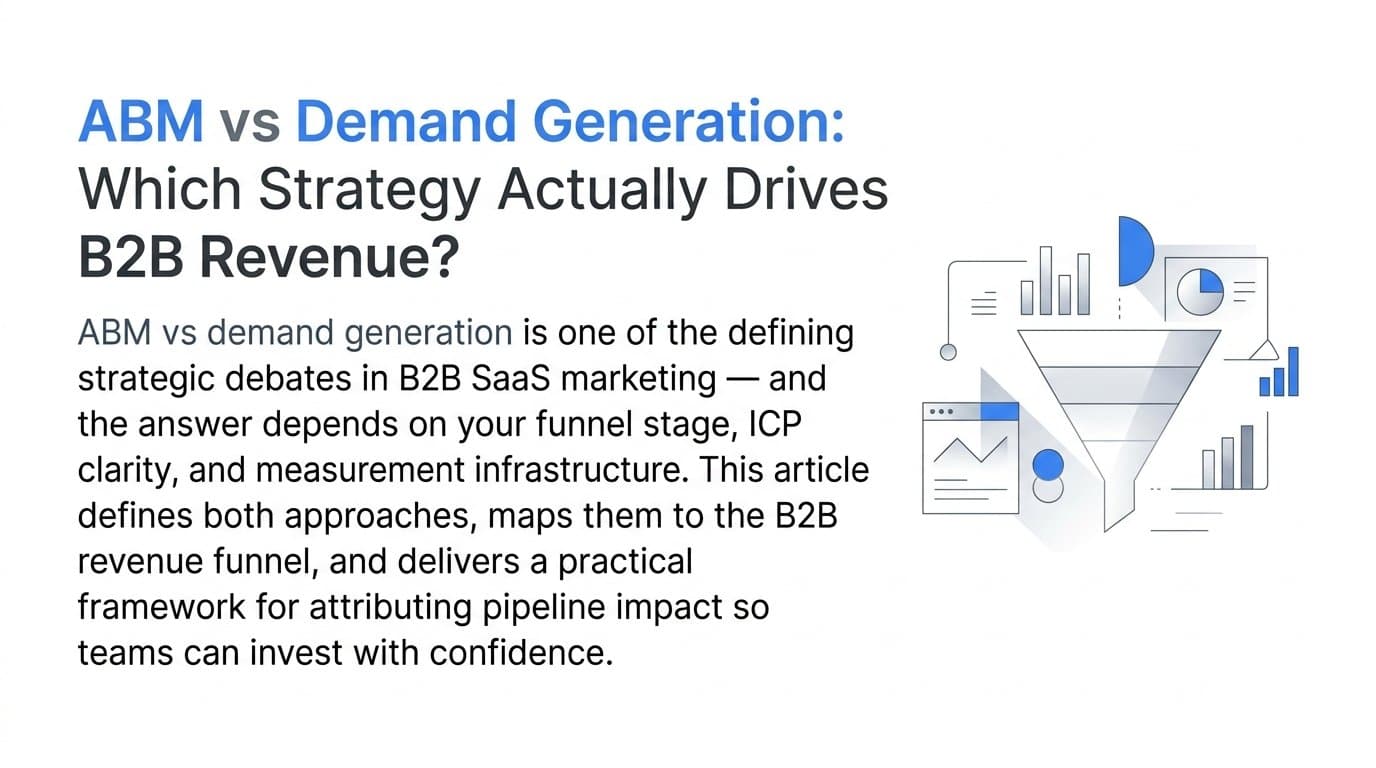
Demand generation typically dominates the top of funnel. Its primary job is to create brand awareness and capture intent signals from buyers who may not yet know they have a problem worth solving, or who are just beginning to explore solutions. A well-executed demand gen program pulls potential buyers into your orbit through educational content, targeted ads, and organic search, and then nurtures them toward a conversion event. The funnel is wide at the top and narrows as leads qualify themselves through engagement.
ABM operates differently. While it can influence every stage of the funnel, it is especially powerful in mid-to-late stages, where personalized engagement accelerates decision-making within a known target account. By the time an ABM sequence kicks into high gear, marketing and sales already know who the stakeholders are, what their business challenges look like, and what objections are likely to come up. That context allows for a level of personalization that generic demand gen content simply cannot match.
Deal size and sales cycle length are the most reliable signals for which approach makes more sense. High-volume products with lower average contract values often favor demand gen because the economics work: you need a large number of leads to hit revenue targets, and the cost of highly personalized ABM outreach per account does not justify the return. On the other hand, enterprise or complex sales with longer cycles and higher ACVs often benefit significantly from ABM. When a single deal can be worth hundreds of thousands of dollars, spending significant resources on personalized engagement with the right accounts is not a cost, it is an investment with a clear return.
The nuance is that many B2B SaaS companies operate across both segments simultaneously. They have a self-serve or SMB motion that benefits from demand gen, and an enterprise motion that requires ABM-level attention. Running both is not a contradiction. It is a reflection of how the market actually works.
What matters is that each motion has its own funnel logic, its own conversion benchmarks, and its own attribution requirements. Trying to manage both with a single set of metrics or a single reporting view leads to confusion and poor decisions. The teams that execute both well are the ones who have built clear segmentation into their measurement frameworks from the start.
The Metrics That Actually Matter for Each Approach
One of the most common mistakes in B2B SaaS marketing is applying the same measurement framework to both demand gen and ABM. It seems logical on the surface, but it produces misleading data that drives bad budget decisions.
Demand generation success is typically measured by MQL volume, cost per lead, channel-level conversion rates, and pipeline contribution from inbound sources. These metrics make sense for a high-volume, top-of-funnel motion. They tell you whether your content and paid programs are generating enough qualified interest to feed the sales team. When your demand gen engine is working, you see a consistent flow of leads at a manageable cost per acquisition, and a meaningful percentage of those leads convert to pipeline.
ABM success requires a completely different set of signals. Account engagement scores matter more than lead volume. Pipeline coverage within the target account list is a more meaningful indicator than total MQLs. Deal velocity within named accounts tells you whether your personalized outreach is actually accelerating decisions. And revenue influenced within the named account list is the ultimate measure of whether ABM is delivering on its promise.
Here is the critical insight: if you measure an ABM program using demand gen metrics, it will always look underperforming. ABM generates fewer leads by design. That is the point. You are trading volume for precision. If your leadership team is evaluating ABM success based on MQL counts, they are measuring the wrong thing, and they will likely pull funding from a program that is actually working.
The reverse is also true. If you evaluate a demand gen program using ABM-style account engagement metrics, you will miss the broader market signals that indicate whether your category awareness efforts are gaining traction.
Attribution at the account level and the touchpoint level is critical for both approaches. For demand gen, you need to know which channels and which pieces of content are actually contributing to pipeline, not just generating clicks. For ABM, you need to track every interaction a target account has with your brand across paid, owned, and earned channels, so you can understand the full picture of how that account moved from cold to closed.
Without that attribution infrastructure, you are making budget decisions based on incomplete information. And in a competitive B2B SaaS market, that gap between what you measure and what is actually happening is where growth opportunities get left on the table.
Why Attribution Is the Missing Link Between Strategy and Revenue
Both ABM and demand generation produce touchpoints across multiple channels. A target account might first encounter your brand through a LinkedIn ad, then read three blog posts, attend a webinar, respond to a personalized outreach email, and finally convert through a demo request. That is six distinct touchpoints before a sales conversation even begins. Without proper attribution, your reporting will credit the demo request form and ignore everything that came before it.
This is why last-touch attribution is particularly dangerous in B2B SaaS. It systematically undervalues the early-stage content and awareness work that demand gen programs produce, and it makes ABM touchpoints invisible unless they happen to be the final conversion event. The result is a reporting environment where the channels doing the most work to build trust and educate buyers look like they are not contributing anything.
Multi-touch attribution models are essential for understanding how demand gen content and ABM outreach work together across the customer journey. A linear model distributes credit evenly across all touchpoints. A time-decay model weights recent interactions more heavily. A position-based model gives more credit to the first and last touch. Each has trade-offs, but any of them will give you a more accurate picture than last-touch alone.
The practical implication is significant. When you can see that a target account engaged with four pieces of content before ever talking to sales, you understand the role your demand gen program played in warming up that account. When you can see that a personalized ABM outreach email was the touchpoint that triggered the demo request, you understand the role your ABM program played in converting that interest into action. Both programs get appropriate credit, and your budget decisions reflect reality.
Pipeline attribution and revenue attribution are increasingly important as finance and revenue leaders demand that marketing prove its contribution to closed revenue, not just lead volume. This shift is particularly relevant for B2B SaaS companies where the sales cycle is long and the relationship between a marketing touchpoint and a closed deal can span months. Traditional reporting tools that only look at last-touch or first-touch miss the complexity of how B2B buyers actually make decisions.
The teams that get this right build attribution infrastructure that connects every marketing touchpoint to pipeline and revenue, across both their demand gen and ABM programs. They can answer questions like: which demand gen channels are generating engagement from target accounts? Which ABM campaigns are contributing to pipeline within the named account list? Which combination of touchpoints correlates most strongly with closed-won deals? Those answers are what allow marketing leaders to allocate budget with confidence rather than intuition.
Running ABM and Demand Generation Together
The most effective B2B SaaS marketing teams do not choose between ABM and demand generation. They run both, and they use each to make the other smarter.
Here is how the integrated approach works in practice. Demand generation programs build broad awareness and capture intent data at scale. They generate inbound leads, track content engagement, and surface signals that indicate which companies and personas are actively researching solutions in your category. That data becomes the intelligence layer that informs your ABM program.
When your demand gen motion is instrumented correctly, you can identify which target accounts on your ABM list are already engaging with your content before sales has made any outreach. That is an enormous advantage. It tells you which accounts are warming up, which topics they care about, and which channels they are using to discover you. Your ABM team can use that information to time outreach more effectively and personalize messages around the content the account has already consumed.
A unified customer journey view is what makes this possible. When you can see every interaction a company has had with your brand, across paid ads, organic content, email, and direct outreach, you can identify patterns that would be invisible in siloed reporting. You might discover that accounts who attend your webinars before receiving ABM outreach close at a significantly higher rate. Or that a specific paid social campaign is generating disproportionate engagement from your target account list. Those insights tell you where to invest more.
First-party data and conversion tracking are the foundation of this approach. When ad platform activity is connected to CRM records, you can see the full picture of how a prospect moved from an anonymous ad click to a qualified opportunity. That connection is what allows both strategies to be measured against the same revenue outcomes, rather than existing in separate reporting silos that never reconcile.
The practical challenge is that most marketing teams have data scattered across multiple platforms. Ad spend lives in Google Ads and LinkedIn Campaign Manager. Lead data lives in the CRM. Engagement data lives in marketing automation. Website behavior lives in analytics. Bringing all of that together into a coherent view of the customer journey requires intentional infrastructure, not just a collection of dashboards.
Measuring What Works: Putting Attribution Into Practice
Setting up attribution to track both demand gen and ABM touchpoints requires a systematic approach that connects data across every stage of the customer journey.
The foundation is comprehensive event tracking. Every significant interaction should be captured: ad clicks, form submissions, content downloads, webinar registrations, email opens, CRM stage changes, and offline conversions from sales calls or in-person events. Each of these events is a data point in the customer journey, and each one needs to be tied back to the original source and the account it belongs to.
For demand gen programs, this means tracking not just which channels generate leads, but which channels generate leads that actually convert to pipeline and revenue. A channel that produces a high volume of MQLs but a low pipeline conversion rate is not performing as well as it looks. Conversely, a channel that produces fewer leads but at a higher quality is worth more investment, even if the raw numbers look smaller.
For ABM programs, this means tracking engagement at the account level across every channel, so you can see the cumulative touchpoint history for each target account and understand what combination of interactions is driving movement through the funnel.
Server-side tracking and Conversion API integrations are increasingly important for both strategies. Browser-based pixels miss a significant portion of conversion events due to ad blockers, browser privacy settings, and cookie restrictions. Server-side tracking captures those events at the server level before they can be blocked, giving you a more complete and accurate picture of what is actually happening. This accuracy matters enormously when you are trying to optimize ad spend across both demand gen and ABM campaigns.
This is where a platform like Cometly becomes a practical asset for B2B SaaS marketing teams. Cometly connects ad spend across channels to pipeline and revenue, giving teams a single source of truth for evaluating which strategy and which specific campaigns are generating the highest return. It captures every touchpoint from the first ad click to the closed-won deal, connects that data to CRM records, and surfaces the account-level and campaign-level insights that allow marketing leaders to make confident budget decisions.
With Cometly, you can see which demand gen campaigns are generating engagement from your target account list, which ABM touchpoints are contributing to pipeline, and how the combination of both strategies is influencing revenue. That visibility replaces guesswork with data, and it gives you the foundation to scale what is working and cut what is not.
Putting It All Together
ABM and demand generation are not rivals. They are complementary strategies that serve different parts of the same revenue goal, and the teams that treat them as such consistently outperform those who treat them as an either/or choice.
Demand generation builds the market awareness and intent signals that make ABM more effective. ABM converts the highest-value opportunities that demand gen surfaces. Together, they create a go-to-market motion that is both broad enough to capture market share and precise enough to close the accounts that matter most.
But the teams that actually win are the ones who can measure both strategies accurately. They know which touchpoints are driving pipeline. They can attribute revenue to specific campaigns across both programs. They have a clear view of the customer journey from first impression to closed deal, and they use that data to allocate budget with confidence rather than gut feel.
That level of visibility is not a nice-to-have. It is the difference between marketing that grows the business and marketing that spends budget without accountability.
If you are ready to build that foundation, explore how Get your free demo with Cometly helps B2B SaaS marketing teams track every touchpoint from first ad click to closed-won revenue. Whether you are running demand gen, ABM, or both, Cometly gives you the single source of truth you need to make smarter decisions and scale what is actually working.