
Most B2B SaaS marketing teams are running the same playbook: broad demand generation campaigns, gated content for lead capture, and MQL targets that keep the funnel looking busy. Meanwhile, the accounts that could actually move the revenue needle sit untouched, never receiving a single targeted message.
Account based marketing flips that model entirely. Instead of casting a wide net and hoping the right fish swim in, ABM starts with a defined list of high-value accounts and builds every campaign around them. Sales and marketing stop operating in separate lanes and start coordinating around the same set of targets. The result is a more focused, more efficient go-to-market motion that aligns effort with opportunity.
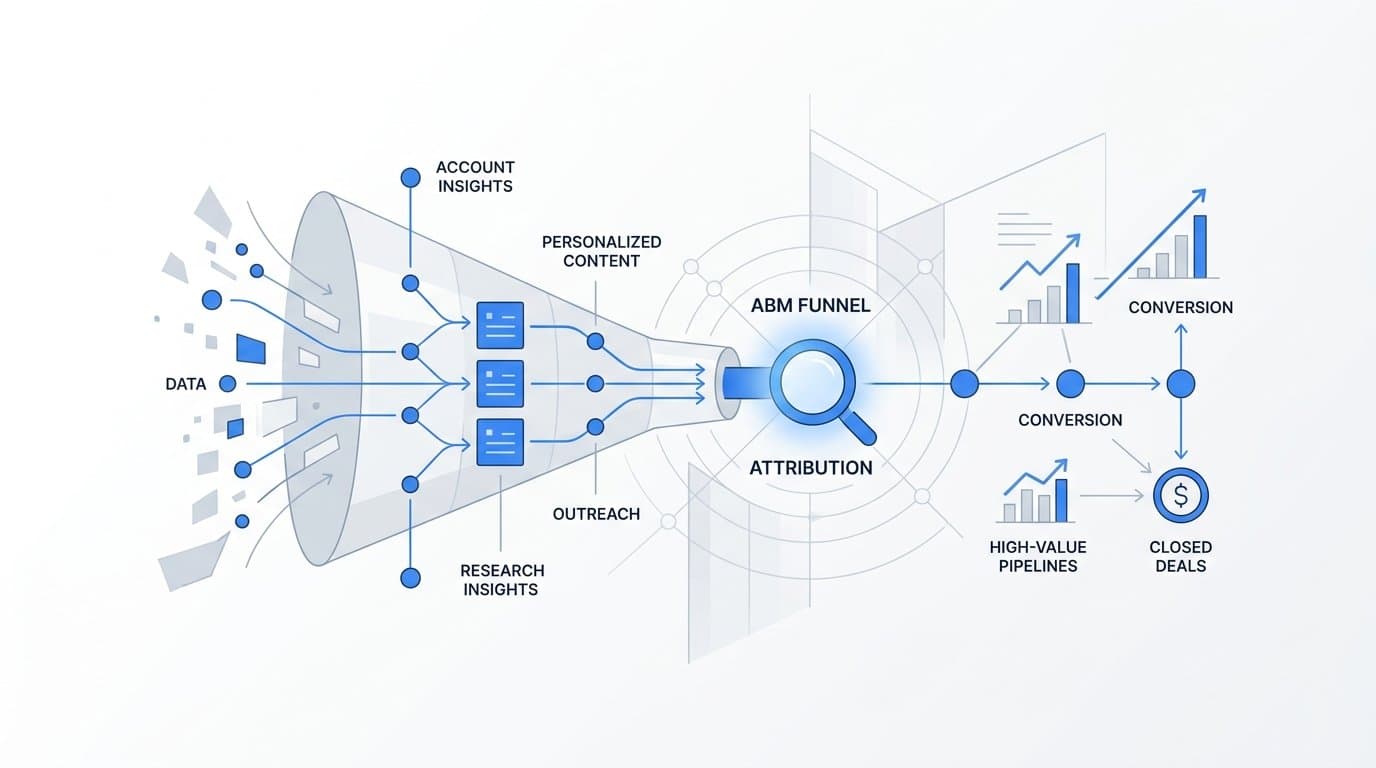
But here is what most account based marketing blog posts leave out: ABM without accurate attribution is just expensive activity. You can run beautifully personalized LinkedIn campaigns, coordinate outbound sequences, and host account-specific webinars, and still have no idea which of those efforts actually influenced pipeline. This article covers how ABM works, how to build and run it properly, and why attribution is the measurement layer that determines whether your ABM program drives revenue or just drives noise.
The Flipped Funnel: How Account Based Marketing Actually Works
Traditional demand generation starts broad. You create content, run ads, and wait for leads to self-select into your funnel. Account based marketing inverts that logic. You identify the accounts you want to win, then build campaigns specifically designed to engage those accounts and move them through the buying process.
This reversal requires tight alignment between sales and marketing from day one. Sales brings knowledge of which account types close fastest and at the highest value. Marketing brings the channel expertise and content production capacity to reach those accounts at scale. Neither function can run ABM alone, and programs that try to separate the two typically fail within a few quarters.
ABM practitioners generally work within three distinct models, each suited to different account tiers and resource levels.
One-to-one ABM: Reserved for your highest-value target accounts. This model involves fully customized campaigns, dedicated landing pages, direct executive outreach, and sometimes custom content built specifically for a single company. The investment is significant, but so is the potential return on each account.
One-to-few ABM: Applied to clusters of accounts that share similar characteristics, such as industry, company size, or use case. Personalization is still meaningful but built around a segment rather than a single company. This model balances resource efficiency with relevance.
One-to-many ABM: Scaled account-based tactics applied to a broader list of accounts that fit your ICP. Personalization happens at the industry or persona level. This tier often looks closest to traditional demand gen but is still guided by a defined account list rather than open-ended targeting.
The critical distinction is that ABM is not a campaign type. It is a go-to-market strategy. Paid ads, content, outbound sequences, events, and direct mail all become coordinated instruments aimed at specific accounts and the buying committees within them. A single LinkedIn ad campaign does not constitute ABM. The coordinated, multi-channel orchestration around a defined account list is what makes it ABM.
Buying committees add another layer of complexity. In B2B SaaS, deals rarely close with a single decision-maker. You are typically influencing a group that includes economic buyers, technical evaluators, end users, and legal or procurement stakeholders. ABM requires you to map those roles within each target account and build messaging that speaks to each persona's specific concerns.
Building Your Target Account List Without Guessing
The quality of your ABM program is directly tied to the quality of your target account list. A poorly constructed list means wasted budget on accounts that will never convert. A well-constructed list means every dollar of ABM spend is working against a genuine opportunity.
The starting point is your Ideal Customer Profile, and it should be grounded in closed-won revenue data, not assumptions. Pull your best existing customers and analyze what they have in common. Look at firmographics like industry, company size, and geography. Examine their tech stack to identify patterns in the tools they use alongside your product. Review deal size, sales cycle length, and time-to-value. The accounts that closed fastest, expanded most, and churned least are the template for your ICP.
This analysis often surfaces surprises. Marketing teams frequently discover that the segment they assumed was their best fit is actually outperformed by a segment they had underinvested in. Letting the data define the ICP rather than intuition is what separates ABM programs built on solid foundations from those built on wishful thinking.
Once you have a defined ICP, the next challenge is prioritizing which accounts to pursue first. Not every ICP-fit account is actively in-market, and treating them all equally burns budget on accounts that are months or years away from a purchase decision.
Intent data helps solve this problem. Third-party intent signals show which accounts are researching topics related to your category across the web. First-party behavioral signals from your website and CRM show which accounts are already engaging with your content, visiting key pages, or interacting with sales. Combining these signals gives you a picture of which accounts fit your ICP on paper and are showing active buying signals right now.
Account scoring models formalize this process. A fit score reflects how closely an account matches your ICP based on firmographic and technographic data. An intent score reflects how actively that account is showing in-market behavior. Combining both into a composite score allows marketing teams to tier accounts and allocate budget proportionally.
Tier one accounts: High fit, high intent. These receive the most personalized, resource-intensive outreach and deserve the largest per-account investment.
Tier two accounts: High fit, moderate intent. These accounts are worth pursuing but may need more nurturing before they are ready for direct sales engagement.
Tier three accounts: Good fit, lower intent. These accounts benefit from scaled ABM tactics that build awareness and capture them when intent increases.
Revisiting and refreshing your account list regularly is equally important. Intent signals shift. Accounts move in and out of active buying cycles. A static list built once and never updated will drift out of alignment with actual market conditions faster than most teams expect.
Running ABM Campaigns Across Paid and Owned Channels
With a tiered account list in place, the next step is building the channel mix that reaches buying committee members wherever they spend their time. ABM is inherently multi-channel, and relying on a single platform limits both reach and effectiveness.
LinkedIn is the dominant paid channel for ABM in B2B SaaS, and for good reason. Its targeting capabilities allow you to reach specific companies, job titles, seniority levels, and functions with a precision that no other paid platform matches. You can upload your target account list directly and serve ads exclusively to contacts within those companies. For buying committee targeting, LinkedIn lets you layer company targeting with persona-level job title filters, so your message reaches the right people at the right accounts.
But LinkedIn alone is not enough. Buying committee members do not spend their entire day on LinkedIn. Google Ads capture accounts that are actively searching for solutions in your category, which is a high-intent signal worth capturing. Display retargeting keeps your brand visible to account contacts who have visited your website. Connected TV and audio advertising are emerging channels that extend reach to buying committee members in non-work contexts, reinforcing brand awareness without requiring active engagement.
Content personalization by account tier is what separates ABM from generic advertising. Tier-one accounts should receive custom landing pages that reference their industry, company size, or specific challenges. If possible, personalize the page dynamically based on the account visiting. Tier-two accounts benefit from industry-specific landing pages and case studies that reflect their segment. Tier-three accounts can be served with broader industry nurture sequences that still feel more relevant than generic demand gen content.
The surround-sound effect is one of the most powerful concepts in ABM execution. When a prospect at a target account sees your LinkedIn ads, receives a personalized email from your sales team, and encounters your retargeting display ads all within the same week, the combined effect is significantly stronger than any single channel could produce alone. Achieving this requires shared visibility between marketing and sales into which accounts are being touched, through which channels, and when.
This coordination breaks down without the right infrastructure. Sales needs to know which accounts are showing high ad engagement so they can prioritize outreach. Marketing needs to know which accounts sales is actively working so they can intensify ad pressure at the right moment. A shared view of account-level activity is not a nice-to-have in ABM. It is the operational requirement that makes the strategy function.
Why ABM Attribution Is Harder Than Standard Lead Attribution
Here is where most ABM programs run into a wall. The measurement infrastructure that most marketing teams have in place was built for lead-based demand generation. It tracks individuals, not accounts. It credits the last click or the last form fill. And it has no mechanism for associating multiple touchpoints from different contacts at the same company into a coherent account-level journey.
ABM measures success at the account level. A deal at a target account might involve six contacts over four months across LinkedIn, Google, direct email, and a webinar. Traditional attribution would credit the last touchpoint before the opportunity was created, completely ignoring the other interactions that built awareness, established credibility, and kept the account engaged throughout the evaluation process.
Buying committee dynamics make this even more complex. The economic buyer might have clicked a LinkedIn ad three months ago and never interacted again. The technical evaluator might have visited your pricing page five times in the past two weeks. The end-user champion might have attended a webinar and downloaded a case study. These are three different people, at the same account, interacting through different channels at different times. Standard analytics tools see three separate leads. ABM requires you to see one account with multiple engagement threads.
Without multi-touch attribution across the full account journey, marketing teams face a fundamental measurement problem. They cannot identify which channels influenced pipeline at the account level. They cannot determine whether their tier-one investment is producing better outcomes than their tier-three spend. They cannot tell leadership which ABM campaigns moved deals forward and which ones consumed budget without impact.
This measurement gap has real consequences. ABM programs that cannot prove pipeline influence get their budgets cut. Marketing teams that cannot connect ABM activity to revenue lose credibility with sales leadership. And without data to optimize against, spend continues to flow toward channels that look active rather than channels that are actually driving outcomes.
The solution requires rethinking attribution from the ground up in an account-based context. Multi-touch attribution models that capture every interaction across every contact at a target account and associate those interactions to the account record are the foundation. Revenue attribution that traces those account-level touchpoints all the way to closed-won deals is the layer that makes ABM ROI visible and defensible.
Measuring ABM Performance: The Metrics That Actually Matter
If you are running ABM and reporting on MQL volume or cost per lead, you are measuring the wrong things. Those metrics were designed for lead-based demand generation. In an account-based context, they actively mislead you about program performance.
The metrics that matter in ABM operate at the account level and connect directly to revenue outcomes.
Account engagement rate: What percentage of your target accounts are actively engaging with your campaigns, content, or sales outreach? Rising engagement rates across your tier-one and tier-two accounts indicate that your messaging is landing and your channel mix is reaching the right people.
Pipeline influenced: How much open pipeline involves accounts from your target list that have been touched by ABM campaigns? This metric connects marketing activity to the deals that sales is actively working, making the marketing contribution to revenue visible without requiring a closed deal to prove value.
Deal velocity: Are target accounts that receive ABM treatment moving through the pipeline faster than accounts that do not? Shorter sales cycles in ABM-touched accounts is a strong indicator that your surround-sound strategy is reducing friction and accelerating decisions.
Revenue attribution by campaign and channel: Which specific ABM campaigns and channels are showing up in the journeys of accounts that closed? This is the metric that tells you whether your LinkedIn investment outperformed your display spend, whether your tier-one custom content drove better outcomes than your tier-three nurture sequences, and where to shift budget in the next quarter.
Comparing attributed pipeline and closed revenue against ABM ad spend gives marketing leaders the data they need to make confident budget decisions. If your tier-one accounts are generating pipeline at a cost that justifies the investment, you scale. If your tier-three spend is not producing engagement or pipeline influence at acceptable rates, you cut or reallocate.
This kind of data-driven optimization is only possible when your attribution infrastructure can connect ad spend to account-level outcomes. Without that connection, you are making budget decisions based on activity metrics that feel productive but do not reflect actual revenue impact.
Connecting ABM Data to Revenue: Where Attribution Platforms Come In
The core challenge of ABM measurement is fragmentation. Your LinkedIn campaign data lives in LinkedIn. Your Google Ads data lives in Google. Your CRM holds your pipeline and closed-won records. Your website analytics show behavioral signals. None of these systems talk to each other by default, and none of them are built to associate multiple contacts from the same company into a unified account journey.
A marketing attribution platform solves this by connecting all of those data sources into a single view of the account journey. Ad platform data, CRM pipeline records, website behavior, and conversion events are unified under the account, not the individual lead. Every touchpoint across every contact at a target account becomes visible in one place, and that full journey can be traced forward to pipeline creation and closed revenue.
Server-side tracking and Conversion API integrations are increasingly critical components of this infrastructure. Browser-based tracking has become less reliable as privacy changes reduce cookie visibility and ad blockers intercept client-side events. Server-side tracking captures conversion events directly from your server rather than the browser, maintaining data quality regardless of what is happening on the client side. Conversion API integrations send those enriched, accurate conversion signals back to ad platforms like Meta and Google, giving their algorithms real revenue events to optimize against rather than top-of-funnel form fills.
This matters enormously for ABM. If LinkedIn's algorithm is optimizing your campaigns based on form fills from leads who never converted to pipeline, it is learning from the wrong signal. When you send it conversion events tied to actual closed-won revenue or qualified pipeline, it optimizes toward the accounts and personas that actually drive business outcomes. Your targeting improves, your spend efficiency improves, and your ABM campaigns start reaching more of the right people.
Cometly is built specifically for this problem. It connects your ad platforms, CRM, and website into a single attribution layer that shows exactly which ABM campaigns and channels are driving pipeline and closed revenue. For B2B SaaS teams running account-based programs, Cometly provides the single source of truth that makes ABM measurement possible: ad spend mapped to account journeys, account journeys mapped to pipeline, and pipeline mapped to closed-won revenue.
With Cometly, marketing leaders can see which tier-one campaigns influenced the deals that closed this quarter, which channels are showing up consistently in the journeys of high-value accounts, and where ABM budget should be concentrated to maximize return. That level of visibility transforms ABM from a strategy that feels right into a strategy that can be proven, optimized, and scaled with confidence.
Putting It All Together
Account based marketing is one of the highest-leverage strategies available to B2B SaaS marketing teams. When it works, it concentrates resources on the accounts most likely to drive significant revenue, aligns sales and marketing around shared targets, and creates a coordinated presence that shortens sales cycles and improves win rates.
But ABM only works when it is backed by accurate measurement. Building a strong target account list, running coordinated campaigns across LinkedIn, Google, and direct outreach, and personalizing content by account tier are all necessary. None of it is sufficient without the attribution layer that connects those efforts to actual pipeline and revenue.
The progression is clear: start with ICP data to build a tiered account list, run coordinated multi-channel campaigns tailored to each tier, and measure performance at the account level using engagement rate, pipeline influence, deal velocity, and attributed revenue. Then use that data to optimize spend, prove ROI to leadership, and scale what is working.
The teams that get this right are not running ABM as a feel-good strategy. They are running it as a data-driven revenue program with clear accountability at every stage. Accurate attribution is what makes that accountability possible.
Ready to connect your ABM ad spend to real pipeline and revenue? Get your free demo and see how Cometly gives B2B SaaS marketing teams the attribution clarity they need to scale account based marketing with confidence.