
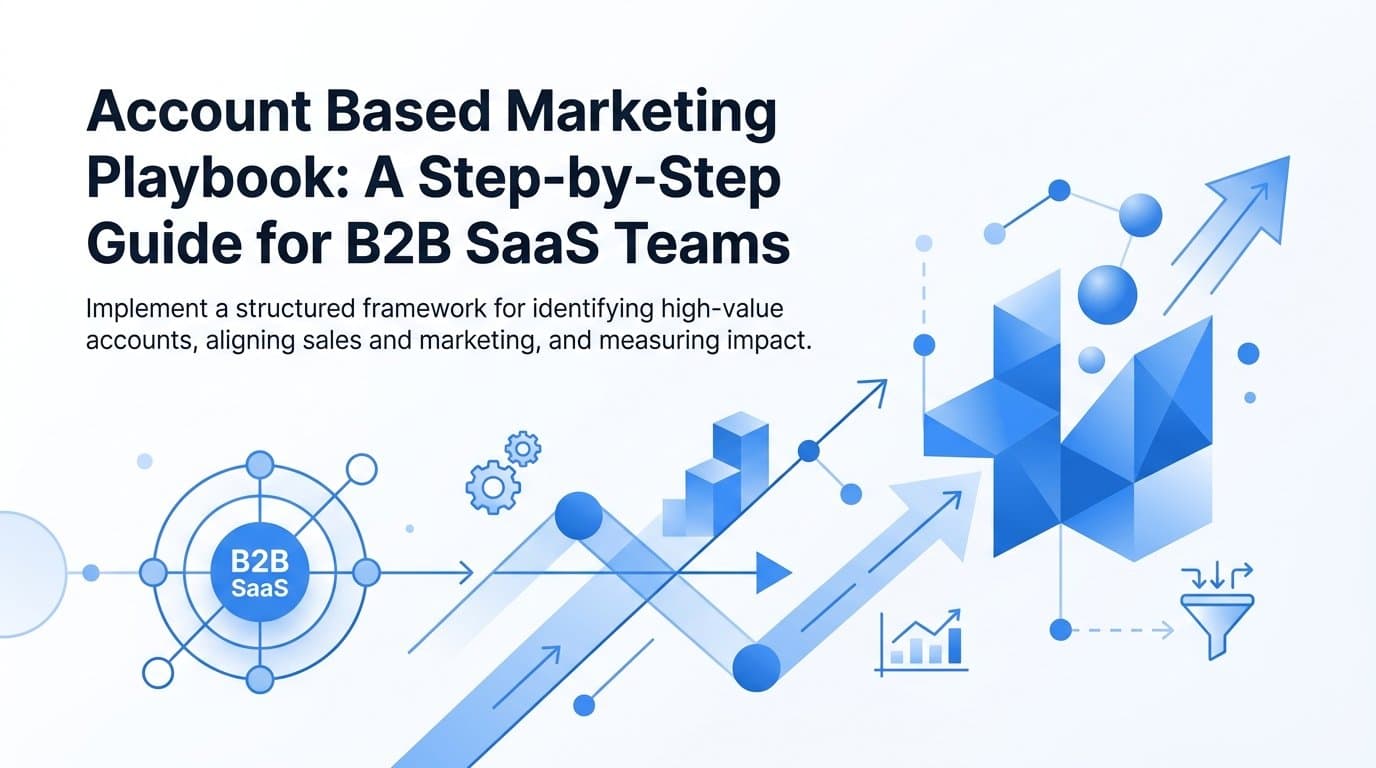
Account based marketing has shifted from a niche tactic to a core growth strategy for B2B SaaS companies. Instead of casting a wide net and hoping the right buyers find you, ABM flips the funnel. You identify the accounts most likely to generate significant revenue, then build campaigns specifically designed to win them over.
The appeal is straightforward: your marketing budget goes toward prospects who actually fit your ideal customer profile, and every touchpoint is designed to move a specific account forward rather than generate anonymous traffic.
The challenge most teams run into is execution. Building an account based marketing playbook that actually works requires more than a list of target accounts and a few personalized emails. It demands tight alignment between marketing and sales, a reliable way to track how accounts engage across every channel, and a measurement framework that connects your efforts to real pipeline and revenue.
This guide walks you through exactly how to build that playbook from scratch. You will learn how to define your ideal account profile, select and tier your target accounts, develop channel strategies that reach buying committees, create content that resonates at every stage, align your sales team for coordinated outreach, and measure performance in a way that proves ABM is working.
Whether you are launching ABM for the first time or rebuilding a program that has underperformed, these steps give you a clear path forward. By the end, you will have a structured playbook your team can execute with confidence and the measurement foundation to scale what works.
Step 1: Define Your Ideal Account Profile
Before you build a target account list, you need to know exactly what a great account looks like. This is where most ABM programs go wrong from the start. Teams confuse an Ideal Customer Profile with a buyer persona, and the distinction matters enormously in ABM.
A buyer persona describes an individual, a marketing director, a VP of Engineering, a CFO. An ICP describes a company. In ABM, the company-level profile drives account selection. You are asking: what does the right organization look like, not just the right person?
Your ICP should capture firmographic, technographic, and behavioral signals. Think about company size by headcount and revenue, industry vertical, geographic market, growth stage, and the technologies they already use. A SaaS company that runs on Salesforce and HubSpot, employs 100 to 500 people, and is in a growth phase looks very different from an enterprise with legacy infrastructure and a procurement committee.
The best place to build your ICP is your own CRM. Pull your closed-won customers from the last 12 to 24 months and look for patterns. Which accounts converted fastest? Which ones retained longest and expanded? Which industries showed up repeatedly? This data tells you more than any market research report because it reflects your actual buyers, not hypothetical ones.
Equally important: define your negative signals. What account characteristics consistently lead to churn, long stalled sales cycles, or poor fit? A company that is too small to afford your solution, or one in an industry you have never successfully served, should be filtered out before they ever make your target list. Knowing who to avoid is just as valuable as knowing who to pursue.
Once you have identified the patterns, document your ICP in a one-page reference sheet. Include the firmographic criteria, the technographic signals, the behavioral indicators like recent funding rounds or hiring surges, and the negative signals to exclude. Both marketing and sales need to review and agree on this document before you move to account selection.
Common pitfall: Building your ICP based on gut instinct rather than CRM data leads to targeting the wrong accounts from day one. If your sales team thinks the ideal customer is a mid-market fintech company but your closed-won data shows your best customers are growth-stage HR tech companies, the data wins every time.
Step 2: Build and Tier Your Target Account List
With a validated ICP in hand, you are ready to build your target account list. But not all target accounts deserve the same level of investment. This is where the tiered ABM model becomes essential.
The three-tier framework is the foundation of most effective ABM programs. Understanding how each tier operates helps you allocate resources intelligently rather than spreading your budget too thin.
Tier 1 (One-to-One): These are your highest-priority named accounts. Campaigns are highly personalized, often involving direct outreach, custom content, and significant sales involvement. List sizes typically range from 10 to 50 accounts. Every account gets a named owner and a dedicated play.
Tier 2 (One-to-Few): These accounts share common characteristics, such as industry vertical or company stage, and receive campaigns tailored to those shared attributes rather than fully individualized content. List sizes typically range from 50 to 200 accounts.
Tier 3 (One-to-Many): Programmatic ABM at scale. Technology does the heavy lifting here, serving targeted ads and content to accounts that match your ICP criteria. Lists can scale into the thousands, but personalization is lighter and more automated.
To populate your list, start with your ICP criteria and run them against your CRM, a prospecting tool, or an intent data provider. Then layer in intent signals. Accounts that are actively researching your category, visiting competitor review pages, or consuming content related to your solution deserve priority placement, often in Tier 1 or Tier 2, because they are already in a buying motion.
Assign accounts to tiers based on estimated deal value, strategic importance, and likelihood to convert. A large enterprise account with a long sales cycle might be Tier 1 even if the deal is harder to close, because the revenue potential justifies the investment. A cluster of mid-market accounts with similar pain points might fit naturally into Tier 2.
Once accounts are tiered, map the stakeholders within each one. Identify the economic buyer who controls the budget, the champion who will advocate internally for your solution, and the technical evaluator who will assess whether your product fits their stack. You will need to reach all three with relevant messaging, not just the person who fills out a form.
Success indicator: Both marketing and sales have reviewed and signed off on the list. Every account has a named owner, a tier assignment, and at least one identified stakeholder before any campaign goes live.
Step 3: Design Your Channel and Content Strategy by Tier
Here is where many ABM programs lose momentum. Teams build a target account list, then run the same campaigns they were already running, just with a narrower audience. That is not ABM. That is retargeting with extra steps.
Effective ABM matches channel investment to tier level. The higher the tier, the more personalized and high-touch the approach needs to be.
For Tier 1 accounts, think about channels that create direct, memorable engagement. Direct mail with a personalized message, executive dinners or private events, one-to-one LinkedIn outreach from senior leaders, and custom landing pages built specifically for that account's industry or use case. These accounts warrant the investment because the potential return justifies it.
For Tier 2 accounts, industry-specific webinars, targeted LinkedIn campaigns segmented by vertical, and personalized email sequences work well. The content speaks to shared pain points within a segment rather than individual account specifics, but it still feels more relevant than generic demand generation.
For Tier 3, programmatic display advertising, paid search capturing intent keywords, and automated nurture sequences carry the load. Technology scales the personalization here, serving relevant content to accounts that match your ICP without requiring manual customization for each one.
Content strategy in ABM also needs to account for the buying committee, not just one persona. The CFO evaluating your solution needs ROI framing and total cost of ownership analysis. The marketing leader needs to understand how your product fits into their existing workflow and what the time-to-value looks like. The technical evaluator needs integration documentation, security details, and API capabilities. One piece of content rarely serves all three.
Paid social platforms like LinkedIn offer firmographic targeting that makes account-matched audiences practical. You can target by company name, job title, seniority, and industry simultaneously, which means your ads can reach the right people at the right companies without requiring a massive audience. Meta platforms can also support account-matched audiences when you upload a contact list, extending your reach beyond LinkedIn.
A critical point on tracking: When accounts engage with your content across multiple channels, a single platform's reporting will never show you the full picture. A prospect might click a LinkedIn ad, read a blog post, attend a webinar, and then respond to a sales email weeks later. Understanding how those touchpoints connect requires a unified attribution layer sitting above your individual channel tools.
Common pitfall: Running generic campaigns to named accounts defeats the purpose of ABM entirely. If your Tier 1 account sees the same ad creative and landing page as everyone else in your retargeting pool, you have wasted both the targeting effort and the budget that tier demands.
Step 4: Align Sales and Marketing Around Account Plays
ABM without sales alignment is just targeted marketing. The real leverage comes from coordinating marketing touches and sales outreach so that accounts experience a coherent, well-timed sequence rather than random contact from two separate teams.
An account play is the mechanism that makes this coordination happen. Think of it as a structured sequence: a trigger event occurs, marketing takes a defined action, sales follows with a specific outreach move, and both actions happen within an agreed timeframe. Each play has clear success criteria so both teams know when it worked and when to try something different.
A simple play might look like this: an account visits your pricing page twice in one week (trigger), marketing serves them a personalized case study ad on LinkedIn (marketing action), sales sends a direct message referencing a relevant challenge in the prospect's industry within 48 hours (sales action). The success criterion is a booked meeting within two weeks.
Shared dashboards and CRM data are what make this coordination possible without requiring constant meetings. When both teams can see account engagement data in real time, a sales rep knows that a prospect has been consuming content before they pick up the phone. That context changes the quality of the conversation significantly.
The handoff process matters too. When marketing signals that an account has reached a defined engagement threshold, such as multiple high-intent page visits, content downloads, or ad interactions, sales receives a warm introduction context rather than a cold name on a list. The rep knows what the account has seen, what problems they are likely researching, and which stakeholders have been active.
A weekly ABM sync between sales and marketing keeps the program moving. Use it to review which accounts progressed, which ones stalled and why, and whether any plays need to be adjusted. Keep the meeting tight and data-driven. Account status updates, not general strategy discussions, should drive the agenda.
Success indicator: Sales reps report that ABM-sourced accounts are easier to connect with because those accounts already have context from prior touchpoints. When a rep references something the prospect has already engaged with, the conversation starts from a position of relevance rather than interruption.
Step 5: Set Up Attribution Tracking Across the Account Journey
This step is where many ABM programs fail quietly. The campaigns run, the accounts engage, deals close, and then someone asks which channels actually drove the pipeline. Without proper attribution setup, you cannot answer that question with confidence.
Standard last-click attribution is particularly problematic in ABM contexts. B2B buying decisions involve multiple stakeholders, each interacting with your brand across different channels over weeks or months. If you only credit the last touchpoint before a form fill or demo request, you miss most of the story. The LinkedIn ad that introduced the brand, the webinar that built credibility, and the direct mail piece that prompted the first sales conversation all contributed to the outcome. Last-click attribution gives credit to none of them.
Multi-touch attribution distributes credit across every touchpoint in the account journey. This gives you a realistic picture of which channels are influencing accounts at each stage of the funnel, not just which channel happened to be last in line when someone converted.
Setting this up requires connecting your ad platforms, CRM, and website into a single attribution layer. When these systems operate in silos, you get disconnected data: your ad platform shows impressions and clicks, your CRM shows pipeline and deals, and your website analytics shows sessions. None of them tell you how a specific target account moved from first touch to closed-won across all three environments.
Server-side tracking and Conversion API integrations address a specific problem that matters more in B2B than in most other contexts. Browser-based pixels rely on cookies, which expire. In a sales cycle that runs three to six months, a cookie set during a prospect's first visit is almost certainly gone by the time they convert. Server-side tracking captures conversion events directly from your server, bypassing browser limitations and giving you more complete data about what influenced each account.
This is where Cometly fits into the ABM stack. Cometly connects your ad spend data directly to pipeline and revenue, pulling together signals from your ad platforms, CRM, and website into a unified view. Instead of asking your team to manually reconcile data across tools, you can see which campaigns are moving target accounts forward, which channels are generating the most pipeline influence, and where your ABM budget is generating real return.
Common pitfall: Skipping the attribution setup because it feels like a technical lift means you will have no reliable way to prove ABM ROI at the end of the quarter. When leadership asks which campaigns drove pipeline, "we think it was LinkedIn" is not an answer that scales a budget.
Step 6: Measure ABM Performance and Scale What Works
Traditional marketing metrics like MQL volume and cost per lead were not designed for ABM. When your goal is to move specific accounts through a defined journey, you need account-level metrics that reflect that reality.
The metrics that matter most in an ABM program include account engagement score, which measures how actively a target account is interacting with your brand across channels. Pipeline influenced by ABM tracks the total pipeline value that ABM touches have contributed to, even when ABM was not the sole driver of a deal. Deal velocity compares how quickly ABM-targeted accounts move through your sales cycle versus non-ABM accounts. Win rate by tier shows you whether your Tier 1 investment is generating better close rates than Tier 2 or Tier 3, which helps you calibrate where to focus resources.
Account-level reporting in your attribution platform is what makes these metrics actionable. Aggregate campaign data tells you how an ad performed across all impressions. Account-level data tells you how a specific target account engaged with that ad, what they did next, and how their journey connected to a deal in your CRM. Those are very different insights.
AI-driven analysis adds another layer of value here. Rather than manually reviewing engagement data for every account, AI can surface patterns across your target account list: which content types are generating the most engagement among Tier 1 accounts, which channels are producing the fastest account progression, and which campaigns are correlating with higher win rates. Cometly's AI recommendations help teams identify these high-performing signals across ad channels so you can scale what is working with confidence rather than guesswork.
A quarterly ABM review should assess three things: which accounts progressed through the funnel, which accounts stalled and what the likely cause was, and which channels drove the most pipeline influence during the period. Use this review to make structural decisions, not just tactical tweaks.
That includes decisions about account list management. Some accounts that were Tier 1 at the start of the quarter may have shown no engagement and should be moved to Tier 3 or removed entirely. Others in Tier 2 may have accelerated and deserve the higher-touch investment of Tier 1. Performance data, not intuition, should drive these calls.
The quarterly review is also the right time to refine your ICP. If accounts with a specific technographic signal are converting at a higher rate, add that signal to your ICP criteria. If a particular industry vertical is consistently stalling, consider whether it belongs in your target profile at all. Each cycle makes the program sharper.
With Cometly connecting revenue attribution to ad spend and CRM data, your team can see exactly which ABM investments are generating closed-won revenue. That visibility is what allows you to go into a budget conversation and say with confidence: these channels, these campaigns, and these account plays are producing pipeline. Scale them.
Putting It All Together
Building an account based marketing playbook is not a one-time project. It is an ongoing system that gets sharper with every campaign cycle. The six steps in this guide give you the foundation: a data-backed ICP, a tiered account list, channel strategies matched to each tier, coordinated sales and marketing plays, a multi-touch attribution setup, and a measurement framework that connects ABM activity to real revenue.
The teams that see the best results from ABM are the ones who treat measurement as seriously as execution. Knowing which touchpoints influenced a deal, which channels moved accounts through the funnel fastest, and which campaigns generated the highest pipeline ROI is what separates ABM programs that scale from ones that stall.
Cometly gives B2B SaaS marketing teams the attribution layer to make those connections clear, from the first ad click on a target account to closed-won revenue in your CRM. Every touchpoint gets captured, every channel gets evaluated, and your AI-driven recommendations show you exactly where to invest next.
If you are ready to bring that level of visibility to your ABM program, Get your free demo today and start connecting your ad platforms and CRM to see exactly how your target accounts are engaging across every channel.