Account based marketing programs have shifted from a niche tactic to a core growth strategy for B2B SaaS companies. Instead of casting a wide net and hoping the right prospects convert, ABM flips the funnel. You identify your highest-value target accounts first, then build coordinated campaigns designed specifically for those accounts.
The result is tighter sales and marketing alignment, shorter sales cycles, and more predictable revenue. But here is the challenge most teams face: running ABM programs without knowing which touchpoints are actually moving accounts through the funnel. You invest in personalized content, targeted ads, and multi-channel outreach, but if your attribution data is fragmented, you cannot tell what is working.
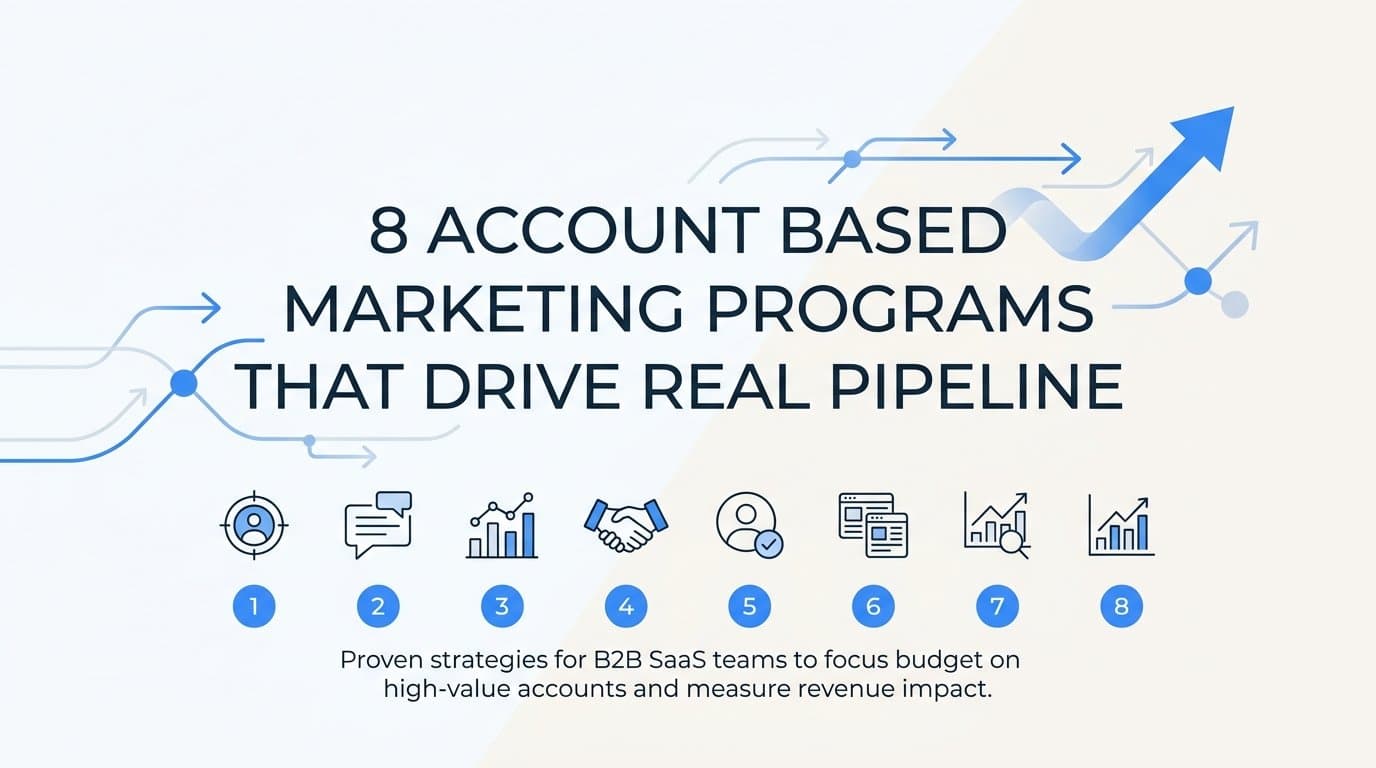
That is where measurement becomes as important as execution. This guide covers eight proven account based marketing programs, how to implement each one, and how to track the revenue impact of your ABM investments. Whether you are launching your first ABM program or optimizing an existing one, these strategies will help you focus budget on the accounts most likely to convert and build a data-driven case for scaling what works.
1. Build a Tiered Target Account List
The Challenge It Solves
Most ABM programs fail before the first campaign launches because every account gets treated the same way. When you apply the same level of effort to every prospect in your total addressable market, you dilute your resources and produce mediocre results across the board. Tiering forces a discipline that most teams resist: not every account deserves the same investment.
The Strategy Explained
Segment your total addressable market into three tiers based on a combination of firmographic fit, technographic signals, and behavioral intent data. Tier 1 accounts receive fully personalized, high-touch treatment. Tier 2 accounts get semi-personalized campaigns at the segment level. Tier 3 accounts are handled through programmatic ABM at scale, with lighter personalization and more automated execution.
Firmographic signals include company size, industry, and annual revenue. Technographic signals reveal which tools a company already uses, which tells you whether they are a strong fit for your product. Behavioral intent signals, sourced from platforms like Bombora or G2 Buyer Intent, show which companies are actively researching solutions like yours right now. Combining all three inputs into an account scoring model gives you a defensible, data-backed prioritization framework rather than a gut-feel list.
Implementation Steps
1. Define your ideal customer profile using closed-won data from your CRM. Identify the firmographic and technographic attributes that your best customers share.
2. Score your total addressable market against those attributes and layer in intent data to surface accounts showing active buying signals.
3. Assign accounts to Tier 1, Tier 2, or Tier 3 based on their composite score, and document the resource level and campaign type appropriate for each tier.
Pro Tips
Revisit your tier assignments quarterly. Account intent signals change, companies grow, and your ICP may evolve as your product does. A static account list becomes stale quickly. Treat tiering as a living process, not a one-time exercise, and your ABM program will stay aligned with where real revenue opportunity actually exists.
2. Deploy Intent-Driven Paid Ad Campaigns
The Challenge It Solves
Paid advertising without account-level targeting is expensive and imprecise. Broad campaigns generate impressions and clicks from audiences that will never become customers. For B2B SaaS companies with a defined target account list, the goal is not reach. It is relevance, reaching the right companies at the exact moment they are in a buying motion.
The Strategy Explained
Use LinkedIn, Google, and Meta to serve targeted ads specifically to named accounts showing buying intent. LinkedIn Campaign Manager allows targeting by company name, job title, seniority, and industry, making it the most precise paid channel for account-level ABM. Google Ads custom intent audiences and Meta business audience targeting can extend your reach beyond LinkedIn and reinforce your message across the broader web.
The key upgrade is layering third-party intent data onto your account lists. When you know which companies are actively searching for solutions like yours, you can prioritize ad spend toward those accounts and reduce waste on companies that are not in a buying cycle. This combination of account-level targeting and intent signals means your ads reach the right people at the right time, not just the right demographic profile.
Tracking which ad touchpoints are influencing pipeline progression is equally important. Without multi-touch attribution, you cannot see whether your LinkedIn awareness campaign is warming up accounts before sales outreach or whether your retargeting spend is contributing to deal acceleration.
Implementation Steps
1. Upload your Tier 1 and Tier 2 account lists to LinkedIn Campaign Manager and build matched audience segments. Supplement with intent data from providers like Bombora or G2 to prioritize in-market accounts.
2. Create separate campaigns for each tier with messaging tailored to where those accounts are in the buying journey. Awareness campaigns for cold accounts, consideration content for engaged ones.
3. Connect your ad platforms to your attribution system so every ad impression and click is tied back to account engagement data and pipeline influence.
Pro Tips
Do not measure paid ABM campaigns by click-through rate alone. The goal is account engagement and pipeline influence, not traffic volume. Set up account-level reporting that shows which target companies are engaging with your ads, and use that data to trigger sales outreach at the right moment.
3. Personalize Content at the Account Level
The Challenge It Solves
Your target accounts receive dozens of generic outreach attempts every week. Persona-level messaging, content written for "VP of Marketing at a mid-market SaaS company," blends into the noise. High-value prospects can tell the difference between content written for someone like them and content written specifically for their company and their situation.
The Strategy Explained
Account-level personalization goes beyond swapping out a company name in an email subject line. It means creating landing pages that reference the target company's industry challenges, ad creative that speaks to their specific use case, and content assets that reflect an understanding of their business. This level of personalization signals that you have done the research, which builds credibility before a single sales conversation happens.
Tools like Mutiny and Intellimize allow you to dynamically personalize web experiences based on the visiting company, so a Tier 1 prospect landing on your site sees a version of your homepage that speaks directly to their industry and pain points. Custom landing pages built for specific accounts or verticals serve the same purpose at a smaller scale without requiring a full personalization platform.
The investment in personalization should be proportional to account tier. Tier 1 accounts justify fully custom landing pages and bespoke content. Tier 2 accounts can be served with industry-specific or segment-level personalization. Tier 3 accounts receive programmatic personalization where automation handles most of the customization.
Implementation Steps
1. Identify the top 10 to 20 Tier 1 accounts and research their specific business challenges, competitive landscape, and strategic priorities.
2. Build account-specific landing pages and content assets that reference those challenges directly. Use their industry terminology and connect your solution to their known pain points.
3. Set up dynamic web personalization for Tier 2 accounts using a tool like Mutiny, so your site experience automatically adjusts based on the visiting company.
Pro Tips
Track engagement with personalized content at the account level, not just aggregate page views. If a Tier 1 account is spending time on your custom landing page and returning multiple times, that is a strong engagement signal worth surfacing to your sales team immediately.
4. Align Sales and Marketing Around Shared Account Data
The Challenge It Solves
One of the most commonly cited failure points in ABM programs is the gap between sales and marketing. Marketing defines success by engagement metrics. Sales defines success by pipeline and revenue. Without a shared view of account data and agreed-upon criteria for what constitutes a sales-ready account, both teams end up working toward different outcomes and blaming each other when results fall short.
The Strategy Explained
Build a shared account dashboard that gives both sales and marketing visibility into account engagement scores, touchpoint history, content interactions, ad exposure, and pipeline status. This dashboard becomes the single source of truth for how target accounts are progressing through the funnel. When both teams see the same data, conversations shift from "marketing is sending us bad leads" to "this account has hit our engagement threshold, let us coordinate on outreach."
Define clear handoff criteria before you launch any campaigns. What engagement score triggers a sales follow-up? Which touchpoints indicate genuine buying intent versus casual browsing? Agreeing on these thresholds in advance removes ambiguity and ensures marketing is not handing off accounts prematurely while sales is not waiting too long to engage.
Attribution data plays a critical role here. When marketing can show sales exactly which touchpoints influenced an account before it entered the pipeline, sales has the context needed to have a more informed first conversation. That context shortens the time it takes to build rapport and qualify the opportunity.
Implementation Steps
1. Build a shared account view in your CRM (Salesforce or HubSpot) that surfaces engagement data from marketing alongside pipeline data from sales.
2. Define your account engagement scoring model and agree on the score threshold that triggers a sales outreach sequence.
3. Establish a regular sales and marketing sync focused on account progression, not campaign metrics. Review which accounts are moving, which are stalling, and what actions to take next.
Pro Tips
Tie marketing's success metrics to pipeline and revenue, not just engagement. When marketing is measured by pipeline influenced and win rate by account tier, the incentive structure naturally drives better alignment with sales goals.
5. Run Multi-Channel Outreach Sequences for Target Accounts
The Challenge It Solves
Single-channel outreach rarely breaks through to enterprise buyers. A cold email sequence alone, a LinkedIn connection request in isolation, or a retargeting campaign without any direct outreach leaves too many gaps in your account coverage. Buyers need multiple relevant touchpoints across different channels before they are ready to engage with sales.
The Strategy Explained
Coordinate email, paid ads, LinkedIn, and direct mail into a single account play rather than running disconnected campaigns. The goal is for each touchpoint to reinforce the others, so by the time sales reaches out directly, the prospect already has some familiarity with your brand and your message. This coordinated approach is what separates ABM from traditional demand generation.
ABM practitioners widely recommend coordinating at least three to five channels in a single account play: personalized email, LinkedIn connection and InMail, paid retargeting, direct mail for Tier 1 accounts, and direct sales outreach. The key is sequencing these touchpoints based on real-time account engagement signals rather than a fixed calendar. If an account opens your email and visits your pricing page, that is a signal to accelerate the sequence and move sales outreach forward, not to wait for the next scheduled touchpoint.
Cross-channel attribution data is essential for understanding which combinations of touchpoints move accounts through the funnel fastest. Without it, you are running coordinated campaigns but making decisions based on incomplete information about what is actually driving progression.
Implementation Steps
1. Map out a full account play for each tier that specifies which channels are activated, in what sequence, and what triggers advancement to the next touchpoint.
2. Connect your engagement data sources so that real-time signals from email, ads, and website visits can trigger sequence adjustments automatically.
3. Use cross-channel attribution to analyze which touchpoint sequences correlate with faster deal velocity and higher win rates, then optimize your plays accordingly.
Pro Tips
For Tier 1 accounts, direct mail remains a highly effective channel precisely because it is underused. A thoughtful physical touchpoint, a relevant book, a personalized gift, or a printed report, stands out in a way that digital-only outreach cannot replicate. Reserve it for your highest-priority accounts and time it to coincide with a key moment in the sequence.
6. Use Retargeting to Stay Visible Across the Buying Committee
The Challenge It Solves
Enterprise B2B deals rarely involve a single decision-maker. By the time a deal reaches legal review, you may be navigating five to ten stakeholders with different priorities and different levels of familiarity with your solution. Most retargeting strategies focus on re-engaging individual visitors, but ABM retargeting requires a different approach: reaching multiple job titles within the same target company simultaneously.
The Strategy Explained
Build account-level retargeting campaigns that serve relevant ads to different stakeholders within the same target company across Meta, Google, and LinkedIn. The goal is to maintain brand visibility across the entire buying committee throughout what is often a long and complex sales cycle. When the CFO, the VP of Marketing, and the Head of RevOps all recognize your brand from multiple touchpoints, your solution feels established and credible before the formal evaluation begins.
LinkedIn's company targeting combined with job function filters allows you to reach specific roles within named accounts. On Meta and Google, custom audiences built from CRM contact lists let you retarget known contacts within your target accounts across the broader web. The creative strategy matters as much as the targeting: different stakeholders care about different outcomes, so rotate messaging to address the priorities of each role rather than serving the same ad to everyone.
Creative rotation is also critical for managing frequency fatigue. Long B2B buying cycles mean your ads may run for months. Without regular creative refreshes, even well-targeted campaigns become invisible as audiences develop ad blindness.
Implementation Steps
1. Segment your retargeting audiences by job function within each target account. Build separate ad sets for economic buyers, technical evaluators, and end users.
2. Create role-specific ad creative that speaks to the outcomes each stakeholder cares about most. Economic buyers want ROI. Technical evaluators want reliability and integration. End users want ease of use.
3. Set up a creative rotation schedule and monitor frequency caps to avoid overexposure. Refresh creative every four to six weeks for accounts in a long buying cycle.
Pro Tips
Track engagement at the account level, not just the individual contact level. If multiple stakeholders from the same target company are engaging with your retargeting ads, that is a strong signal of active committee-level evaluation. Surface that signal to your sales team so they can coordinate outreach accordingly.
7. Build an ABM Measurement Framework That Connects to Revenue
The Challenge It Solves
ABM programs are expensive. They require significant investment in content, tools, paid media, and sales coordination. Without a measurement framework that connects that investment to real revenue outcomes, it is nearly impossible to justify the budget, optimize the program, or demonstrate marketing's contribution to pipeline. Vanity metrics like impressions and click-through rates will not save your ABM budget when leadership asks for ROI.
The Strategy Explained
Replace surface-level metrics with a measurement framework built around the outcomes that matter: account engagement scores, pipeline influenced, pipeline created, deal velocity, and win rate by account tier. Each of these metrics tells you something specific about how your ABM program is performing and where to optimize.
Account engagement score aggregates all the activity from a target account across channels into a single signal of buying intent. Pipeline influenced measures the revenue in your pipeline that was touched by marketing programs at some point in the journey. Deal velocity tracks how quickly accounts move from first touch to closed-won, which is where you can see whether your ABM programs are actually accelerating the sales cycle. Win rate by account tier tells you whether your tiering model is working and whether Tier 1 accounts are actually converting at a higher rate than lower-tier accounts.
Multi-touch attribution is the engine that makes this framework possible. Because ABM buying cycles are long and involve many touchpoints across multiple channels, last-click attribution systematically undercounts the influence of early-funnel programs like awareness ads and educational content. A multi-touch model gives credit to every touchpoint that contributed to the outcome, giving you an accurate picture of what is actually driving revenue. Platforms like Cometly are built specifically for this kind of end-to-end attribution, connecting ad spend to pipeline and closed-won revenue in a single view.
Implementation Steps
1. Define your core ABM metrics and set baseline targets for each: engagement score thresholds, pipeline influenced goals, deal velocity benchmarks, and win rate targets by tier.
2. Implement multi-touch attribution across all your ABM channels so every touchpoint is captured and credited appropriately.
3. Build a reporting dashboard that surfaces these metrics at the account level and the program level, so you can see both individual account progression and overall program performance.
Pro Tips
Report ABM results in the same language your CFO uses: pipeline and revenue. When you can show that your ABM program influenced a specific dollar amount of pipeline and contributed to a measurable improvement in win rate for Tier 1 accounts, the conversation about budget becomes much easier to have.
8. Scale What Works With AI-Driven Insights
The Challenge It Solves
As your ABM program generates more data across more accounts and channels, manual analysis becomes a bottleneck. Patterns that could inform better targeting decisions, like which ad creative sequences correlate with faster deal velocity or which channels have the highest influence on Tier 1 account conversion, are buried in data that no analyst has time to surface manually. Without a systematic way to learn from your program data, you end up optimizing based on intuition rather than evidence.
The Strategy Explained
Use AI to surface patterns in account engagement and campaign performance data that are invisible in manual reporting. AI-powered attribution platforms can identify which combinations of touchpoints, channels, and creative formats are most strongly correlated with pipeline progression and closed revenue for your specific target accounts. These insights then feed directly back into your campaign decisions, creating a continuous improvement loop between what you measure and what you do.
One of the highest-leverage applications of AI in ABM is feeding enriched conversion data back to your ad platforms. When you send enriched, conversion-ready events back to Meta via Conversion API and to Google via Enhanced Conversions, you give those platforms better signal about which account types actually convert to revenue. The ad platform's algorithm then uses that signal to improve targeting, reduce wasted spend, and find more accounts that look like your best customers. This is where Cometly's server-side tracking and Conversion API integration creates a compounding advantage: better data fed back to ad platforms means better algorithmic targeting, which means better campaign performance over time.
AI-driven insights also help you identify when an account's engagement pattern suggests it is entering a buying cycle, so you can trigger outreach at the right moment rather than waiting for a sales rep to notice a spike in website visits.
Implementation Steps
1. Implement server-side conversion tracking and Conversion API integration to ensure your ad platforms receive enriched, accurate conversion signals rather than cookie-dependent browser data.
2. Use an AI-powered attribution platform to analyze patterns in your account engagement and campaign performance data. Look for correlations between specific touchpoint sequences and faster deal velocity or higher win rates.
3. Build a feedback loop: take AI-generated insights from your attribution platform and use them to adjust targeting, creative strategy, and channel mix in your next campaign cycle.
Pro Tips
Treat AI insights as a starting point for hypothesis testing, not a replacement for strategic judgment. When your attribution platform surfaces a pattern, such as Tier 1 accounts that engage with a specific content type closing faster, test that hypothesis deliberately in your next campaign cycle and measure the result. That combination of AI pattern recognition and deliberate experimentation is what drives compounding improvement in ABM performance.
Putting It All Together: Your ABM Implementation Roadmap
Effective account based marketing programs are built on two foundations: precise execution and accurate measurement. You can run the most personalized campaigns in your market, but without knowing which touchpoints are influencing your target accounts, you are optimizing blind.
Start by building a tiered account list and deploying intent-driven paid campaigns. Layer in multi-channel outreach and account-level personalization as your program matures. Align your sales and marketing teams around shared account data so both sides are working toward the same revenue outcomes. Use retargeting to stay visible across the buying committee throughout a long sales cycle.
But from day one, invest in a measurement framework that connects your ABM activity to pipeline and revenue. Without multi-touch attribution, you cannot see which programs are actually moving accounts, which means you cannot make confident decisions about where to scale and where to cut.
Cometly gives B2B SaaS marketing teams the attribution data they need to see exactly which programs are moving accounts through the funnel. From first ad click to closed-won revenue, every touchpoint is tracked and connected to real outcomes. That visibility is what allows you to scale the programs that work and cut the ones that do not. If you are ready to build an ABM program that is grounded in data and built for revenue, Get your free demo today and start capturing every touchpoint to maximize your conversions.