
Account based marketing flips the traditional funnel. Instead of casting a wide net and hoping the right companies convert, ABM starts with a precise list of high-value target accounts and builds every campaign around them. For B2B SaaS teams, this approach is particularly powerful because sales cycles are long, deal sizes justify personalized outreach, and buying committees are complex.
The challenge most marketing teams face is not understanding ABM in theory but actually building a repeatable, measurable system for executing it. Without a structured template, ABM efforts tend to drift: target lists get stale, campaigns run without clear ownership, and revenue impact is nearly impossible to attribute back to specific account-level touchpoints.
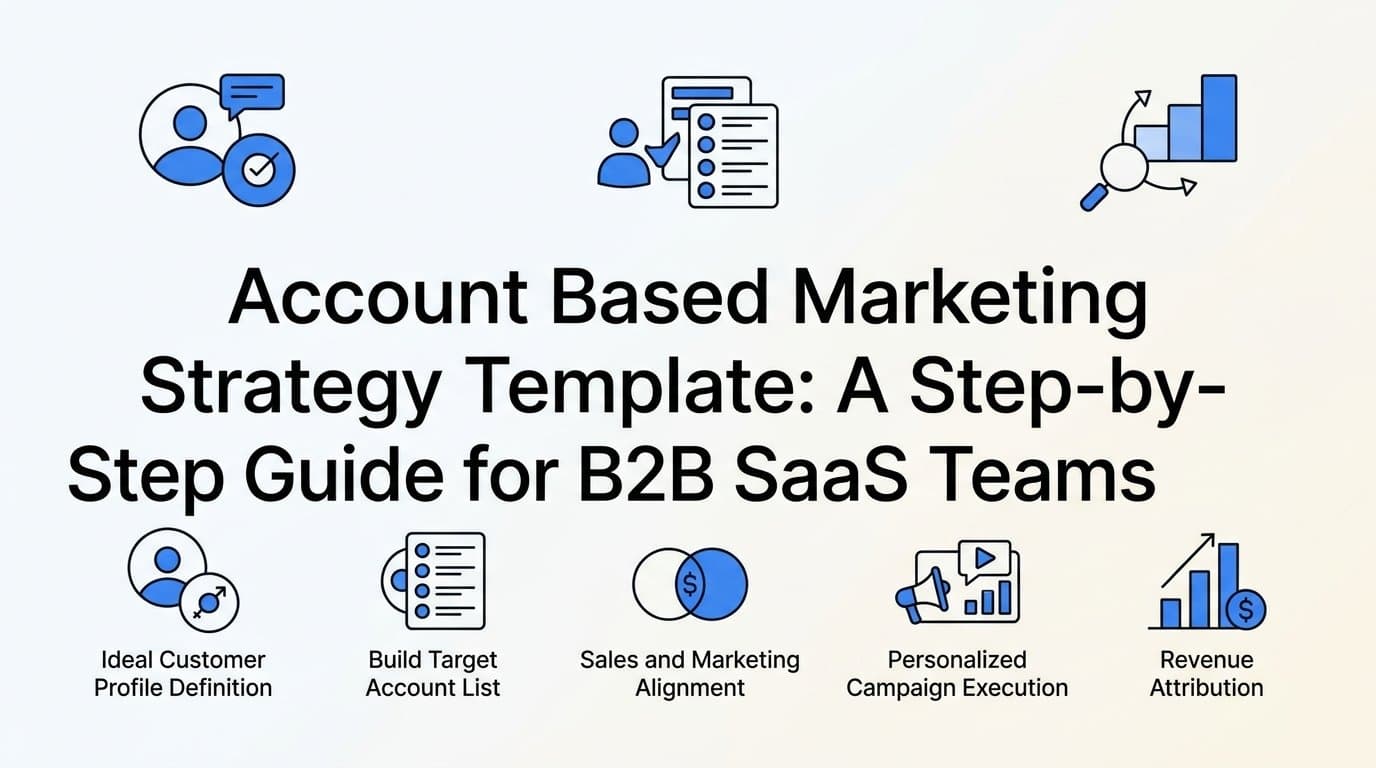
This guide gives you a working account based marketing strategy template you can implement immediately. You will walk through how to define your ideal customer profile, build your target account list, align your sales and marketing teams, create personalized content and campaigns, activate the right channels, and measure what actually matters.
Each step is designed to be actionable and sequenced so that the output of one step feeds directly into the next. Whether you are launching ABM for the first time or rebuilding a program that lost momentum, this framework will help you move from a vague strategy to a structured execution plan with clear performance signals at every stage.
Step 1: Define Your Ideal Customer Profile
Everything in your account based marketing strategy template starts here. A well-defined ICP is not a wish list of the types of companies you hope to attract. It is a data-backed profile built from the customers you have already won, retained, and grown.
Start by pulling your top 20 to 30 existing customers by revenue, retention, or expansion potential. Look for patterns across firmographic dimensions: company size, industry vertical, annual revenue range, tech stack, and growth stage. The goal is to find the common characteristics that predict a strong fit before you ever have a sales conversation.
Beyond firmographics, dig into the behavioral and situational triggers that preceded those accounts converting. Did they come in during a hiring surge? Had they recently raised a funding round? Were they in the middle of a product launch or a digital transformation initiative? These situational signals are often more predictive than firmographics alone, and they give your team concrete triggers to watch for in prospecting.
Once you have identified those patterns, document your ICP in a single reference document. Include three categories:
Must-have criteria: The non-negotiable characteristics that every target account must meet. If an account does not meet these, it should not enter your list regardless of other signals.
Nice-to-have criteria: Characteristics that increase the likelihood of a strong fit but are not disqualifying on their own. These help you prioritize within your list.
Disqualifying signals: The red flags that indicate an account is unlikely to succeed with your product, even if it looks good on paper. Include things like incompatible tech stacks, company size outside your serviceable range, or industries where your product has historically underperformed.
Validate your ICP against two sets of accounts: closed-won deals and churned customers. Closed-won accounts should align closely with your ICP criteria. Churned accounts should reveal where your ICP assumptions broke down. This validation step stress-tests your profile before you build an entire program on top of it.
A common pitfall at this stage is defining an ICP that is too broad. If your ICP describes thousands of companies, it is not specific enough to drive ABM. The goal is a profile specific enough that your sales team can immediately recognize a fit when they see one.
Success indicator: Your ICP document is specific enough to generate a finite, prioritized list of target accounts. If you cannot use it to build a list, it needs more refinement.
Step 2: Build and Tier Your Target Account List
With your ICP defined, the next step is turning that profile into an actual list of named accounts. This is where your account based marketing strategy template becomes tangible.
Source accounts from multiple places: your CRM for existing contacts and past opportunities, intent data providers that signal active in-market behavior, LinkedIn Sales Navigator for firmographic filtering, and your current pipeline for accounts already in motion. Cross-referencing these sources gives you a richer, more validated list than relying on any single data point.
Once you have a raw list, segment accounts into three tiers based on deal potential and strategic fit:
Tier 1: Your highest-priority accounts. These receive fully personalized, one-to-one campaigns where every piece of content, outreach, and ad creative is tailored to the specific account. Tier 1 lists typically range from 10 to 50 accounts depending on your team size and available resources. Fewer is often better at this tier because quality of execution matters more than volume.
Tier 2: Accounts with strong fit that warrant industry or segment-level personalization. Campaigns at this tier address the challenges specific to a vertical or company profile rather than a single named account. This tier can scale to several hundred accounts.
Tier 3: Accounts that match your ICP broadly but have not yet shown strong intent signals. These receive scaled, programmatic campaigns with lighter personalization. This tier can include thousands of accounts and is typically managed through paid channels and automated email sequences.
Assign account ownership clearly. Every account in your list should have a named marketing owner and a named sales owner. Without this, accounts fall through the cracks and outreach becomes inconsistent.
Enrich your account list with contact-level data for the buying committee roles most relevant to your product. You need more than the company name. You need the actual people you will be reaching: their titles, email addresses, LinkedIn profiles, and any known context about their priorities.
Success indicator: Every account in your list has a tier designation, an owner, and at least three mapped contacts within the buying committee. If any account is missing these elements, it is not ready for campaign activation.
Step 3: Map the Buying Committee and Personalize Messaging
B2B SaaS purchases rarely involve a single decision-maker. By the time a deal closes, multiple stakeholders have weighed in, each with different priorities and different reasons to say yes or no. Your messaging needs to speak to all of them.
Start by identifying the key stakeholder roles involved in a typical purchase decision for your product. For most B2B SaaS companies, the buying committee includes at least four distinct roles:
The economic buyer: The executive who controls budget and ultimately approves the purchase. They care about ROI, strategic alignment, and risk. They are not reading your feature documentation.
The champion: The internal advocate who sees the value of your product and wants to make it happen. They need your help building the business case for the economic buyer. Give them the ammunition they need to sell internally.
The technical evaluator: The person responsible for assessing whether your product integrates with existing systems, meets security requirements, and can be implemented without disrupting operations. They want specifics, not vision.
The end user: The person who will actually use your product day to day. They care about ease of use, workflow fit, and whether the product will make their job easier or harder.
For each role, document three things: their primary pain points, the success metrics they are measured against, and their most common objections. This becomes the foundation of your messaging matrix.
A messaging matrix maps each stakeholder role to specific value propositions, proof points, and content assets. For example, the economic buyer might respond to ROI framing and pipeline impact data, while the technical evaluator needs integration documentation and security information. The same product, positioned differently for each audience.
For Tier 1 accounts, go one level deeper. Reference the company's specific context in your outreach: a recent product announcement, a new executive hire, a funding round, or a publicly stated strategic initiative. This level of personalization signals genuine research and dramatically increases response rates.
For Tier 2 accounts, personalize at the segment level by addressing the specific challenges facing their industry or company profile. You will not have time to research every account individually at this tier, but you can still be far more relevant than a generic pitch.
A common pitfall here is sending the same message to every contact in an account. When the CFO and the product manager receive identical outreach, it signals that you have not done your homework. Personalization at the role level is the minimum bar for ABM.
Success indicator: You have a documented messaging matrix with at least three stakeholder profiles, each with corresponding value propositions, proof points, and content assets ready to deploy.
Step 4: Activate Multi-Channel ABM Campaigns
With your accounts tiered, your contacts mapped, and your messaging matrix built, you are ready to activate campaigns. The core principle at this stage is coordination. ABM works because multiple touchpoints across multiple channels reinforce the same message for the same accounts at the same time. That surround-sound effect is what makes ABM feel different from standard demand generation.
Select channels based on where your target accounts are most active. For B2B SaaS, the most effective ABM channels typically include LinkedIn ads, Google display, personalized email sequences, direct mail for Tier 1 accounts, and targeted event invitations. You do not need all of them from day one, but you do need at least three channels running in coordination for Tier 1 accounts.
LinkedIn is particularly valuable for ABM because of its company targeting and contact list upload capabilities. You can upload your target account list and serve ads directly to the specific contacts you have mapped in your buying committee. This means your ads are reaching the right people at the right companies, not just anyone with a similar job title.
Sequence your outreach deliberately. A common and effective pattern is to run paid ad exposure for two to three weeks before your SDR makes direct contact. By the time your sales rep reaches out, the account has already seen your brand multiple times across LinkedIn and display. The cold outreach becomes a warm introduction.
Set campaign budgets at the account or tier level rather than at the campaign level. This matters for attribution. When you can see how much you are spending per account and what pipeline that account generates, you can make informed decisions about where to concentrate resources. Budget allocation by campaign alone obscures the account-level economics that ABM depends on.
Coordinate timing between marketing and sales explicitly. Marketing should notify sales when a Tier 1 account enters a new campaign phase. Sales should notify marketing when an account goes dark or moves into a late-stage conversation so messaging can be adjusted accordingly. Without this coordination, accounts receive inconsistent messaging at the wrong moments, which is one of the most common reasons ABM programs underperform.
Success indicator: Target accounts are being reached across multiple channels with coordinated timing and consistent messaging. You can confirm this by checking that each Tier 1 account has active touchpoints across at least three channels within the same campaign window.
Step 5: Track Account Engagement and Attribution
Most marketing analytics tools are built around leads, not accounts. They track individual form fills, email opens, and click-throughs tied to a person record. ABM requires a different measurement layer: one that aggregates all of those individual signals up to the account level so you can see the full picture of how an account is engaging with your program.
Move beyond lead-level metrics and start tracking account-level engagement signals. These include website visits from IP-matched target accounts, content downloads, ad clicks and impressions, email opens and replies, and sales meeting bookings. Each of these signals tells you something about where an account is in their buying journey and how your program is influencing that progression.
Map every touchpoint back to both the account and the specific contact. When you know that the CFO at a Tier 1 account clicked your LinkedIn ad, visited your pricing page twice, and then the champion downloaded your ROI guide the next day, you have a meaningful picture of buying committee engagement. That kind of account-level intelligence drives better sales conversations.
Multi-touch attribution is particularly important in ABM because of how long B2B SaaS sales cycles tend to be. A deal that closes after six months of engagement involves dozens of touchpoints across multiple channels and multiple contacts. Last-touch attribution would credit only the final interaction, systematically undercrediting the awareness campaigns, the nurture content, and the early ad exposure that built the relationship. Multi-touch attribution distributes credit across the full journey, giving you a more accurate picture of what is actually working.
Connect your ad platform data to your CRM so that pipeline created and revenue closed can be attributed back to specific ABM campaigns and channels. This connection is where most teams struggle because ad platforms and CRMs operate in separate data environments by default. Bridging that gap requires either native integrations or a dedicated attribution layer.
Platforms like Cometly connect ad spend data from LinkedIn, Google, and other channels directly to CRM pipeline and revenue. This gives you account-level attribution across the entire customer journey, from the first ad impression to closed-won revenue. Instead of guessing which campaigns influenced a deal, you can see the actual sequence of touchpoints that moved each account through your pipeline.
Track account engagement scores over time to identify accounts that are warming up and approaching a point where direct sales outreach will be well-timed. An account that has been quiet for weeks but suddenly spikes in website activity and ad engagement is sending a clear signal.
Success indicator: You can report on pipeline influenced and revenue attributed at the account tier level, broken down by channel. If you cannot produce this report, your attribution setup needs attention before you can optimize your program with confidence.
Step 6: Align Sales and Marketing Around Account Milestones
ABM is a team sport. The strategy falls apart when marketing is optimizing for engagement metrics and sales is optimizing for meetings booked, and neither team is looking at the same data to make coordinated decisions. Alignment is not a soft requirement. It is a structural one.
Start by defining clear handoff criteria between marketing and sales. In traditional demand generation, handoffs are triggered by individual lead scores. In ABM, handoffs should be triggered by account-level engagement thresholds. For example, a Tier 1 account might be handed to sales when it reaches a defined engagement score based on a combination of ad clicks, website visits, and content downloads within a rolling 30-day window. This ensures sales is reaching out when there is genuine intent, not just because a lead filled out a form.
Establish a regular account review cadence. Weekly or biweekly reviews where marketing and sales sit down together to look at engagement data for Tier 1 accounts are one of the most effective practices in high-performing ABM programs. These sessions surface accounts that are warming up, identify gaps in coverage, and create space for coordinated decision-making about outreach timing.
Create a shared account status framework with clearly defined stages. A simple version might include: Identified, Engaged, Meeting Booked, Opportunity Created, and Closed. Both teams should use the same stage definitions and update account status in the same system. When marketing and sales are working from the same account record with the same stage definitions, coordination becomes much easier.
Use engagement data to inform sales outreach timing directly. When a Tier 1 account spikes in ad engagement or website activity, that is a signal for the sales rep to reach out within 24 to 48 hours while the account is actively thinking about the problem your product solves. This kind of data-driven timing dramatically improves response rates compared to outreach driven by arbitrary follow-up schedules.
Document what worked and what did not at the account level after each campaign cycle. Which messages generated responses? Which channels drove meeting bookings? Which accounts went cold despite significant investment? These patterns inform how you refine your playbook for the next cycle.
Success indicator: Sales and marketing are reviewing the same account data in the same system and making coordinated decisions about outreach timing. If each team is working from a separate dashboard with different definitions of success, alignment is still a work in progress.
Step 7: Measure, Optimize, and Scale Your ABM Program
Once your program is running, the work shifts from building to optimizing. ABM generates a rich set of account-level data that most teams underuse. The teams that scale ABM successfully are the ones that treat measurement as an ongoing practice rather than a quarterly reporting exercise.
Track four core ABM metrics consistently:
Account coverage: The percentage of your target accounts that have been reached by at least one campaign touchpoint. Low coverage means your program is not penetrating the list you built. High coverage is the baseline requirement before you can interpret other metrics.
Account engagement rate: The percentage of reached accounts that are actively engaging with your content, ads, or outreach. This metric tells you whether your messaging and channels are resonating with the accounts you are targeting.
Pipeline generated from target accounts: The total pipeline value created from accounts on your target list. This connects your ABM program to the revenue metrics your leadership team cares about.
Revenue closed from target accounts: The actual closed-won revenue attributable to your ABM program. This is the ultimate proof point and the metric that justifies continued investment.
Compare performance across tiers regularly. If Tier 1 accounts are generating strong pipeline but Tier 3 accounts are consuming budget without producing results, that is a signal to reallocate resources. If a particular channel is driving engagement in Tier 2 but not Tier 1, that is worth investigating further.
Refresh your target account list on a quarterly basis. Accounts that have gone cold after sustained investment should be deprioritized and replaced with new accounts that match your ICP and show fresh intent signals. Keeping stale accounts on your active list wastes resources and distorts your engagement metrics.
Use attribution data to reallocate budget toward the channels and campaigns most directly linked to pipeline and revenue at the account level. This is where tools like Cometly become particularly valuable. When you can see which specific campaigns and channels are influencing accounts that ultimately convert to pipeline and revenue, you can make budget decisions based on actual performance rather than assumed influence.
Scale what works. Once you have a repeatable playbook for Tier 1 accounts, document it clearly and apply those learnings to improve Tier 2 and Tier 3 campaigns. The personalization intensity changes across tiers, but the underlying logic of what channels, messages, and sequences drive engagement should transfer.
Success indicator: You can demonstrate a clear connection between ABM campaign investment and pipeline or revenue outcomes, and you have a documented optimization process that runs on a defined cadence.
Putting It All Together
Building an account based marketing strategy is not a one-time project. It is an ongoing system that gets sharper over time as you gather more data about which accounts engage, which channels work, and which messages resonate.
The template in this guide gives you the foundation: a defined ICP, a tiered account list, a messaging matrix, coordinated multi-channel campaigns, and a measurement framework that connects marketing activity to revenue. Each step builds on the one before it, so the quality of your execution at the early stages directly determines the accuracy of your optimization later.
The teams that get the most out of ABM treat attribution as a core part of the program from day one. When you can see exactly which touchpoints are influencing target accounts and which campaigns are driving pipeline, you can make faster, more confident decisions about where to invest. Without that visibility, you are optimizing based on assumptions rather than evidence.
Cometly helps B2B SaaS marketing teams close that loop by connecting ad spend across LinkedIn, Google, and other channels directly to CRM pipeline and closed revenue. You get a single source of truth for account-level attribution so you can prove the impact of your ABM program and scale what is working.
Start by completing Steps 1 and 2 this week. Define your ICP and build your initial target account list. Everything else in this framework builds from those two foundations. When you are ready to connect your campaign data to revenue outcomes, Get your free demo and see how Cometly gives your ABM program the attribution clarity it needs to grow with confidence.