
If you are running Facebook ads for a B2B SaaS company and relying solely on Meta's native reporting, you are likely making budget decisions based on incomplete data. Browser-based pixel tracking has become increasingly unreliable due to privacy-focused browser updates, ad blockers, and the ripple effects of iOS privacy changes. The result is underreported conversions, inflated cost-per-lead figures, and ad algorithms that cannot optimize properly because they are not receiving accurate signals.
The good news is that this is a solvable problem. Accurate Facebook ad tracking is not about finding a single magic fix. It is about building a layered system where server-side data reinforces browser-side data, your CRM feeds offline conversions back to Meta, and your reporting connects ad spend to actual closed revenue rather than stopping at the lead.
This guide walks you through a practical, seven-step process to set up accurate Facebook ad tracking from the ground up. You will learn how to layer server-side tracking on top of your pixel, configure conversion events that map to real business outcomes, connect your CRM data to close the loop between ad clicks and closed revenue, and use attribution reporting to make confident scaling decisions.
Whether you are a marketing manager trying to prove ROI or a growth leader optimizing a six-figure ad budget, this process gives you a reliable foundation for data-driven advertising. By the end of these steps, you will have a tracking setup that captures more conversions, sends stronger signals back to Meta's ad algorithm, and connects your Facebook spend directly to pipeline and revenue.
Let's start at the beginning: understanding what your current setup is actually doing.
Step 1: Audit Your Current Facebook Pixel Setup
Before you add anything new, you need to understand exactly what you have. Many teams assume their pixel is working because it shows activity in Meta Events Manager. But partial firing, missing parameters, and duplicate installations are silent problems that quietly degrade your optimization without triggering any obvious errors.
Open Meta Events Manager and navigate to the Events tab for your pixel. Review which events are firing, how frequently they are triggering, and whether they are being received from the browser, the server, or both. Pay close attention to the deduplication status. If you see events being counted from multiple sources without a deduplication mechanism in place, your conversion numbers are inflated and Meta's algorithm is receiving confusing signals.
Check for duplicate pixel installations. It is surprisingly common for pixels to be installed in multiple places simultaneously: hardcoded in the site header, loaded via Google Tag Manager, and embedded by a third-party tool like a landing page builder or CRM integration. Each duplicate installation multiplies your event firing and corrupts your data. Understanding Facebook pixel tracking best practices can help you identify and eliminate these silent data quality issues before they compound.
Identify browser-side versus server-side events. In Events Manager, each event will show its connection method. Note which events are firing browser-side only. These are the events most vulnerable to being lost due to ad blockers, browser privacy settings, and iOS restrictions.
Look for critical gaps in your funnel coverage. For B2B SaaS specifically, check whether these events are being tracked and firing correctly: free trial signups, demo request form submissions, qualified lead form completions, and any purchase or subscription events. Missing or misfiring events at these stages means Meta's algorithm is optimizing toward incomplete data.
Record your event match quality scores. Meta assigns a match quality score to each event based on how well the customer data parameters match actual Meta user profiles. Note these scores now. They become your baseline for measuring improvement as you work through the steps ahead.
The output of this audit should be a clear inventory: every event, its firing method, its current match quality score, and any gaps or anomalies you have identified. This document becomes your roadmap for everything that follows.
Success indicator: You have a complete inventory of every conversion event, its firing method (browser, server, or both), and its current match quality score in Events Manager.
Step 2: Implement the Meta Conversion API for Server-Side Tracking
The Meta Conversion API, commonly called CAPI, is no longer an optional enhancement for serious advertisers. It is a foundational requirement for accurate Facebook ad tracking. While your browser pixel relies on the user's browser to fire events, CAPI sends those same events directly from your server to Meta. Browser restrictions, ad blockers, and privacy settings cannot interfere with server-to-server communication.
The practical impact is significant. Events that your pixel would have missed due to a user's browser settings are captured server-side instead. Meta receives a more complete picture of your conversions, which directly improves how its algorithm optimizes your campaigns. The reason server-side tracking is more accurate comes down to its immunity to the browser-level restrictions that silently strip data from pixel-only setups.
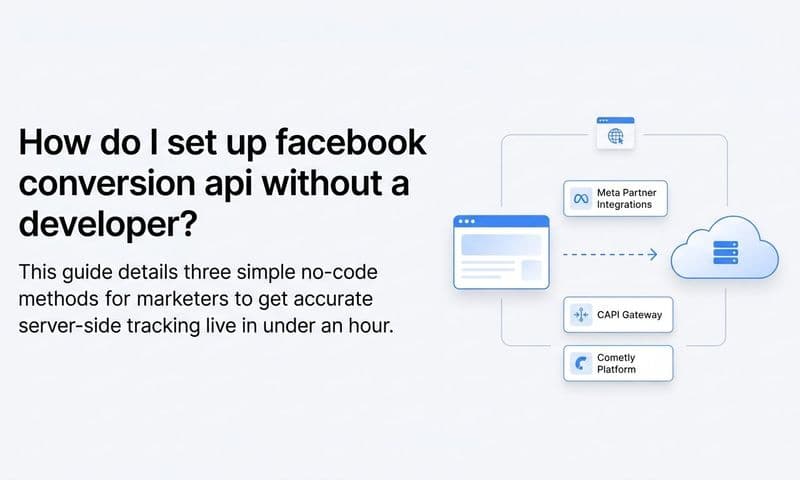
Choose your implementation method. You have three main options. The first is a direct API integration, which requires engineering resources to build and maintain. The second is using Meta's native partner integrations, which work well for standard e-commerce setups but often lack the flexibility needed for B2B SaaS funnels. The third is using a dedicated attribution platform like Cometly, which manages the CAPI connection for you, enriches events with the right parameters automatically, and removes the ongoing engineering overhead.
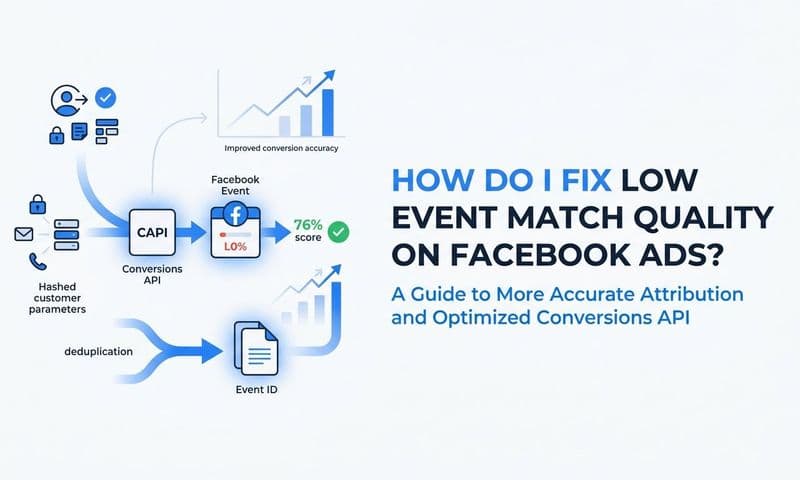
Configure deduplication carefully. When you run both a browser pixel and CAPI simultaneously, the same event can be received twice: once from the browser and once from the server. Without deduplication, Meta counts both and your conversion numbers become inflated. The solution is to pass a consistent event_id parameter with every event. Meta uses this identifier to recognize and remove duplicate events, keeping your counts accurate.
Pass first-party customer data with every event. The power of CAPI is not just in capturing missed events. It is in the quality of data you can attach to each event. Include hashed email addresses, phone numbers, external user IDs, and client IP addresses with your server events. These parameters are what drive your event match quality scores upward and help Meta connect your conversions to actual user profiles more accurately.
Test your implementation before declaring it live. Use the Test Events tool in Meta Events Manager to confirm that your server events are being received, that the event names match your browser events, and that deduplication is functioning correctly. Do not skip this step. A misconfigured CAPI setup can cause more problems than no CAPI at all.
Success indicator: Your server events appear in Events Manager with a match quality score of Good or Excellent, and the deduplication report confirms that duplicate events are being removed correctly.
Step 3: Define and Map Conversion Events to Real Business Outcomes
Here is a pattern that holds back many B2B SaaS advertisers: they are tracking the wrong things. Page views, button clicks, and generic form submissions are easy to measure, but they do not tell Meta's algorithm what you actually care about. If you optimize for events that do not predict revenue, the algorithm will deliver more of the users who complete those low-intent actions, not the users who become paying customers. Inaccurate conversion tracking at this stage is one of the most common reasons Facebook campaigns fail to scale profitably.
The fix starts with a clear conversion event hierarchy.
Micro-conversions are early-stage signals: content downloads, pricing page views, and blog engagement. They are useful for audience building and retargeting, but they should not be your primary optimization target.
Macro-conversions are the actions that actually predict revenue: demo requests, free trial activations, qualified lead form submissions, and MQL milestones. These are the events your campaigns should optimize toward.
Revenue events are the downstream outcomes: opportunities created in your CRM, deals moved to closed-won, and subscription revenue generated. These take longer to close the loop on, but they are the most valuable signals you can send back to Meta.
Once you have your hierarchy defined, configure custom conversions in Meta for each stage. This allows you to create separate campaigns optimized toward different funnel stages and compare performance across them. A top-of-funnel awareness campaign might optimize toward demo requests, while a retargeting campaign optimizes toward trial activations.
Assign conversion values wherever possible. Even estimated values help Meta's algorithm prioritize higher-value actions. If your average closed deal is worth a certain amount, assigning a proportional value to a demo request gives the algorithm a signal about relative importance. You do not need exact numbers. Directionally accurate values are better than no values at all.
Connect your CRM to close the offline conversion loop. B2B SaaS sales cycles often run 30 to 180 days or longer. The user who clicked your Facebook ad in January might not become a closed-won deal until March. Without sending that offline conversion event back to Meta via CAPI, the algorithm never learns that the ad worked. Configuring your CRM to sync conversion data to Facebook Ads is one of the highest-leverage improvements you can make.
Success indicator: Every stage of your funnel from ad click to closed revenue has a corresponding conversion event being tracked and reported, and your campaign optimization targets are aligned with events that predict actual revenue.
Step 4: Add UTM Parameters and First-Party Tracking to Every Campaign
Server-side tracking solves the data loss problem on the Meta side. UTM parameters and first-party session tracking solve the attribution problem on your side. Without consistent UTM tagging, you cannot reliably trace a lead in your CRM back to the specific Facebook campaign, ad set, or creative that drove it.
Build a consistent UTM naming convention. Every Facebook campaign should include all five UTM parameters: utm_source, utm_medium, utm_campaign, utm_content, and utm_term. Understanding what UTM tracking is and how it helps your marketing is the foundation for building a naming convention that scales without becoming fragmented across team members.
Use dynamic UTM parameters in Meta Ads Manager. Meta supports dynamic value insertion for campaign name, ad set name, and ad name. Using these dynamic parameters means you do not have to manually update UTM strings when you rename campaigns or create new ad sets. The correct values populate automatically, and granular ad-level data flows into your analytics and CRM without manual effort.
Preserve UTM parameters through the entire session. This is where many setups break down. A user clicks your ad with a full UTM string, lands on your site, clicks through to another page, fills out a form, and somewhere in that journey the UTM data gets stripped. Common culprits include redirects that do not pass query parameters, landing page builders that do not carry UTMs into form hidden fields, and single-page applications that reset session data on navigation.
Audit your full click-to-form-submission path by running a test click through your actual funnel. Check that the UTM parameters from your ad URL appear in the hidden fields of your lead capture form and ultimately populate the source fields in your CRM record.
Implement first-party cookie or server-side session tracking. For users who convert across multiple sessions, a first-party cookie that persists the original click source ensures you can attribute the conversion to the right campaign even when the user returns days later without the original UTM parameters in the URL.
Success indicator: Every lead in your CRM has a populated source field that traces back to the specific Facebook campaign, ad set, and creative that drove the first or last touch, with no gaps in the attribution chain.
Step 5: Connect Ad Data to Pipeline and Revenue in Your Attribution Platform
This is the step where accurate Facebook ad tracking becomes genuinely powerful for B2B SaaS teams. Everything up to this point has been about capturing clean data. This step is about connecting that data across systems to answer the question that actually matters: which Facebook campaigns are generating revenue?
To answer that question, you need three data sources talking to each other: your Facebook Ads account, your CRM, and your payment or billing platform. When these are integrated into a single attribution platform, you get one source of truth that shows the complete picture from ad spend to closed revenue. Choosing the right marketing attribution software is the decision that determines whether this integration actually delivers actionable insight or just adds another dashboard to ignore.
Integrate your core data sources. A platform like Cometly connects your Facebook Ads data, CRM pipeline data, and Stripe revenue data in one place. This means you can see not just how many leads a campaign generated, but how many of those leads became opportunities, how many became customers, and what revenue those customers generated. That is a fundamentally different level of insight than Meta's native dashboard provides.
Configure multi-touch attribution models. Last-click attribution consistently undervalues top-of-funnel channels like Facebook awareness campaigns. In B2B SaaS, a user might discover your product through a Facebook ad, research you through organic search over several weeks, and convert through a direct visit. Last-click gives all the credit to direct, and your Facebook campaign looks like it contributed nothing.
Multi-touch models, including linear, time-decay, and data-driven approaches, distribute credit across all the touchpoints in the customer journey. Comparing these models side by side often reveals that Facebook ads attribution plays a much larger role in driving pipeline than last-click data suggests.
Build pipeline attribution reports. Set up reports that surface the metrics B2B SaaS teams actually need: cost per MQL, cost per demo booked, cost per pipeline opportunity, and revenue attributed per campaign. These metrics connect your ad spend to business outcomes in a way that cost per click and CTR simply cannot.
Identify your highest-LTV campaigns. The campaign that generates the most leads is not always the campaign that generates the most revenue. Revenue attribution reporting lets you identify which Facebook campaigns are attracting customers with the highest lifetime value, which is the insight that should drive your budget allocation decisions.
Success indicator: You can view a report that shows Facebook ad spend on one side and closed revenue attributed to those ads on the other, with full funnel visibility across every stage in between.
Step 6: Validate Data Accuracy and Feed Better Signals Back to Meta
Setting up your tracking system is only half the work. Validating that it is actually accurate and using that accuracy to improve your ad performance is what separates teams that track data from teams that act on it.
Compare your internal numbers against Meta's reporting. Pull your conversion counts from your attribution platform for a specific time period and compare them against what Meta Events Manager reports for the same period. Some discrepancy is normal due to attribution window differences and modeling. But large gaps, particularly where Meta is significantly underreporting, indicate problems worth investigating. Reviewing Facebook ads measurement benchmarks can help you distinguish normal modeling variance from genuine data quality failures.
If Meta is underreporting, the most common causes are deduplication issues where events are being deduplicated too aggressively, missing event parameters that are preventing accurate user matching, or events that are still firing browser-side only and being lost to privacy restrictions.
Use event match quality scores as a diagnostic tool. Navigate to each conversion event in Events Manager and review which customer data parameters are contributing to your match quality score. If you are passing email addresses but not phone numbers or external IDs, adding those additional parameters can meaningfully improve your score. Higher match quality means Meta can attribute more conversions to the right users and optimize delivery more effectively.
Send enriched conversion events back to Meta. This is where the loop closes between measurement and performance. When you send high-quality, enriched conversion events back to Meta via CAPI, including hashed customer data, you are not just improving your measurement accuracy. You are giving Meta's algorithm better training data to find more users who look like your best customers. Better signals fed back to Meta directly improve your ad delivery, targeting, and cost efficiency over time.
Audit your custom audience quality. Check the size and match rate of retargeting audiences built from your conversion events. Low match rates often indicate that your events are not passing enough customer data parameters for Meta to identify the users in its system. Improving your event data quality improves your audience quality, which improves your retargeting performance.
Success indicator: Your event match quality scores have improved from your baseline audit, your attributed conversion volume in Meta is closer to your internal tracking numbers, and your campaign CPAs are trending in the right direction.
Step 7: Build a Reporting Workflow to Monitor and Optimize Continuously
Accurate Facebook ad tracking is not a one-time project. It is an ongoing system that requires regular monitoring to catch data quality issues before they compound and to surface the insights that drive better budget decisions. The final step is building the reporting workflow that keeps this system healthy and actionable.
Establish a weekly reporting cadence. Your primary performance review should use your attribution platform data, not Meta's native dashboard. Meta's reported metrics are useful for platform-specific optimization, but they should always be cross-referenced against your CRM and revenue data before making significant budget decisions. A campaign that looks strong in Meta's dashboard may be generating low-quality leads that never convert to pipeline.
Build a dashboard that surfaces B2B SaaS-specific metrics. The metrics that matter for your business are cost per MQL, cost per demo booked, cost per pipeline opportunity, and revenue attributed per campaign and per creative. These metrics connect directly to your business outcomes and give you a clear basis for deciding where to increase spend and where to pull back. Dedicated Facebook attribution dashboard tools are designed specifically to surface these revenue-connected metrics without requiring manual data assembly across multiple platforms.
Set up alerts for tracking failures. Tracking issues rarely announce themselves loudly. More often, a pixel stops firing on a key page, a CAPI connection drops, or a UTM parameter starts getting stripped, and you only notice weeks later when your data looks off. Configure alerts in your attribution platform for significant drops in conversion event volume, sudden changes in match quality scores, or gaps between your internal conversion counts and Meta's reporting.
Use AI-driven insights to guide optimization. Platforms like Cometly use AI to surface which ads and audiences are driving the highest quality pipeline and where budget should be reallocated. Rather than manually sifting through campaign data, you get proactive recommendations backed by revenue attribution data. This is particularly valuable when you are managing multiple campaigns across different funnel stages simultaneously.
Review attribution model comparisons monthly. As you scale your Facebook ad spend and add new channels to your mix, the role Facebook plays in your customer journey will evolve. Monthly attribution model reviews help you understand whether Facebook is primarily driving top-of-funnel awareness, bottom-of-funnel conversions, or both, and how that balance shifts over time.
Success indicator: Your team has a reliable weekly reporting process, tracking issues are identified and resolved within 24 hours, and every major budget decision is backed by revenue attribution data rather than platform-reported metrics alone.
Putting It All Together
Accurate Facebook ad tracking is not a one-time setup task. It is an ongoing system that requires the right technical foundation, clean data flowing through every layer of your funnel, and a reporting process that connects ad spend to real revenue outcomes.
By following these seven steps, you move from relying on fragmented, browser-only data to operating with a complete picture of how your Facebook campaigns are performing across the entire customer journey. The payoff is meaningful: better signals fed back to Meta's algorithm, more confident budget decisions, and the ability to scale campaigns that are genuinely driving pipeline rather than just surface-level conversions.
Each step in this process builds on the one before it. Your pixel audit reveals what you have. Your CAPI implementation fills the gaps. Your conversion event mapping aligns your tracking with real business outcomes. Your UTM setup preserves attribution across every session. Your attribution platform connects ad spend to revenue. Your validation process keeps the system accurate. And your reporting workflow turns all of that data into decisions.
Cometly is built specifically for B2B SaaS teams who need this level of tracking clarity. It connects your Facebook Ads, CRM, and revenue data in one place, tracks every touchpoint from first ad click to closed-won deal, and sends enriched conversion events back to Meta to improve targeting and optimization. If your current tracking setup leaves gaps between your ad spend and your revenue data, this is the place to start.
Ready to elevate your marketing game with precision and confidence? Discover how Cometly's AI-driven recommendations can transform your ad strategy. Get your free demo today and start capturing every touchpoint to maximize your conversions.