Meta says you got 120 conversions this week. Google says 45. Your CRM shows 60. So which number do you actually report to leadership on Friday?
This is not a glitch. It is not a sign that your tracking is broken. It is the predictable result of how ad platforms are built: each one measures, attributes, and reports performance through its own lens, using its own rules, and claiming as much credit as its attribution window allows. The result is a pile of conflicting numbers that makes confident budget decisions feel nearly impossible.
Ad platform data reconciliation is the discipline that cuts through that noise. It is the process of aligning conversion, spend, and performance data from multiple ad platforms against your own first-party sources, so you can arrive at a single, trusted version of the truth. For B2B SaaS marketing teams running campaigns across Meta, Google, LinkedIn, and beyond, reconciliation is not optional. It is the foundation of every smart budget decision you will ever make.
Without it, you are essentially optimizing based on whichever platform tells the most flattering story about itself. That is a fast path to wasted spend, misallocated budgets, and a marketing team that cannot prove its impact on revenue. This guide breaks down exactly why your numbers never match, what it costs you when you ignore the problem, and how modern attribution infrastructure solves it.
The Data Conflict Every Marketing Team Faces
At its core, ad platform data reconciliation means cross-referencing the conversion, spend, and performance data reported by each ad platform against a neutral, first-party source of truth. That source of truth is typically your CRM, your attribution platform, or your website analytics. The goal is to eliminate double-counting, normalize how each platform defines a conversion, and arrive at a number you can actually trust.
Picture a B2B SaaS team running paid campaigns simultaneously on Meta, Google Ads, and LinkedIn. Over a two-week period, they generate a meaningful volume of demo requests. When the team pulls the numbers, Meta reports 85 conversions, Google reports 52, and LinkedIn reports 38. Add those up and you get 175 total conversions. But the CRM shows 94 new leads. The math does not add up, and the team has no clear answer for why.
This is the standard experience for any growth team running multi-channel paid campaigns. And it creates a real problem: if you cannot reconcile those numbers, you cannot confidently answer which channel is actually driving your pipeline. You end up making budget decisions based on whichever platform dashboard you happened to look at last.
The important thing to understand is that this discrepancy is not a sign that something is broken. It is expected behavior rooted in how each platform is designed to track and claim credit for conversions. Meta, Google, and LinkedIn are each operating by their own rules, using their own tracking pixels, and applying their own attribution logic. None of them are wrong exactly. They are just answering a slightly different question than the one you are actually asking.
Reconciliation is the discipline that makes sense of it all. It is the process of stepping outside any single platform's perspective and asking: what actually happened, according to our own data? That shift in framing, from trusting platform dashboards to trusting a unified first-party view, is what separates marketing teams that scale efficiently from those that keep throwing budget at channels that look great on paper but contribute little to actual revenue.
Why Ad Platforms Report Different Numbers
The root cause of most reconciliation headaches comes down to three structural issues: different attribution windows, self-serving credit claiming, and degraded pixel-based tracking accuracy.
Attribution windows: Every ad platform defines a default window during which it will claim credit for a conversion after a user interacts with an ad. Meta's default is a 7-day click and 1-day view window. Google Ads defaults to a 30-day click window. LinkedIn can use a 30-day view window. This means that if a user clicks a Meta ad on Monday, clicks a Google ad on Wednesday, and converts on Friday, both platforms claim full credit for that conversion. They are not sharing credit. They are each independently saying "that was us."
Double-counting: This is the natural consequence of overlapping attribution windows across channels. A single conversion can be claimed simultaneously by Meta, Google, and LinkedIn if the user touched all three platforms within their respective attribution windows before converting. This is why the sum of all platform-reported conversions almost always exceeds your actual CRM conversion count. You are not seeing more conversions. You are seeing the same conversions counted multiple times across different dashboards.
The absence of a neutral arbiter: No ad platform has any incentive to tell you that another platform deserves the credit. Each platform's reporting is built to show its own value as favorably as possible. This is not malicious. It is structural. But it means you cannot use any single platform's dashboard as an objective measure of cross-channel performance.
Browser privacy changes and tracking degradation: iOS 14+ privacy updates, the ongoing deprecation of third-party cookies across major browsers, and the widespread use of ad blockers have all reduced the accuracy of pixel-based tracking. The problem is that each platform is affected differently and at different rates. Meta's pixel might miss a higher percentage of conversions than Google's tag in certain browser environments. This causes each platform to under-report in its own way, making raw cross-platform comparisons even less reliable than they used to be.
The result is a situation where your platforms are simultaneously over-counting (due to double attribution) and under-counting (due to tracking gaps), often at the same time. Without a reconciliation process, you have no way to know which direction the error is running for any given channel. You are just looking at numbers and hoping they reflect reality.
What Unreconciled Data Actually Costs You
The consequences of ignoring reconciliation are not abstract. They show up directly in how you allocate budget, how you report to leadership, and how efficiently your ad spend converts into actual revenue.
Budget misallocation: When teams trust platform-reported data at face value, they often end up scaling the channel that claims the most conversions in its own dashboard. But that channel may simply be the last-touch beneficiary of awareness and consideration work done by other channels earlier in the funnel. A retargeting campaign on Meta will almost always look like a conversion machine in Meta's own reporting, because by the time someone sees a retargeting ad, they were already primed by earlier touchpoints. Without reconciliation, you scale retargeting while cutting the top-of-funnel channels that actually created the demand.
Pipeline and revenue reporting gaps: For B2B SaaS teams, the real measure of marketing success is not conversion volume. It is pipeline generated and revenue closed. When marketing cannot connect campaign activity to CRM pipeline in a reliable way, finance and leadership lose confidence in marketing's ability to report on ROI. That makes it harder to justify budget increases, even when marketing is genuinely driving growth. Reconciliation is what gives you the data to make that connection credible.
Wasted spend on inflated metrics: Teams that optimize toward platform-reported conversions without reconciling against CRM data often end up scaling campaigns that generate low-quality leads, duplicate records, or form fills that never progress in the sales cycle. The platform sees a conversion event. The CRM sees a junk lead. Without reconciliation, you keep pouring budget into that campaign because the dashboard looks healthy. With reconciliation, you catch the disconnect early and redirect spend toward campaigns that actually generate qualified pipeline.
The compounding effect of these issues is significant. Misallocated budget, weakened leadership confidence, and spend wasted on inflated metrics all reinforce each other over time. The longer a team operates without a reconciliation process, the further their ad investment drifts from what is actually driving revenue.
How to Reconcile Data Across Ad Platforms
Reconciliation is not a one-time audit. It is an ongoing process built on a clear framework. Here is how to approach it systematically.
Establish a single source of truth: Your CRM or attribution platform should be the authoritative record for conversions, not any individual ad platform. This means defining what counts as a conversion in your business (a demo request, a trial signup, a qualified lead) and ensuring that definition is consistent across all your tracking systems. When platform numbers conflict, you defer to your source of truth, not to whichever platform reported the highest number.
Map conversion events to consistent definitions: Before you can compare numbers across platforms, every platform needs to be tracking the same events. If Google is counting form submissions and Meta is counting page views of your thank-you page, you are not comparing the same thing. Audit each platform's conversion setup and align them to the same underlying events before drawing any cross-platform conclusions.
Align attribution windows before comparing: This is one of the most overlooked steps. If you compare Meta's 7-day click data to Google's 30-day click data, you are comparing apples to oranges. Before any cross-platform analysis, set all platforms to the same attribution window. Most teams default to a 7-day click, 1-day view window as a standard for comparison purposes, though the right choice depends on your typical sales cycle length.
Use UTM parameters consistently: UTM tagging is what allows your CRM and analytics tools to connect ad clicks to actual records. Every ad, across every platform, should have consistent UTM parameters that capture the source, medium, campaign, and ad name. Without this, your CRM cannot tell you which campaigns generated which leads, and reconciliation becomes much harder.
Implement server-side tracking and Conversion APIs: Meta's Conversion API (CAPI) and Google's Enhanced Conversions allow you to send conversion events directly from your server to the ad platform, rather than relying on a browser-based pixel. Because server-side events are not blocked by ad blockers or affected by browser privacy restrictions, they give each platform a more complete and accurate conversion signal. This reduces the gap between platform-reported conversions and your actual CRM data, making reconciliation cleaner and more reliable.
Deduplicate conversion events: Deduplication is the process of ensuring a single conversion event is counted only once, even if it is sent through multiple tracking methods. If a user converts and you send the event via both your pixel and your CAPI integration, deduplication logic prevents it from being counted twice. This is a critical technical step in any reconciliation process and a core function of modern attribution software.
Attribution Models and Their Role in Reconciliation
Reconciliation and attribution modeling are deeply connected. You cannot fully reconcile your data without first deciding how you want to distribute credit across the touchpoints in a customer journey.
Consider what happens when you apply different models to the same set of data. A last-touch model gives 100 percent of the conversion credit to the final touchpoint before conversion, typically a retargeting ad or a branded search click. A first-touch model gives all the credit to the initial awareness touchpoint, often a top-of-funnel paid social ad. A linear model splits credit equally across every touchpoint in the journey. Each of these models will produce a completely different conversion count per channel, even when applied to the same underlying data.
This is why choosing an attribution model is not just a philosophical decision. It directly affects the numbers you are reconciling against. If your CRM is tracking conversions but your attribution platform is applying a last-touch model, your channel-level conversion counts will look very different from what each ad platform reports, because each platform is effectively applying its own first-party, self-serving attribution logic.
Multi-touch attribution is the approach that aligns most naturally with the reconciliation goal. Rather than letting each platform claim 100 percent of the credit, multi-touch attribution distributes credit across all the touchpoints that contributed to a conversion, based on a defined model. This produces a view of channel contribution that reflects the actual customer journey rather than each platform's preferred narrative.
For B2B SaaS companies with longer sales cycles and multiple decision-makers involved in a single purchase, data-driven or position-based attribution models tend to produce reconciled numbers that align most closely with actual pipeline and revenue outcomes. These models weight touchpoints based on their demonstrated influence on conversion, rather than applying a fixed formula, which makes them particularly well-suited to complex buying journeys where a prospect might interact with six or eight touchpoints over several weeks before requesting a demo.
The practical implication is straightforward: before you start reconciling numbers across platforms, align your team on an attribution model. That model becomes part of your single source of truth, and every cross-platform comparison flows from it.
Turning Reconciled Data Into Smarter Ad Decisions
Reconciliation is not just an accounting exercise. It changes the quality of every optimization decision your team makes.
When you are working from unreconciled platform data, the conversation tends to revolve around which platform reports the most conversions. That is a low-quality question because the answer is always going to be "the platform with the most generous attribution window." When you shift to reconciled data, the conversation becomes: which channels actually contributed to closed-won revenue? That is a question worth answering, and the answer drives meaningfully different budget decisions.
Reconciled data often reveals that the channels that look best in their own dashboards are not the channels doing the most work in the actual customer journey. Top-of-funnel channels like LinkedIn awareness campaigns or YouTube video ads rarely get credit in last-touch or platform-native reporting, but they frequently appear as significant early touchpoints in a multi-touch attribution view. Without reconciliation, those channels get cut. With reconciliation, they get properly valued.
There is also a compounding benefit to feeding reconciled, enriched conversion data back to the ad platforms themselves. When you send high-quality conversion signals to Meta via CAPI or to Google via Enhanced Conversions, you are giving those platforms' machine learning algorithms better data to work with. Better signals mean better audience targeting, more efficient bidding, and higher-quality traffic over time. The improvement in signal quality compounds: better data in leads to better performance out, which generates better data to feed back in.
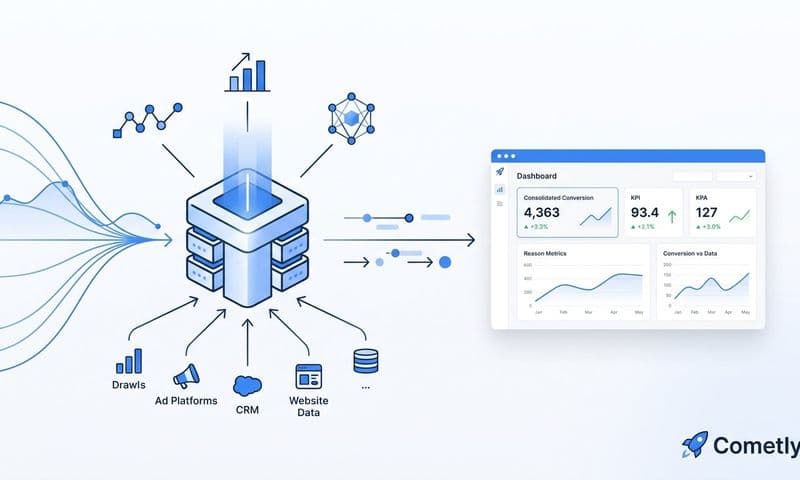
This is where a platform like Cometly becomes genuinely valuable. Rather than manually pulling data from each platform, cross-referencing spreadsheets, and trying to normalize attribution windows by hand, Cometly automates the entire reconciliation process. It connects your ad platforms, CRM records, and website events into a single attribution dashboard, so you can see the full customer journey from first ad click to closed-won revenue without stitching together reports from five different tools.
Cometly's server-side tracking and Conversion API integrations improve data completeness at the source, its multi-touch attribution models distribute credit accurately across every touchpoint, and its AI-powered insights surface which campaigns and channels are genuinely driving pipeline. The result is a single, trusted view of your marketing performance that makes budget decisions faster, more confident, and more grounded in what actually works.
Moving Forward with Confidence
Data discrepancies between ad platforms are inevitable. They are baked into how each platform is designed to measure and report its own performance. But those discrepancies do not have to be paralyzing, and they do not have to drive your budget decisions.
Reconciliation is the process that transforms noisy, conflicting platform data into a reliable signal. It starts with a single source of truth, builds through consistent event definitions and attribution window alignment, and matures into a full multi-touch attribution view that connects every channel to actual revenue outcomes.
The teams that invest in reconciliation and proper attribution infrastructure are the ones that scale efficiently. Every budget decision they make is grounded in what actually drives revenue, not in which platform dashboard tells the most flattering story. Over time, that compounding advantage shows up in better ROI, stronger pipeline, and a marketing function that earns and keeps the confidence of leadership.
If your team is still navigating this manually, or if your current setup leaves you with more questions than answers when the numbers do not add up, it is worth seeing what a unified attribution platform can do. Get your free demo of Cometly today and see how it connects all your ad platforms, CRM, and conversion events into one clear, accurate view so you can stop guessing and start growing with confidence.