
Most B2B ad campaigns fail not because of poor creative, but because teams lack visibility into what actually converts. You can run dozens of ad variations across LinkedIn, Google, and Meta, and still walk away unsure which ones drove qualified pipeline. That disconnect between ad spend and revenue is exactly why studying real B2B ads examples matters. It is not just about inspiration. It is about understanding the strategic mechanics behind ads that move buyers through complex, multi-touch sales cycles.
B2B buyers behave differently from consumers. They research longer, involve multiple stakeholders, and rarely convert on a first impression. The ads that perform in this environment share a common thread: they speak to specific pain points, target the right audience at the right funnel stage, and are backed by measurement systems that connect impressions to revenue.
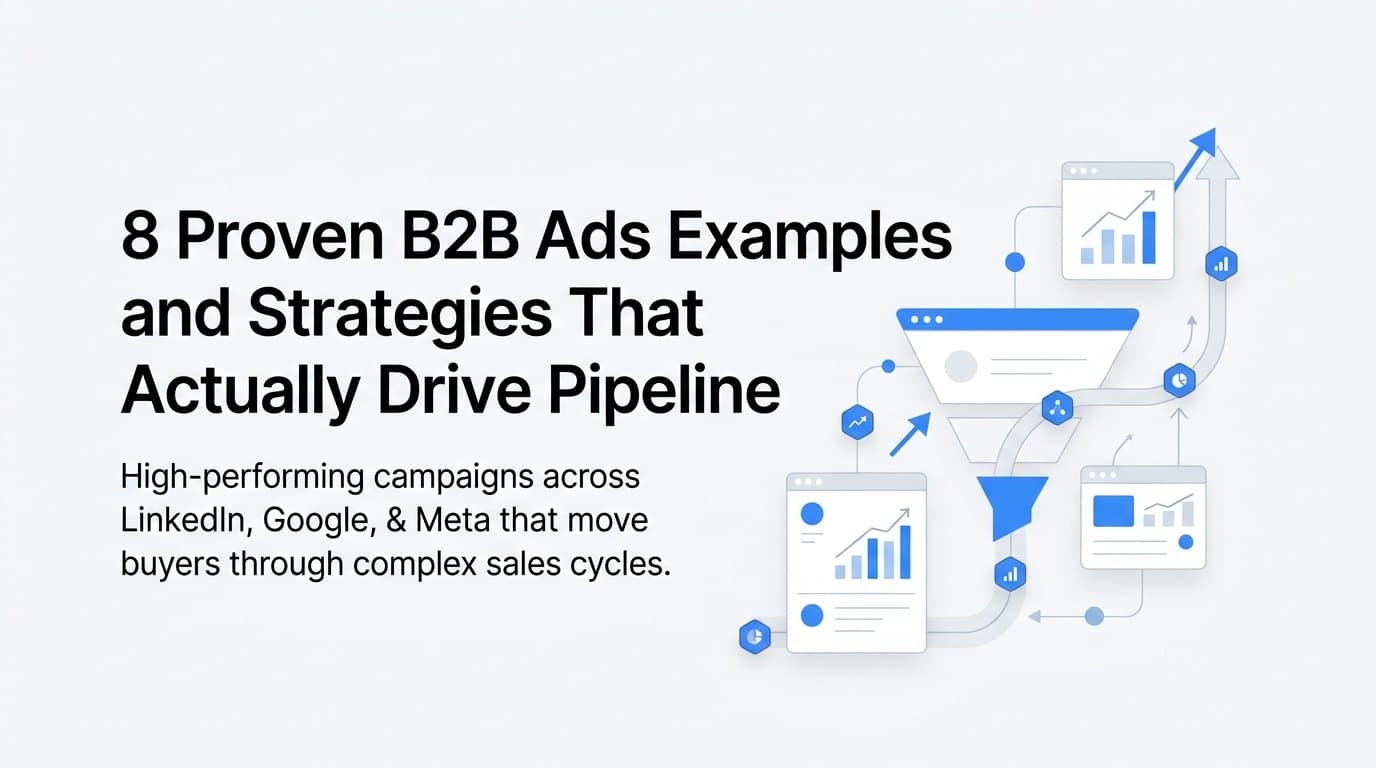
In this article, we break down eight proven B2B ad strategies drawn from observable patterns across high-performing campaigns. Each strategy covers the challenge it solves, how to implement it, and how to measure whether it is working. Whether you are running paid search, LinkedIn Sponsored Content, or retargeting campaigns, these frameworks will help you build ads that do more than generate clicks. They will help you generate pipeline you can actually track.
1. Lead with the Problem, Not the Product
The Challenge It Solves
Most B2B ads open with a product claim: "Introducing [Product Name], the all-in-one platform for X." The problem is that buyers are not searching for your product. They are searching for a solution to a problem they are already experiencing. When your ad leads with features instead of pain points, it forces buyers to make a mental leap you have not earned yet. The result is weak engagement and wasted impressions.
The Strategy Explained
Problem-led messaging structures your ad copy around the specific frustration your ideal customer profile is actively experiencing. Think about the language a VP of Marketing uses when venting to a colleague: "We have no idea which campaigns are actually driving revenue" or "We are spending six figures on ads and cannot prove ROI to the board." That language belongs in your ad copy, not your product spec sheet.
This approach works because it creates immediate relevance. When a buyer reads your ad and thinks "that is exactly my problem," you have cleared the first and most important hurdle in a B2B sales cycle. From there, your product becomes the natural answer to a question they are already asking.
Implementation Steps
1. Interview five to ten customers about the problem they had before finding your solution. Capture their exact language, not your internal terminology.
2. Write three to five headline variations that open with that problem language. Test them against each other in a controlled ad experiment.
3. Structure your ad copy in a problem-agitate-solve format: name the pain, make it feel real, then position your product as the logical resolution.
4. Match your landing page headline to the problem framing in the ad so the message stays consistent from click to conversion.
Pro Tips
Review sites like G2 and Capterra are goldmines for problem language. Read your competitors' negative reviews and pull the exact phrases buyers use to describe their frustrations. Those phrases, used verbatim in your ad copy, will outperform anything your internal team writes from scratch. Authenticity in problem framing is what separates ads that resonate from ads that blend into the feed.
2. Use Social Proof Ads to Reduce Buying Risk
The Challenge It Solves
B2B buyers are accountable to stakeholders, budget committees, and sometimes entire boards. Every purchase decision carries professional risk. If a software implementation fails, someone's credibility takes the hit. That risk aversion is one of the primary reasons B2B sales cycles stretch so long. Ads that ignore this dynamic and simply push product benefits miss a critical psychological lever.
The Strategy Explained
Social proof ads reduce perceived risk by showing buyers that peers like them have already made this decision and succeeded. This can take several forms: a recognizable customer logo wall, a direct quote from a director or VP at a company your prospect respects, or an outcome-oriented statement like "teams using this approach report cleaner attribution data and faster budget approvals."
The key is specificity and credibility. A vague testimonial from an anonymous user carries little weight. A named quote from a Head of Growth at a recognizable SaaS company, paired with a concrete outcome, carries significant weight. Buyers in evaluation mode are actively looking for permission to move forward. Social proof gives them that permission.
Implementation Steps
1. Identify your most recognizable and relevant customer logos. Prioritize companies your prospects will recognize and aspire to emulate.
2. Collect outcome-oriented quotes from customers. Focus on quotes that reference a specific problem solved or a measurable shift in how they work.
3. Build ad creative variations: one featuring a logo wall, one featuring a single strong quote, and one combining both. Test which format resonates most with your target audience.
4. Rotate social proof ads into your retargeting sequences, where buyers are already familiar with your brand and need credibility signals to move forward.
Pro Tips
Pull reviews directly from G2 or Capterra and use them in your ad creative with attribution to the platform. Third-party review sources carry more credibility than self-reported testimonials on your own website. The implied validation of a public review platform adds a layer of trust that first-party testimonials cannot replicate on their own.
3. Build Funnel-Stage-Specific Ad Sequences
The Challenge It Solves
Serving the same generic ad to a buyer who has never heard of your brand and one who has already visited your pricing page is one of the most common inefficiencies in B2B advertising. The first buyer needs context and relevance. The second buyer needs a reason to act. When you treat them identically, you waste budget and miss conversion opportunities at the moments that matter most.
The Strategy Explained
Funnel-stage sequencing maps distinct ad creative and messaging to three phases: awareness, consideration, and decision. At the awareness stage, your ads introduce the problem and your category. At the consideration stage, they demonstrate how your solution works and why it is differentiated. At the decision stage, they create urgency and reduce friction with offers like demos, trials, or direct comparison content.
Retargeting audiences make this possible. By segmenting your ad audiences based on website behavior, video watch time, or engagement with previous ads, you can move buyers through each stage with messaging that matches exactly where they are in their thinking.
Implementation Steps
1. Define your three funnel stages and the buyer mindset at each one. Write a one-sentence description of what a buyer at each stage needs to believe before moving forward.
2. Build retargeting audiences based on behavioral signals: all website visitors for consideration-stage ads, pricing or demo page visitors for decision-stage ads.
3. Create distinct creative for each stage. Awareness ads should educate. Consideration ads should differentiate. Decision ads should convert.
4. Use frequency caps to prevent ad fatigue and set time-based exclusions so buyers do not see awareness ads after they have already engaged at a deeper level.
Pro Tips
Use multi-touch attribution to identify which funnel stage contributes most to closed-won revenue. You may find that decision-stage ads close deals but awareness-stage ads are responsible for initiating the journey. Understanding that relationship helps you allocate budget across stages more intelligently rather than over-investing in bottom-funnel ads alone.
4. Target by Job Title and Company Signal, Not Just Demographics
The Challenge It Solves
Broad demographic targeting in B2B advertising is one of the fastest ways to burn budget. Targeting "marketing professionals aged 25 to 45" sounds reasonable until you realize it includes entry-level coordinators, freelancers, and people at companies that could never afford your product. Every impression served to the wrong person is a dollar that did not contribute to pipeline.
The Strategy Explained
LinkedIn's targeting capabilities allow B2B advertisers to reach buyers by job title, seniority level, company size, industry, and even specific company names. This level of precision means your ads can reach the VP of Marketing at a 200-person SaaS company while excluding everyone else in the same demographic bucket who does not fit your ideal customer profile.
Layering intent data or account-based marketing lists on top of these filters adds another dimension of precision. Instead of reaching everyone with the right title, you reach everyone with the right title who is also showing buying signals through content consumption, competitor research, or category searches.
Implementation Steps
1. Define your ideal customer profile with specific parameters: job titles, seniority levels, company size ranges, and target industries.
2. Build your LinkedIn campaign audience using these filters. Start with a narrower audience and expand only if volume is insufficient.
3. Upload your CRM account list as a matched audience to reach known prospects and existing pipeline contacts with tailored messaging.
4. Layer intent data from tools like Bombora or LinkedIn's own interest categories to prioritize accounts showing active buying signals.
Pro Tips
Test job title targeting against job function plus seniority targeting. LinkedIn's job title matching can be inconsistent because people use different titles for similar roles. Combining job function with seniority level often reaches a broader but equally relevant audience, and it tends to scale more efficiently as your campaigns grow.
5. Run Comparison and Alternative Ads to Capture High-Intent Searches
The Challenge It Solves
Not all search traffic is created equal. A buyer searching for "marketing attribution software" is in early research mode. A buyer searching for "[competitor name] alternative" or "best [category] tools comparison" has already done that research and is now actively evaluating options. These high-intent queries represent some of the most valuable traffic available in B2B paid search, and many teams leave them entirely uncaptured.
The Strategy Explained
Comparison and alternative ads target buyers who are in active evaluation mode. These buyers have identified a category, often tried or researched a competitor, and are now looking for the best fit. Your ad appearing at this moment, with messaging that directly addresses the comparison context, positions you as a credible alternative at exactly the right time.
The ad copy and landing page must align tightly with the search intent. A buyer searching for "[competitor] alternative" needs to land on a page that acknowledges the comparison, highlights your differentiators, and makes it easy to take the next step. Generic product pages will not convert this audience effectively.
Implementation Steps
1. Research the comparison and alternative queries relevant to your category. Use Google's autocomplete, related searches, and keyword research tools to build a comprehensive list.
2. Build dedicated landing pages for each major comparison theme. Each page should address the specific context of the search query.
3. Write ad copy that acknowledges the comparison intent directly. Phrases like "Looking for a [competitor] alternative?" or "See how [your product] compares" signal immediate relevance.
4. Track these campaigns separately in your attribution platform so you can measure their contribution to pipeline independently from your broader brand and category campaigns.
Pro Tips
Do not just target competitor brand terms. Category comparison queries like "best marketing attribution software" or "marketing attribution tools comparison" often have lower cost-per-click and reach buyers who have not yet committed to evaluating a specific competitor. Capturing these buyers early gives you a competitive advantage before they narrow their shortlist.
6. Use Video Ads to Explain Complex Value Propositions
The Challenge It Solves
Some B2B products are genuinely difficult to explain in a static ad format. If your value proposition requires more than a headline and two lines of copy to land, a banner ad or text ad will not do it justice. Buyers who do not immediately understand what you do will scroll past without engaging, and you will have paid for an impression that generated no awareness at all.
The Strategy Explained
Short-form video ads on LinkedIn, YouTube, and Meta give you the time and format to walk buyers through a problem and demonstrate your solution visually. The most effective B2B video ads follow a clear structure: open with the problem in the first three seconds, agitate it briefly, then show the solution in action. Screen recordings, product walkthroughs, and animated explainers all work well depending on your product and audience.
Keep videos under 60 seconds for most placements. Attention drops significantly after the first 15 seconds, so front-load your most important message. The goal of the video is not to explain everything. It is to create enough curiosity and relevance that the viewer clicks through to learn more.
Implementation Steps
1. Script your video with a strict three-act structure: problem (seconds 0 to 10), solution demonstration (seconds 10 to 45), and clear call to action (seconds 45 to 60).
2. Add captions to every video. A significant portion of LinkedIn and social video is watched without sound, and captions ensure your message lands regardless of viewing context.
3. Deploy video ads at the awareness and consideration stages. Use view-based retargeting to follow up with buyers who watched a significant portion of your video but did not convert.
4. Measure video completion rates and downstream conversion events, not just view counts. A high view count with low downstream engagement signals a disconnect between your video content and your conversion path.
Pro Tips
Test different opening hooks aggressively. The first three seconds determine whether a buyer stops scrolling or keeps moving. A question, a surprising statement, or a direct call-out of the viewer's role ("If you are running B2B paid ads...") can dramatically improve view-through rates. Create multiple versions of the opening and keep the rest of the video consistent to isolate what is driving performance differences.
7. Align Ad Messaging with CRM Stage Data
The Challenge It Solves
Most ad platforms operate in isolation from your CRM. The result is a common and costly scenario: your sales team is actively working a deal, and your ad platform is simultaneously serving that same prospect a generic awareness ad that makes your company look out of touch. Worse, you may be spending budget on ads targeting accounts that are already closed or have churned, generating zero pipeline value.
The Strategy Explained
CRM-aligned ad messaging synchronizes your ad audiences with pipeline stage data so that every buyer sees content that reflects where they actually are in the sales process. An account in early discovery gets different ad content than an account in active negotiation. Closed-lost accounts can be targeted with re-engagement campaigns. Already-closed accounts are suppressed entirely to avoid wasted spend.
This strategy requires a reliable connection between your CRM and your ad platforms. Server-side tracking improves the reliability of these audience syncs by reducing dependence on browser-based cookies, which are increasingly unreliable due to privacy changes across browsers and operating systems.
Implementation Steps
1. Map your CRM pipeline stages to specific ad messages. Define what content is most relevant at each stage: educational content for early stages, case study content for mid-stage, and urgency-driven offers for late-stage opportunities.
2. Build CRM-based audience lists and sync them to your ad platforms. Most major CRMs integrate directly with LinkedIn, Google, and Meta for audience matching.
3. Set up suppression lists for closed-won and closed-lost accounts to eliminate wasted spend on audiences that will not convert.
4. Audit your audience syncs regularly. CRM data changes frequently, and stale audience lists can quickly erode the precision of this strategy.
Pro Tips
Coordinate with your sales team when implementing CRM-aligned ads. They can tell you which types of content prospects find most useful at each stage, and they will notice if ad messaging conflicts with what they are saying in direct outreach. Alignment between sales and marketing on this strategy is what makes it genuinely powerful rather than just technically functional.
8. Measure Every Ad Against Pipeline and Revenue, Not Just Leads
The Challenge It Solves
Lead volume is the most commonly tracked B2B ad metric and one of the most misleading. A campaign that generates a high volume of form fills from unqualified prospects looks successful in a dashboard but contributes nothing to revenue. Meanwhile, a campaign generating fewer but highly qualified leads that consistently convert to closed-won deals may be undervalued and underfunded. Optimizing for the wrong metric produces exactly the wrong outcomes.
The Strategy Explained
Replacing lead volume with pipeline contribution and closed-won revenue as your primary success metrics requires connecting your ad platforms to your CRM outcomes. This is the core problem that marketing attribution platforms like Cometly are built to solve. When you can see which campaigns, ad sets, and individual ads are generating deals that actually close, you can make budget allocation decisions based on real return rather than proxy metrics.
Multi-touch attribution is essential here because B2B buyers rarely convert from a single ad interaction. A buyer might see a LinkedIn awareness ad, click a Google search ad three weeks later, and then convert after a retargeting ad. Each touchpoint contributed to the outcome, and a last-touch-only model would credit only the final interaction while obscuring the full picture.
Implementation Steps
1. Connect your ad platforms to your CRM so that lead and opportunity data flows back to the campaign level. This connection is the foundation of revenue-based measurement.
2. Define your primary success metrics: cost per qualified opportunity, cost per closed-won deal, and return on ad spend calculated against actual revenue, not lead volume.
3. Choose an attribution model that reflects your buying cycle. Linear or time-decay models often work well for B2B contexts where multiple touchpoints contribute meaningfully across a long sales cycle.
4. Build a reporting cadence that reviews pipeline and revenue contribution by campaign, channel, and ad creative. Use this data to reallocate budget toward what is genuinely driving growth.
Pro Tips
Do not wait until the end of a campaign to review revenue attribution data. Set up real-time dashboards that show pipeline progression by campaign so you can make in-flight adjustments. Campaigns that are generating opportunities early in a period often continue to perform well, and catching that signal early allows you to increase investment while the momentum is active rather than after the fact.
Putting It All Together: Your B2B Ads Implementation Roadmap
The eight strategies outlined here are not isolated tactics. They work best when layered together inside a measurement framework that connects every ad touchpoint to actual pipeline and revenue. Starting with problem-led messaging and funnel-stage sequencing gives your creative a strategic foundation. Adding precise targeting, social proof, and comparison ads ensures you reach buyers at the moments that matter most.
But none of it compounds without accurate attribution. When you can see which ads, channels, and sequences are genuinely driving closed-won revenue, you stop guessing and start scaling with confidence.
Here is a practical order for implementation. Start by auditing your current ad copy for problem-led messaging and rewrite any headlines that lead with features. Then build your funnel-stage audiences and create distinct creative for each stage. Add social proof and comparison ads as your creative library grows. Finally, connect your ad platforms to your CRM and shift your primary success metrics to pipeline and revenue.
Each layer you add improves the precision and accountability of the entire system. Problem-led messaging improves click quality. Funnel sequencing improves conversion rates. Precision targeting reduces wasted spend. Revenue attribution ensures you keep investing in what actually works.
Cometly is built to give B2B SaaS marketing teams exactly that visibility. It connects your ad platforms, CRM, and website into a single source of truth, so every dollar you spend is tied to a measurable outcome. If you are ready to move beyond vanity metrics and build a B2B ad strategy grounded in real data, Get your free demo today and start capturing every touchpoint to maximize your conversions.