If you can't track conversions accurately, you're not alone. Most marketers running paid campaigns today are staring at three different dashboards showing three completely different stories. Meta says your campaign drove 80 conversions. Google Analytics counts 45. Your CRM shows 30 closed deals. Which number do you trust? More importantly, which number do you act on?
This disconnect isn't just frustrating. It's expensive. When your conversion data is unreliable, every budget decision you make is built on a shaky foundation. You end up scaling campaigns that look good on paper but aren't actually driving revenue, while cutting channels that quietly contribute to sales you can't see.
The good news is that inaccurate conversion tracking isn't inevitable. It's a solvable problem, and the solutions are more accessible than ever. This article breaks down why your conversion data is likely off, what's causing the gaps, and how to build a tracking system that gives you numbers you can actually trust and act on.
The Real Cost of Broken Conversion Data
Let's start with what's actually at stake. Inaccurate conversion tracking isn't just a reporting headache. It directly shapes how you allocate budget, which campaigns you scale, and how confident your team feels about the decisions you're making.
When your tracking overstates performance on a particular channel, you naturally pour more money into it. This is one of the most common and costly traps in digital marketing. A campaign might show a strong return on ad spend inside the ad platform's dashboard, but when you reconcile that against actual revenue in your CRM, the numbers fall apart. You've been funding a channel that looked productive but wasn't doing the heavy lifting you thought it was. Understanding how to properly go about tracking closed won revenue is essential to avoiding this trap.
The cascading effect goes deeper than your own budget decisions. Ad platforms like Meta and Google use the conversion signals you send them to power their optimization algorithms. These algorithms decide who sees your ads, when, and how often. When the conversion data you're feeding back to these platforms is incomplete or inaccurate, the algorithms are essentially working with corrupted inputs. They optimize toward the wrong signals, find the wrong audiences, and make targeting decisions that drift further from what actually drives revenue for your business.
Think of it like giving a GPS the wrong destination. The system works perfectly. It just takes you somewhere you didn't want to go.
There's also a trust problem that develops inside marketing teams. When the numbers from Meta, Google Analytics, and your CRM don't reconcile, conversations about performance become circular. Teams spend time arguing about which data source is right instead of making decisions. Reporting becomes a negotiation rather than a clear picture. Leadership loses confidence in the marketing team's ability to demonstrate ROI, and the marketing team loses confidence in their own data.
This erosion of trust is one of the most underappreciated costs of broken conversion tracking. The technical problem creates a cultural problem, and that slows everything down.
Five Root Causes Behind Inaccurate Conversion Tracking
Understanding why your data is off is the first step toward fixing it. There are several distinct forces working against accurate conversion tracking, and most marketers are dealing with more than one of them simultaneously.
Privacy changes and browser restrictions: This is the biggest structural shift the industry has faced in years. Apple's iOS 14.5 App Tracking Transparency update gave users the ability to opt out of cross-app tracking, and a significant portion of them did. This fundamentally changed what Meta and other platforms can observe about user behavior. At the same time, browsers like Safari and Firefox have blocked third-party cookies for years, and Google Chrome has been moving in the same direction. Traditional pixel-based tracking relies on these cookies to match ad clicks to conversions. When the cookies are blocked or the tracking permission is denied, those conversions simply disappear from the platform's view. They happened. You just can't see them. Marketers should also be preparing for iOS 17 Link Tracking Shield and its additional restrictions.
Cross-device and cross-platform journeys: A customer might see your ad on their phone during their morning commute, research your product on their work laptop, and convert on their home desktop three days later. Each of these interactions happens on a different device, potentially in a different browser, and none of them are automatically connected. Single-platform tracking treats each session as isolated, creating blind spots that make it look like certain touchpoints have no impact when they actually played a meaningful role in the journey. Implementing proper cross-channel tracking is critical for connecting these fragmented journeys.
Misconfigured pixels and tag errors: This one is surprisingly common and often invisible until you go looking for it. Duplicate event firing, incorrect trigger conditions, and tags that fire on the wrong pages can silently inflate or deflate your conversion counts. A checkout confirmation page that fires a purchase event twice looks like double the conversions. A pixel that stops loading because of a site update goes unnoticed for weeks. These configuration issues don't announce themselves. They just quietly corrupt your data in the background.
Attribution window mismatches: Meta defaults to a 7-day click, 1-day view attribution window. Google Ads uses a 30-day click window by default. TikTok has its own settings. When you're looking at performance across multiple platforms without accounting for these differences, you're comparing apples to oranges. A single conversion can fall inside the attribution window of multiple platforms simultaneously, meaning each one claims full credit for the same sale. Your total reported conversions across platforms can add up to far more than what actually happened.
Missing offline and CRM data: Many businesses convert customers through processes that don't happen entirely online. A lead fills out a form, a sales rep follows up, a deal closes in the CRM weeks later. If that offline conversion event never gets connected back to the original ad click, the campaign that generated the lead gets zero credit for the revenue it actually drove. Learning how to track offline conversions is essential for businesses with longer sales cycles.
Why Ad Platform Reporting Alone Falls Short
Here's something worth understanding clearly: ad platforms are not neutral reporters of your marketing performance. They are businesses with an incentive to show you that your ads are working. That doesn't mean they're being dishonest, but it does mean their reporting is built around their own data, their own attribution models, and their own definitions of success.
The multi-platform credit problem is the most obvious issue. When you're running campaigns on Meta, Google, and TikTok simultaneously, each platform attributes conversions based on its own rules. A customer who clicked a Google ad on Monday and a Meta ad on Wednesday before purchasing on Friday will likely be counted as a conversion by both platforms. Neither is technically wrong by its own logic. But your actual conversion count is one, not two. When you add up reported conversions across platforms, the total can be dramatically higher than what your CRM or backend systems show.
Modeled conversions add another layer of complexity. As privacy restrictions have reduced the amount of observable conversion data available to platforms, Meta and Google have increasingly turned to statistical modeling to fill the gaps. When a platform can't directly observe a conversion because of tracking limitations, it uses machine learning to estimate whether one likely occurred based on patterns from users it can observe. This modeling can be sophisticated, but it introduces a layer of estimation into your reporting that isn't always clearly labeled. You may be looking at a mix of observed conversions and statistically inferred ones without realizing it.
View-through attribution is another area where context matters enormously. A view-through conversion is counted when someone sees your ad but doesn't click it, then converts within a defined window. Including view-through conversions in your ROAS calculations can make campaigns look significantly more effective than they are, particularly for top-of-funnel awareness placements. The problem isn't that view-through attribution is inherently wrong. It's that mixing it with click-based attribution without distinguishing between the two produces ROAS numbers that are difficult to interpret and easy to misread.
The practical takeaway is that you can't rely on any single ad platform's dashboard to give you an accurate, complete picture of your marketing performance. Each platform is showing you its own version of reality. Building a clear view of what's actually happening requires pulling data from multiple sources and applying a consistent attribution framework across all of them.
Server-Side Tracking: Closing the Data Gap
If traditional pixel-based tracking is losing data because of browser restrictions and privacy changes, the logical solution is to move the tracking off the browser entirely. That's exactly what server-side tracking does.
With client-side tracking, a pixel embedded in your website fires from the user's browser when a conversion event occurs. Understanding what a tracking pixel is and how it works helps clarify why this approach is increasingly unreliable. This approach is vulnerable to ad blockers, browser privacy settings, cookie restrictions, and any number of technical issues on the user's device. If any of those things interfere with the pixel, the conversion goes unrecorded.
Server-side tracking works differently. Instead of relying on the browser to send conversion data, your own server captures the event and sends it directly to the ad platform's API. The data travels from your server to Meta's Conversions API, Google's Enhanced Conversions, or whichever platform you're using. Because this happens server-to-server, it completely bypasses browser-level restrictions. Ad blockers can't intercept it. Safari's Intelligent Tracking Prevention can't strip the cookie. The conversion gets recorded regardless of what's happening in the user's browser.
The accuracy advantage is significant. Server-side setups consistently capture a higher percentage of actual conversions compared to client-side pixels alone. For a deeper dive into the data, explore why server-side tracking is more accurate than traditional methods. Conversions that would have been invisible under traditional tracking start showing up in your data. This gives you a more complete and reliable dataset to work with, which improves the quality of every decision you make downstream.
There's also a downstream benefit for your ad platform algorithms. When you feed richer, more complete conversion data back to Meta and Google through their server-side APIs, you're giving their optimization engines better signals to work with. Better signals mean better targeting decisions, better audience expansion, and ultimately better campaign performance. The data quality improvement creates a compounding effect: more accurate tracking leads to smarter algorithmic optimization, which leads to better results from the same ad spend.
Platforms like Cometly make server-side tracking accessible without requiring deep engineering resources. Cometly's server-side tracking infrastructure captures conversion events and syncs enriched data back to ad platforms, closing the gap between what actually happened and what the platforms can see.
Multi-Touch Attribution: Seeing the Full Customer Journey
Even with server-side tracking in place, there's still a fundamental question that accurate data collection alone can't answer: which touchpoints in the customer journey actually deserve credit for a conversion?
Single-touch attribution models give a simple answer to a complex question. Last-click attribution gives all the credit to the final interaction before conversion. First-click gives it all to the first touchpoint. Both models are easy to understand, but they produce a distorted view of how your marketing actually works. Last-click systematically undervalues every upper-funnel and mid-funnel effort that built awareness and consideration before the customer was ready to buy. First-click does the opposite, ignoring the channels that closed the deal.
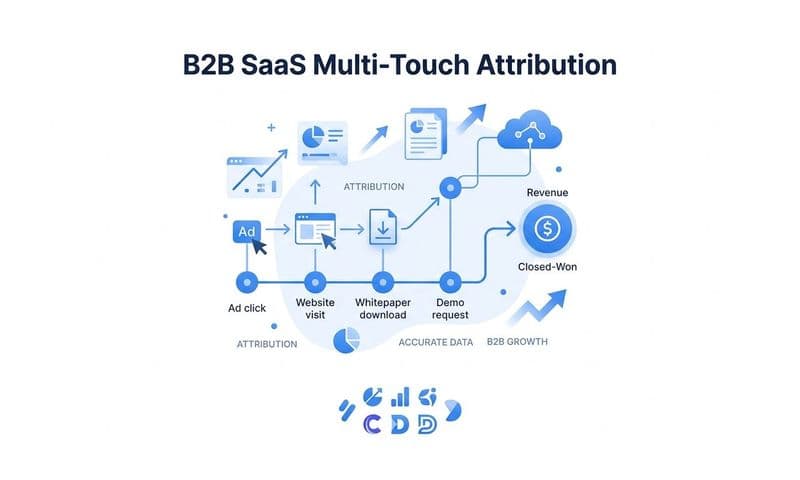
Multi-touch attribution distributes credit across every interaction in the customer journey. Instead of one touchpoint getting all the recognition, each touchpoint gets a portion of the credit based on the model you choose. Choosing the right software for tracking marketing attribution is critical to implementing this effectively. This gives you a much more honest view of how different channels and campaigns contribute to revenue.
The most common multi-touch models each have different strengths depending on your campaign structure and business goals.
Linear attribution gives equal credit to every touchpoint in the journey. It's straightforward and ensures that no channel is completely ignored. It works well when you genuinely don't have strong evidence that any particular touchpoint is more influential than others.
Time-decay attribution gives more credit to touchpoints that occurred closer to the conversion. The logic is that the interactions that happened right before a customer decided to buy had more influence over that decision. This model tends to favor bottom-of-funnel channels and is useful when your goal is to understand what's closing deals.
Position-based attribution (also called U-shaped) gives the most credit to the first and last touchpoints, with the remaining credit distributed among the middle interactions. This model acknowledges that both the initial awareness moment and the final conversion push are particularly important, while still giving some recognition to everything in between.
The right model depends on your business. For longer sales cycles with complex journeys, time-decay or position-based models often reveal the most actionable insights. For shorter, simpler funnels, linear attribution can be a reasonable starting point. The key is moving beyond single-touch models entirely, because any model that assigns all credit to one touchpoint is hiding more than it reveals.
Building a Conversion Tracking System You Can Trust
Understanding the problems and the solutions is one thing. Putting it all together into a reliable, ongoing system is where the real work happens. Here's a practical approach to building conversion tracking you can actually depend on.
Start with an audit: Before adding anything new, map out what you currently have. Identify every pixel, tag, and tracking script on your site. Check for duplicate event firing, incorrect triggers, and any events that haven't been validated recently. Compare your platform-reported conversions against your CRM data for the same time period and note the discrepancies. Our guide on fixing conversion tracking gaps walks through this process in detail. Understanding the size and nature of the gap tells you where to focus your energy first.
Implement server-side tracking as your foundation: Client-side pixels should be treated as a secondary layer, not your primary source of truth. Set up server-side event tracking through the Conversions API for Meta and Enhanced Conversions for Google Ads. Make sure your server-side setup is capturing the same events you care about most: purchases, form submissions, qualified leads, and any other actions that connect directly to revenue.
Unify your data sources: The goal is a single source of truth that pulls together ad platform data, website events, and CRM outcomes. This is where platforms like Cometly become genuinely valuable. Cometly connects your ad platforms, CRM, and website tracking into one unified analytics view, so you can see the full customer journey without manually reconciling data across disconnected tools. The AI-powered recommendations layer on top of that unified data to surface which campaigns and channels are actually driving revenue, and where you should be scaling.
Close the loop with conversion sync: Once you have accurate conversion data, feed it back to your ad platforms continuously. This is what keeps Meta and Google's algorithms optimizing toward real outcomes rather than proxy signals. Cometly's Conversion Sync automates this process, sending enriched conversion events back to ad platforms so their targeting engines always have the most accurate and complete data available.
Build in ongoing validation: Conversion tracking isn't a set-it-and-forget-it system. Site updates break pixels. Tag configurations drift. Attribution windows get changed. Schedule regular audits, at least monthly, to verify that your key conversion events are firing correctly and that your data across sources continues to reconcile within an acceptable range. Catching a tracking issue two weeks in is far less costly than discovering it two months later.
Putting It All Together
Inaccurate conversion tracking is not a minor inconvenience. It's a direct threat to your marketing ROI. When your data is off, your budget decisions are off. When your budget decisions are off, your campaigns underperform. And when your campaigns underperform on corrupted data, you often can't tell whether the problem is the strategy or the measurement.
The path forward is clear. Address the privacy-era tracking gaps that client-side pixels can no longer cover by implementing server-side solutions. Move beyond single-platform reporting by adopting multi-touch attribution that shows you the full picture of how customers move through your funnel. And build a system that continuously feeds accurate, enriched conversion data back to ad platforms so their algorithms are always working from your best information.
These aren't theoretical improvements. They translate directly into better targeting, smarter budget allocation, and more confident decision-making across your entire marketing operation.
If you're ready to stop guessing and start working with conversion data you can actually trust, Cometly is built for exactly this. From server-side tracking and multi-touch attribution to AI-powered recommendations that connect every touchpoint to real revenue, Cometly gives you the unified view your marketing decisions deserve. Get your free demo today and start capturing every conversion with the accuracy your ad spend requires.