Acquiring a new customer in B2B SaaS is expensive. Depending on your sales cycle, channel mix, and onboarding investment, the cost can run into thousands of dollars per logo. But here is the uncomfortable truth that many growth teams overlook: losing a customer quietly, without ever seeing it coming, is often more damaging than the acquisition cost alone. When churn compounds over months and years, it silently erodes the ARR growth that your entire go-to-market motion is working to build.
The good news is that churn is rarely sudden. Customers do not wake up one morning and decide to cancel. The decision builds gradually, leaving behavioral signals along the way: fewer logins, unused features, a support ticket that went unresolved, a renewal conversation that never happened. Churn prediction models exist specifically to catch those signals before they turn into cancellations.
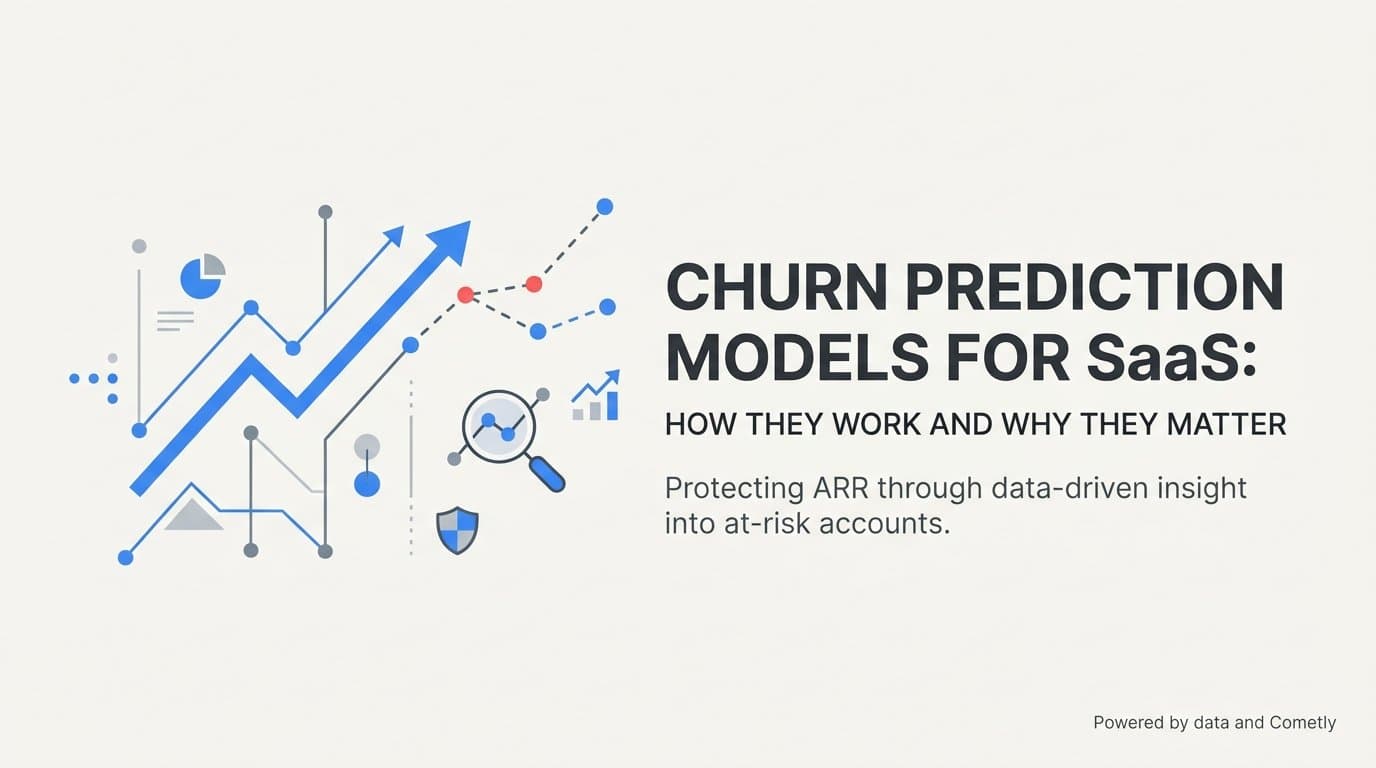
In plain terms, a churn prediction model is a data-driven framework that analyzes customer behavior patterns and assigns each account a risk score based on how likely they are to leave. For B2B SaaS growth teams, these models have shifted from a nice-to-have data science experiment into a core operational tool. This article will walk you through why churn costs more than most teams realize, how these models actually work, which approaches are most practical for SaaS companies, and how connecting your marketing attribution data to retention intelligence gives you a structural advantage in building a customer base that actually stays.
The Hidden Cost of Churn That Most SaaS Teams Underestimate
Here is a number worth sitting with: even a modest monthly churn rate compounds into a serious drag on your ARR over time. A company churning a small percentage of its customer base each month can find itself running hard just to stay in place, because every new customer acquired is partially offset by the revenue quietly walking out the back door. This is the compounding nature of churn, and it is why retention deserves the same strategic attention as acquisition.
Most SaaS leaders understand this intellectually, but the operational reality is that acquisition gets the budget, the headcount, and the executive attention. Retention is often treated as a customer success problem to manage rather than a growth lever to optimize. That framing is costly.
It helps to distinguish between two types of churn, because each requires a different predictive approach. Voluntary churn happens when a customer actively decides to cancel, typically because they are not getting enough value, a competitor is more appealing, or their business needs have changed. Involuntary churn happens when a customer loses access due to a failed payment or billing issue, not because they wanted to leave. These are very different problems. A churn model built to predict voluntary disengagement will not help you catch failed credit card renewals, and vice versa. Knowing which type you are trying to solve for shapes everything about how you build and deploy your model.
Perhaps the most important reframe for any SaaS team thinking about churn is this: churn is a lagging indicator. By the time a customer submits a cancellation request or simply stops logging in, the decision to leave was often made weeks or even months earlier. The visible cancellation event is just the final step in a longer disengagement journey. This is precisely why reactive retention strategies, ones that kick in only after the cancellation signal appears, are structurally too late. Predictive models exist to move the intervention point earlier in that journey, when there is still time to change the outcome.
What Churn Prediction Models Actually Do
A churn prediction model is, at its core, a machine learning or statistical framework that looks at historical customer behavior and learns which patterns tend to precede cancellation. Once trained, the model can evaluate your current active customers against those same patterns and output a risk score for each account, essentially answering the question: based on everything we know about how this customer is behaving, how likely are they to churn in the next 30, 60, or 90 days?
The inputs that feed these models are where things get interesting. Product usage data is consistently one of the strongest predictors of churn in SaaS. Signals like declining login frequency, reduced engagement with core features, or a drop in API call volume are well-recognized leading indicators of disengagement. A customer who logged in daily during onboarding but has not touched the product in three weeks is sending a clear signal, even if they have not said a word to your team.
Beyond product usage, strong churn models typically incorporate a range of additional behavioral signals. Support ticket volume and sentiment can indicate friction. Billing history, including late payments or failed charges, surfaces financial risk. Feature adoption depth matters too: a customer who has integrated deeply with your platform is structurally harder to replace than one who only ever used a single feature. Engagement signals like email open rates, attendance at customer webinars, or participation in QBRs all add texture to the picture.
The output of a churn model is usually a risk score or a segment label assigned to each account. In practice, most teams work with a tiered segmentation: high risk, medium risk, and low risk. This tiering is what makes the model operationally useful. Customer success teams can prioritize their outreach toward high-risk accounts rather than spreading attention evenly across the entire customer base. Marketing teams can build targeted re-engagement campaigns for accounts that have gone quiet. Leadership can track the health distribution of the customer base over time as a leading indicator of future retention performance.
The key shift that churn prediction models enable is moving from a reactive posture, where teams respond to cancellation signals, to a proactive one, where teams intervene before the decision to leave is finalized. That shift in timing is where the real retention value lives.
The Most Common Churn Prediction Approaches in SaaS
Not all churn prediction models are built the same way, and the right approach for your team depends on the size of your dataset, your technical resources, and what questions you most need to answer. Three approaches are particularly common in SaaS contexts, each with distinct tradeoffs.
Logistic Regression: This is the foundational approach and often the right starting point for teams building their first churn model. Logistic regression is interpretable, relatively fast to build, and works well when you have clean historical data and want to understand which variables are most strongly associated with churn. The model produces a probability score for each account, and because the math is transparent, you can explain to stakeholders exactly why a given account is flagged as high risk. The limitation is that logistic regression assumes relatively linear relationships between your input variables and churn probability, which means it can miss more complex patterns in your data.
Gradient Boosting Models: For teams with richer datasets and more technical capacity, gradient boosting methods like XGBoost and LightGBM are widely used in applied machine learning for their predictive accuracy on tabular data. These models excel at capturing non-linear relationships, meaning they can detect subtle combinations of signals that a simpler model would miss. A customer might show low churn risk on any single dimension, but a gradient boosting model might recognize that the specific combination of declining feature usage plus a recent support escalation plus an upcoming renewal date is a high-risk pattern. The tradeoff is interpretability: these models are harder to explain, which can create friction when trying to communicate risk logic to non-technical stakeholders.
Survival Analysis: This is the most sophisticated approach and the one most often overlooked by SaaS teams. Survival analysis does not just ask whether a customer will churn; it asks when they are likely to churn. This time-aware framing is particularly valuable for SaaS companies with longer sales cycles, tiered contract structures, or meaningful variation in customer tenure. Knowing that a customer has a high probability of churning within the next 30 days is operationally different from knowing they are likely to churn sometime in the next year. Survival models give your customer success and marketing teams the timing context they need to prioritize interventions appropriately.
Building the Data Foundation Your Model Needs
Here is the part that data science teams will tell you is the hardest, and they are right: a churn prediction model is only as good as the data feeding it. You can build a technically sophisticated model, but if the underlying data is incomplete, inconsistent, or siloed across disconnected systems, the model's predictions will be unreliable at best and misleading at worst.
The data challenge in SaaS is structural. Product telemetry typically lives in a product analytics tool. CRM records live in Salesforce or HubSpot. Billing data lives in Stripe or another payment system. Marketing attribution data lives in your ad platforms or a dedicated attribution tool. Each of these systems captures a meaningful piece of the customer story, but none of them, on their own, gives you a complete behavioral profile for each account.
This is the data silo problem, and it is the most commonly cited obstacle in building effective churn models. The modeling itself is often the easier part. The hard work is stitching together a unified customer record that connects acquisition source, onboarding behavior, feature usage over time, support interactions, billing events, and revenue history into a single coherent timeline for each account.
What does a strong data foundation look like in practice? It starts with a reliable customer identifier that exists across all your systems, so that a given account in your CRM can be linked to its corresponding product usage records, billing history, and marketing touchpoints. From there, you need a data pipeline that pulls these signals together on a regular cadence, whether that is daily, weekly, or near-real-time depending on your use case. The resulting unified customer record becomes the input layer for your churn model, and the richer and cleaner that record is, the more accurate your predictions will be.
Teams that invest in this data infrastructure often find that the unified customer view is valuable far beyond churn prediction. It becomes the foundation for customer health scoring, expansion opportunity identification, and, critically, connecting acquisition quality to downstream retention outcomes.
Where Marketing Attribution Connects to Churn Prevention
Most SaaS teams think of churn as a post-sale problem. The customer is already in the door, and now customer success needs to keep them. But this framing misses something important: the customers most likely to churn often share a common origin story. They came from a low-intent channel, were brought in by a campaign that prioritized volume over fit, or had expectations set during the acquisition phase that the product could never realistically meet.
This is where marketing attribution data becomes a retention tool, not just an acquisition optimization tool. When you can connect the acquisition source of each customer to their downstream retention behavior, you start to see patterns that are invisible when you look at acquisition and retention in isolation. A particular paid social campaign might be driving strong conversion volume but producing customers who churn at a significantly higher rate than those who came through organic search or a product-led motion. Without attribution data connected to retention outcomes, that pattern stays hidden, and budget continues to flow toward campaigns that look efficient on a cost-per-lead basis but are quietly damaging your ARR.
Connecting acquisition source to churn rates allows marketing teams to optimize for customer quality, not just customer volume. The question shifts from "which campaigns are driving the most conversions?" to "which campaigns are driving customers who actually stay and expand?" That is a fundamentally different optimization target, and it tends to produce much better long-term business outcomes.
This is where a platform like Cometly becomes directly relevant to churn prevention strategy. Cometly connects ad platform data, CRM events, and customer journey touchpoints into a single unified view, giving marketing teams the attribution clarity to see which sources, channels, and creatives produce customers with strong retention profiles versus those who leave quickly. By tracking the full journey from first ad click through to closed-won revenue and beyond, Cometly makes it possible to evaluate acquisition channels not just on conversion metrics but on the quality and longevity of the customers they bring in. That insight allows marketing budgets to shift toward higher-LTV acquisition, which reduces churn at its source rather than trying to recover it downstream.
Turning Churn Predictions Into Retention Actions
A churn prediction model that sits in a data warehouse and produces scores that no one acts on is not a retention strategy. It is just reporting. The real value of churn prediction comes from embedding risk intelligence into the operational workflows your teams already use every day.
The starting point is a defined playbook for each risk tier. When a model flags an account as high risk, what happens next? The answer should be specific and pre-decided, not improvised. For customer success teams, this might mean a triggered outreach sequence: a personal email from the account manager, a check-in call, or an invitation to a product training session focused on features the customer has not yet adopted. For accounts in a medium-risk tier, a lighter-touch automated campaign might be appropriate, perhaps a targeted email series highlighting use cases relevant to their industry or a prompt to schedule a quarterly business review.
Marketing teams have their own set of retention levers that churn risk scores can activate. At-risk accounts who have gone quiet on product engagement but are still within their contract period are candidates for re-engagement campaigns, whether through email, paid retargeting, or direct outreach. On the acquisition side, churn risk data can improve the quality of lookalike audiences: suppressing recently churned customers from lookalike modeling helps ensure that your paid campaigns are not optimizing toward the profile of customers who leave.
The operational infrastructure matters as much as the model itself. Risk scores need to flow into the CRM so that customer success managers see them in context. They need to feed into marketing automation platforms so that at-risk segments can be targeted without manual list management. They need to appear in the analytics dashboards that leadership reviews, so that the health distribution of the customer base is visible as a forward-looking metric alongside ARR and pipeline.
Teams that close this loop, from prediction to action to measurement of intervention effectiveness, build a genuine retention capability over time. Each intervention cycle produces new data about which actions actually move accounts from high risk to healthy, and that data feeds back into the model to improve future predictions.
Putting It All Together: Churn Prediction as a Growth Strategy
Churn prediction is not a data science exercise. It is a growth strategy. The progression from understanding churn signals to building models to acting on predictions represents a meaningful shift in how SaaS companies think about their customer base: not as a static asset to be managed, but as a dynamic system to be monitored, understood, and actively shaped.
The most important insight this article has tried to surface is the connection between acquisition quality and retention outcomes. Churn does not begin at the cancellation event. It often begins at the acquisition stage, when the wrong customer is brought in through a misaligned channel or campaign. Marketing teams that can see this connection, that can trace a customer from the first ad impression through to whether they renewed 18 months later, have a structural advantage in building a customer base that compounds rather than erodes.
SaaS teams that connect their marketing attribution data with retention intelligence will consistently outperform those that treat acquisition and retention as separate functions. They will spend less on acquiring customers who churn, invest more in channels that produce durable revenue, and build churn prediction models on richer, more complete data because their customer records actually capture the full journey.
Cometly is built to bridge exactly this gap. By connecting ad platform data, CRM events, and customer journey touchpoints into a single source of truth, Cometly gives marketing and growth teams the visibility to evaluate campaigns not just on conversion volume but on the quality of the customers they produce. That is the attribution clarity that makes churn prevention a marketing responsibility, not just a customer success one.
If you are ready to connect your acquisition data to your retention outcomes and start making smarter decisions about where your marketing budget actually belongs, Get your free demo and see how Cometly can help you capture every touchpoint from first click to closed revenue.