
Modern marketing teams run campaigns across dozens of channels, but most struggle to see the full picture. Data lives in silos, attribution models conflict, and the customer journey remains fragmented across platforms that don't talk to each other.
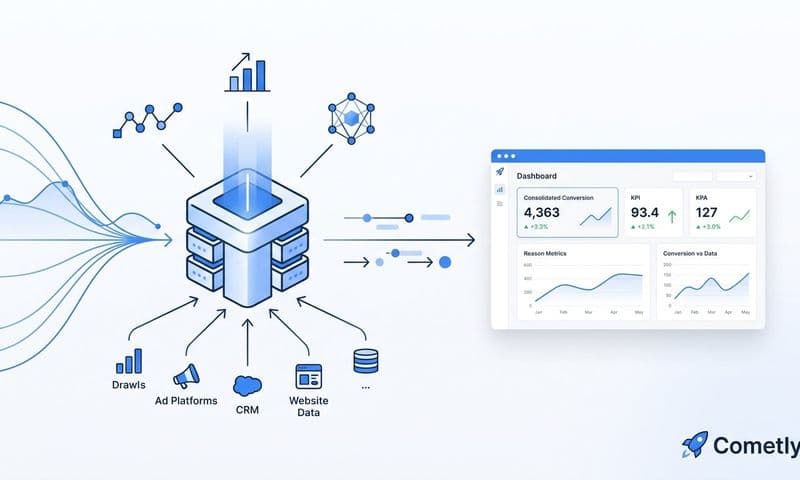
A complete marketing visibility platform solves this by unifying your ad platforms, CRM, website analytics, and conversion data into a single source of truth. Instead of jumping between dashboards and reconciling conflicting reports, you get one cohesive view of what's actually driving revenue.
This guide covers the top platforms that give marketers end-to-end visibility into performance across every touchpoint. We evaluated each based on cross-platform tracking capabilities, attribution accuracy, integration depth, and real-time reporting features.
1. Cometly
Best for: Marketers running multi-platform paid campaigns who need accurate attribution and AI-powered optimization
Cometly is an AI-powered marketing attribution platform that tracks the complete customer journey from first ad click through final conversion and revenue.
 9 Best Complete Marketing Visibility Platforms in 2026
Where This Tool Shines
Cometly addresses the core challenge that most attribution platforms miss: accuracy in a privacy-first world. Its server-side tracking captures conversion data that browser-based pixels can't reach, especially critical for iOS users and privacy-conscious browsers.
The platform's AI layer analyzes your complete customer journey data to surface optimization recommendations across all your ad channels. Instead of just reporting what happened, it tells you which campaigns to scale and where to reallocate budget for maximum ROI.
Key Features
Multi-Touch Attribution: Track every touchpoint across all marketing channels with customizable attribution models that show the true customer journey.
Server-Side Tracking: Capture accurate conversion data beyond browser limitations, ensuring you see the complete picture even with iOS restrictions.
AI Ads Manager: Get data-driven recommendations on which campaigns to scale, pause, or optimize based on actual revenue performance.
Conversion Sync: Feed enriched conversion data back to Meta, Google, and other ad platforms to improve their algorithm optimization.
AI Chat for Analysis: Ask questions about your marketing data in plain language and get instant insights without building complex reports.
Best For
Digital marketing teams and agencies running significant paid advertising budgets across multiple platforms who need to prove ROI and optimize spend allocation. Particularly valuable for businesses struggling with attribution accuracy due to iOS tracking limitations or complex multi-touch customer journeys.
Pricing
Custom pricing based on your ad spend volume and tracking requirements. Contact their team for a quote tailored to your business needs.
2. Triple Whale
Best for: DTC ecommerce brands running on Shopify who need unified ad and profit metrics
Triple Whale is an ecommerce-focused analytics platform built specifically for Shopify merchants running paid advertising campaigns.
 7 Best Funnel.io Alternatives for Marketing Data Analytics in 2026
Where This Tool Shines
Triple Whale speaks the language of DTC brands. Instead of generic marketing metrics, you get profit and loss tracking by channel, product-level contribution margins, and customer lifetime value calculations that factor in actual costs.
The platform's Triple Pixel combines first-party data collection with Shopify's native data to give you attribution visibility that survives iOS updates. For brands spending heavily on Meta and Google, this accuracy matters when deciding which campaigns actually drive profitable growth.
Key Features
Triple Pixel: First-party tracking that captures conversion data beyond standard browser pixels for more accurate attribution.
Profit Tracking: See actual profit by channel and campaign, not just revenue, with automatic COGS and expense calculations.
Customer Journey Visualization: Map the complete path from first touch to purchase with clear attribution across all touchpoints.
Shopify Native Integration: Deep integration pulls product data, inventory levels, and customer information directly from your store.
Creative Analytics: Track performance at the individual ad creative level to identify winning concepts faster.
Best For
Shopify-based DTC brands with monthly ad spend above $10,000 who need to understand true profitability by channel, not just top-line revenue metrics.
Pricing
Growth plan starts at $129/month. Higher tiers available for brands with larger order volumes and more complex tracking needs.
3. Northbeam
Best for: Growth teams managing six-figure monthly ad budgets who need machine learning attribution
Northbeam is a machine learning attribution platform that uses media mix modeling to show cross-channel impact on conversions and revenue.
 9 Best Attribution Software with API Access in 2026
Where This Tool Shines
Northbeam takes a fundamentally different approach to attribution by using machine learning models that analyze patterns across your entire marketing mix. Instead of relying solely on click-through data, it identifies correlations between channel spend and conversions that traditional attribution misses.
The platform excels at answering strategic questions like "What happens to overall conversions if I increase Meta spend by 20%?" Its media mix modeling approach accounts for interaction effects between channels that simpler attribution models ignore.
Key Features
Machine Learning Attribution: Algorithmic models that identify true incremental impact of each marketing channel on conversions.
Media Mix Modeling: Understand how channels work together and influence each other's performance across your marketing ecosystem.
Budget Recommendations: Get specific guidance on how to reallocate spend across channels for maximum efficiency.
Cohort Analysis: Track customer behavior and lifetime value by acquisition cohort to measure long-term channel quality.
Creative Performance Tracking: See which ad creatives drive the best results with detailed creative-level attribution.
Best For
Performance marketing teams at growth-stage companies spending $100,000+ monthly on paid advertising who need sophisticated attribution beyond last-click models.
Pricing
Custom enterprise pricing, typically starting around $1,000+ per month depending on ad spend volume and data complexity.
4. Rockerbox
Best for: Enterprise brands running omnichannel campaigns including offline conversions
Rockerbox is an enterprise marketing attribution platform that unifies online and offline customer journeys with built-in incrementality testing capabilities.
 9 Best Complete Marketing Visibility Platforms in 2026
Where This Tool Shines
Rockerbox handles attribution complexity that most platforms can't touch. If your customers interact with digital ads, then visit retail locations, then purchase through a call center, Rockerbox connects those dots with offline conversion tracking.
The platform's incrementality testing framework helps you move beyond correlation to causation. You can run geo-based holdout tests or audience splits to measure the true incremental lift from each marketing channel, not just attribution based on touchpoints.
Key Features
Omnichannel Journey Tracking: Connect online and offline customer touchpoints into unified journey maps that show the complete path to conversion.
Incrementality Testing: Run controlled experiments to measure true incremental impact of marketing channels beyond attribution models.
Offline Conversion Attribution: Track in-store purchases, phone orders, and other offline conversions back to digital marketing touchpoints.
Custom Attribution Models: Build attribution models tailored to your specific business model and customer journey patterns.
Data Activation: Push attribution insights back to ad platforms and marketing tools to optimize campaigns based on true performance.
Best For
Enterprise brands with complex omnichannel customer journeys that include retail locations, call centers, or other offline conversion points alongside digital channels.
Pricing
Enterprise-level pricing available through direct sales contact. Designed for companies with substantial marketing budgets and complex attribution needs.
5. Dreamdata
Best for: B2B companies with multi-touch sales cycles who need account-based attribution
Dreamdata is a B2B revenue attribution platform that tracks account-based customer journeys from first marketing touch through closed deal.
 9 Best Cross Channel Attribution Tools to Track Your Full Marketing Journey in 2026
Where This Tool Shines
B2B attribution is fundamentally different from ecommerce. Multiple stakeholders research your product over weeks or months, touching dozens of marketing assets before a deal closes. Dreamdata is built specifically for this reality.
The platform maps entire account journeys, showing which content, ads, and touchpoints influenced each stakeholder in the buying committee. You see not just what converted an individual lead, but what drove the entire account to become a customer.
Key Features
Account-Based Attribution: Track marketing influence at the account level, not just individual leads, to match B2B buying committee dynamics.
CRM Integration: Deep integration with Salesforce, HubSpot, and Pipedrive to connect marketing touchpoints with sales pipeline data.
B2B Journey Mapping: Visualize the complete account journey across all stakeholders from awareness through closed-won deals.
Revenue Impact Reporting: See exactly how marketing activities influence pipeline creation and closed revenue, not just lead generation.
Content Attribution: Understand which blog posts, whitepapers, and resources actually drive account progression through the funnel.
Best For
B2B SaaS companies and service providers with sales cycles longer than 30 days who need to prove marketing's impact on pipeline and revenue.
Pricing
Free tier available for early-stage companies. Paid plans start at $999/month for growing teams with more advanced attribution needs.
6. Segment
Best for: Teams needing real-time customer data infrastructure across their entire marketing stack
Segment is a customer data platform that collects, unifies, and routes data across your entire marketing and analytics ecosystem in real time.
 8 Best Attribution-Focused Platforms vs Segment: Which Approach Fits Your Marketing Stack in 2026
Where This Tool Shines
Segment solves the infrastructure problem underneath marketing visibility. Instead of building custom integrations between every tool in your stack, Segment becomes your single data collection layer that feeds every downstream system.
The platform's identity resolution capabilities are particularly powerful. It tracks users across devices and sessions, creating unified customer profiles that every connected tool can access. This means your email platform, analytics tool, and ad platforms all work from the same customer data.
Key Features
Real-Time Data Collection: Capture customer interactions as they happen and route them instantly to any connected tool in your stack.
Identity Resolution: Unify user activity across devices, sessions, and platforms into single customer profiles with cross-device tracking.
400+ Integrations: Pre-built connectors to marketing tools, analytics platforms, data warehouses, and advertising systems.
Data Governance: Control data quality, privacy compliance, and access permissions from a central governance layer.
Event Tracking: Define custom events once and automatically send them to all connected tools without changing code.
Best For
Product-led companies and technical marketing teams who need flexible customer data infrastructure that scales across multiple tools and use cases.
Pricing
Free tier available for startups with limited data volume. Team plan starts at $120/month, with higher tiers for growing data needs.
7. HubSpot Marketing Hub
Best for: Teams wanting all-in-one marketing automation with built-in attribution and CRM integration
HubSpot Marketing Hub is a comprehensive marketing platform with native attribution reporting and seamless CRM integration for full-funnel visibility.
 9 Best Complete Marketing Visibility Platforms in 2026
Where This Tool Shines
HubSpot's biggest advantage is integration depth without integration headaches. Because the CRM, marketing automation, and attribution reporting live in the same platform, you get contact-level journey tracking without wrestling with API connections.
The multi-touch revenue attribution reports show exactly which marketing activities influenced deals at every stage. You can see the first touch that brought a contact in, the nurture emails that kept them engaged, and the campaign that finally drove them to request a demo.
Key Features
Multi-Touch Revenue Attribution: Track marketing influence across the entire customer journey with customizable attribution models tied to actual revenue.
Native CRM Integration: Seamless connection between marketing activities and sales pipeline data without third-party integrations.
Campaign Performance Analytics: See ROI by campaign across email, ads, content, and social in unified dashboards.
Contact Journey Tracking: View every interaction a contact has had with your marketing across channels in a single timeline.
Marketing Automation: Built-in workflows, email marketing, and lead nurturing that feed directly into attribution reporting.
Best For
Growing B2B companies that want marketing automation, CRM, and attribution in one platform without managing multiple tool integrations.
Pricing
Free tools available with limited features. Professional tier starts at $800/month, with Enterprise options for advanced attribution and reporting needs.
8. Funnel.io
Best for: Marketing teams drowning in manual reporting who need automated data aggregation
Funnel.io is a marketing data hub that automatically collects, transforms, and exports data from 500+ sources to your analytics and BI tools.
Where This Tool Shines
Funnel.io excels at the unglamorous but critical work of data aggregation. If you're spending hours each week pulling reports from different ad platforms and reconciling metrics in spreadsheets, Funnel automates that entire workflow.
The platform's data transformation layer is particularly valuable. It normalizes metrics across platforms so "conversions" in Meta means the same thing as "conversions" in Google Ads, eliminating the confusion that comes from different platforms defining metrics differently.
Key Features
500+ Data Connectors: Pre-built integrations to ad platforms, analytics tools, social media, and ecommerce systems with automatic data pulls.
Automated Data Transformation: Clean and normalize data from different sources so metrics are comparable across platforms.
Data Warehouse Exports: Send unified marketing data to BigQuery, Snowflake, Redshift, or other data warehouses for advanced analysis.
Cross-Platform Normalization: Standardize metric definitions and naming conventions across all your marketing data sources.
Scheduled Reporting: Automatically refresh data and update connected dashboards and reports on your preferred schedule.
Best For
Marketing teams running campaigns across many platforms who need to aggregate data for reporting but don't require complex attribution modeling.
Pricing
Essentials plan starts at $399/month. Pricing scales based on the number of data sources and volume of data processed.
9. Supermetrics
Best for: Marketers who live in spreadsheets and BI tools for reporting and analysis
Supermetrics is a marketing data pipeline that pulls metrics from ad platforms and analytics tools directly into Google Sheets, Excel, and BI dashboards.
Where This Tool Shines
Supermetrics takes a different approach than most visibility platforms. Instead of building its own dashboard, it brings your marketing data to the tools you already use for analysis and reporting.
For teams that have invested heavily in custom Google Sheets templates or Data Studio dashboards, Supermetrics is the bridge that keeps those workflows running with fresh data. You maintain full control over how you analyze and present data while automating the tedious extraction process.
Key Features
Direct BI Integrations: Push marketing data directly to Looker Studio, Power BI, Tableau, and other business intelligence platforms.
Automated Scheduled Reporting: Set up automatic data refreshes so your reports and dashboards always show current metrics.
Google Sheets Connector: Pull live marketing data into spreadsheets for custom analysis and reporting templates.
Data Warehouse Destinations: Export marketing data to BigQuery, Snowflake, or Redshift for centralized storage and analysis.
Custom Metric Queries: Build specific data requests to pull exactly the metrics and dimensions you need from each platform.
Best For
Marketing analysts and agencies who prefer building custom reports in spreadsheets or BI tools rather than using pre-built dashboards.
Pricing
Starts at $39/month per data source for basic connectors. Enterprise plans available for teams with more complex data needs and higher volume.
Making the Right Choice
Choosing the right marketing visibility platform depends on your business model and what you're actually trying to solve.
If you're running paid campaigns across multiple platforms and need accurate attribution that survives iOS limitations, Cometly delivers the most complete solution with AI-powered optimization recommendations. The server-side tracking and conversion sync capabilities address the fundamental accuracy problems that plague most attribution platforms.
DTC ecommerce brands on Shopify often find Triple Whale or Northbeam fit naturally into their workflow, with profit-focused metrics and creative-level tracking built for the way DTC marketers think about performance.
B2B companies with complex sales cycles should prioritize Dreamdata. Account-based attribution that connects marketing touchpoints to closed deals is fundamentally different from tracking individual conversions, and Dreamdata is built specifically for that reality.
If your main challenge is data aggregation rather than attribution, Funnel.io or Supermetrics handle the heavy lifting of connecting disparate sources and normalizing metrics. They won't tell you which touchpoint deserves credit, but they'll save hours of manual reporting work.
Start by mapping your current data gaps. Are you struggling to see which campaigns drive revenue? That's an attribution problem. Spending too much time pulling reports from different platforms? That's a data aggregation problem. Can't connect marketing activities to sales pipeline? That's a CRM integration problem.
Match those specific needs to the platform strengths outlined above, and you'll find the right fit for your team.
Ready to elevate your marketing game with precision and confidence? Discover how Cometly's AI-driven recommendations can transform your ad strategy. Get your free demo today and start capturing every touchpoint to maximize your conversions.