Your ad dashboard is showing strong conversion numbers. Cost-per-acquisition looks healthy. ROAS is trending up. But when you pull the pipeline report from your CRM, the story is completely different. Deals aren't closing. Revenue isn't materializing. The leads your campaigns are supposedly generating aren't showing up where it matters.
Sound familiar? This gap between what your ad platforms report and what your business actually experiences is one of the most frustrating and costly problems in modern B2B SaaS marketing. And it's not a quirk of your specific setup. It's a systemic issue affecting virtually every marketing team running paid campaigns across multiple channels today.
Conversion data accuracy problems are not edge cases. They're the default state for most marketing organizations that haven't deliberately addressed the technical and structural gaps in their tracking infrastructure. When the data feeding your decisions is corrupted at the source, every downstream choice from budget allocation to channel prioritization to algorithm optimization becomes unreliable.
This article breaks down exactly what causes these problems, how they compound as data moves through your funnel, and what modern tracking approaches actually fix them. If you're a growth marketer, demand gen leader, or anyone responsible for making paid media decisions, understanding this is no longer optional.
The Gap Between What Your Ads Report and What Actually Happened
Every major ad platform has a built-in incentive to show you impressive conversion numbers. Meta, Google, and LinkedIn each measure conversions using their own attribution logic, their own tracking pixels, and their own attribution windows. None of them are designed to reconcile with each other, and none of them are designed to reconcile with your CRM.
This creates a fundamental disconnect. The conversion your Meta pixel records when someone fills out a form is not the same data point as the lead your CRM creates, the opportunity your sales team opens, or the revenue your finance team recognizes. These are different systems measuring different things, and treating them as equivalent is where the trouble starts.
Browser-side pixel tracking, which remains the default for most ad platforms, adds another layer of unreliability. Safari's Intelligent Tracking Prevention (ITP) limits how long cookies can persist, often to just 24 hours. Firefox has implemented similar protections. Many browsers now block third-party cookies entirely by default. And among B2B SaaS buyers, a technically sophisticated audience, ad blocker adoption is notably high. The result is that a meaningful portion of your actual conversions are simply never recorded by your browser pixels, creating systematic underreporting. These pixel tracking problems on iOS and other platforms have made browser-side measurement increasingly unreliable.
Then there's the problem of data fragmentation. Your conversion signals live in separate silos. Meta has its pixel data. Google has its tag data. LinkedIn has its insight tag. Your CRM has its own lead and opportunity records. None of these systems talk to each other in a structured way unless you deliberately build that connection. When each platform operates in isolation, discrepancies don't just appear, they multiply. A single lead who clicked a Google ad, saw a LinkedIn retargeting ad, and converted through a Meta campaign might appear as three separate conversions across three different dashboards, each platform claiming full credit.
Without a single source of truth that sits above all of these platforms and reconciles their data against actual business outcomes, you're not measuring marketing performance. You're measuring each platform's self-reported version of marketing performance, which is a very different thing.
Five Root Causes of Conversion Data Accuracy Problems
Understanding the specific mechanisms behind inaccurate conversion data makes it much easier to address them systematically. Here are the five most common root causes affecting B2B SaaS marketing teams today.
Cookie deprecation and browser privacy changes: Third-party cookies have been the backbone of pixel-based tracking for years. As browsers progressively restrict or eliminate them, pixel-only tracking setups miss a growing share of conversion events. This doesn't just mean underreporting. It means your ad platforms are receiving a skewed, incomplete picture of which campaigns are driving results, which distorts the optimization signals they use to improve targeting and bidding over time.
Event deduplication failures: Many teams implement server-side tracking (Conversion API) alongside their existing browser pixels, which is the right instinct. But without proper deduplication logic, both the pixel and the server event fire for the same conversion, and the ad platform counts it twice. This inflates reported conversion volume and makes your cost-per-acquisition metrics look better than they actually are. Decisions made on inflated CPA data lead to misplaced confidence and wasted budget.
Attribution window mismatches: Different platforms default to different attribution windows, and this creates a cross-channel comparison problem that most marketers underestimate. Meta has historically defaulted to a 7-day click and 1-day view window. Google Ads uses data-driven attribution by default. LinkedIn uses its own windows. When a prospect clicks a Google ad on Monday, sees a LinkedIn ad on Wednesday, and converts after clicking a Meta ad on Friday, all three platforms may claim that conversion within their respective windows. Understanding what conversion window attribution means across platforms is essential to diagnosing why your total reported conversions can easily exceed your actual conversion count by a significant margin.
Missing offline conversion data: In B2B SaaS, the most valuable conversions don't happen in a browser. They happen when a sales rep closes a deal in your CRM. If you're not passing offline conversion data, such as opportunity stage progressions and closed-won events, back to your ad platforms, those platforms have no visibility into what actually drove revenue. They optimize toward form fills and trial signups, which may or may not correlate with the deals that actually close.
Inconsistent event naming and taxonomy: When different team members set up tracking across different platforms at different times, event naming becomes inconsistent. One platform tracks "Lead Form Submit." Another tracks "Form Completion." Your CRM fires a "New Lead" event. Without a standardized event taxonomy, it becomes nearly impossible to compare data across systems or build a coherent attribution model on top of it. Following best practices for tracking conversions accurately from the start prevents this fragmentation from compounding over time.
How Inaccurate Conversion Data Breaks Your Marketing Decisions
The consequences of conversion data accuracy problems extend far beyond reporting. They directly corrupt the decisions that determine how you spend your budget and how your campaigns perform.
Start with ad platform algorithms. Meta, Google, and LinkedIn all rely heavily on machine learning to optimize bidding and targeting. These algorithms are trained on conversion signals. When you tell Meta that a certain type of user converts, Meta's algorithm finds more users who look like that person. When those conversion signals are wrong, duplicated, or misattributed, the algorithm optimizes toward the wrong audience. You end up spending money reaching people who look like your reported converters, not your actual revenue-generating customers. The algorithm is working exactly as designed; it's just working with bad data.
Budget allocation decisions suffer just as badly. Marketing leaders who rely on platform-reported ROAS to decide where to invest more are making decisions on corrupted data. A channel that looks like it's delivering strong returns based on its own self-reported metrics may be double-counting conversions from other channels, operating with an attribution window that captures credit for deals it didn't meaningfully influence, or measuring form fills that never progress to pipeline. Scaling that channel based on those numbers means pouring more money into something that isn't actually driving revenue. Learning how to fix attribution discrepancies in data is often the first step toward making budget decisions you can actually trust.
The downstream effect on attribution models is equally damaging. Attribution models, whether first-touch, last-touch, linear, or data-driven, are only as reliable as the events they're built on. If the conversion events feeding your attribution model are duplicated, missing, or misattributed, every model output becomes unreliable. You might conclude that a particular channel deserves more investment because it appears frequently in customer journeys, when in reality it's appearing frequently because its tracking is overcounting, not because it's genuinely influential.
There's also a compounding timing problem specific to B2B SaaS. Buying cycles are long. A prospect might click an ad, start a trial, engage with nurture emails, attend a demo, and close a deal weeks or months later. Standard ad platform attribution, which measures conversions within short windows after a click, fundamentally cannot capture this journey. When you make budget decisions based on short-window attribution data, you're systematically undervaluing channels that influence early-stage awareness and overvaluing channels that show up at the moment of conversion, regardless of whether they actually drove the decision.
Server-Side Tracking and First-Party Data: The Technical Fix
The good news is that the technical solutions to conversion data accuracy problems are well-established. The challenge is implementing them correctly and completely.
Server-side tracking, implemented through Meta's Conversion API (CAPI), Google's Enhanced Conversions, and similar solutions from other platforms, is the primary technical fix for browser-side tracking limitations. Instead of relying on a browser pixel that can be blocked by ad blockers, restricted by ITP, or dropped due to cookie deprecation, conversion events are sent directly from your server to the ad platform. Browser restrictions are bypassed entirely. The conversion is recorded regardless of what the user's browser does or doesn't allow. This Conversion API implementation tutorial walks through exactly how to recover lost attribution data and restore accurate campaign measurement.
This is no longer an advanced optional feature. It's the baseline for accurate conversion tracking in 2026. Any marketing team still relying exclusively on browser pixels for conversion measurement is operating with a structural gap in their data.
First-party data enrichment amplifies the value of server-side tracking significantly. By passing customer identifiers alongside conversion events, such as hashed email addresses, phone numbers, and user IDs collected directly from your own leads and customers, you improve the match rate between your conversion events and the ad platform's user profiles. Higher match rates mean more conversions are correctly attributed to the campaigns that drove them, giving the platform's algorithm better signal to optimize with.
As third-party data becomes less available due to browser restrictions and privacy changes, first-party data becomes the primary mechanism for accurate event matching. Building a first-party data strategy isn't just a privacy best practice; it's a direct lever on attribution accuracy and ad performance.
Event deduplication is the third critical piece. When you implement both browser-side pixels and server-side CAPI events, you need a mechanism to prevent double-counting. The standard approach is to assign a unique event ID to each conversion and pass that same ID through both the pixel and the server event. When the ad platform receives both signals with matching event IDs, it recognizes them as the same conversion and discards the duplicate. Without this, your conversion counts are inflated and your CPA metrics are distorted, even with CAPI properly implemented.
Getting all three of these elements right simultaneously, server-side tracking, first-party data enrichment, and event deduplication, requires deliberate architecture. But the payoff is conversion data you can actually trust.
Closing the Loop from Ad Click to Revenue
Fixing your pixel and CAPI setup solves the technical tracking problem. But for B2B SaaS companies, it only solves part of the attribution problem. Because the events that matter most, pipeline creation, opportunity progression, and closed-won revenue, don't happen in a browser. They happen in your CRM, weeks or months after the original ad click.
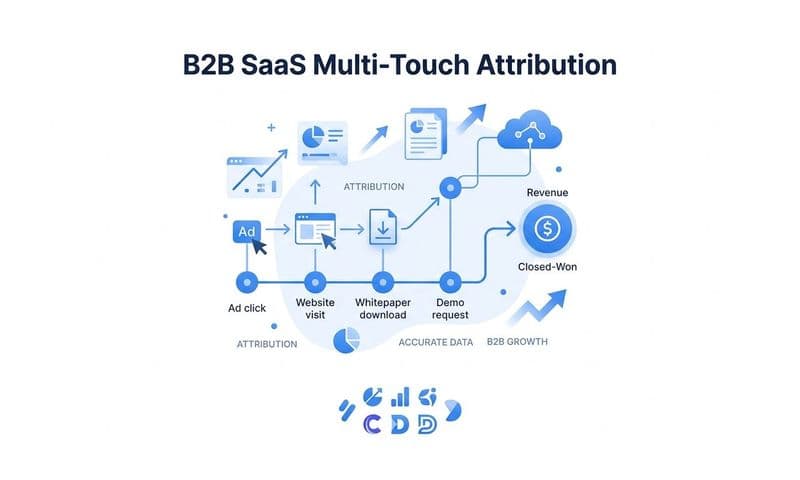
Connecting ad-level data to CRM outcomes requires a persistent tracking layer that follows the lead through the entire funnel. When someone clicks your ad, a persistent identifier needs to be attached to that person and carried forward through every subsequent interaction: the trial signup, the sales development touchpoint, the demo, the proposal, and the final close. Without that thread connecting the original ad click to the eventual revenue, you can fix your pixel tracking perfectly and still have no idea which campaigns are actually driving business outcomes.
This is where multi-touch attribution models become essential. Rather than crediting only the last click before conversion or only the first touch that introduced the prospect to your brand, multi-touch attribution distributes credit across all the touchpoints a prospect interacted with throughout their journey. For B2B SaaS, where buying decisions involve multiple interactions across multiple channels over extended periods, this is the only attribution approach that reflects how customers actually make decisions.
But multi-touch attribution is only as good as the data feeding it. If your touchpoint data is incomplete because browser pixels are missing events, or inflated because deduplication isn't working, your attribution model will produce misleading outputs regardless of how sophisticated the model itself is.
This is exactly the problem Cometly is built to solve. Cometly connects your ad platforms, CRM, and website data into a single source of truth, giving you a complete, accurate picture of every customer journey from the first ad click to closed-won revenue. Instead of relying on each platform's self-reported metrics, you get a unified view that shows which specific ads and campaigns drove actual pipeline and revenue, not just form fills or trial signups. For B2B SaaS marketing teams trying to make confident budget decisions, that level of clarity is the difference between scaling what works and scaling what looks good on paper.
Building a Reliable Conversion Tracking Stack
Knowing what needs to be fixed is useful. Knowing how to fix it systematically is what actually moves the needle. Here's how to approach building a conversion tracking stack you can trust.
Start with an audit of your current setup: Before adding anything new, understand what you have. Identify every pixel and CAPI integration currently firing. Check for duplicate events by comparing platform-reported conversion volumes against your CRM's actual lead and opportunity counts. Look for gaps where conversions are being missed. Most teams discover both overcounting and undercounting happening simultaneously in different parts of their funnel.
Standardize your event taxonomy: Define a consistent naming convention for every conversion event across every platform. Use the same event names, the same event IDs, and the same parameters everywhere. This is the foundation that makes cross-platform comparison and unified attribution possible. Without it, you're trying to reconcile data that was never designed to be reconciled.
Implement server-side tracking with deduplication: Set up CAPI or Enhanced Conversions for every major ad platform you're running. Assign unique event IDs to every conversion and pass them through both browser and server events. Enrich those events with first-party identifiers to maximize match rates. Verify that deduplication is working by monitoring for any remaining discrepancy between browser and server event counts. Reviewing top conversion tracking platforms can help you identify the right tools to support this infrastructure.
Close the CRM loop: Configure your CRM to pass offline conversion data back to your ad platforms. At minimum, pass events for qualified lead creation, opportunity creation, and closed-won deals. This gives your ad platforms the signal they need to optimize toward revenue-generating conversions rather than just top-of-funnel events.
An AI-powered analytics layer, like the one built into Cometly, adds another dimension on top of clean tracking infrastructure. When your conversion data is accurate and deduplicated, AI can surface genuine insights about which campaigns are performing based on real outcomes, not platform-reported vanity metrics. It can identify patterns in your highest-converting customer journeys and recommend where to allocate budget for maximum revenue impact. Using the right ad tracking tools to scale with accurate data is what separates teams that grow confidently from those that guess.
The compounding benefit of getting this right is significant. When ad platforms receive accurate, enriched conversion signals, their machine learning improves targeting and bidding over time. Better signals produce better optimization, which produces better results, which produces better data. Clean conversion tracking doesn't just fix your reporting; it actively improves your ad performance through a feedback loop that builds on itself.
The Bottom Line on Conversion Data Accuracy
Conversion data accuracy problems are not a minor reporting inconvenience. They are a structural issue that corrupts every downstream decision your marketing team makes, from which channels get more budget to how your ad platform algorithms optimize to which attribution insights you trust when planning your next quarter.
The fix requires both technical infrastructure and a unified analytics layer working together. On the technical side: server-side tracking to bypass browser restrictions, first-party data enrichment to improve match rates, and event deduplication to eliminate inflated conversion counts. On the analytics side: a platform that connects your ad spend to actual pipeline and revenue, giving you a single source of truth that sits above each platform's self-interested reporting.
For B2B SaaS marketing teams, getting this right is how you move from making decisions based on what your dashboards want you to believe to making decisions based on what's actually driving your business forward.
If you're ready to stop guessing and start seeing exactly which ads and campaigns are driving real revenue, Get your free demo of Cometly today and experience end-to-end attribution from the first ad click to closed-won revenue.