
You're spending real budget on paid ads. The campaigns are running, the clicks are coming in, and your team is watching dashboards refresh daily. But when someone asks which campaigns are actually driving revenue, the honest answer is: you're not entirely sure. Sound familiar?
This is the defining frustration for B2B SaaS marketing teams right now. Platform dashboards show impressions, clicks, and cost-per-lead. But they rarely show the full picture of what happens after a lead enters your CRM, moves through a sales cycle, and eventually becomes a paying customer. The gap between what your ad platforms report and what your revenue data shows is not a reporting inconvenience. It is a strategic blind spot that costs you real money.
The concept of conversion lift from better tracking addresses this directly. It refers to the measurable improvement in recorded conversions, attributed revenue, and ad optimization performance that comes specifically from fixing how your tracking infrastructure works, not from changing your creative or increasing your budget. When you close the gap between what actually happens in your customer journey and what your ad platforms can see, performance improves in ways that compound over time.
This article breaks down why tracking quality is the root cause of underperformance for most B2B SaaS teams, what conversion lift from better tracking actually looks like in practice, and how to build the infrastructure that makes it possible.
Why Your Current Tracking Is Leaving Revenue on the Table
Most B2B SaaS marketing teams rely on the default attribution that comes built into ad platforms. Google Ads reports on conversions it can see. Meta reports on conversions it can attribute. Each platform tells its own story, and each story is incomplete by design. Platform-native attribution is siloed, meaning Google does not know about the touchpoints that happened on Meta, and Meta does not know about the organic search visit that happened three weeks before the paid click.
The result is a fragmented view of the customer journey where every channel looks like it deserves more credit than it actually does, and no single source of truth exists to reconcile the contradictions. For B2B SaaS teams with long sales cycles and multiple touchpoints per deal, this fragmentation is especially damaging. You end up making budget decisions based on whichever platform's dashboard you happen to be looking at, rather than on what is actually driving closed revenue.
Beyond fragmentation, there is a more fundamental problem: browser-based tracking has become significantly less reliable over the past several years. Safari's Intelligent Tracking Prevention, Firefox's enhanced privacy protections, and the broader deprecation of third-party cookies have all progressively degraded the accuracy of pixel-based tracking. When a user visits your site, completes a form, or triggers a conversion event, there is a growing probability that the browser-side pixel does not fire correctly or gets blocked entirely before the signal reaches the ad platform.
Ad blockers compound this further. A meaningful share of your target audience, particularly in technical B2B markets, uses browser extensions that intercept tracking pixels. These conversions happen, but they never get recorded in your platform dashboards. From the ad platform's perspective, that campaign did not drive a conversion. From your revenue perspective, it did.
Here is where the problem becomes self-reinforcing. Ad platforms like Meta and Google use machine learning to optimize ad delivery. These algorithms depend on conversion signals to learn which users, placements, and creative combinations are producing results. When the signals they receive are incomplete because of tracking degradation, the algorithms make worse decisions. They bid on the wrong audiences, optimize toward the wrong behaviors, and underperform relative to what they could achieve with clean, complete data.
The practical consequence is that many B2B SaaS teams are running campaigns that are underperforming not because the strategy is wrong or the creative is weak, but because the tracking infrastructure feeding those campaigns is broken. Fixing the tracking is often the highest-leverage intervention available, and it is one that most teams have not yet made.
Defining the Lift: What Better Tracking Actually Produces
Conversion lift from better tracking is not about inflating your reported numbers. It is about closing the gap between what is actually happening in your business and what your marketing stack can see and act on. Understanding the two distinct types of lift helps clarify what you are actually working toward.
The first type is recovered lift. These are conversions that were already happening but were not being counted. A lead filled out a demo request form, the pixel did not fire because of an ad blocker, and the conversion went unrecorded. The deal eventually closed, but your attribution platform never connected it back to the campaign that drove the initial click. Recovered lift is about making the invisible visible: capturing the conversion signal that was always there but never reached your reporting stack.
The second type is optimized lift. This is new performance generated because better data improved how your ad platforms target and bid. When Meta or Google receives richer, more complete conversion signals, their algorithms can identify patterns in the users who actually convert into customers. They shift delivery toward higher-quality audiences. The campaigns do not just report better results; they actually produce better results because the optimization engine is working with better inputs.
Both types of lift matter, and they are related. Recovering lost signal is often the prerequisite for generating optimized lift, because the algorithm cannot improve its targeting until it has enough clean data to learn from.
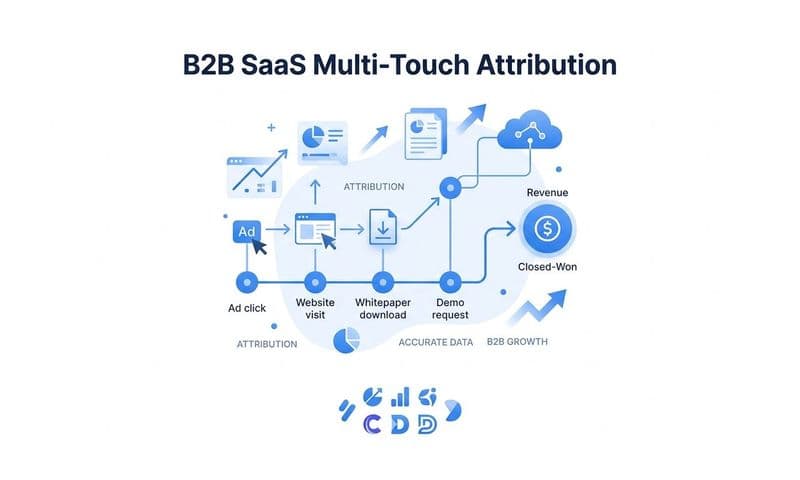
For B2B SaaS specifically, the magnitude of both types of lift tends to be larger than in e-commerce or direct-to-consumer contexts. The reason is structural. B2B buying journeys involve multiple stakeholders, evaluation cycles that can span weeks or months, and conversion events that happen inside a CRM rather than on a website. A demo is booked. An opportunity is created. A proposal is sent. A deal closes. None of these events are captured by a standard website pixel, which means the gap between what your tracking sees and what your revenue data shows is proportionally larger.
When you connect CRM events to your ad platforms and attribution layer, you are not just recovering a few missed form fills. You are illuminating an entire downstream funnel that was previously invisible to your optimization infrastructure. The lift that results from making that connection can be substantial, and it compounds over time as the ad platforms use that richer signal to improve their targeting. Understanding what lift in conversion rate truly means helps teams set realistic benchmarks for these improvements.
The Tracking Infrastructure That Drives Real Lift
Achieving conversion lift from better tracking requires moving beyond browser-based pixels as your primary data collection mechanism. The infrastructure shift that matters most is adopting server-side tracking and Conversion APIs as the foundation of your measurement stack.
Meta's Conversions API (CAPI) and Google's Enhanced Conversions both work by sending conversion events directly from your server to the ad platform, rather than relying on a browser-side pixel to fire. Because the data travels server-to-server, it bypasses the browser privacy restrictions, ad blockers, and cookie limitations that degrade pixel-based tracking. The conversion signal reaches the platform regardless of what is happening in the user's browser environment.
Meta has publicly stated that higher event match quality scores, which reflect how well the conversion events you send can be matched to Meta users, correlate with improved ad delivery and optimization outcomes. This is not a theoretical benefit. It is platform-documented guidance that richer, more accurately matched conversion data produces better algorithmic performance. Server-side tracking and CAPI implementation are the primary levers for improving that match quality.
The second critical infrastructure component is CRM integration. For B2B SaaS teams, the most valuable conversion events do not happen on your website. They happen when a lead becomes a qualified opportunity, when a demo turns into a proposal, and when a deal closes in your CRM. Connecting these downstream events to your ad platforms and attribution layer is what enables revenue attribution rather than just lead attribution.
When your ad platform receives a signal that says "this user, who clicked your ad three weeks ago, just became a closed-won customer worth $24,000 in annual recurring revenue," the optimization algorithm has something genuinely useful to learn from. It can identify the characteristics of that user and find more people like them. Without that CRM connection, the algorithm only knows that someone clicked an ad and filled out a form. It has no idea whether that lead turned into revenue.
The third component is first-party data enrichment and event deduplication. When you send conversion events server-side, you want those events to be as enriched as possible, including hashed email addresses, phone numbers, and other identifiers that help the platform match the event to a real user profile. Deduplication ensures that if both your pixel and your server-side integration fire for the same event, the platform does not count it twice. Clean, enriched, deduplicated data is what produces high match quality scores and reliable optimization signals.
How Better Data Feeds Ad Platform AI and Multiplies Performance
There is a widely understood principle in machine learning: the quality of the output is bounded by the quality of the input. Ad platform algorithms are no different. Meta's and Google's optimization engines are sophisticated, but they can only optimize toward the conversion signals they receive. If those signals are incomplete, delayed, or misaligned with your actual business goals, the algorithm will optimize toward the wrong outcomes.
This is precisely what happens when B2B SaaS teams optimize campaigns for form fills or demo requests without connecting those events to downstream revenue data. The algorithm gets very good at finding people who will fill out forms. It does not get good at finding people who will become paying customers, because it has never been shown what a paying customer looks like in terms of the behavioral and demographic signals it can act on.
When you shift to sending downstream revenue signals, the algorithm's optimization target changes fundamentally. Instead of learning "find more people who click and fill out forms," it learns "find more people who click, engage, enter a sales process, and close as customers." The audience it targets becomes more qualified. The leads that result from those campaigns are more likely to convert. Cost-per-acquisition improves not because you changed the creative or the bid strategy, but because the algorithm is now working with better information.
This creates a compounding dynamic that is worth understanding clearly. Better signals lead to better targeting. Better targeting generates higher-quality conversions. Higher-quality conversions produce richer, more accurate training data for the algorithm. That training data improves targeting further. Each cycle reinforces the next, which means the performance gap between teams with strong tracking infrastructure and teams without it tends to widen over time rather than stay constant.
Teams that implement server-side tracking and CRM integration often find that campaigns which appeared to be underperforming were actually generating strong downstream revenue, but the optimization algorithm had no way of knowing that. Once the revenue signal is connected, the algorithm can amplify what was already working rather than reallocating budget away from it. Using the right conversion tracking tools makes this connection reliable and scalable across every campaign.
Measuring Conversion Lift: The Metrics That Tell the Real Story
Understanding whether your tracking improvements are producing real lift requires looking at the right metrics, many of which are not the ones most teams default to.
The first place to start is event match quality. Inside Meta Events Manager, you can see a score for each conversion event that reflects how well the events you are sending can be matched to Meta user profiles. A low score means your events are arriving without enough identifying information to be useful for optimization. Improving this score, through server-side tracking and first-party data enrichment, is a direct lever for improving ad performance. Google's Tag Manager and Enhanced Conversions offer similar diagnostic signals for evaluating data quality on the Google side.
The second metric to examine is the discrepancy between platform-reported conversions and CRM-recorded conversions. Pull the conversion counts from your ad platform dashboards and compare them to the lead and opportunity counts in your CRM for the same time period and traffic source. A large discrepancy indicates that a significant share of conversions are not being recorded by your tracking infrastructure. That gap represents your recovered lift opportunity. Teams that follow best practices for tracking conversions accurately consistently close this gap faster than those relying on default platform settings.
The third and most important shift is moving from cost-per-lead as your primary campaign evaluation metric to pipeline attribution and revenue attribution. Cost-per-lead is a surface metric. It tells you how efficiently a campaign generates form fills, but it says nothing about whether those form fills turn into revenue. A campaign with a high cost-per-lead may be generating the majority of your closed deals. A campaign with a low cost-per-lead may be generating leads that never progress past the first sales call.
When you can see pipeline created and revenue closed by campaign, you can make budget decisions that reflect actual business outcomes rather than top-of-funnel efficiency. This is the practical expression of conversion lift from better tracking: not just better numbers in your dashboards, but better decisions about where your budget should go.
Tracking these metrics consistently over time also lets you quantify the lift that results from infrastructure improvements. If your event match quality score improves after implementing CAPI, and your attributed revenue per campaign increases in the following weeks, you have a clear signal that the tracking improvement is producing real performance gains.
Building a Single Source of Truth Across Every Channel
Even with server-side tracking and CRM integration in place, many B2B SaaS teams still struggle with a fundamental problem: their data lives in multiple disconnected places. Google Ads reports one set of numbers. Meta reports another. The CRM shows a third. Each platform attributes credit according to its own model, and the totals never add up. Marketers end up spending significant time reconciling contradictory data rather than acting on clear insights.
This fragmentation is not just an inconvenience. It actively undermines decision-making. When you cannot trust your attribution data, you default to gut feel or to whichever platform's dashboard happens to look best that week. Budget decisions get made based on incomplete information, and the compounding performance gains that come from consistently scaling what works never materialize. Recognizing the signs you need better marketing analytics is often the first step toward resolving this problem.
Consolidating your tracking into a single attribution platform solves this by creating one authoritative view of every touchpoint across every channel. Instead of asking "what does Google say versus what does Meta say," you can ask "what actually drove this pipeline, from first touch to closed deal, across every interaction in between." The right attribution tracking setup makes this possible without requiring your team to manually reconcile data across platforms.
This is exactly the problem Cometly is built to solve. Cometly connects your ad platforms, CRM, and website behavior into a unified attribution layer that tracks the full customer journey from the first ad click to closed-won revenue. It supports multi-touch attribution across all channels, integrates with your CRM to capture downstream pipeline and revenue events, and uses server-side tracking to ensure conversion signals are complete and accurate.
With Cometly, B2B SaaS marketing teams can see which campaigns, channels, and touchpoints are actually driving revenue, not just leads. The AI-powered recommendations surface which ads are performing and where budget should be reallocated, based on revenue data rather than surface metrics. And because the conversion signals Cometly captures are enriched and complete, they can be fed back to Meta, Google, and other ad platforms to improve algorithmic targeting and optimization.
The practical outcome is not just better reporting. It is better action. When you know with confidence which campaigns are generating pipeline and revenue, you can scale them. When you know which campaigns are generating cheap leads that never close, you can cut them. That cycle of informed action is what produces sustained conversion lift over time.
The Bottom Line on Conversion Lift from Better Tracking
Conversion lift from better tracking is not about chasing vanity metrics or making your dashboards look more impressive. It is a structural improvement to the way marketing data flows through your stack, how ad platforms optimize, and how your team makes decisions about where to invest.
The progression is logical and repeatable. Broken tracking creates incomplete conversion signals. Incomplete signals cause ad platform algorithms to optimize toward the wrong outcomes. Poor optimization produces underperformance that compounds over time. Fixing the tracking reverses this chain: recovered signal improves optimization, better optimization generates higher-quality conversions, and higher-quality conversions produce richer training data that improves performance further with each cycle.
For B2B SaaS teams specifically, the opportunity is larger than in most other contexts because the gap between what standard tracking captures and what actually drives revenue is proportionally wider. Connecting CRM events, pipeline data, and closed-won revenue to your attribution infrastructure is not a nice-to-have. It is the foundation of any marketing operation that wants to scale with confidence.
If you are ready to close the gap between your ad spend and your revenue data, Get your free demo of Cometly today. See how it connects every touchpoint from first click to closed deal, feeds enriched conversion signals back to your ad platforms, and gives your team the single source of truth it needs to make smarter budget decisions and start seeing real, compounding conversion lift.