You run a CRO experiment. You change the headline, tighten the form, rewrite the CTA. A week later, your conversion rate ticks up. But here's the question that should keep you up at night: do you actually know why it moved?
For most B2B SaaS teams, the honest answer is no. They have conversion counts, maybe a Google Analytics goal or two, and a handful of ad platform pixels firing somewhere on the page. What they don't have is a connected measurement system that ties every marketing action, every page change, every campaign tweak, to a measurable outcome. That gap is the difference between optimizing with evidence and optimizing with hope.
Conversion rate optimization tracking is the practice of building that measurement system. It's not just about counting conversions. It's about creating a feedback loop where every input you change produces a signal you can read, analyze, and act on. For B2B SaaS companies specifically, this is harder than it sounds. Your buyers don't convert in a single session. They read a blog post, see a retargeting ad, attend a webinar, get a cold email, take a demo call, and close a deal weeks later. Tracking that journey accurately requires infrastructure that most teams haven't fully built yet.
This article breaks down what conversion rate optimization tracking actually looks like in practice, which metrics matter, where standard tracking falls short, and how to build a system that gives your CRO work a solid foundation of reliable data.
Tracking Conversions vs. Tracking Optimization: A Critical Distinction
These two things sound similar but they operate at completely different levels of sophistication. Tracking a conversion means recording that an event happened: a form was submitted, a trial was started, a deal was closed. It's a single data point in time.
Conversion rate optimization tracking is something bigger. It's a continuous measurement system that connects changes you make to shifts in conversion outcomes over time. The question it answers isn't "did conversions happen?" It's "why did the conversion rate change, and which specific inputs caused it?"
Think of it like this: a thermometer tells you the temperature. A weather monitoring system tells you why the temperature changed, what conditions preceded it, and what's likely to happen next. Most marketing teams have thermometers. What they need is the monitoring system.
This distinction matters enormously in B2B SaaS because the funnel is not a straight line. In ecommerce, a customer sees an ad, lands on a product page, and buys. The conversion path is often a single session, which makes it relatively straightforward to connect cause and effect. In B2B SaaS, the path from first click to closed-won revenue typically spans multiple sessions across multiple channels over multiple weeks, sometimes months.
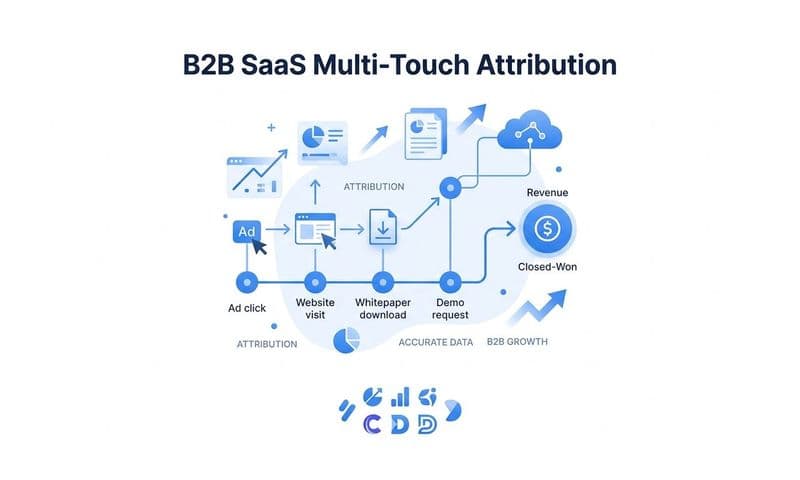
A prospect might first discover your product through a paid search ad. They visit your site, read a few pages, and leave without converting. Two weeks later, they see a LinkedIn retargeting ad and click through to a case study. A few days after that, they come back directly, request a demo, and eventually sign a contract after two sales calls. How many of those touchpoints does your current tracking system actually capture? And which one gets credit for the conversion?
Without a proper CRO tracking framework, teams end up optimizing individual pieces of the funnel in isolation. They improve landing page conversion rates without knowing whether the traffic hitting that page was high-quality to begin with. They pause ad campaigns that look like they're not converting, not realizing those campaigns were driving the first-touch visits that eventually closed. They run A/B tests on forms without understanding that the bottleneck was actually further down the funnel at the demo-to-close stage.
Conversion rate optimization tracking closes these gaps by treating the funnel as a connected system where every stage feeds the next, and where changes at any point can have ripple effects throughout. Understanding conversion rate optimization best practices starts with recognizing that measurement infrastructure is the foundation everything else is built on.
The Core Metrics Every CRO Tracking System Must Capture
One of the most common mistakes B2B SaaS teams make is focusing exclusively on a single top-level conversion rate. The overall visitor-to-signup rate is a useful headline number, but it tells you almost nothing about where to focus your optimization efforts. You need stage-by-stage metrics.
A well-structured CRO tracking system captures conversion rates at each transition point in the funnel. The key rates to monitor are:
Click-to-lead rate: What percentage of visitors who click your ads or organic links actually convert into leads? This metric sits at the intersection of traffic quality and landing page performance, making it one of the most actionable numbers in the funnel.
Lead-to-MQL rate: Of the leads entering your system, how many qualify as marketing-qualified based on fit, intent, or engagement signals? A low rate here often points to a targeting problem upstream, not a conversion problem on the page.
MQL-to-opportunity rate: How many marketing-qualified leads turn into active sales opportunities? This stage is where marketing and sales hand off, and tracking it reveals whether your MQL definition is calibrated correctly.
Opportunity-to-closed-won rate: The ultimate downstream metric. If this rate drops, the problem might be in sales execution, but it could also trace back to the quality of leads your marketing is generating.
Beyond these stage-level rates, your tracking system needs to capture both micro-conversions and macro-conversions. Micro-conversions are the smaller actions that signal intent: a content download, a demo request, a free trial signup, a pricing page visit. Macro-conversions are the outcomes that directly tie to revenue: a paid subscription, a closed deal, a contract signed.
Tracking only macro-conversions is like only checking your revenue at the end of the quarter without monitoring any of the leading indicators that predict it. Micro-conversions give you an early warning system. If demo request rates drop, you know a problem is forming before it shows up in your closed-won numbers three weeks later.
There's a third metric category that often gets overlooked: conversion velocity. This is the time it takes a visitor to move through each funnel stage. If your average time from lead to MQL suddenly increases, that's a signal worth investigating even if your conversion rates look stable. Velocity slowdowns often indicate friction somewhere in the process, whether that's a longer sales cycle, a disqualification bottleneck, or a nurture sequence that isn't moving prospects forward effectively.
Together, stage rates, micro and macro conversions, and velocity give you a three-dimensional view of funnel health that a single conversion rate number simply cannot provide. Applying the right conversion rate optimization strategies depends entirely on having this multi-stage visibility in place first.
Where Standard Pixel Tracking Falls Short
Most marketing teams start their conversion tracking with browser-side pixels: a Meta Pixel on the thank-you page, a Google Ads conversion tag on the confirmation screen, maybe a Google Analytics goal tied to a URL. This approach works reasonably well for simple funnels with fast, digital-only conversions. For B2B SaaS, it breaks down in several important ways.
The most significant gap is offline conversions. In B2B SaaS, many of the most important conversion events happen outside the browser entirely. A sales call gets logged in your CRM. A contract gets signed via DocuSign. A deal moves from "proposal sent" to "closed-won" inside Salesforce. None of these events are visible to a browser-side pixel. If your tracking system only captures what happens on a webpage, you're missing the second half of your own funnel. Offline conversion tracking is the critical piece most B2B teams haven't implemented yet.
The second major problem is browser privacy restrictions. iOS privacy changes, cookie deprecation, and increasingly aggressive browser-level tracking prevention have significantly degraded the reliability of client-side pixel data. Ad platforms themselves have acknowledged this: the match rates between pixel-reported conversions and actual business outcomes have declined as these restrictions have expanded. What you see in your Meta Ads Manager or Google Ads dashboard may represent only a portion of the conversions that actually occurred.
This creates a dangerous situation for CRO work. If your optimization decisions are based on incomplete conversion data, you're not just missing information. You're actively making decisions based on a distorted picture. You might pause a campaign that looks like it's underperforming when in reality it's driving offline conversions your pixel can't see.
Server-side tracking and Conversion API integrations address both of these problems. Instead of relying on the browser to fire a tracking pixel, server-side tracking sends conversion signals directly from your server to the ad platform. The data bypasses browser restrictions entirely, resulting in more complete and more accurate conversion reporting.
Meta's Conversion API (CAPI) and Google's Enhanced Conversions are the two most widely implemented versions of this approach. Both allow you to send conversion events from your server, your CRM, or your data warehouse directly to the ad platform, matching them to the original ad interactions with much higher fidelity than browser-only tracking can achieve. Understanding why server-side tracking is more accurate is essential context for any team serious about CRO. For B2B SaaS teams running paid campaigns, implementing server-side tracking is no longer optional. It's the baseline for having trustworthy conversion data.
Attribution as a Core Component of CRO Tracking
Here's a question that reveals whether your CRO tracking system is complete: when a conversion happens, do you know which channel, campaign, and ad drove it?
If you can't answer that question with confidence, you have a conversion event but not conversion intelligence. Knowing that a demo was requested is useful. Knowing that the demo was requested by someone who first clicked a LinkedIn ad, then returned through organic search, then converted after clicking a retargeting ad on Meta, is actionable. Those are fundamentally different levels of insight.
Attribution is not a separate discipline from CRO tracking. It's a core component of it. Without attribution, you can measure that your conversion rate changed but you can't connect that change to any specific marketing input. You can't tell whether the improvement came from a landing page test, a new ad creative, a different audience segment, or a shift in your organic traffic mix.
Multi-touch attribution solves this by assigning credit to every touchpoint that contributed to a conversion, not just the last one. This matters enormously for B2B SaaS teams because the buyer journey is genuinely multi-touch. Giving 100% of the credit to the last click before a demo request systematically undervalues the campaigns and channels that drive awareness and consideration earlier in the funnel.
Different attribution models tell different stories about your funnel, and comparing them is itself a CRO insight. First-touch attribution shows you which channels are best at generating initial awareness and pulling new prospects into the funnel. Last-touch attribution shows you which channels are most effective at closing the loop and driving the final conversion action. Linear attribution distributes credit evenly across all touchpoints, giving you a view of the full journey. Data-driven attribution uses statistical modeling to assign credit based on actual contribution to conversion outcomes. The right marketing attribution software makes it possible to compare these models side by side without manual data assembly.
The practical implication for CRO teams is this: if you're running landing page tests or ad creative experiments, you need attribution data to know whether a conversion rate improvement is coming from the change you made or from a shift in traffic mix. A landing page might look like it's converting better simply because the traffic hitting it has shifted toward a higher-intent audience segment. Without attribution, you'd attribute the improvement to the page change and make incorrect decisions downstream.
Building attribution into your CRO tracking framework means connecting your ad platforms, your website analytics, and your CRM into a single view of the customer journey. That connection is what transforms raw conversion data into optimization intelligence.
From Tracking Data to Actionable CRO Decisions
Data without interpretation is just noise. The real value of a conversion rate optimization tracking system is what it enables you to do with the information it surfaces.
The most immediate application is bottleneck identification. When you have stage-by-stage conversion rates across your funnel, you can see exactly where drop-off is highest. If your click-to-lead rate is strong but your lead-to-MQL rate is weak, that tells you the traffic quality and landing page performance are working but something is wrong with how you're qualifying or nurturing leads. If your MQL-to-opportunity rate is healthy but your opportunity-to-close rate is low, the problem likely sits in the sales process or in the quality of your MQL definition. In both cases, you know where to focus your optimization energy rather than spreading effort across the entire funnel simultaneously.
Ad-level conversion data adds another layer of diagnostic value. One of the most common CRO mistakes is treating a conversion rate problem as a landing page problem when it's actually a traffic quality problem. If an ad is driving clicks from a poorly matched audience, no amount of landing page optimization will fix the conversion rate. The traffic is simply the wrong fit. Ad-level attribution data lets you separate these two variables: you can compare conversion rates by ad, by audience segment, and by campaign to determine whether low conversion rates are a page issue or a traffic issue. Those are very different problems requiring very different solutions. Teams that rely on ad tracking tools with accurate data can make this distinction quickly instead of spending weeks diagnosing the wrong problem.
AI-powered analysis is increasingly valuable here because conversion datasets in B2B SaaS can be large and multidimensional. Manually reviewing conversion data across dozens of campaigns, hundreds of ads, multiple channels, and several funnel stages is time-consuming and prone to confirmation bias. AI analysis can surface patterns that manual review would miss: which audience segments consistently convert at higher rates, which ad creative formats correlate with faster conversion velocity, which traffic sources produce leads that close at higher rates even if they don't look impressive at the top of the funnel.
The output of this kind of analysis isn't just interesting. It's directly actionable. When you know that a specific audience segment converts at a meaningfully higher rate than average, you can shift budget toward that segment with confidence. When you know that a particular landing page variant produces leads that close faster, you can make that variant permanent and use those learnings to inform future tests. Reviewing conversion rate optimization tips grounded in real data patterns will consistently outperform generic best-practice checklists.
This is what conversion rate optimization tracking is ultimately for: not to produce reports, but to produce better decisions faster.
Building a Unified Conversion Tracking Stack
At this point, the components of a complete conversion rate optimization tracking system should be clear. Let's put them together.
A complete stack includes event tracking on your website and in your product, server-side data collection that captures conversion signals without relying on the browser, CRM integration that brings offline conversion events like deal stages and closed-won revenue into the same data model, multi-touch attribution that connects every touchpoint to conversion outcomes, and a reporting layer that ties all of this back to ad spend so you can see true ROI at the campaign and channel level. Reviewing the best practices for tracking conversions accurately is a useful starting point when auditing whether your current stack covers all of these components.
The single most important benefit of building this stack is having one source of truth. Most B2B SaaS teams today are looking at conversion data in at least three different places: their ad platform dashboards, their website analytics tool, and their CRM. These three sources almost never agree. Ad platforms overcount conversions due to attribution window overlaps. Analytics tools miss offline events. CRMs don't connect back to the ad campaigns that started the journey. The result is a constant low-level confusion about which numbers to trust, which leads to slower decisions and less confident optimization.
A unified tracking stack eliminates that confusion. When your conversion data flows through a single system that connects ad clicks to pipeline to revenue, you stop arguing about whose numbers are right and start making decisions based on a shared, accurate picture of what's working. Teams evaluating their options should look at the best conversion tracking tools available to find a platform that unifies these data streams rather than adding another siloed dashboard.
This is exactly what Cometly is built to do. Cometly connects your ad platforms, your website, and your CRM into a single attribution and analytics platform that tracks the entire customer journey in real time. With server-side event tracking, Conversion API integrations for Meta and Google, multi-touch attribution modeling, and direct Stripe revenue integration, Cometly gives B2B SaaS teams the complete conversion tracking infrastructure they need to run CRO programs with confidence. You can see which ads are driving leads, which leads are converting to revenue, and which channels are actually moving the needle, all in one place.
The Foundation Everything Else Depends On
Conversion rate optimization is only as good as the measurement system behind it. Without reliable tracking, you're not optimizing. You're guessing, and occasionally getting lucky.
The teams that consistently improve conversion rates aren't the ones running the most experiments. They're the ones who have built the infrastructure to know, with confidence, what their experiments are actually producing. That means capturing every funnel stage, tracking both digital and offline conversion events, implementing server-side tracking to close the gaps that browser pixels leave open, and connecting attribution data so every conversion ties back to a specific marketing input.
If you're not sure whether your current tracking setup meets that bar, start with an audit. Check whether your conversion data matches across your ad platforms, analytics tool, and CRM. Look for gaps in offline event capture. Review whether you have multi-touch attribution in place or whether you're still relying on last-click. Identify whether your server-side tracking is configured for your key paid channels.
Those gaps are where your optimization program is leaking value right now. Closing them is the highest-leverage move you can make before running another test.
Ready to build a complete conversion tracking and attribution system for your B2B SaaS team? Get your free demo and see how Cometly connects every touchpoint from first ad click to closed-won revenue so you can optimize with real data.