The digital advertising landscape has fundamentally changed, and there is no going back. For years, third-party cookies were the invisible infrastructure powering how marketers tracked users across the web, built retargeting audiences, and measured campaign performance. That infrastructure is now crumbling, replaced by browser restrictions, privacy regulations, and user expectations that have made cookie-based tracking increasingly unreliable.
If you have noticed your attribution data becoming patchier, your audience sizes shrinking, or your reported conversions diverging from actual revenue, you are experiencing the real-world consequences of this shift. Many marketers feel a mix of confusion and urgency right now, and understandably so. The playbook that worked for a decade no longer applies.
This guide cuts through the noise. You will get a clear explanation of what cookieless tracking actually means, the core technologies replacing cookies, and the practical steps you can take to build a measurement system that is accurate, resilient, and ready for the road ahead. By the time you finish reading, the path forward will be much clearer.
Why the Cookie Crumbled: The Forces Behind the Shift
The decline of third-party cookies did not happen overnight. It has been a slow, deliberate dismantling driven by browser vendors, regulators, and users themselves, each pushing in the same direction for different reasons.
Apple led the charge. Safari introduced Intelligent Tracking Prevention (ITP) in 2017, and by 2020 the browser was blocking third-party cookies by default. Firefox followed with Enhanced Tracking Protection, blocking third-party cookies by default since 2019. These two browsers collectively represent a significant share of web traffic, which means a large portion of your audience was already invisible to cookie-based tracking long before the conversation reached mainstream marketing circles.
Then came Google Chrome, the browser with the largest global market share. Google began restricting third-party cookies for users starting in early 2024 and has continued expanding those restrictions through 2025 and into 2026. The direction is clear even if the timeline has shifted: Chrome is moving toward a world where third-party cookies are no longer available.
Apple's iOS 14.5 update in April 2021 added another layer of disruption. The App Tracking Transparency (ATT) framework requires apps to get explicit user opt-in before tracking across other apps and websites. The result for platforms like Meta was a dramatic reduction in the signal data available for targeting and optimization. Advertisers running campaigns on Meta felt the impact almost immediately in the form of degraded audience matching, shorter attribution windows, and reported conversion numbers that no longer reflected reality. For a deeper look at how to navigate these iOS changes, see our guide on preparing for iOS link tracking restrictions.
Privacy regulations have accelerated the trend further. Legislation across multiple regions has tightened the rules around user data collection and consent, pushing companies to rethink data practices that were previously taken for granted.
For marketers, the practical consequences are significant. Audience targeting has become less precise because the behavioral signals that once powered lookalike audiences and retargeting pools are incomplete. Attribution windows have broken down because the chain of cookie-based identifiers that linked ad clicks to conversions across sessions no longer holds together reliably. Many advertisers have experienced inflated cost-per-acquisition figures as a result, not because their campaigns became less effective, but because the measurement layer stopped capturing the full picture. Understanding these conversion tracking gaps is essential to addressing them.
Understanding these forces is the first step. The second is knowing what replaces cookies, and that is where the real opportunity lies.
The Core Technologies Powering Cookieless Tracking
Cookieless tracking is not a single technology. It is a collection of approaches, each designed to address different parts of the measurement problem that cookie deprecation creates. The strongest strategies layer multiple methods together rather than relying on any one solution.
Server-Side Tracking: This is the most impactful shift available to marketers right now. Traditional pixel-based tracking runs in the browser, which means it is subject to all the restrictions that browsers, ad blockers, and iOS privacy settings impose. Server-side tracking moves the data collection from the browser to your own server. When a user converts, the event is captured server-side and sent directly to ad platforms via their APIs, bypassing browser-level interference entirely. The result is more complete, more accurate conversion data. You can explore the top server-side tracking tools to find the right fit for your stack.
First-Party Cookies: Unlike third-party cookies, first-party cookies are set by the domain the user is actually visiting. They are far less affected by browser restrictions and remain a reliable way to track user behavior within your own website. When combined with a well-structured analytics setup, first-party cookies can support attribution across multiple sessions for users on the same device and browser.
Authenticated User Data and CRM-Based Identity Resolution: When users log in, subscribe, or complete a form, they provide identifiable information that you can use to stitch together their journey across sessions, devices, and channels. CRM-based identity resolution connects this authenticated data to ad platform signals, enabling more accurate matching without relying on third-party cookies at all. This is why building first-party data assets, email lists, customer databases, loyalty programs, has become a strategic priority for performance marketers.
Probabilistic Modeling and Modeled Conversions: When deterministic data is incomplete, statistical modeling fills the gaps. Platforms like Google use modeled conversions to estimate the conversions that cannot be directly observed due to privacy restrictions. These models use aggregated signals to infer likely outcomes, giving advertisers a more complete picture of campaign performance even when individual-level tracking is unavailable.
Cohort-Based Targeting: Google's Privacy Sandbox introduced the Topics API as a replacement for FLoC (Federated Learning of Cohorts). Rather than tracking individuals, this approach assigns browsers to interest-based topics based on recent browsing history, and those topics are shared with advertisers without exposing individual user data. It is a fundamentally different targeting paradigm, one that trades individual precision for privacy-respecting aggregation.
Contextual Signals: Contextual targeting matches ads to the content of the page rather than the behavior of the user. It requires no personal data at all. While it was considered a step backward compared to behavioral targeting, advances in natural language processing have made contextual targeting significantly more sophisticated, allowing for nuanced content matching that performs well for many campaign types.
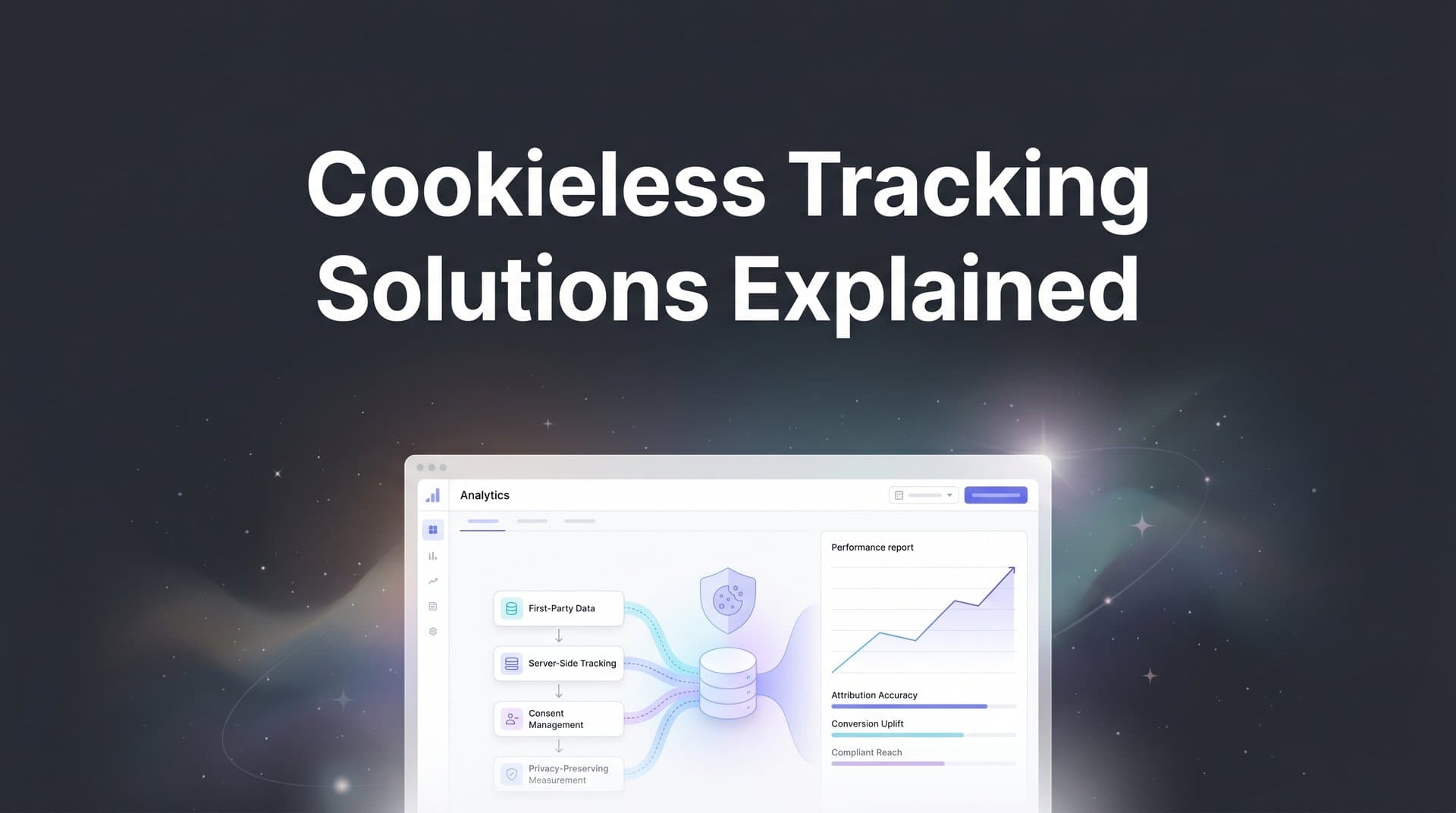
No single approach replaces everything cookies once did. The marketers who adapt most successfully are those who combine server-side tracking, first-party data, and smart attribution models into a unified measurement strategy.
Server-Side Tracking: The Backbone of Modern Attribution
If there is one investment that delivers the most immediate impact in a cookieless world, it is server-side tracking. Understanding how it works, and why it outperforms browser-based pixels, is essential for any marketer serious about accurate measurement.
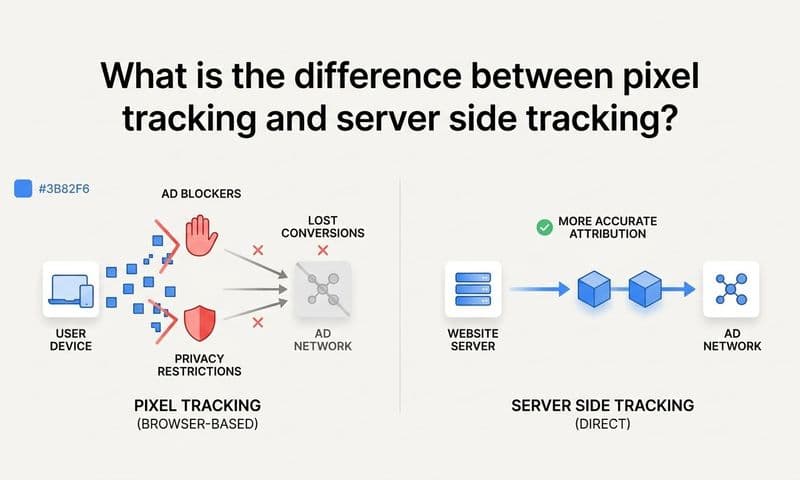
Here is the core difference. When you install a Meta Pixel or Google Tag on your website, those scripts run in the user's browser. They depend on the browser allowing the script to execute, the user not having an ad blocker installed, and cookies being available to store and transmit identifiers. In 2026, all three of those dependencies are increasingly unreliable. Ad blockers are widely used. iOS privacy settings limit what scripts can do. Browser restrictions block or shorten cookie lifetimes. For a detailed comparison, read our guide on why server-side tracking is more accurate than browser-based methods.
Server-side tracking sidesteps these problems entirely. Instead of relying on the browser to fire a pixel, your server captures the conversion event directly and sends it to ad platforms via their server-to-server APIs: Meta's Conversions API (CAPI), Google's Offline Conversions API, TikTok's Events API, and similar integrations for other platforms. The data travels from your server to theirs, never touching the browser environment where restrictions apply.
The quality of data that arrives at the ad platform is also richer. Server-side events can include customer information like hashed email addresses and phone numbers, which ad platforms use for identity matching. This improves event match quality scores, which directly affects how well platforms can attribute conversions to the correct ad interactions and optimize delivery toward users most likely to convert.
The resilience benefits extend across multiple threat vectors. iOS restrictions that prevent apps from tracking across other apps and websites have less impact on server-side data because the event capture happens at the server level. Ad blockers that prevent browser-based pixels from firing do not affect server-side calls. Browser privacy updates that shorten cookie lifetimes do not disrupt server-side event transmission.
The downstream effect on campaign performance is meaningful. Ad platform algorithms are heavily dependent on conversion signals to optimize delivery. When those signals are incomplete because browser-based pixels miss conversions, the algorithm operates with degraded information. It targets less effectively, optimizes toward the wrong outcomes, and struggles to scale efficiently. Feeding better conversion data back to the algorithm through server-side tracking gives it what it needs to perform. Many advertisers who implement conversion tracking setup with server-side methods report improved return on ad spend as a result, not because their ads changed, but because the optimization engine finally had accurate data to work with.
Multi-Touch Attribution Without Cookies: How It Works
Attribution has always been complex. Cookieless tracking makes it more challenging, but modern attribution platforms have developed approaches that work without relying on third-party cookie chains to stitch together the customer journey.
The traditional cookie-based attribution model worked by dropping a cookie when a user clicked an ad, then reading that cookie when the user converted to credit the right campaign. When cookies are blocked or expire before conversion happens, that chain breaks. The click and the conversion appear as disconnected events, and the ad that drove the sale gets no credit.
Modern cookieless attribution replaces that chain with a combination of first-party signals. UTM parameters appended to ad URLs capture campaign, source, and medium information at the click level and store it in first-party cookies or your own database. Server-side events capture conversion data with customer identifiers. CRM data connects lead activity to closed revenue. When these data sources are unified in a single attribution platform, you can reconstruct the customer journey without needing third-party cookies at all.
This is also where the difference between single-touch and multi-touch attribution becomes critically important. Single-touch models, like first-click or last-click attribution, assign all credit to one interaction. In a world where data gaps are common, single-touch models are particularly vulnerable to misattribution because if the tracked touchpoint happens to be one that was captured correctly, it gets all the credit regardless of what else influenced the conversion.
Multi-touch attribution distributes credit across all the touchpoints that contributed to a conversion. This approach is more resilient to data gaps because it relies on a broader set of signals rather than a single cookie-dependent handoff. It also provides a more accurate picture of which channels and campaigns are genuinely driving revenue versus which ones are simply present at the last moment before conversion. Explore the best marketing attribution platforms for revenue tracking to see how this works in practice.
Connecting your ad platforms, website analytics, and CRM creates the unified data layer that makes multi-touch attribution work. A user might click a Google Search ad, visit your site, leave, see a retargeting ad on Meta, click through, and convert. Without CRM integration, you might only see the last touchpoint. With a connected system, you see the full journey and can allocate budget to the channels that actually contributed.
Platforms like Cometly are built specifically to create this unified view, pulling together data from ad platforms, website events, and CRM activity to show which campaigns and channels are driving real revenue across the entire customer journey.
Practical Steps to Transition Your Tracking Stack
Knowing the landscape is one thing. Making the transition is another. Here is a prioritized action plan that reflects how successful marketers are approaching the move away from cookie-dependent tracking.
Step 1: Audit Your Current Cookie Dependencies. Start by mapping every place in your marketing stack where third-party cookies are doing important work. This includes retargeting audiences built from pixel data, attribution models that rely on cookie-based click tracking, and any analytics reports that depend on cross-site cookie chains. Understanding what is at risk helps you prioritize where to focus first. A comprehensive marketing tracking system can help you identify these dependencies quickly.
Step 2: Implement Server-Side Tracking. This is the highest-leverage action you can take. Set up server-side event capture for your key conversion events and connect them to the Conversions APIs for the platforms you advertise on. Meta CAPI, Google's Offline Conversions, and TikTok's Events API are the most important starting points for most advertisers. Prioritize the events that matter most to your campaigns: purchases, lead form submissions, and high-intent actions.
Step 3: Enrich Your First-Party Data Collection. Build systems that capture authenticated user data throughout the customer journey. This means collecting email addresses and other identifiers at every reasonable touchpoint, storing them in your CRM, and using them to improve event matching quality when sending data to ad platforms. Hashed customer data dramatically improves match rates and attribution accuracy.
Step 4: Connect CRM Data to Ad Platforms. Offline conversion imports and CRM integrations allow you to send downstream conversion events, like qualified leads, sales opportunities, and closed deals, back to the ad platforms that generated those customers. This closes the loop between ad spend and actual revenue, giving platform algorithms the signal they need to optimize toward your real business outcomes rather than surface-level proxy events. Learn more about tracking closed won revenue to maximize this approach.
Step 5: Implement Conversion Sync Workflows. Conversion sync is the ongoing process of feeding accurate, enriched event data back to ad platforms so their algorithms can continuously improve. This is not a one-time setup. It requires regular review to ensure event match quality remains high, deduplication logic is working correctly, and the right events are being prioritized.
Common pitfalls to avoid along the way: relying solely on platform-reported metrics without cross-referencing your own data, ignoring cross-device journeys that require identity resolution to track accurately, and delaying migration until your tracking breaks completely. The time to build a resilient tracking stack is before the data quality problems become critical, not after.
Building a Future-Proof Tracking Strategy
Here is the reframe that changes everything: cookieless tracking is not a limitation you are working around. It is an opportunity to build a measurement system that is more accurate, more resilient, and more aligned with how customers actually behave.
Cookie-based tracking was always fragile. It depended on cookies persisting across sessions, browsers cooperating, and users not clearing their data. The measurement systems being built today, grounded in server-side tracking, first-party data, and multi-touch attribution, are fundamentally more reliable because they are not dependent on the browser environment staying cooperative.
The marketers who come out ahead are those who treat this transition as an infrastructure investment rather than a compliance exercise. When your conversion data is complete, your attribution is accurate, and your ad platform algorithms have the signals they need, your campaigns perform better. That is the real upside of getting this right.
Cometly is built for exactly this environment. It captures every touchpoint from ad clicks to CRM events, connects them into a complete view of the customer journey, and feeds enriched conversion data back to Meta, Google, TikTok, and other platforms so their algorithms can optimize effectively. With multi-touch attribution across every channel and AI-powered recommendations for scaling what works, Cometly gives you the clarity and confidence to make better decisions with your ad budget.
The transition to cookieless tracking is happening whether marketers are ready or not. The question is whether you build the right infrastructure now, while you have time to do it thoughtfully, or scramble to catch up later when the gaps in your data have already cost you.
If you are ready to take control of your tracking stack and build a measurement foundation that actually works in 2026 and beyond, start by evaluating your current setup against the framework outlined here. Then explore what server-side attribution can do for your campaigns. Get your free demo of Cometly today and see exactly which touchpoints are driving your revenue, with the accuracy and completeness your ad spend deserves.