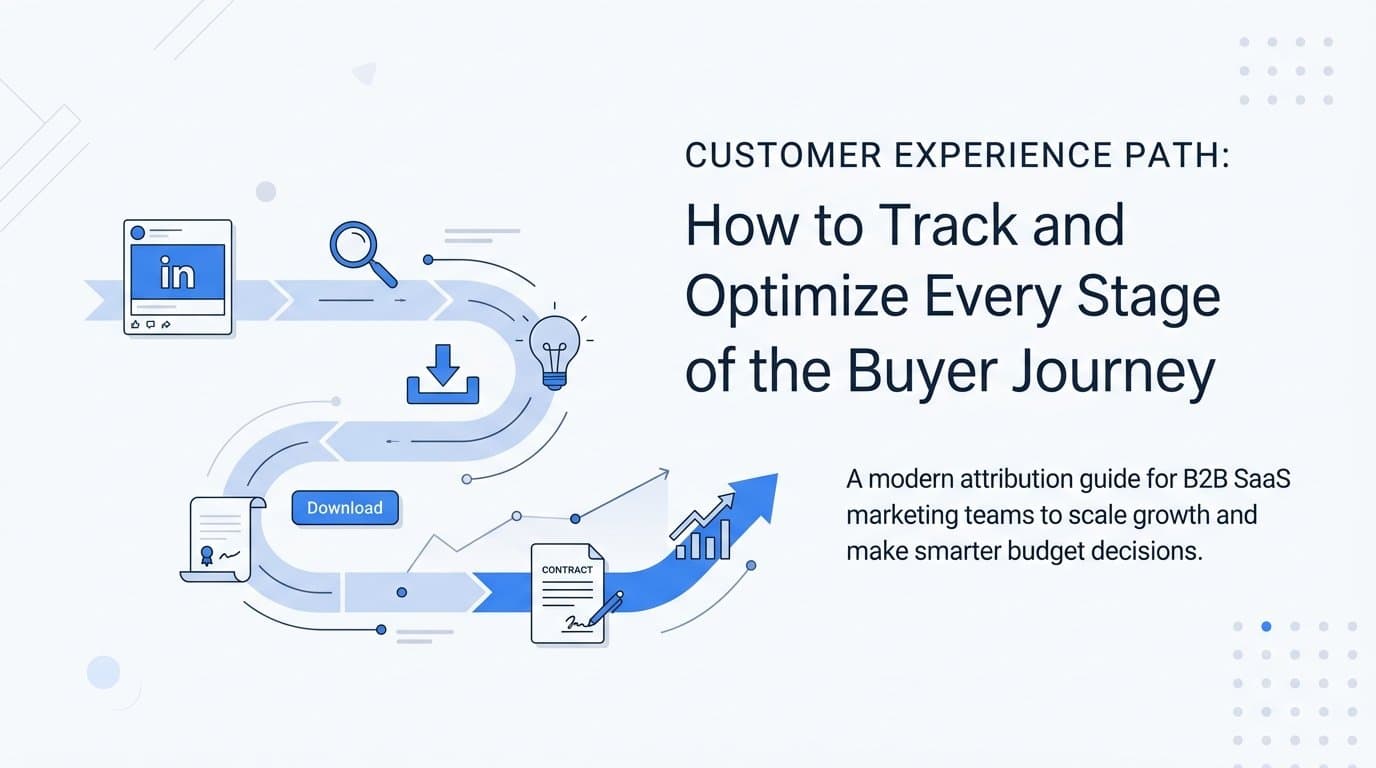
Your prospects don't convert the first time they see your ad. They discover you through a LinkedIn post, read a blog article two weeks later, attend a webinar, compare you on a review site, sit through a demo, and then finally talk to sales. By the time they sign a contract, they've touched your brand across a dozen different channels and interactions.
Yet most B2B SaaS marketing teams are making budget decisions based on a fraction of that story. They see the last click. Maybe the demo request. Rarely the full sequence that led someone from stranger to customer.
This is the customer experience path problem. And it's not a UX challenge or a customer success concern. It's a revenue problem sitting at the heart of how modern marketing teams allocate spend, evaluate campaigns, and scale what works. When you can't see the full path, you can't optimize it. And when you can't optimize it, you're leaving growth on the table.
This article breaks down what the customer experience path actually looks like for B2B SaaS buyers, why most teams only see fragments of it, and how the right tracking and attribution approach transforms that path into your most powerful growth lever.
The Anatomy of a Customer Experience Path in B2B SaaS
Before we go any further, it's worth drawing a clear line between two terms that often get confused: the customer journey map and the customer experience path.
A customer journey map is a planning artifact. It's the diagram your team creates in a workshop to visualize how a hypothetical buyer moves through stages. It's useful for strategy, but it reflects assumptions, not reality.
The customer experience path is different. It's the actual, tracked sequence of interactions a real prospect has with your brand across channels and time. It's data-driven, not hypothetical. And in B2B SaaS, that distinction matters enormously because the real path is almost always more complex than the map suggests.
A typical B2B SaaS customer experience path moves through three broad stages, each involving multiple channels and touchpoints.
Discovery: This is where the path begins. A prospect encounters your brand through a paid search ad, an organic blog post, a LinkedIn sponsored post, a podcast mention, or a referral from a colleague. They may not even realize they have a problem you can solve yet. These early touchpoints plant the seed.
Evaluation: Once a prospect recognizes a need, they enter a deeper research phase. They read comparison content, watch product videos, explore your documentation, sign up for a free trial, or attend a live demo. This stage often spans weeks, involves multiple team members, and touches channels ranging from your website to third-party review platforms.
Decision: This is where sales conversations happen, pricing pages get scrutinized, security reviews get completed, and contracts get negotiated. The marketing team's influence doesn't disappear here. The content, ads, and retargeting campaigns that keep your brand present during this phase directly affect close rates.
What makes B2B SaaS paths fundamentally different from B2C is the combination of length and stakeholder complexity. A B2C purchase might follow a path measured in hours or days. A B2B SaaS deal can span weeks or months, involve multiple decision-makers across different roles, and require consensus from people who each have their own distinct path of interactions with your brand.
This complexity is exactly why visibility into each stage is so valuable. If you can only see the final touchpoint before a demo request, you're missing the entire upstream story that made that request possible.
Why Most Teams Only See Part of the Picture
Here's the uncomfortable reality: even teams with sophisticated marketing stacks are typically working with incomplete path data. The reason comes down to fragmentation.
Your ad platforms know what they served and what they last-clicked. Your CRM knows what happened after a lead was created. Your website analytics knows which pages were visited. But none of these tools talk to each other by default. Each one holds a different piece of the customer experience path, and without intentional integration, those pieces never come together into a single coherent view.
The result is that budget decisions get made based on whichever tool happens to be open when a marketing leader asks "what's working?"
Last-click attribution makes this problem significantly worse. When you credit the final touchpoint before a conversion, you're essentially telling your data that nothing else mattered. The paid search ad that captured the initial click? Invisible. The content piece that brought the prospect back three weeks later? Uncredited. The retargeting campaign that kept your brand top of mind during the evaluation phase? Ignored.
Last-click attribution systematically over-values bottom-funnel channels because they appear most frequently at the moment of conversion. It under-values top-of-funnel channels because they rarely appear last. Over time, this creates a self-reinforcing cycle: teams shift budget toward the channels that get credit, starve the channels that initiate the path, and then wonder why their pipeline starts drying up months later.
The consequences of these blind spots are concrete and measurable. Budget gets misallocated toward channels that look good in last-click reports but don't actually initiate high-value journeys. Campaigns that consistently bring in the prospects most likely to convert get cut because they don't show up in attribution models. And the ability to identify which specific touchpoints accelerate movement through the path, which is arguably the most valuable insight in B2B marketing, simply doesn't exist without a complete view.
The gap between what teams see and what actually drives revenue isn't a strategy problem. It's a data problem. And it starts with how the path is being tracked and attributed.
Attribution Models and What They Reveal About the Path
Attribution models are the lens through which you interpret the customer experience path. Change the model and you change the story your data tells. Understanding which model to use, and when, is one of the most important decisions a B2B marketing team can make.
First-touch attribution credits the very first interaction a prospect had with your brand. This model is useful when you want to understand which channels are best at initiating the customer experience path. If your goal is to optimize awareness spend, first-touch gives you a clear view of what's generating new demand.
Last-click attribution credits the final touchpoint before conversion. As discussed, this model distorts the full picture but can be useful in isolation for understanding which channels close the loop. The problem is when it's used as the only model.
Linear attribution distributes equal credit across every touchpoint in the path. This model acknowledges that multiple interactions contributed to a conversion without making assumptions about which ones mattered most. It's a good baseline for understanding path breadth.
Time-decay attribution weights touchpoints more heavily the closer they occur to conversion. This model reflects the intuition that interactions near the decision point have more direct influence, and it tends to be useful for teams focused on pipeline velocity and close rate optimization.
Data-driven attribution uses algorithmic weighting based on actual conversion patterns in your data. Rather than applying a fixed rule, it learns from your specific customer experience paths to assign credit based on what actually correlates with conversion. For B2B SaaS teams with sufficient data volume, this is typically the most accurate model available.
Multi-touch attribution is the broader framework that makes all of this possible. Rather than forcing a single model onto every analysis, multi-touch attribution distributes credit across all touchpoints in the path. This gives marketers a far more accurate representation of how prospects actually move through the customer experience path, and it allows you to run different models side by side to compare what each one reveals.
The key insight here is that no single model is universally correct. The right choice depends on your business goals. A team optimizing for brand awareness should weight early touchpoints differently than a team focused on shortening the sales cycle. Multi-touch attribution gives you the flexibility to ask the right question and get a meaningful answer.
Server-Side Tracking and First-Party Data: The Foundation of Accurate Path Data
Even if you have the right attribution models in place, they're only as good as the data feeding them. And increasingly, the data quality problem starts at the tracking layer.
Browser-based pixel tracking, the technology that has powered digital marketing measurement for years, is becoming less reliable. Safari's Intelligent Tracking Prevention, Firefox's enhanced privacy settings, and the widespread adoption of ad blockers all interfere with client-side pixels. When a pixel fires in a browser that blocks it, that touchpoint disappears from your path data entirely. The conversion still happened. You just can't see it.
This creates systematic gaps in the customer experience path. Top-of-funnel touchpoints are often the most affected because they occur during early browsing sessions when privacy settings are most likely to block tracking. The result is that your path data underrepresents the early stages of the journey, which reinforces the same bias that last-click attribution creates.
Server-side tracking addresses this directly. Instead of relying on a browser to fire a pixel, server-side tracking sends event data directly from your server to the ad platform or analytics system. It bypasses browser-level restrictions entirely, which means touchpoints that would have been invisible to client-side pixels get captured reliably.
Conversion API integrations, such as Meta's Conversions API and Google's Enhanced Conversions, extend this capability to the ad platforms themselves. When you send enriched conversion events directly from your server to these platforms, you're giving their algorithms a more complete and accurate picture of which ads led to real outcomes. This improves their optimization and targeting, which feeds back into better campaign performance over time.
First-party data enrichment is the other critical piece of this foundation. As third-party cookies become less reliable, the most durable source of path data is the information you collect directly from your own interactions with prospects and customers. Connecting ad click data with CRM records, connecting CRM records with revenue data from your billing system, and stitching all of that together into a unified view of each customer's journey is what transforms fragmented signals into a complete customer experience path.
When you can connect a specific ad impression to a lead record, to a pipeline opportunity, to a closed-won deal with a specific contract value, you've built the foundation for truly revenue-connected marketing decisions.
Turning Path Data Into Decisions That Drive Growth
Complete path data is only valuable if it changes how you make decisions. Here's what becomes possible when you can actually see the full customer experience path.
You can identify which channels initiate the most valuable journeys. Not just which channels drive the most conversions, but which channels bring in the prospects who convert to the highest contract values and shortest sales cycles. This is a fundamentally different question, and it often produces a different answer. A channel that drives a high volume of leads might consistently initiate paths that stall in the evaluation stage, while a smaller channel might consistently initiate paths that move quickly to closed-won revenue.
You can see where prospects drop off between stages. If a large percentage of prospects who engage with your evaluation-stage content never make it to a demo request, that's a signal worth investigating. Is there a content gap? A friction point in the demo scheduling flow? A competitive alternative that's winning at that stage? Path data surfaces these questions in ways that siloed channel metrics never could.
You can understand which content accelerates movement between stages. Not all content is created equal when it comes to pipeline velocity. Some pieces consistently appear in the paths of prospects who move quickly from evaluation to decision. Others appear frequently but don't seem to accelerate anything. Path data lets you identify the difference and invest accordingly.
AI-powered analysis takes this further. When you have a large enough dataset of complete customer experience paths, machine learning can surface patterns that manual reporting would never find. Which combinations of ad creative and content type correlate with faster sales cycles? Which early-stage touchpoints are the strongest predictors of high contract values? These are the kinds of insights that shift marketing from reactive to genuinely predictive.
The feedback loop completes when you send enriched conversion data back to your ad platforms. When Meta and Google receive more accurate, more complete conversion signals from your server, their targeting algorithms improve. They get better at finding prospects who resemble your best customers, which means the new journeys they initiate are more likely to follow the high-value paths you've identified. Better data in creates better targeting out, which creates better path data to analyze, which creates even better targeting. This compounding effect is one of the most powerful advantages of investing in complete path visibility.
Building a Complete View: From First Ad Click to Closed Revenue
Understanding the customer experience path conceptually is one thing. Building the infrastructure to track it end to end is another. Here's what that actually requires in practice.
The first step is integrating your ad platforms so that impression and click data flows into a central attribution system. This means connecting Google Ads, Meta, LinkedIn, and any other paid channels you run. Without this, you're missing the top of the path entirely.
The second step is enabling server-side event tracking on your website and product. This ensures that the touchpoints occurring in privacy-restricted browsers get captured reliably, filling the gaps that client-side pixels leave behind.
The third step is syncing your CRM data. This is where the path connects to pipeline. When a lead is created, progressed, or closed in your CRM, that event needs to flow back into your attribution system so you can tie it to the specific ad interactions and content touchpoints that preceded it.
The fourth step is connecting revenue data. For B2B SaaS teams, this typically means integrating with your billing platform, such as Stripe, so that actual subscription revenue and contract values can be attributed back to specific campaigns and channels. This is what transforms attribution from a marketing metric into a revenue metric.
When all of these pieces are connected, you arrive at what's often called a single source of truth for marketing data. Every team, marketing, sales, and leadership, works from the same path data rather than pulling numbers from different platform dashboards that often contradict each other. This alignment alone eliminates a significant amount of wasted time and misaligned priorities.
Real-time path visibility adds another dimension. When you can see the customer experience path as it's happening rather than in retrospective reports, you can make faster budget decisions. You can identify a campaign that's initiating high-quality paths and scale it mid-flight rather than waiting for the end of the quarter. You can catch a channel that's generating activity but not pipeline and reallocate before the budget is fully spent. And you can forecast pipeline with greater confidence because you're working from live data rather than historical averages.
Teams that build this kind of end-to-end visibility don't just measure better. They compete differently. They move faster, allocate more precisely, and scale with a level of confidence that teams working from fragmented data simply can't match.
The Path Forward
The customer experience path is not a static diagram you create once and hang on a wall. It's a living dataset that reflects how real prospects actually interact with your brand across every channel and every stage of their journey. When that dataset is complete and accurate, it becomes the most powerful input available for marketing decisions.
The gap between what most B2B SaaS marketing teams see and what actually drives their revenue is not a strategy gap. It's a tracking and attribution gap. The campaigns that initiate the highest-value journeys are often invisible in last-click reports. The channels that accelerate pipeline velocity rarely get the credit they deserve. And the decisions made without complete path data are, at best, educated guesses.
Closing that gap requires server-side tracking to capture every touchpoint reliably, multi-touch attribution to distribute credit accurately, first-party data integration to connect ad activity to pipeline and revenue, and AI-powered analysis to surface the patterns that manual reporting misses. That's exactly what Cometly is built to do for B2B SaaS teams.
Ready to elevate your marketing game with precision and confidence? Discover how Cometly's AI-driven recommendations can transform your ad strategy. Get your free demo today and start capturing every touchpoint to maximize your conversions.