Most B2B SaaS marketing teams are running blind. They invest heavily in paid ads, content programs, and outbound sequences, but when leadership asks which channels are actually driving revenue, the honest answer is often a guess dressed up as a report. The problem is not a lack of effort. It is a lack of structure.
A customer journey framework solves that problem at the root. It gives your team a shared model for understanding how prospects move from first discovering your brand to signing a contract and expanding their usage over time. More importantly, it creates the scaffolding for connecting real tracking data to real business outcomes.
B2B sales cycles are long. They involve multiple stakeholders with competing priorities. Prospects engage across a dozen channels over weeks or months before they ever talk to sales. Without a framework to organize all of that activity, your marketing data stays fragmented, your attribution stays incomplete, and your budget decisions stay reactive. This article breaks down what a customer journey framework actually looks like in practice, where most teams go wrong when they try to implement one, and how to build the data infrastructure that makes the framework genuinely useful for driving revenue decisions.
The Anatomy of a B2B Customer Journey
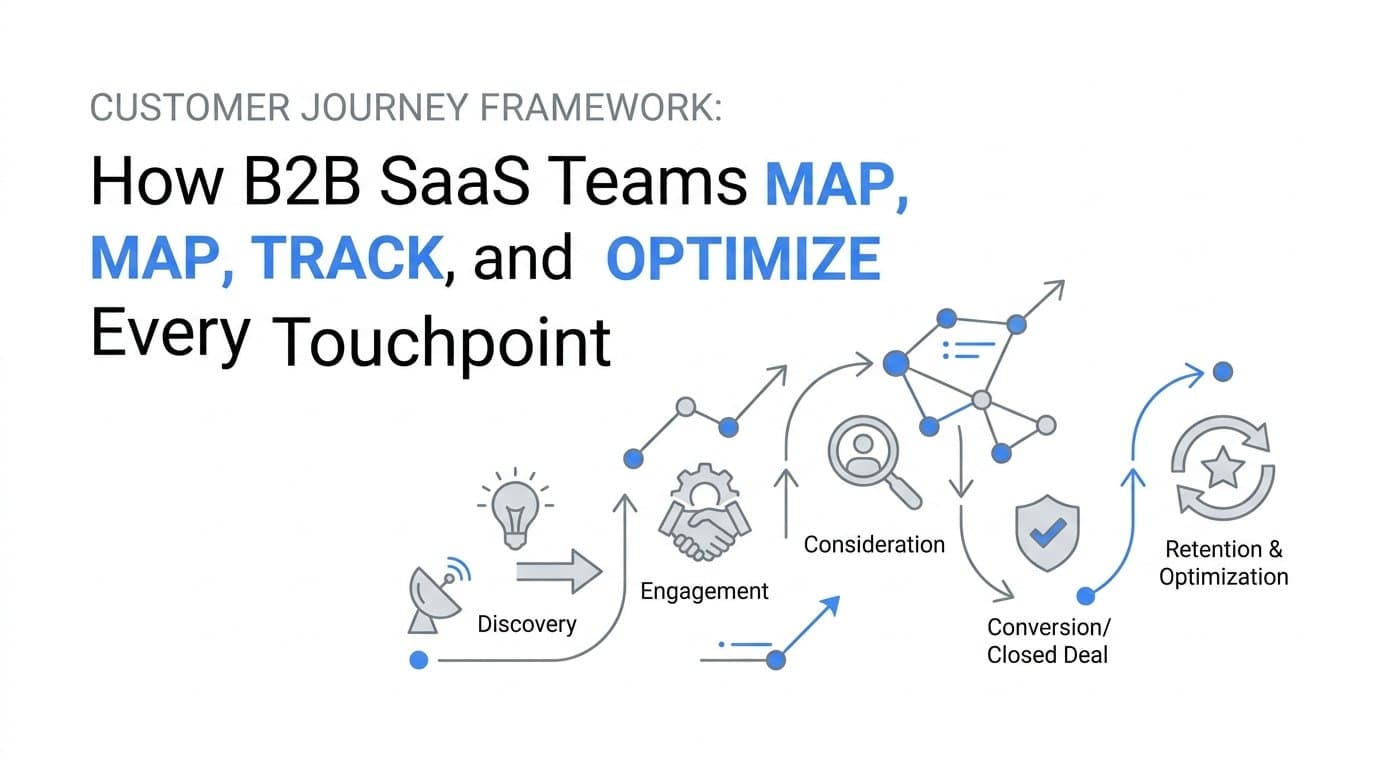
A customer journey framework starts with stages. In B2B SaaS, the most widely used model defines five core phases: Awareness, Consideration, Evaluation, Decision, and Retention. Each stage represents a distinct mindset and a different set of interactions your prospect is having with your brand and your competitors.
Awareness: The prospect recognizes a problem or opportunity and begins looking for information. They might encounter your brand through a paid search ad, a LinkedIn post, an organic article, or a peer recommendation. They are not ready to buy. They are trying to understand the landscape.
Consideration: The prospect has defined the problem and is now actively researching solutions. They are reading comparison content, watching product walkthroughs, and signing up for webinars. This is where educational content and retargeting campaigns do their heaviest lifting.
Evaluation: The prospect has shortlisted vendors and is doing deeper diligence. This stage typically involves demos, free trials, security reviews, and conversations with multiple stakeholders inside the buying organization. In enterprise deals, this can last weeks.
Decision: The prospect is ready to commit. Negotiations happen, contracts are reviewed, and the deal closes. The touchpoints here are often sales-led, but marketing still plays a role through case studies, ROI calculators, and bottom-of-funnel ads that reinforce confidence.
Retention: The customer is live and using the product. The journey does not end at closed-won. Expansion revenue, referrals, and advocacy all trace back to how well the post-sale experience is mapped and managed.
The critical thing to understand about B2B journeys is that they are rarely linear. A prospect might engage with three pieces of content, go completely dark for six weeks, and then re-enter the funnel through a completely different channel after a colleague mentions your product in a Slack channel. They might loop back from Evaluation to Consideration when a new stakeholder joins the buying committee and wants to start fresh. A strong customer journey framework does not pretend the path is a straight line. It accounts for this non-linearity by tracking every touchpoint, regardless of where it falls in the sequence.
Touchpoints are the building blocks of the framework. Every interaction between a prospect and your brand counts: a LinkedIn ad impression, an organic search click, a webinar registration, a sales email reply, a product demo, a follow-up sequence. Mapping these touchpoints to journey stages is what transforms a generic funnel diagram into an operational model your team can actually use.
Where Journey Frameworks Usually Fall Apart
Here is the uncomfortable truth about most customer journey frameworks: they live in slide decks. Teams spend hours in workshops mapping out stages, defining personas, and drawing arrows between touchpoints on a whiteboard. Then the presentation gets filed away and nothing changes about how the business actually tracks or measures anything.
The most common failure point is the gap between the framework as a concept and the framework as a data infrastructure. You can have a beautifully designed journey map that describes exactly how your ideal customer moves from awareness to decision, but if that map is not connected to real event tracking, it is just a diagram. It cannot tell you which channels are driving pipeline. It cannot show you where prospects are dropping off. It cannot help you justify budget decisions.
This gap creates what is often called the attribution problem. When touchpoint data is siloed across platforms, like Google Ads reporting in one dashboard, Meta in another, and your CRM in a third, you end up with three different stories about what is driving revenue. None of them are complete. Each platform takes credit for more than it deserves because none of them can see the full path.
The downstream consequences of this fragmentation are significant. Marketing teams end up allocating budget based on last-click data, which systematically overweights bottom-of-funnel channels and undervalues the awareness and consideration touchpoints that started the journey. Channels that are genuinely driving pipeline get cut because they cannot prove their contribution within the narrow window of a single-platform report. And when leadership asks for a clear picture of marketing ROI, the answer is a patchwork of conflicting numbers that erodes confidence in the marketing function.
The solution is not a better slide deck. It is connecting the journey framework to a tracking infrastructure that captures every touchpoint and stitches them together into a single, coherent view of the customer path. That is where the framework stops being theory and starts being a tool for making better decisions.
Choosing the Right Attribution Model for Your Journey
Once you have a framework and the data to power it, you need to decide how to assign credit across the touchpoints in a customer's path. That is the job of an attribution model, and the model you choose will fundamentally shape how you interpret your marketing performance.
First-touch attribution credits the very first interaction that brought a prospect into your funnel. If someone clicked a LinkedIn ad six months before they signed a contract, that ad gets all the credit. This model is useful for understanding what drives initial awareness, but it ignores everything that happened between that first click and the closed deal.
Last-click attribution takes the opposite approach. It credits the final touchpoint before a conversion event, which is often a branded search or a direct visit. This model is simple and easy to implement, but it systematically undervalues the content, ads, and outreach that built the relationship over time. In long B2B sales cycles, last-click attribution is particularly misleading.
Linear attribution distributes credit equally across every touchpoint in the path. If a prospect had ten interactions before converting, each one gets ten percent of the credit. It is more balanced than single-touch models, but it treats a quick ad impression the same as a 45-minute product demo, which does not reflect reality.
Time-decay attribution gives more weight to touchpoints that occurred closer to the conversion event. This can work well for shorter sales cycles where recent interactions are genuinely more influential, but in complex B2B deals, it risks undervaluing early-stage awareness channels that seeded the relationship.
Data-driven attribution is generally the most accurate approach for complex B2B journeys. Instead of applying fixed rules, it uses algorithmic analysis of your actual conversion path data to assign credit proportionally based on which touchpoints statistically correlate with successful outcomes. It requires sufficient conversion volume to generate reliable patterns, but when that threshold is met, it produces a far more honest picture of what is driving revenue.
The right model for your team depends on where you are in your growth journey and what decisions you are trying to make. Early-stage companies building brand awareness may find first-touch attribution valuable for understanding which channels are filling the top of the funnel. More mature teams focused on optimizing pipeline velocity and revenue efficiency need multi-touch models that reflect the full complexity of the buying journey. The key is choosing a model intentionally rather than defaulting to whatever your ad platform reports by default.
Tracking the Journey Across Every Channel and Stage
Understanding attribution models is one thing. Actually capturing the data to power them is another challenge entirely. Full-journey tracking in B2B SaaS requires a technical infrastructure that most teams underestimate when they first start building their framework.
At a minimum, you need three things working together. First, server-side event tracking on your website and landing pages to capture every meaningful interaction a prospect has before they identify themselves. Second, integrations between your ad platforms, your website, and your CRM so that anonymous ad clicks can eventually be connected to named leads and opportunities. Third, a revenue integration that ties closed deals back to the original marketing touchpoints that started the journey.
Browser-based pixels have historically handled much of this work, but they are increasingly unreliable. Ad blockers, browser privacy restrictions, and the ongoing deprecation of third-party tracking mechanisms all degrade the quality of pixel-based data. When a pixel fires are blocked or delayed, touchpoints disappear from the record, and your attribution data develops gaps that compound over time.
This is where server-side tracking and Conversion API integrations become essential. Instead of relying on a browser to fire a pixel, server-to-server event transmission sends conversion data directly from your server to ad platforms like Meta and Google. The data arrives accurately regardless of what is happening in the user's browser. Touchpoints that would have been lost are preserved, and the signal quality that ad platforms use for optimization improves significantly.
First-party data is the foundation of this entire infrastructure. As third-party cookies continue to be phased out, teams that have invested in first-party data collection and server-side event transmission maintain tracking accuracy while others see their data quality erode. Building on first-party data is not just a privacy best practice. It is a competitive advantage in attribution accuracy.
Cometly is built specifically to solve this integration challenge for B2B SaaS teams. It connects your ad platform data, CRM events, and revenue data into a single attribution view, so you can see the complete path from a prospect's first ad click to a closed-won deal without manually stitching together exports from five different platforms. When a deal closes in your CRM, Cometly traces it back through every recorded touchpoint and shows you exactly which channels and campaigns contributed to that outcome. That is what makes the customer journey framework operational rather than theoretical.
Turning Journey Data Into Actionable Marketing Decisions
Capturing journey data is the foundation. Turning it into decisions that improve performance is the payoff. This is where a well-instrumented customer journey framework starts to generate real competitive advantage.
The first thing journey analytics reveals is which channels and touchpoints consistently appear in the paths of your highest-value customers. You will likely find that certain channel combinations appear repeatedly in deals that close quickly and at high contract values. You will also find channels that generate plenty of activity but rarely appear in the paths of customers who actually convert. That distinction is the difference between spending on what looks good in a platform dashboard and spending on what actually drives revenue.
Pattern recognition at this level is difficult to do manually when you are managing campaigns across multiple channels and tracking dozens of touchpoints per customer path. This is where AI-powered insights become genuinely useful. AI applied to journey data can surface patterns that human analysts would miss at scale: which ad creative combinations tend to accelerate deal velocity, which touchpoint sequences produce the highest pipeline conversion rates, or which awareness channels are disproportionately represented in the journeys of your highest-LTV customers.
Cometly's AI ads manager does exactly this. It analyzes performance across every channel and surfaces recommendations based on actual journey data, not just surface-level metrics like click-through rates or cost-per-click. When you can see which ads are contributing to closed revenue rather than just generating clicks, the optimization decisions become much clearer.
There is also a feedback loop dimension to this that compounds over time. When you send enriched, first-party journey data back to ad platforms like Meta and Google through their Conversion API integrations, you improve the quality of the signals those platforms use for algorithmic targeting and optimization. Better signals mean better audience matching, which means better campaign performance. The more accurately you track your journey, the better your ad platforms perform, which generates more high-quality journey data to analyze. That cycle, when it is running well, creates a durable performance advantage that is difficult for competitors to replicate.
Building a Journey Framework That Scales With Your Growth
Knowing what a customer journey framework should do is useful. Knowing how to actually build and maintain one as your business grows is what separates teams that execute from teams that theorize.
Start with the fundamentals. Define your key journey stages and identify the specific conversion events that signal a prospect has moved from one stage to the next. These might include a form fill for a content offer, a demo request, a trial signup, an opportunity created in your CRM, and a deal closed-won. Each of these events should be tracked as a server-side event so the data is accurate and complete.
Once your events are defined and instrumented, connect your data sources. Your ad platforms, your website tracking, your CRM, and your revenue system all need to talk to each other. Without those connections, you are back to silos. The goal is a single source of truth for journey data that every team references when making decisions about budget, channel strategy, and campaign performance.
That single source of truth matters more than most teams realize. When sales, marketing, and leadership are all looking at different attribution reports, alignment breaks down. Budget conversations become political rather than analytical. A shared attribution view changes that dynamic. When everyone is working from the same data, decisions get faster and more defensible.
Establish a regular reporting cadence so the framework stays active rather than becoming a one-time project. Review journey performance monthly at a minimum, and revisit your stage definitions and attribution model weighting quarterly or whenever your business goes through a significant change.
As your business grows, your framework needs to evolve with it. New channels require new tracking events. New product lines may need separate journey maps. New customer segments may move through the funnel differently than your original ICP. A journey framework is not a set-it-and-forget-it artifact. It is a living model that should reflect how your customers actually behave right now, not how they behaved when you first built it.