Most B2B SaaS marketing teams have a version of the customer journey they believe in. It usually looks something like this: a prospect sees an ad, visits the website, downloads a resource, and eventually books a demo. Clean, linear, predictable. The problem is that real buyers almost never behave this way.
The actual path from first awareness to closed-won deal is messy. Prospects encounter your brand through multiple channels, revisit your content weeks later from a different device, go silent for a month, re-engage after a colleague mentions you, and finally convert through a channel that looks like it did all the work but actually came last in a long sequence of touchpoints. If your team is making budget decisions based on the clean version of that journey, you are optimizing for a fiction.
This is where customer journey training becomes essential. It is not a soft-skills workshop or a one-afternoon exercise. It is a structured discipline that builds team-wide fluency in how your buyers actually behave across every channel and touchpoint, from the first paid ad impression to the CRM event that marks a deal as closed. It encompasses journey mapping, attribution model literacy, data interpretation, and the operational habits that connect journey insights to real campaign decisions.
By the end of this article, you will understand what customer journey training actually involves, why it matters specifically for B2B SaaS teams dealing with long sales cycles and multiple stakeholders, and how to build this capability in a way that drives measurable improvements in how your team allocates budget and scales campaigns.
The Gap Between How You Think Buyers Move and How They Actually Do
B2B SaaS buying cycles are rarely short and almost never simple. A single deal might involve a marketing manager who found you through a Google search, a director who later saw a retargeting ad, and a VP who only entered the conversation after a sales rep reached out directly. Each of those people touched different content at different times, and none of them followed the funnel you drew on a whiteboard during your last planning session.
This non-linear reality creates serious problems for teams that operate on assumptions. When you assume most deals start with paid search, you over-invest there and underfund the organic content or LinkedIn campaigns that are actually initiating high-value journeys. When you assume the demo request is the pivotal moment, you miss the touchpoints earlier in the cycle that made the prospect ready to request one in the first place.
The organizational blind spots compound when marketing and sales lack a shared mental model of the journey. Marketing measures success by lead volume and cost per lead. Sales measures success by deal velocity and close rate. Neither team has a complete picture of how a prospect actually moved through the buying process, which means messaging gets misaligned, handoffs get fumbled, and ad spend flows toward channels that look good in siloed reports but do not actually drive revenue.
Customer journey training addresses this directly. It is the structured process of building shared fluency across your team in how real buyers behave, not hypothetical ones. That means understanding which channels tend to initiate awareness, which touchpoints tend to accelerate consideration, and which interactions correlate with deals that actually close. It means moving from a team that has opinions about the journey to a team that has evidence about it.
The distinction matters because opinions are cheap and evidence is actionable. When your marketing team, sales team, and leadership all share a data-grounded understanding of the customer journey, you stop arguing about which channel gets credit and start making coordinated decisions about where to invest, what to say, and when to say it. That alignment is what customer journey training is ultimately designed to create.
What Customer Journey Training Actually Covers
The phrase "customer journey training" can sound vague, so it helps to break it into its concrete components. There are four core areas that any meaningful program needs to address: journey mapping methodology, touchpoint identification, attribution model literacy, and the ability to read customer journey analytics in practice.
Journey Mapping Methodology: This is the foundation. Teams learn how to define the stages of their specific buying process, identify the questions buyers are asking at each stage, and document the channels and content types that are active at each point. The emphasis here is on methodology, meaning teams learn how to build and update a journey map rather than just receiving a static one to reference.
Touchpoint Identification: A touchpoint is any interaction a prospect has with your brand, paid or organic, inbound or outbound, digital or human. Training teams to identify and categorize touchpoints accurately is harder than it sounds. It requires connecting data across ad platforms, your website, your CRM, and sometimes your product itself. Teams that can name and track their touchpoints precisely are teams that can actually measure which ones matter.
Attribution Model Literacy: This is where many teams have the biggest gap. Understanding that different attribution models tell different stories about the same journey is a critical skill. First-touch attribution highlights what initiated awareness. Last-click attribution credits what closed the deal. Multi-touch models distribute credit across the full path. A team that only ever looks at last-click data is making decisions based on one narrow slice of the journey, and they may not even realize it.
Reading Journey Analytics in Practice: There is a meaningful difference between surface-level journey awareness and operational fluency. Surface-level awareness means knowing that stages like awareness, consideration, and decision exist. Operational fluency means being able to open an attribution report, trace a specific deal back through its actual touchpoints, and draw conclusions about what drove that outcome. Training should develop the latter, not just the former.
The data skills component deserves particular emphasis. Teams need to learn how to interpret multi-touch attribution reports, understand what first-touch versus last-click differences reveal about their specific buyer behavior, and connect ad performance data to pipeline outcomes rather than just surface-level metrics like clicks and impressions. This is what makes journey training genuinely useful rather than academically interesting.
Building a Journey Map Your Whole Team Can Use
A journey map that only lives in a marketing deck is not a training tool. It is a presentation artifact. For customer journey training to work, the map needs to be something your entire team, including sales, marketing, and leadership, can reference, update, and make decisions from.
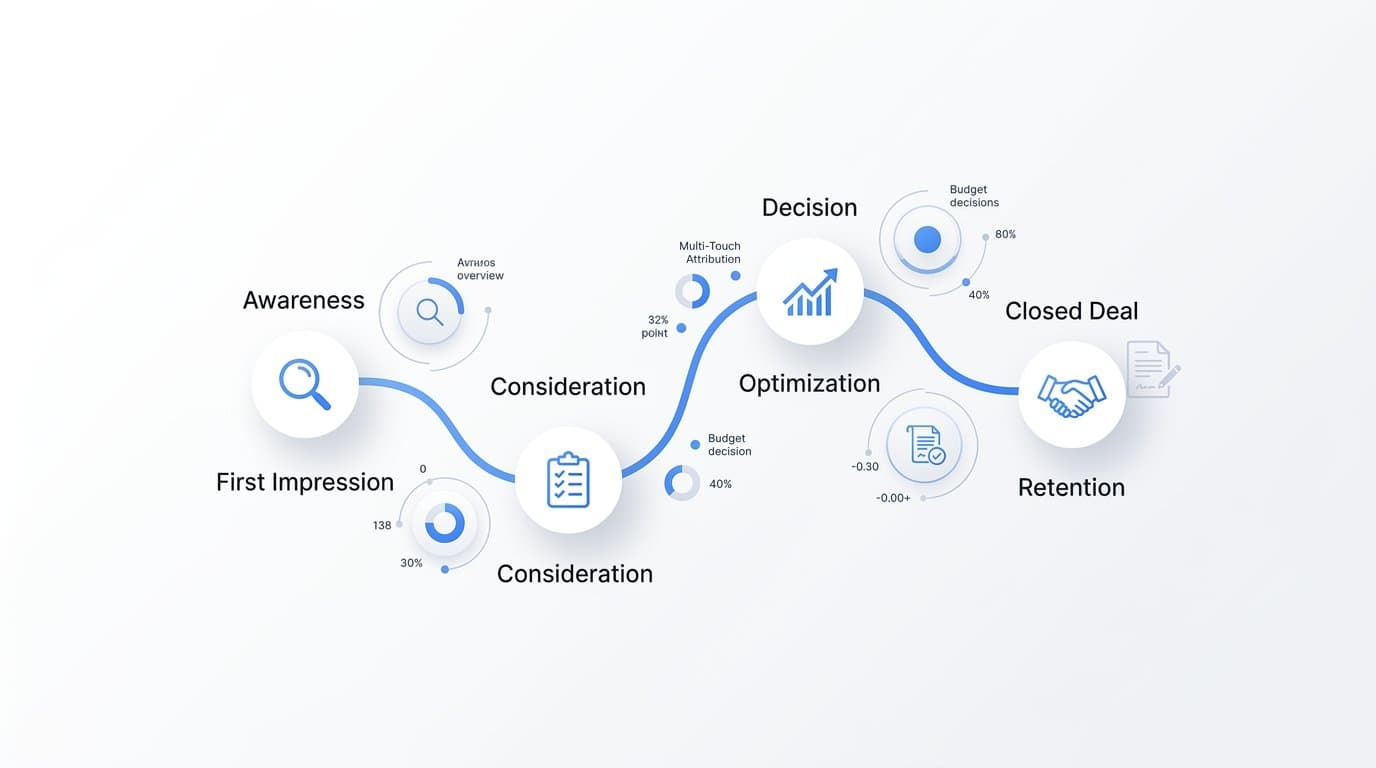
Building that kind of shared artifact starts with defining your stages clearly. For most B2B SaaS companies, this means awareness (the prospect first encounters your brand), consideration (they are actively evaluating solutions), decision (they are ready to commit), and retention (they are a customer you are working to expand and keep). The specific stage names matter less than the clarity about what buyer behavior characterizes each one.
Once stages are defined, the next step is identifying which channels are active at each stage. Paid social and content marketing tend to drive awareness. Organic search, comparison content, and case studies tend to support consideration. Direct outreach, demos, and pricing conversations tend to drive decisions. This is not universal, and the training value comes from mapping it to your actual data rather than industry assumptions.
That data anchoring is what separates a useful journey map from a guess. You want to look at your ad platform data to understand which campaigns are generating first touches. You want to look at your CRM events to understand which touchpoints correlate with deals moving from one stage to the next. You want to look at website behavior to understand which content paths buyers follow before converting. When you build the journey map from this data, you are training your team on evidence rather than intuition.
Documenting the conversion events that signal progression is equally important. What does it mean for a prospect to move from awareness to consideration in your specific context? Is it a second website visit? A content download? A specific page view? When your team agrees on what these signals are and tracks them consistently, the journey map becomes a live document that updates as new data comes in rather than a static slide that gets outdated within weeks.
The shared journey map then becomes the central training artifact. When marketing and sales both reference the same map, they stop having conversations about whose leads are better and start having conversations about which touchpoints are most effectively moving prospects through the journey. That is a fundamentally more productive conversation, and it only happens when the map is grounded in data everyone trusts.
Attribution Models as a Training Tool, Not Just a Reporting Setting
Many teams treat attribution model selection as a technical configuration decision made once during platform setup and then forgotten. Customer journey training reframes attribution models as a diagnostic tool that your team actively uses to understand different dimensions of the buying journey.
The model you choose determines which touchpoints receive credit, which channels appear effective, and ultimately where budget flows. This means that a team operating exclusively on last-click attribution is systematically undervaluing every touchpoint that happened before the final conversion event. Over time, this leads to over-investment in bottom-funnel channels and chronic underfunding of the awareness and consideration touchpoints that created the pipeline in the first place.
Training teams to compare attribution models side by side is one of the most valuable exercises in customer journey training. When you look at the same set of deals through first-touch attribution and then through last-click attribution, you often see dramatically different pictures of which channels matter. A LinkedIn campaign might look marginal in last-click data but appear as the primary initiator of your highest-value deals when you look at first-touch. That insight changes how you allocate budget.
Multi-touch attribution models distribute credit across the full path, which gives a more complete view of how the journey actually works. Linear models split credit evenly across all touchpoints. Time-decay models give more credit to touchpoints closer to conversion. Position-based models weight the first and last touches more heavily. Each of these reflects a different assumption about how value is created across the journey, and understanding those assumptions is part of what makes teams better at interpreting their data.
Data-driven attribution takes this further by using actual conversion patterns to determine credit distribution rather than applying a fixed rule. When teams are trained to understand how data-driven attribution works, they move beyond rule-based assumptions and let their own buyer behavior inform how credit is assigned. This makes attribution a genuinely adaptive tool rather than a static setting.
The training goal here is not for every team member to become an attribution expert. It is for every team member to understand that the model they are looking at tells one story about the journey, not the whole story, and that comparing models is how you develop a more complete understanding of what is actually driving results.
Turning Journey Insights into Campaign Decisions
Understanding the customer journey is only valuable if it changes what your team does. The bridge between journey training and business outcomes is the ability to translate journey insights into specific, confident campaign decisions.
Trained teams use journey data to answer questions that untrained teams can only guess at. Which channels are initiating the most high-value journeys? Not just generating the most leads, but starting the paths that tend to end in closed-won deals with strong contract values. Which touchpoints seem to accelerate deal velocity, meaning which interactions correlate with prospects moving through stages faster? Where are prospects dropping off, and what does that suggest about messaging gaps or channel misalignment?
These questions require journey data, but they also require the analytical fluency to ask them correctly and interpret the answers with appropriate nuance. That is what training develops over time.
The feedback loop between journey training and ad optimization is one of the most powerful dynamics in modern B2B SaaS marketing. When you send enriched conversion data back to ad platforms through server-side tracking and Conversion API integrations, you improve the quality of signals those platforms use for targeting and bidding. Better signals generate better-quality audiences, which produce better-quality journeys to analyze. The cycle reinforces itself, but only if your team understands how to set it up and how to read what comes back.
This is where AI-driven recommendations become a meaningful layer on top of journey analytics. Modern attribution platforms can surface patterns in your journey data that would be difficult or time-consuming for human analysis to identify. Which sequences of touchpoints correlate most strongly with conversion? Which ad creative combinations tend to appear in the journeys of your best customers? Which channel combinations tend to produce the fastest deal cycles?
AI surfaces these patterns at scale. But teams still need the foundational journey training to understand what those recommendations mean, evaluate whether they make sense given what they know about their buyers, and act on them with confidence. The AI accelerates the insight; the training gives teams the context to use it well.
The practical output of this capability is a marketing team that makes budget and campaign decisions from evidence rather than instinct. Not just "we think LinkedIn is working" but "LinkedIn is initiating a high proportion of our enterprise deals based on first-touch data, and those deals close at a higher rate than deals that start through other channels, so we are increasing investment there and testing new creative formats to see if we can improve that initiation rate further."
Putting Customer Journey Training Into Practice
Rolling out customer journey training across a B2B SaaS marketing team works best when it follows a deliberate sequence rather than trying to tackle everything at once.
Start with data infrastructure. Before you can train your team to read journey data accurately, you need to ensure that data is complete and trustworthy. That means verifying your tracking setup, implementing server-side tracking where possible to reduce data loss from browser-based limitations, and connecting your ad platforms, CRM, and website into a unified view. Training on incomplete data teaches your team the wrong lessons, so this foundation is non-negotiable.
Once the data infrastructure is solid, the next step is building shared vocabulary. This sounds simple but it matters enormously. When marketing says "conversion" and sales says "conversion," do they mean the same thing? When the attribution report shows "first touch," does everyone on the team understand what that means and what it does not mean? Establishing clear, agreed-upon definitions for the terms your team uses to discuss the customer journey prevents the confusion that makes journey training feel abstract.
From there, move into regular journey review sessions. These are structured meetings where the team looks at actual journey data together, traces specific deals or cohorts through their touchpoint sequences, and draws conclusions about what the data suggests for campaign decisions. These sessions are where training becomes operational. The goal is not to review dashboards passively but to practice the analytical reasoning that connects journey data to action.
The critical point is that journey training is ongoing, not a one-time workshop. Buyer behavior shifts. New channels emerge. Your product evolves. Your competitive landscape changes. All of these affect how prospects move through the journey, which means your team's understanding of that journey needs to update continuously. Tying training to a live analytics environment where teams can see real customer journeys updating in real time keeps the learning grounded in current reality rather than historical assumptions.
This is where Cometly becomes the data layer that makes customer journey training actionable. Cometly connects your ad platforms, CRM, and website data into a single view, giving your team accurate, complete journey data rather than fragmented reports from disconnected tools. With multi-touch attribution, server-side conversion tracking, and AI-driven recommendations built into the platform, your team is not just learning to read data. They are learning to act on it, with every touchpoint captured and every insight tied directly to pipeline and revenue outcomes.
The Bottom Line on Customer Journey Training
Customer journey training is what separates marketing teams that react to data from teams that genuinely understand it. The difference shows up in budget decisions, campaign performance, and ultimately in revenue outcomes.
The progression is logical and buildable. You start by mapping real journeys grounded in actual data rather than assumptions. You build attribution literacy so your team understands that different models reveal different truths about the same journey. You connect those insights to specific campaign decisions about where to invest, what to test, and how to optimize. And you create a continuous learning loop by tying your training to a live analytics environment that reflects how your buyers are actually behaving right now.
None of this requires a massive organizational overhaul. It requires the right data infrastructure, a shared vocabulary, regular practice with real journey data, and a commitment to treating the customer journey as something you actively study rather than something you assume you already understand.
The teams that invest in this discipline consistently make better decisions about where their marketing budget goes and why. They stop funding channels because they feel right and start funding them because the journey data says they work. That shift in how decisions get made is the real outcome of customer journey training.
If you are ready to give your team the complete, accurate journey data they need to train smarter and optimize with confidence, Get your free demo and see how Cometly connects every touchpoint from first ad click to closed-won revenue in a single, real-time view.