Most B2B SaaS marketing teams are running paid ads, publishing content, sending email sequences, and investing in SEO simultaneously. Yet when it comes time to report on what's actually working, the picture gets murky fast. Which channel started the conversation? Which touchpoint pushed the prospect to book a demo? Which campaign finally closed the deal?
Without clear visibility into the customer journey, these questions go unanswered. And when they go unanswered, budget decisions get made on gut feeling rather than data. That's a costly way to operate, especially when sales cycles stretch across weeks or months and buyers interact with your brand dozens of times before ever speaking to a salesperson.
The customer journey is not a straight line. It's a web of touchpoints spanning multiple channels, devices, and timeframes. Understanding it fully is the foundation of accurate attribution, smarter budget allocation, and ultimately, predictable revenue growth. This guide breaks down what the customer journey actually looks like in B2B SaaS, where most teams fall short in tracking it, and how to measure it in a way that connects marketing activity to real business outcomes.
Why the Path from Stranger to Customer Is Never a Straight Line
Picture a typical B2B SaaS buyer. They might first encounter your brand through a LinkedIn ad while scrolling between meetings. They don't click. A week later, they search a problem-related keyword and land on your blog. They read it, leave, and forget about you. Then a colleague mentions your product in a Slack message. Now they're curious. They search your brand name directly, visit your pricing page, and sign up for a free trial. Three weeks after that, a retargeting ad brings them back. They book a demo. The deal closes six weeks later.
That's not an unusual journey. It's a fairly common one. And it involves at least six distinct touchpoints across organic search, direct traffic, paid social, referral, and retargeting. If you only look at the last click before the trial signup, you might credit paid social. If you only look at the first touch, you might credit organic. Neither answer is complete, and both can lead you to misallocate budget.
B2B buying decisions also rarely involve just one person. Multiple stakeholders often research, evaluate, and weigh in on software purchases. This means the journey is not only non-linear for individual buyers, it's also happening in parallel across different people within the same account. A marketing manager might discover you through content while a VP of Sales is simultaneously seeing your ads. Both paths matter.
Relying on first-touch or last-touch data alone creates a distorted picture of what's actually driving conversions. First-touch attribution tends to over-credit awareness channels like social and display. Last-touch attribution tends to over-credit bottom-of-funnel actions like branded search or direct visits. Both models ignore everything in between, which is often where the most important persuasion happens.
Understanding the full journey is not just an analytics exercise. It's a strategic necessity. When you know which combinations of touchpoints correlate with closed deals, you can invest more confidently, cut what isn't contributing, and build campaigns that work together rather than in silos. That kind of clarity starts with mapping the journey accurately from the very first interaction.
The Core Stages of the Customer Journey in B2B SaaS
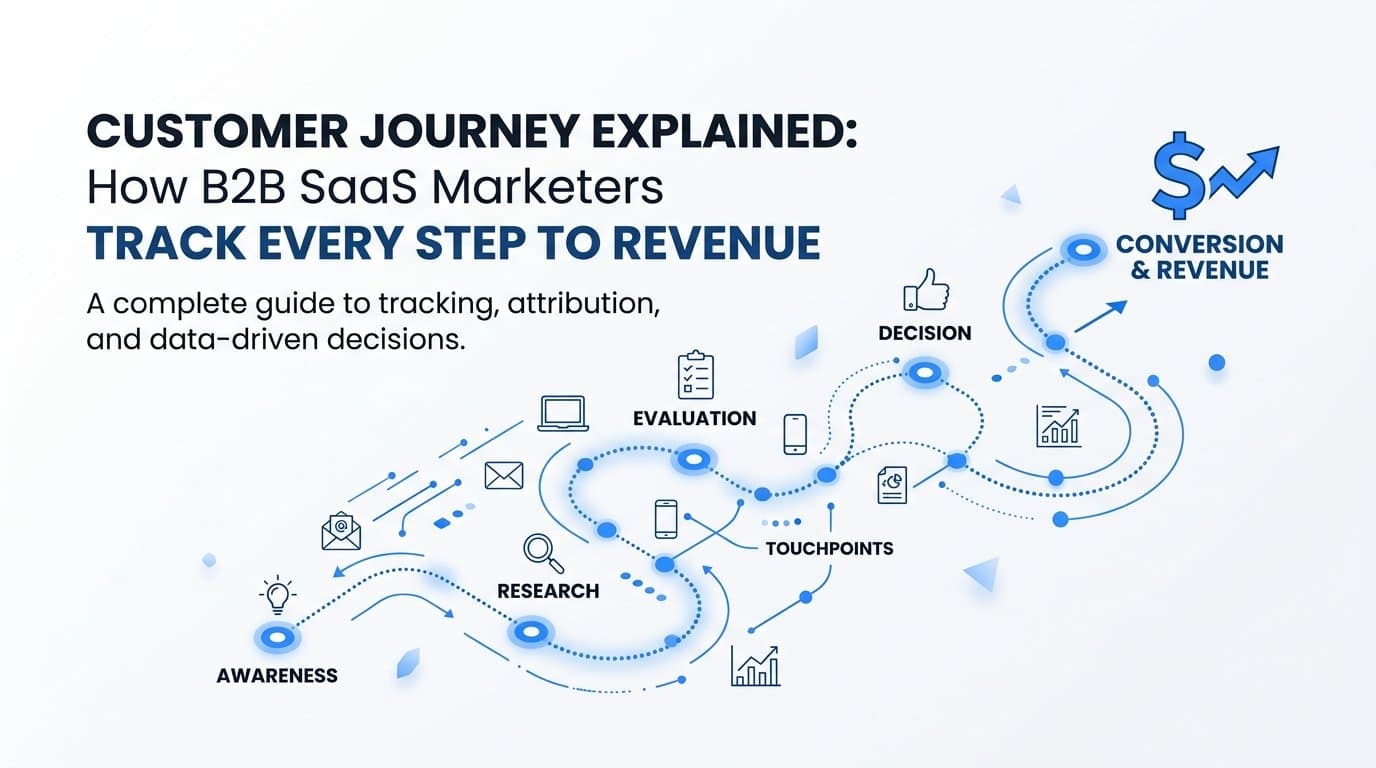
While every buyer's path is unique, B2B SaaS journeys tend to follow a recognizable arc. Breaking that arc into defined stages helps marketing teams understand which channels and content types belong where, and which conversion events to track at each point.
Awareness: This is where buyers first encounter your brand or recognize they have a problem worth solving. Touchpoints at this stage typically include paid social ads, display campaigns, organic content, podcast sponsorships, and word-of-mouth referrals. The goal here is reach and relevance. Conversion events to track include first ad impressions, blog visits, and new visitor sessions.
Consideration: The buyer is now actively researching solutions. They're comparing vendors, reading reviews on G2 or Capterra, watching product demo videos, and consuming more in-depth content like guides or webinars. Channels that tend to dominate this stage include organic search, email nurture sequences, and retargeting campaigns. Conversion events include return visits, content downloads, email opens tied to ad sequences, and free trial signups.
Evaluation: The buyer is narrowing their shortlist. They're engaging more deeply with your product, attending live demos, asking specific technical questions, and possibly involving other stakeholders. Retargeting ads featuring case studies, comparison pages, or demo invitations are particularly effective here. Conversion events include demo requests, product-qualified actions within a trial, and sales call completions.
Decision: The deal is on the table. Pricing conversations, contract reviews, and final approvals happen at this stage. Marketing's role shifts to supporting sales with the right content and maintaining brand presence through channels like branded search and direct email. Conversion events include closed-won opportunities and subscription activations.
Retention: The journey doesn't end at the sale. For SaaS businesses built on recurring revenue, post-purchase behavior matters enormously. Onboarding emails, product usage events, and expansion campaigns all contribute to long-term value. Tracking retention-stage touchpoints helps identify which acquisition channels bring in customers who actually stick around and grow.
Each stage generates different data signals, and each requires different tracking configurations to capture accurately. A marketing team that only tracks form fills and demo requests is missing the full picture. The richest attribution data comes from connecting signals across all five stages into a continuous, unified view of how buyers move toward revenue.
The Hidden Gap: What Most Teams Miss When Tracking the Journey
Most marketing teams have some form of tracking in place. They're using Google Analytics, their ad platforms' native dashboards, and maybe a CRM with basic lead source fields. The problem is that these tools, used in isolation, capture only fragments of the journey. The gaps between them are where attribution breaks down.
One of the most common blind spots is mid-funnel engagement. Teams often track clicks and form fills but miss the signals that indicate a prospect is warming up before they convert. Things like multiple visits to the pricing page, time spent on comparison content, or email opens that happen in sequence with retargeting ad exposures. These behaviors are meaningful signals of intent, and ignoring them means your attribution model is working with incomplete data.
The bigger structural problem is the reliability of browser-based pixel tracking. Pixels placed on your website depend on the browser to fire correctly and report back to your ad platforms. But several forces have eroded that reliability significantly. Apple's App Tracking Transparency changes, introduced in 2021 and continuing to evolve, limit the data that ad platforms can collect from iOS users. Cookie deprecation trends across major browsers have further reduced the lifespan and accuracy of pixel-based tracking. And widespread use of ad blockers means a meaningful portion of your traffic may never be recorded at all.
The result is that your ad platforms are working with incomplete conversion data. When Meta or Google can't see all the conversions your campaigns are generating, their optimization algorithms suffer. They bid less efficiently, target less accurately, and deliver worse results than they would with complete data.
Server-side tracking addresses this directly. Instead of relying on a browser pixel to fire and report conversion data, server-side tracking sends that data from your server directly to the ad platform. It's not affected by ad blockers, iOS restrictions, or browser privacy settings. The data arrives cleaner, more complete, and more reliable.
Conversion API integrations, such as Meta's CAPI and Google's enhanced conversions, work on this same principle. They allow you to send first-party conversion events directly from your server, supplementing or replacing the data that pixels would otherwise capture. For B2B SaaS teams running multi-channel campaigns, implementing server-side tracking is no longer optional. It's the baseline for accurate journey measurement.
Without it, attribution models are drawing conclusions from a dataset that's missing key pieces. And decisions made on incomplete data tend to produce incomplete results.
How Attribution Models Interpret the Customer Journey Differently
Once you have complete journey data, the next question is how to interpret it. That's where attribution models come in. Different models assign credit to touchpoints in fundamentally different ways, and choosing the wrong one can lead to systematically flawed budget decisions.
First-Touch Attribution: Gives all credit to the very first interaction a buyer had with your brand. This model is useful for understanding which channels generate initial awareness, but it ignores everything that happened after that first touch. For long B2B sales cycles, it often overstates the value of top-of-funnel channels.
Last-Touch Attribution: Gives all credit to the final interaction before conversion. This is the default in many analytics tools and CRMs. It's simple to implement but systematically undervalues the channels and content that built interest and intent throughout the journey. If branded search or direct traffic tends to be the last click before a demo booking, last-touch will credit those while ignoring the paid campaigns that drove awareness and consideration.
Linear Attribution: Distributes credit equally across every touchpoint in the journey. This is more balanced than single-touch models, but it treats a quick blog visit the same as a product demo, which may not reflect actual influence on the buying decision.
Time-Decay Attribution: Assigns more credit to touchpoints that occurred closer to the conversion event. The logic is that recent interactions are more influential. This works reasonably well for shorter sales cycles but can undervalue early-stage awareness touchpoints that planted the initial seed.
Data-Driven Attribution: Uses algorithmic analysis to assign credit based on actual conversion patterns in your data. Rather than applying a fixed rule, it identifies which touchpoints and sequences correlate most strongly with conversions. This is generally the most accurate model for complex B2B journeys, but it requires a sufficient volume of conversion data to produce reliable results.
Multi-touch attribution, which encompasses linear, time-decay, and data-driven models, gives a more complete view by distributing credit across the entire journey rather than concentrating it at a single point. For B2B SaaS teams with long sales cycles and multiple influencing touchpoints, this approach is far more aligned with how buying decisions actually happen.
The key takeaway is that no single model is universally correct. The right approach is to understand what each model tells you, compare them against each other, and use a platform that lets you switch between models to see how the story changes. That flexibility is what separates teams that truly understand their customer journey from those that are just reporting on it.
Connecting Customer Journey Data to Pipeline and Revenue
Tracking the journey doesn't stop at lead capture. For B2B SaaS companies, a lead is just the beginning of the story. What matters is whether that lead becomes a paying customer, how quickly they move through the pipeline, and what their long-term value turns out to be. Without connecting journey data to these downstream outcomes, marketing teams are measuring activity rather than impact.
The gap between marketing data and revenue data is one of the most persistent challenges in B2B SaaS. Marketing teams often report on metrics like cost per lead, click-through rate, and form fill volume. But sales teams and executives care about pipeline generated, deal velocity, and closed-won revenue. When these two worlds don't connect, marketing struggles to demonstrate its true contribution to the business.
Bridging that gap requires integrating ad platform data with CRM data. When you can tie a specific ad campaign to a specific opportunity in your CRM, you can see which campaigns are generating pipeline, not just leads. You can identify which channels produce deals that close faster, at higher contract values, or with better retention rates. That's a fundamentally different level of insight than cost per click.
Taking it one step further, integrating revenue data from billing platforms like Stripe allows you to connect marketing touchpoints all the way to actual revenue. You can calculate true cost per acquired customer by channel, measure lifetime value by acquisition source, and identify which campaigns are generating customers who expand and renew versus those who churn quickly. This is what revenue attribution looks like in practice.
Revenue attribution allows marketing teams to shift the conversation from vanity metrics to business outcomes. Instead of reporting that a campaign generated 200 leads, you can report that it generated a specific amount of pipeline and contributed to a measurable portion of closed-won revenue. That kind of reporting builds credibility, earns budget, and aligns marketing directly with company growth goals.
The practical requirement is that your tracking infrastructure must be set up to pass consistent identifiers across your ad platforms, website, CRM, and billing system. When a lead from a specific campaign is created in the CRM, that campaign data needs to travel with the record through every pipeline stage. Without that continuity, the connection between marketing activity and revenue outcome is lost.
Putting Customer Journey Tracking Into Practice
Understanding the theory is one thing. Building the infrastructure to track the customer journey accurately is where most teams need a clear starting point. Here's how to approach it practically.
Implement Server-Side Tracking First: Before anything else, address the data collection layer. Move away from relying solely on browser pixels and implement server-side tracking to ensure conversion events are captured reliably across all users, regardless of browser settings, ad blockers, or device type. Set up Conversion API integrations with your key ad platforms so they receive clean, first-party event data directly from your server.
Define Conversion Events at Each Journey Stage: Map out the specific actions that signal progression through each stage of the journey. For awareness, this might be a first session from a paid ad. For consideration, a pricing page visit or content download. For evaluation, a demo request or trial activation. For decision, a closed-won event in the CRM. Each of these should be a tracked event that feeds into your attribution model.
Connect Ad Data to CRM Records: Ensure that lead source data from your ad platforms is passed into your CRM at the point of lead creation and maintained through every pipeline stage. This is what allows you to trace a closed deal back to the specific campaign, ad set, and ad that started the journey.
Use a Unified Attribution Platform: Individual ad platform dashboards and standalone analytics tools each show you a slice of the picture. What you need is a platform that unifies touchpoint data across all channels into a single view of the customer journey. This is exactly what Cometly is built to do. It connects your ad platforms, website events, and CRM activity into one place, giving you a complete, accurate view of how buyers move from first touch to closed-won revenue.
Cometly's server-side conversion tracking and Conversion API integrations ensure that your data collection layer is reliable. Its multi-touch attribution models let you analyze the journey from multiple angles. And its pipeline and revenue attribution features connect marketing activity directly to the business outcomes that matter most. With Stripe integration, you can see which campaigns are generating customers with the highest lifetime value, not just the highest lead volume.
Beyond data collection and attribution, Cometly's AI-driven insights surface patterns in your journey data that would be difficult to identify manually. Which combinations of touchpoints correlate with faster sales cycles? Which awareness channels consistently produce high-value customers? Which mid-funnel content is doing the most work to move prospects toward a decision? AI analysis answers these questions at scale, so you can reallocate budget with confidence rather than guesswork.
The Bottom Line on Customer Journey Tracking
The customer journey is the backbone of accurate marketing attribution. Every impression, click, content view, email open, demo request, and CRM stage transition is a data point that tells part of the story. When you can see all of those data points connected in sequence, you understand what's actually driving revenue. When you can't, you're making budget decisions based on fragments.
Modern B2B SaaS marketers need more than basic analytics. They need a unified platform that connects ad data, website behavior, and CRM events into one clear, accurate picture of how buyers move from stranger to customer. They need server-side tracking to ensure data reliability. They need multi-touch attribution to distribute credit fairly. And they need revenue attribution to connect marketing activity to the outcomes that actually matter to the business.
The teams that invest in tracking the full customer journey don't just report better metrics. They make smarter decisions, scale campaigns more confidently, and demonstrate marketing's direct contribution to growth in terms that resonate across the entire organization.
Ready to see your full customer journey in one place? Get your free demo and discover how Cometly connects every touchpoint from first ad click to closed-won revenue, so you can stop guessing and start growing with confidence.