Running paid campaigns across Google Ads and Facebook Ads is standard practice for most marketing teams. But tracking performance across both platforms in a unified way? That is where things get complicated fast.
Each platform uses its own pixel, its own attribution window, and its own reporting logic. Google Ads defaults to a 30-day click-through attribution window. Meta defaults to 7-day click and 1-day view-through. Both platforms are self-attributing networks, meaning they each take full credit for conversions independently. Add those dashboards together and you will almost always see inflated totals that do not match reality.
Sound familiar? Google reports 40 conversions. Facebook claims 35. Your CRM shows 50 total. You are left guessing where your budget should actually go.
This is not a minor reporting inconvenience. It is a decision-making problem. When you cannot trust your data, you cannot confidently scale what is working or cut what is not. You end up spreading budget based on gut feel rather than evidence.
This guide walks you through exactly how to set up unified tracking for Google Ads and Facebook Ads so you can see the full customer journey, compare platforms accurately, and make confident budget decisions. Whether you are a solo marketer managing both platforms or part of a team scaling spend across channels, these six steps will take you from fragmented, conflicting data to a single source of truth.
By the end, you will have a working system that captures every touchpoint, attributes conversions correctly, and feeds better data back to both ad platforms so their algorithms can optimize toward your actual buyers.
Let us get into it.
Step 1: Audit Your Current Tracking Setup on Both Platforms
Before you build anything new, you need to understand what you are working with. A tracking audit sounds tedious, but skipping it means you will likely rebuild the same problems with better tools. Spend the time here and everything downstream becomes cleaner.
Start with Google Ads. Navigate to your Conversion Actions and document every event you are currently tracking. Note the conversion category, the attribution window, the counting method (every conversion vs. one conversion), and whether the source is a Google tag, an imported Google Analytics goal, or a manually created action. For a deeper dive into setting up conversion events properly, review this guide on Google Ads conversion tracking.
Then move to Meta Ads Manager. Review your Pixel events and, if you have it set up, your Conversions API configuration. List every standard event and custom event you are firing, where they are triggered, and whether deduplication is enabled between the Pixel and CAPI.
As you document, watch for these common issues:
Mismatched attribution windows: Google's 30-day click window and Meta's 7-day click plus 1-day view window will naturally produce different conversion counts for the same campaigns. Neither is wrong, but comparing them directly is like measuring distance in miles on one side and kilometers on the other.
Duplicate conversion events: Many accounts accidentally fire the same purchase or lead event multiple times, inflating counts. Check for both platform-level duplicates and cross-platform duplicates where the same conversion is counted in both Google and Meta.
Missing or inconsistent UTM parameters: Pull a sample of landing page URLs from recent ads on both platforms. Check whether UTM parameters are present, correctly formatted, and passing through to your analytics tool without being stripped or overwritten.
CRM mismatch: Pull your actual conversion data from your CRM or backend system for the same time period you are reviewing in both ad platforms. Document the gap. This number, how far off each platform's reported conversions are from your actual closed deals or verified leads, is your baseline problem to solve.
Create a simple spreadsheet with columns for platform, event name, attribution window, counting method, UTM status, and known issues. A marketing campaign tracking spreadsheet can serve as a great starting template for this document, which becomes your tracking source of truth and your roadmap for everything that follows.
Success indicator: You have a completed spreadsheet showing every tracked event, every attribution setting, and every known data gap across both platforms. You know exactly where the numbers are inflated and why.
Step 2: Standardize UTM Parameters and Naming Conventions
UTM parameters are the universal language of cross-platform tracking. They work independently of any platform's native tracking, which makes them your most reliable tool for comparing Google Ads and Facebook Ads in a single analytics view.
The goal of this step is to create a consistent UTM structure that cleanly identifies every piece of traffic, regardless of which platform sent it.
Here is a structure that works well for cross-platform tracking:
utm_source: Use "google" for Google Ads and "facebook" or "meta" for Meta Ads. Pick one and stick with it. Inconsistency here breaks segmentation downstream.
utm_medium: Use "cpc" for paid search and "paid-social" for Facebook and Instagram ads. This allows you to filter by channel type across all sources.
utm_campaign: Use a consistent naming format across both platforms. A structure like [platform]-[objective]-[audience] works well. For example: "google-search-retargeting" or "meta-prospecting-lookalike". Proper Facebook campaign tracking depends on getting this naming convention right from the start.
utm_content: Use this to identify the specific ad creative or ad set. This is particularly useful for comparing creative performance across platforms.
utm_term: For Google Ads, this is typically your keyword. For Facebook Ads, you can use it to identify audience segment or targeting type.
For Google Ads, enable auto-tagging (GCLID) in your account settings. GCLID passes additional click data that UTMs alone cannot capture, and it is required for importing conversions back from Google Analytics. Auto-tagging and UTMs can coexist, so enable both.
For Meta Ads, set up URL parameters directly in your ad set settings under the "Tracking" section. Meta also appends its own FBCLID parameter automatically, which you do not need to add manually. Just make sure your UTMs are present alongside it.
The most common pitfall at this stage is inconsistent formatting. Capitalization matters. "Google" and "google" are treated as two different sources in most analytics tools. Build a naming convention document and share it with everyone who touches campaigns. Include examples, approved values for each UTM field, and a note that deviations will break your reporting.
A shared naming convention document is not glamorous, but it is one of the highest-leverage things you can do for long-term data quality. Enforce it from the start and you will thank yourself six months from now when your cross-platform reports actually make sense.
Success indicator: Every active ad on both platforms has consistent UTM parameters applied. You can open your analytics tool and see clearly separated traffic from Google Ads and Facebook Ads with no overlap or mystery "direct" sessions caused by missing tags.
Step 3: Implement Server-Side Tracking for Accurate Data Collection
Here is the uncomfortable truth about browser-based tracking in 2026: it is no longer reliable enough to base major budget decisions on.
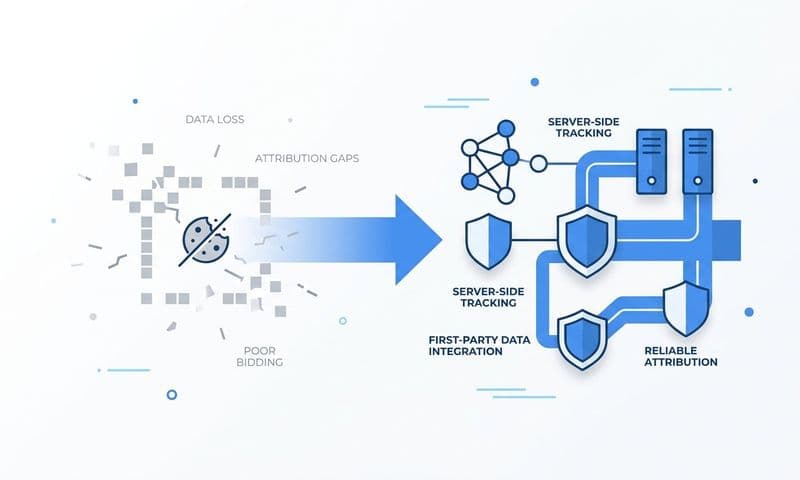
Apple's App Tracking Transparency framework, introduced with iOS 14.5, significantly reduced the data Meta receives from mobile users who opt out of tracking. Safari's Intelligent Tracking Prevention and Firefox's Enhanced Tracking Protection limit how long cookies persist in browsers. Ad blockers prevent pixels from firing entirely for a growing segment of users. The result is that browser-based pixels, both Google's and Meta's, are increasingly missing conversion events that actually happened. Understanding these gaps in Facebook Pixel tracking is critical before moving to a server-side solution.
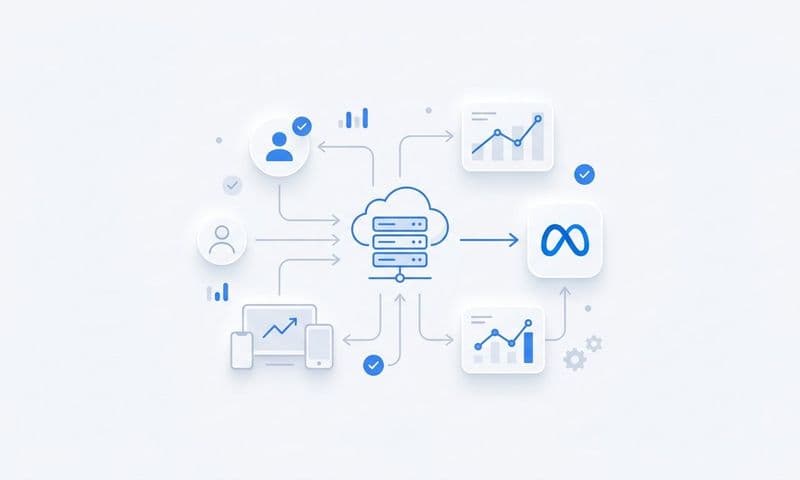
Server-side tracking solves this by sending conversion data directly from your server to both Google and Meta, completely bypassing browser-level restrictions. When a conversion happens, your server captures it and sends the event data directly through Meta's Conversions API (CAPI) and Google's Enhanced Conversions. The browser never has to fire a pixel for the conversion to be recorded.
Here is how to approach the implementation:
For Meta: Set up the Conversions API alongside your existing Pixel. Meta recommends running both in parallel with deduplication enabled. The Pixel handles browser-side events when it can, and CAPI fills in the gaps. You will need to pass an event ID that matches between both signals so Meta can deduplicate correctly and avoid double-counting.
For Google: Enhanced Conversions for Google Ads works similarly. You pass hashed first-party customer data (like email addresses) alongside your conversion events, which allows Google to match conversions more accurately even when cookies are missing.
Setting this up natively requires developer resources and ongoing maintenance as both platforms update their APIs. This is where a tool like Cometly simplifies the process significantly. Cometly's server-side tracking captures conversion events at the server level and routes them to both Google and Meta simultaneously, without requiring you to manage two separate API integrations. It also handles deduplication automatically, so you are not inflating counts by sending the same event from both browser and server without proper matching.
The practical difference this makes is substantial. Many marketers who implement server-side tracking discover they were missing a meaningful portion of conversions in their browser-based setup. That gap was causing both platforms to underreport performance, which in turn caused their algorithms to optimize poorly because they were learning from incomplete data.
Success indicator: Conversion counts from your server-side setup closely match your CRM or backend data. You are no longer seeing the large discrepancy between platform-reported conversions and actual verified conversions in your system of record.
Step 4: Connect Both Platforms to a Unified Attribution Dashboard
Even with perfect tracking in place, relying on each platform's native reporting will always give you a distorted picture. This is not a flaw in the platforms. It is simply how self-attributing networks work. Both Google and Meta are designed to show their own performance in the best possible light, and both will claim credit for the same conversion when a user touched both platforms before buying. Understanding these Facebook Ads reporting discrepancies is key to appreciating why a unified dashboard matters.
The solution is a central attribution dashboard that pulls data from Google Ads, Meta Ads, your CRM, and your website into one unified view, then applies a consistent attribution model across all of it.
This is where multi-touch attribution becomes essential. Single-touch models, whether first-click or last-click, will always over-credit one platform at the expense of the other. A buyer who saw a Facebook ad, searched Google three days later, and then converted will be 100% attributed to Google in a last-click model. Facebook gets no credit even though it initiated the journey. Flip to first-click and the opposite problem occurs.
Multi-touch attribution distributes credit across all touchpoints in the customer journey based on the model you choose:
Linear attribution: Distributes credit equally across every touchpoint. Good for getting a baseline view of how all channels contribute.
Time decay attribution: Gives more credit to touchpoints closer to the conversion. Useful when your sales cycle is short and recency matters most.
Position-based (U-shaped) attribution: Gives more credit to the first and last touchpoints. Works well when both awareness and closing are distinct priorities.
Data-driven attribution: Uses your actual conversion data to assign credit based on which touchpoints statistically correlate with conversions. The most accurate model, but requires sufficient conversion volume to be reliable. For a complete walkthrough on building this kind of system, see this guide on attribution tracking setup.
Cometly connects all of these data sources, including Google Ads, Meta Ads, your CRM, and your website, into a single analytics view and applies multi-touch attribution across the full customer journey. Instead of looking at two separate dashboards that disagree with each other, you see one timeline showing how Google and Facebook touchpoints worked together to drive each conversion.
This view changes how you think about both platforms. You stop asking "which platform performed better?" and start asking "how do these platforms work together, and what role does each one play in my funnel?"
Success indicator: You can view a single conversion timeline that shows the sequence of Google and Facebook touchpoints leading to a sale. You have chosen an attribution model that matches your business goals and applied it consistently across both platforms.
Step 5: Sync Enriched Conversion Data Back to Ad Platforms
Most marketers set up tracking in one direction: from the ad platforms into their analytics dashboard. But the loop is not complete until you send data back the other way.
Both Google and Meta use machine learning to optimize ad delivery, bidding, and targeting. That machine learning is only as good as the conversion signals it receives. When your tracking is incomplete or delayed, the algorithms are optimizing toward a distorted version of your buyers. The result is wasted spend and slower performance improvements over time.
Conversion sync closes this loop. It takes the verified, deduplicated conversion events from your attribution tool and sends them back to both Google Ads and Meta Ads so their algorithms can learn from your actual buyers, not just the conversions they happened to observe on their own. This is one of the most impactful ways ad tracking tools can help you scale ads using accurate data.
Here is why this matters in practice. After implementing server-side tracking, you are likely capturing more conversions than your browser-based pixels were recording. If you only send those conversions to your dashboard but not back to the platforms, Google and Meta are still optimizing on incomplete data. Syncing enriched conversions back corrects this.
For Meta, this means sending events through the Conversions API with enriched customer data, including email addresses and phone numbers that Meta can use for matching. The more complete your match data, the better Meta can identify who converted and find similar users to target. Properly feeding this data back is essential for Facebook Ads optimization at scale.
For Google, Enhanced Conversions allows you to pass hashed first-party data alongside your conversion events, improving match rates and giving Google's Smart Bidding strategies better signals to work with.
Cometly's Conversion Sync feature handles this automatically. It sends enriched, deduplicated conversion events back to both Meta CAPI and Google Ads from your verified attribution data. The platforms receive cleaner signals, their algorithms improve, and your campaign performance compounds over time as the targeting gets sharper.
The common pitfall to avoid here is sending data only one direction. Many teams invest in a great attribution dashboard but never close the loop back to the platforms. This leaves their machine learning running on incomplete information and slows down the performance gains they could otherwise achieve.
Success indicator: Both Google Ads and Meta Ads are receiving conversion events from your server-side attribution tool. Your conversion volumes in each platform reflect the fuller, more accurate data from your server-side setup rather than the incomplete browser-based counts from before.
Step 6: Analyze Cross-Platform Performance and Reallocate Budget
With unified tracking in place, server-side data flowing, and enriched conversions syncing back to both platforms, you now have something most marketers never achieve: a reliable, cross-platform view of what is actually driving revenue.
Now you use it.
Open your unified paid ads analytics dashboard and start with the metrics that matter most for budget decisions: true ROAS, cost per acquisition, and conversion volume by platform. Because you are using a consistent attribution model applied to deduplicated data, these numbers are directly comparable without double-counting inflating either side.
Look beyond the top-line numbers and examine the customer journey patterns. Multi-touch attribution often reveals that Google and Facebook are playing very different roles in your funnel. Common patterns include:
Facebook initiates, Google closes: Prospecting campaigns on Meta introduce your brand to new audiences. Those users later search Google, click a branded or competitor keyword, and convert. In a last-click model, Google gets all the credit. In multi-touch, you can see Facebook's role in starting the journey.
Google initiates, Facebook retargets: Users find you through search, visit your site but do not convert, then see a retargeting ad on Facebook and come back to buy. Here, cutting Facebook retargeting spend because it "costs too much" would actually hurt Google's conversion rate downstream.
Both platforms work independently by segment: Some customer segments convert entirely through one channel. Knowing this lets you allocate budget toward the channel that works best for each audience type.
Once you understand these patterns, budget reallocation becomes a data-driven decision rather than a platform preference. Use AI ads optimization recommendations, like those available in Cometly's AI Ads Manager, to identify which specific campaigns, ad sets, and creatives are delivering the strongest results across both platforms. These recommendations surface high-performing opportunities and flag underperforming spend so you can act quickly.
Review your cross-platform performance on a regular cadence, weekly for active campaigns and monthly for strategic budget allocation. The goal is not to pick a winner between Google and Facebook but to understand how they work together and fund each one appropriately based on the role it plays in your actual customer journey.
Success indicator: You can clearly articulate which platform deserves more budget and why, with specific attribution data to support the decision. You have identified at least one insight about how Google and Facebook interact in your funnel that was invisible before unified tracking was in place.
Your Cross-Platform Tracking Checklist: Putting It All Together
You now have a complete system for tracking Google Ads and Facebook Ads together. Before you move on, here is a quick-reference checklist to confirm everything is in place:
1. Audit complete: You have documented every conversion event, attribution window, and data gap across both platforms in a shared spreadsheet.
2. UTMs standardized: Every active ad on both platforms uses consistent UTM parameters and naming conventions that cleanly separate traffic sources in your analytics tool.
3. Server-side tracking live: Conversion events are being captured at the server level and sent to both Google Enhanced Conversions and Meta CAPI, bypassing browser restrictions and filling in the gaps that pixels miss.
4. Unified dashboard connected: Google Ads, Meta Ads, your CRM, and your website data are all pulling into a single attribution view with a consistent multi-touch attribution model applied.
5. Conversion sync active: Enriched, deduplicated conversion events are flowing back to both platforms so their algorithms can optimize toward your actual buyers.
6. Cross-platform analysis running: You are reviewing true ROAS, CPA, and customer journey patterns regularly, and making budget decisions based on unified data rather than each platform's self-reported numbers.
The goal here is not just better reporting. It is better decisions. When you can see the full journey from first click to closed deal across both Google and Facebook, you stop guessing and start scaling with confidence. You know which platform initiates purchase intent, which one closes it, and how much credit each deserves in your budget allocation.
Cometly brings all of this together in one platform. From server-side tracking to multi-touch attribution to conversion sync, it gives you the unified view that makes cross-platform tracking actually work without stitching together five different tools and hoping they play nicely.
If you are ready to stop guessing and start making budget decisions backed by real data, Get your free demo today and see how Cometly helps you capture every touchpoint, connect every channel, and maximize what your ad spend can actually do.