Picture this: you're in a quarterly planning meeting, and someone asks whether the team should invest more in growth marketing or double down on demand generation. Half the room nods at one term, half at the other, and nobody quite agrees on what either actually means. Sound familiar?
This confusion is more common than most marketing leaders want to admit. Growth marketing and demand generation are two of the most frequently conflated terms in B2B SaaS, often used interchangeably in job descriptions, budget conversations, and strategy decks. But they represent meaningfully different philosophies, timelines, and team structures, and treating them as synonyms can quietly drain your budget while leaving your attribution data in shambles.
The distinction matters for a practical reason: if you invest in the wrong strategy for your stage of growth, you will spend months optimizing the wrong metrics. A seed-stage SaaS company running product-led retention experiments before it has a repeatable pipeline is solving the wrong problem. A growth-stage company relying entirely on top-of-funnel demand gen while ignoring activation and churn is leaving significant revenue on the table.
This article will clarify what each strategy actually means, where each one operates in the funnel, what tactics and team structures each requires, and how to measure both accurately. More importantly, it will help you decide which to prioritize given where your company is today, and how to eventually run both in parallel with the data infrastructure to support it.
Two Strategies, Two Different Jobs to Be Done
Let's start with clear definitions, because precision here matters more than most people realize.
Growth marketing is a full-funnel, experimentation-driven discipline focused on acquiring, activating, retaining, and expanding customers across the entire customer lifecycle. It is not a synonym for paid acquisition, and it is not limited to top-of-funnel awareness. Growth marketing teams run structured experiments across every stage of the customer journey, from the moment someone first hears about your product to the moment they become a loyal advocate or expand their contract.
The discipline emerged from startup and product-led cultures, popularized by the concept of the growth hacker but long since matured into a rigorous, data-driven function. The core belief is simple: every part of the customer journey is an opportunity to optimize, and decisions should be driven by data and rapid testing rather than intuition or convention.
Demand generation, by contrast, is a B2B-specific strategy focused on creating and capturing market demand through awareness, education, and pipeline creation. It typically encompasses content marketing, SEO, paid media, webinars, events, and account-based marketing. The goal is to generate a predictable, qualified pipeline of prospects that a sales team can work and close.
Demand gen teams are generally measured on marketing qualified leads, sales accepted leads, pipeline influenced, and cost per opportunity. Their primary customer is often internal: the sales organization. When demand gen works well, sales has a consistent flow of educated, interested prospects entering the funnel every month.
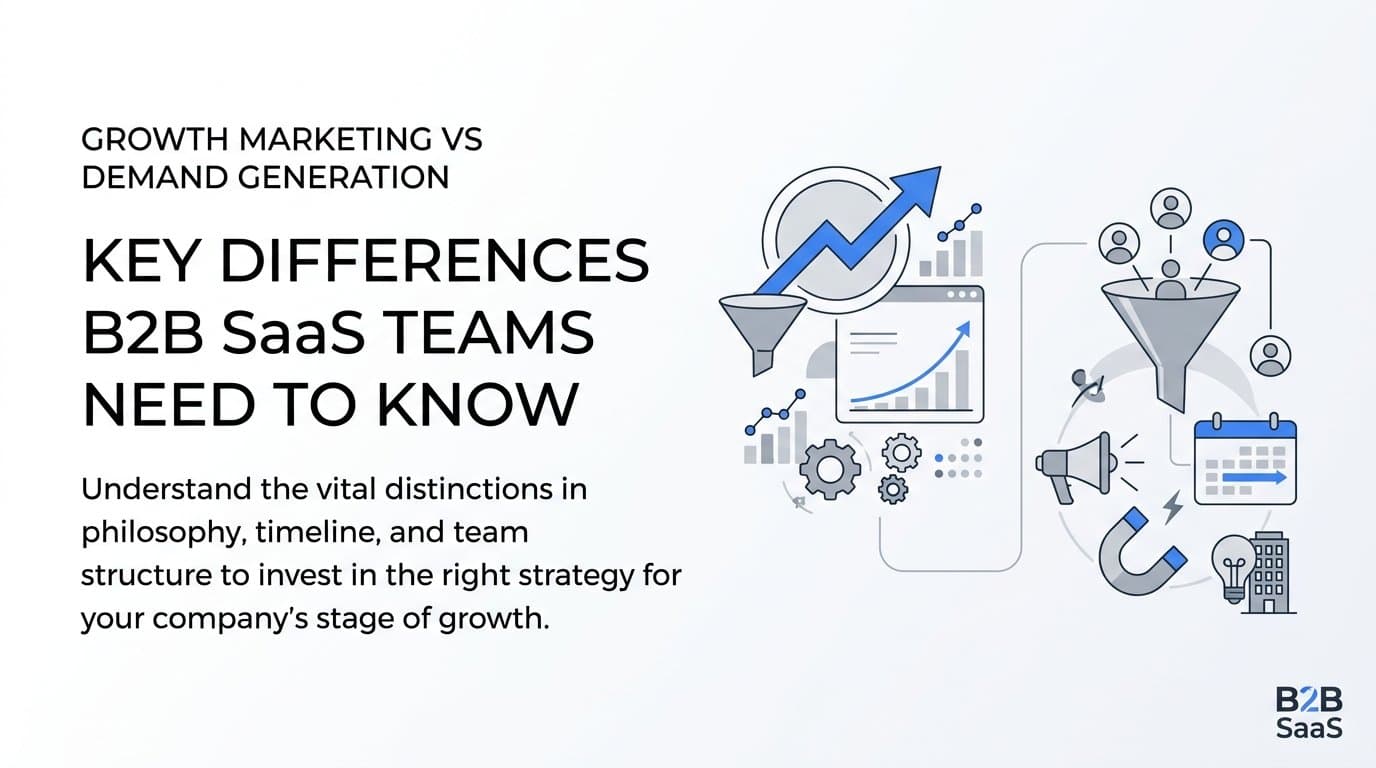
The core philosophical difference comes down to scope and ownership. Growth marketing optimizes the entire customer journey using rapid testing and data feedback loops, touching product, onboarding, retention, and expansion. Demand generation prioritizes building a predictable pipeline of qualified prospects for a sales team to close, with its primary focus on the top and middle of the funnel.
Neither is better than the other in the abstract. They are designed to do different jobs, and understanding that distinction is the first step toward investing in the right one at the right time.
Where Each Strategy Lives in the Funnel
One of the clearest ways to distinguish these two strategies is to map where each one operates. The funnel position shapes everything: the metrics you track, the tools you use, and the teams you build.
Growth marketing maps across the full AARRR framework, sometimes called the pirate metrics model: Acquisition, Activation, Retention, Referral, and Revenue. This is not a metaphor. Growth marketing teams genuinely own work across all five stages, which means they are involved in paid acquisition experiments, yes, but also in onboarding flow optimization, in-app messaging, lifecycle email sequences, referral program design, and expansion revenue strategies.
This breadth is what makes growth marketing so powerful at scale and so difficult to implement early. It requires close collaboration with product and engineering teams, access to product usage data, and the ability to run experiments across both the marketing surface and the product itself. Growth marketing does not stop when a user signs up. In many ways, that is where the real work begins.
Demand generation, on the other hand, primarily operates at the top and middle of the funnel. Its job is to create awareness among the right audience, educate that audience about the problem your product solves, and convert that awareness into qualified pipeline. The typical demand gen motion includes brand awareness campaigns, content marketing and SEO, gated assets and lead magnets, webinars, paid social and search campaigns, and lead nurturing sequences that move prospects from awareness to sales-ready.
Once a prospect becomes a sales accepted lead or books a demo, demand generation's job is largely done. The handoff goes to sales, and the demand gen team turns its attention to generating the next cohort of qualified pipeline.
This funnel positioning directly shapes the metrics each team owns. Growth marketing teams track activation rates, time-to-value in onboarding, retention curves, net revenue retention, and expansion revenue. These metrics live in your product analytics and CRM, not just your ad platform dashboards.
Demand gen teams track MQLs, pipeline created, pipeline influenced, cost per opportunity, and lead-to-opportunity conversion rates. These metrics live at the intersection of your marketing automation platform, your ad platforms, and your CRM.
The practical implication: if your analytics setup only measures top-of-funnel activity, you can evaluate demand generation performance but you are flying blind on growth marketing. And if your attribution model stops at the lead stage, you cannot connect either strategy to closed-won revenue, which is ultimately the only metric that matters.
Tactics, Channels, and Team Structures
Understanding the funnel positions of each strategy makes the tactical differences much easier to see. Let's look at what each approach actually does in practice.
Growth Marketing Tactics
Growth marketing teams run structured experiments designed to reduce friction and increase value delivery at every stage of the lifecycle. Common tactics include A/B testing onboarding flows to improve activation rates, building referral programs that turn satisfied customers into acquisition channels, deploying in-app messaging to guide users toward key product moments, and designing lifecycle email sequences that drive users from initial signup toward deep product engagement.
Product-led growth experiments are also a core part of the growth marketing toolkit. This might mean optimizing a freemium tier to convert free users into paid customers, testing different upgrade prompts inside the product, or reducing the steps between signup and first value delivery. In a PLG model, the product itself is the primary acquisition and expansion vehicle, and growth marketing is the discipline that continuously optimizes that vehicle.
Demand Generation Tactics
Demand gen teams operate with a different set of tools. Their toolkit typically includes gated content and lead magnets designed to capture contact information from in-market buyers, SEO-driven thought leadership content that attracts organic traffic from people searching for solutions, paid social campaigns on platforms like LinkedIn targeting specific job titles and company sizes, and intent data targeting that identifies companies actively researching solutions like yours.
Account-based marketing is increasingly central to demand gen in B2B SaaS, particularly for companies selling into mid-market and enterprise segments. ABM coordinates marketing and sales effort around a defined list of target accounts, using personalized content, outreach, and advertising to create awareness and pipeline within those specific organizations. SDR alignment is also critical: demand gen teams often work closely with sales development reps to ensure that inbound leads are followed up on quickly and that outbound sequences complement inbound campaigns.
How Team Structures Differ
The organizational differences are just as significant as the tactical ones. Growth marketing teams typically sit closer to product and engineering. They need access to product data, the ability to ship experiments quickly, and close collaboration with data science or analytics functions. In many product-led companies, growth is its own team with dedicated engineering resources.
Demand gen teams, by contrast, typically report into the broader marketing organization with tight alignment to sales. They work closely with the CRM, marketing automation platforms, and SDR teams. Their success is measured by the quality and volume of pipeline they hand to sales, which means their relationship with the sales organization is one of their most important operating dependencies.
Measuring What Actually Matters for Each Approach
Here is where things get genuinely complicated, and where many B2B SaaS marketing teams run into serious problems.
Growth marketing requires tracking micro-conversions and product events across a long customer lifecycle. You need to know not just that someone signed up, but whether they completed onboarding, reached a key activation milestone, returned to the product after day seven, expanded their usage in month three, and referred a colleague in month six. This level of measurement requires product analytics tools, event tracking, and a data pipeline that connects product behavior to your CRM and marketing data.
Demand generation faces a different measurement challenge. The goal is to connect top-of-funnel touchpoints to closed-won revenue through multi-touch attribution. In a typical B2B buying cycle, a prospect might encounter your brand through an organic search result, attend a webinar, click a LinkedIn ad, read three blog posts, and then book a demo after seeing a retargeting ad. Which of those touchpoints gets credit for the deal?
Last-click attribution, which assigns all credit to the final touchpoint before conversion, fails both strategies. For demand generation, it systematically undercredits the awareness and education content that created the conditions for a prospect to convert. A LinkedIn thought leadership campaign that introduced your brand to a buyer six months before they booked a demo will show zero attributed revenue in a last-click model, even though it may have been the catalyst for the entire relationship.
For growth marketing, last-click attribution misses the product and lifecycle touchpoints entirely, because those events rarely show up in ad platform attribution windows at all.
Multi-touch attribution models, including linear, time-decay, position-based, and data-driven approaches, provide a more accurate picture of how both strategies contribute to revenue. They distribute credit across the touchpoints that actually influenced a buyer's journey, giving marketing leaders a clearer view of which programs are working and which are not.
The practical requirement this creates is significant: you need to connect your ad platform data from Meta, Google, and LinkedIn to your CRM pipeline and revenue data. This connection is what allows you to see which demand gen campaigns actually influenced closed deals, not just lead volume. It is also what allows you to see which growth marketing experiments drove expansion revenue, not just activation rates.
Without this connection, you are making budget decisions based on incomplete information, which almost always means overinvesting in the channels that are easiest to measure rather than the ones that are actually driving revenue.
Which Strategy Fits Your Stage of Growth
Knowing what each strategy does is only half the answer. The other half is knowing when to use each one.
Early-Stage B2B SaaS
At the earliest stages, demand generation is typically the right priority. Your primary goal is building initial pipeline, proving product-market fit, and establishing a repeatable sales motion. You need qualified prospects entering the funnel so you can learn what messaging resonates, which customer profiles convert, and what objections your sales team needs to overcome.
Running sophisticated growth marketing experiments at this stage, before you have a meaningful user base or a clear understanding of what drives retention, often means optimizing something you do not yet understand well enough to improve. Focus on demand gen first: get prospects in the door, close deals, and learn from real customers before investing heavily in lifecycle optimization.
Growth-Stage B2B SaaS
As your company scales, growth marketing becomes increasingly important. You now have a user base to retain, expand, and turn into referral sources. Churn is a real problem. Expansion revenue is a real opportunity. And the cost of acquiring a new customer through demand gen is almost always higher than the cost of expanding an existing one.
At this stage, investing in onboarding optimization, lifecycle email sequences, in-app engagement, and referral programs typically delivers strong returns. You also have enough data to run meaningful experiments, because you have the sample sizes and the historical context to interpret results accurately.
Demand generation remains important at this stage, but it shares priority with growth marketing rather than dominating the entire marketing budget.
Mature B2B SaaS
The most effective organizations at scale run both strategies in parallel. Demand gen feeds new pipeline consistently. Growth marketing maximizes revenue from the existing customer base through retention, expansion, and referral programs. The two functions complement each other: demand gen brings new customers in, and growth marketing ensures those customers stay, grow, and bring others along.
Running both in parallel requires unified data to avoid siloed decision-making. If the demand gen team and the growth marketing team are working from different dashboards with different definitions of success, you will inevitably have budget conflicts, attribution disputes, and strategic misalignment. A single source of truth for your marketing data is not a nice-to-have at this stage. It is an operational requirement.
Building the Data Foundation Both Strategies Require
The real competitive advantage in B2B SaaS marketing is not choosing growth marketing over demand generation, or vice versa. It is having the measurement infrastructure to know which programs are working across both, so you can allocate budget with confidence rather than intuition.
This requires connecting three data sources that most companies keep in separate silos: ad platform data, CRM data, and website and product analytics. When these sources are unified, you can trace a closed-won deal back to the specific campaigns, channels, and touchpoints that influenced it, whether those touchpoints were a LinkedIn ad, a webinar registration, an onboarding email, or an in-app prompt.
A marketing attribution platform built for B2B SaaS does exactly this. It connects your ad platforms, your CRM, and your customer journey data into a single view so that marketing leaders can see which demand gen campaigns are actually driving pipeline, which growth marketing experiments are improving retention and expansion, and how the two strategies interact across the full customer lifecycle.
This kind of attribution clarity also feeds your ad platform AI with better data. When you send enriched, conversion-ready events back to Meta, Google, and LinkedIn, those platforms can optimize toward the outcomes that actually matter, such as closed-won revenue rather than form fills, which improves targeting and ad ROI over time.
The practical next step is an attribution audit. Look at your current analytics setup and ask a simple question: can you accurately trace revenue back to the specific campaigns, channels, and touchpoints that drove it? If the answer is no, or if the answer is "kind of, but only for last-click conversions," you have a data infrastructure problem that will limit both your demand gen and your growth marketing, regardless of how well-designed your strategy is.
Putting It All Together
Growth marketing and demand generation are not competing strategies. They are complementary disciplines designed to do different jobs at different stages of the customer lifecycle. Demand generation creates and captures market demand, building the pipeline that feeds your sales team. Growth marketing optimizes the full customer journey, maximizing the value of every customer your demand gen efforts bring in.
The teams that win are those who understand which job each approach is designed to do, invest in the right strategy for their current stage of growth, and have the data infrastructure to measure both accurately. That last piece is where most companies fall short, not because they lack ambition, but because connecting ad spend to CRM pipeline to closed-won revenue across a multi-touch B2B buying cycle is genuinely difficult without the right tools.
Ask yourself whether your current analytics stack gives you visibility into the full customer journey, from first ad click to closed-won revenue. If there are gaps, those gaps are costing you budget efficiency and strategic clarity in equal measure.
Cometly connects ad spend, CRM data, and customer journey analytics to give B2B SaaS teams the attribution clarity they need to scale both strategies with confidence. From multi-touch attribution to AI-driven campaign recommendations, it gives you a single source of truth for every touchpoint that matters. Get your free demo today and start capturing every touchpoint to maximize your conversions across both demand generation and growth marketing.