AI-powered search tools like ChatGPT, Perplexity, and Google's AI Overviews are reshaping how B2B buyers discover software, vendors, and solutions. Instead of clicking through pages of search results, decision-makers are asking AI systems direct questions and acting on the answers they receive. The shift is real, and it is accelerating.
For B2B SaaS marketing teams, this creates a new visibility challenge. If your brand is not being mentioned in AI-generated responses, you are missing a growing segment of your pipeline. Buyers are forming opinions about vendors before they ever visit your website, based entirely on what AI tools tell them.
The good news is that AI search visibility is buildable. It is not a black box reserved for the biggest brands with the largest budgets. It is built on a combination of content depth, structured data, brand authority signals, and consistent topical expertise. These are things every serious marketing team can develop with the right approach.
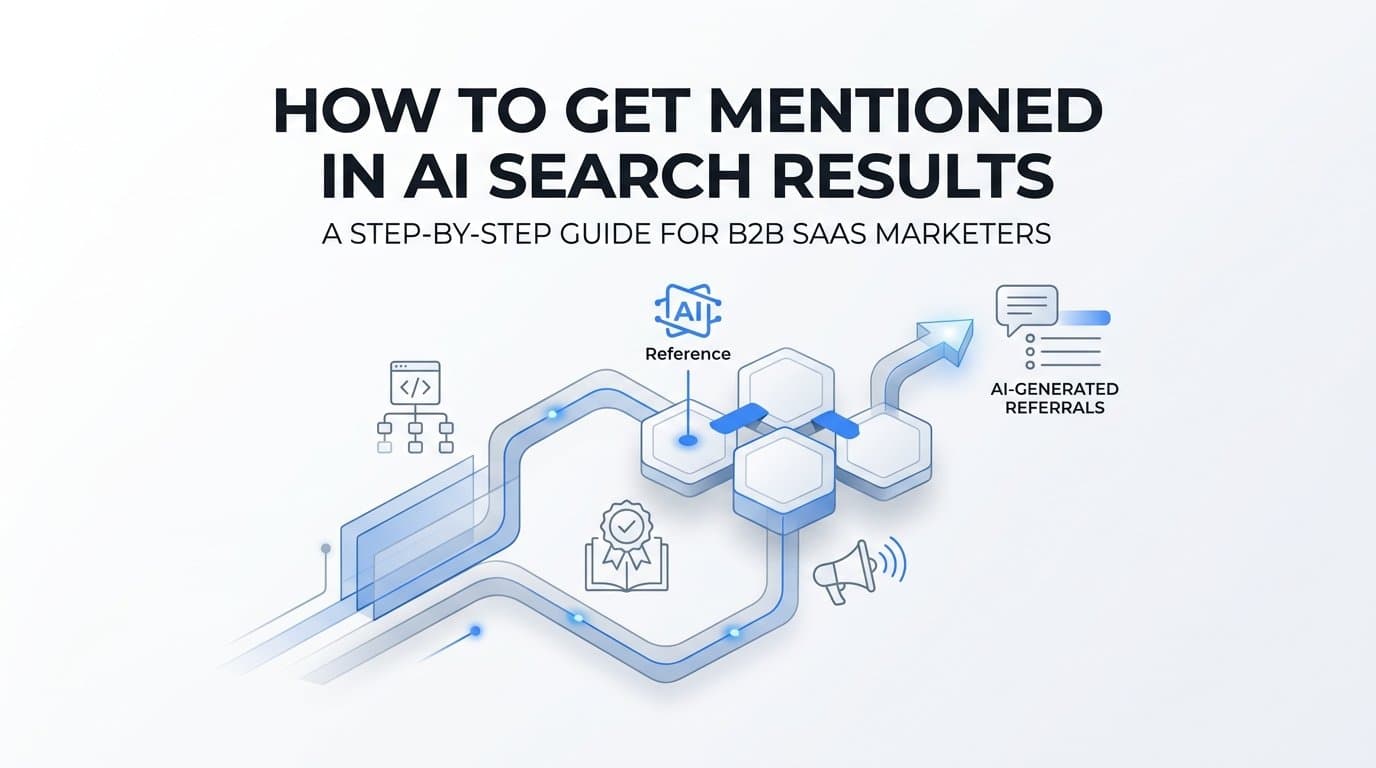
This guide walks you through a practical, six-step process to position your brand so AI systems recognize it as a credible, authoritative source worth referencing. It is designed for marketing leaders and growth teams who already understand paid acquisition and attribution, but want to expand their organic presence into the AI discovery layer.
Unlike traditional SEO tactics focused on keyword density and link volume, AI search visibility requires a more holistic strategy. You need to define your brand entity clearly, create content that directly answers buyer questions, earn mentions from sources AI systems trust, and structure your content so it can be extracted and referenced accurately.
By the end of this guide, you will have a clear action plan to improve how often your brand surfaces in AI-generated answers. And because visibility without measurement is just vanity, we will also cover how to connect your AI search efforts to actual pipeline data so you can prove the ROI of every step you take.
Step 1: Understand How AI Search Systems Decide What to Mention
Before you can optimize for AI search visibility, you need to understand how these systems actually work. The mechanics are different from traditional search engines, and treating them the same way is one of the most common mistakes B2B SaaS marketing teams make.
Large language models like those powering ChatGPT, Perplexity, and Google's AI Overviews generate responses by drawing on patterns learned during training and, in some cases, real-time indexed content. They do not simply return the page with the highest keyword density. Instead, they synthesize information from multiple sources to construct a coherent, confident answer.
This means brands that appear consistently across high-authority sources, with clear and consistent descriptions, are far more likely to be referenced. AI systems are essentially pattern-matching engines. The more clearly and consistently your brand is described across the web, the more confidently an AI system can reference you in a relevant response.
It is also worth understanding that different AI search tools work differently. Google's AI Overviews pull heavily from indexed web content and tend to favor sources that already rank well in traditional search. Conversational AI tools like ChatGPT draw primarily from training data, with some models also accessing live search results. Perplexity functions more like a real-time answer engine, citing sources directly and pulling from current indexed pages.
Each of these has different signal weights, which means a single-channel approach will not be sufficient. You need to build visibility across multiple layers: your website content, third-party mentions, structured data, and review platforms.
A concept worth understanding here is entity recognition. AI systems use entity recognition to understand what a brand is, what it does, and who it serves. Your brand needs to be clearly defined as an entity across the web so AI systems can confidently reference it without ambiguity. If your company description varies significantly from platform to platform, AI systems may struggle to form a clear picture of what you do.
Common pitfall: Treating AI search optimization like traditional keyword stuffing. Repeating your target phrase dozens of times on a page will not help you get mentioned in AI responses. What matters is genuine expertise, consistent entity signals, and content that directly answers specific questions.
Success indicator: Run test queries in ChatGPT and Perplexity related to your product category. Search for questions like "what is the best marketing attribution software for B2B SaaS" or "how do I track ad performance across channels." Note whether your competitors appear before you. This gives you a baseline to measure against as you execute the steps that follow.
Step 2: Build a Clear Brand Entity Across the Web
Think of your brand entity as the digital fingerprint AI systems use to identify and describe your company. If that fingerprint is inconsistent or unclear, AI tools will either skip you entirely or describe you inaccurately. Building a clear, consistent entity across the web is foundational to everything else in this guide.
Start by defining the core elements of your brand entity: your company name, your product category, your core use case, and your target audience. Write a single, clear description of your company that captures all four elements in plain, unambiguous language. This becomes your canonical description, and it should appear consistently across every public-facing property you control.
Next, audit your presence on high-authority platforms. The most important ones for B2B SaaS companies include G2, Capterra, LinkedIn's company page, Crunchbase, and your own About page. Visit each one and compare how your company is described. Small inconsistencies, like describing your product as "marketing analytics software" in one place and "attribution platform" in another, create ambiguity that reduces your chances of being referenced accurately.
Your website itself is a critical entity signal. Your homepage, About page, and product pages should clearly state what your product does, who it is for, and what problems it solves. Avoid vague language like "we help businesses grow." Be specific: "Cometly is a marketing attribution platform built for B2B SaaS companies that connects ad spend directly to pipeline and closed revenue."
On the technical side, add structured data markup to your website using Schema.org vocabulary. Organization schema and Product schema help search crawlers and AI indexers parse your brand information accurately. This is not optional if you are serious about AI search visibility. It is one of the clearest signals you can send to automated systems about who you are and what you do.
If your company qualifies, consider creating or claiming a Wikipedia or Wikidata entry. These are among the most heavily weighted knowledge sources for AI systems, particularly for large language models that rely on curated knowledge bases during training.
Consistency check: Your company description should read nearly identically across G2, LinkedIn, your homepage, and any press mentions. The exact wording does not need to be identical, but the core positioning, category, and audience should be unmistakably consistent.
Success indicator: Search your brand name in Perplexity and review the description it returns. Does it match your intended positioning? Does it correctly identify your product category and target audience? If not, the gap between what Perplexity says and what you want it to say is your entity optimization roadmap.
Step 3: Create Content That Directly Answers Category-Level Questions
AI systems are optimized to answer specific questions. So your content strategy needs to mirror that. If your blog and resource library are filled with thought leadership pieces and product announcements but lack content that directly answers the questions your buyers are asking AI tools, you are leaving significant visibility on the table.
The starting point is question research. Tools like AlsoAsked and AnswerThePublic help you identify the exact questions being asked in your category. For B2B SaaS marketing teams, priority topics typically include marketing attribution models, conversion tracking methods, ad performance analysis, customer journey mapping, and how to measure ROI across channels. These are the questions your buyers are typing into ChatGPT and Perplexity right now.
Once you have your question list, write dedicated pages or articles for each major question. The structure matters: lead with a clear, concise answer in the first paragraph, then provide supporting depth, examples, and context in the sections that follow. AI systems are much more likely to extract and reference content that answers the question immediately rather than burying the answer after three paragraphs of preamble.
The content formats that AI systems most frequently reference are comparison content, definition content, and how-to content. These three categories should form the core of your content production plan.
Comparison content covers questions like "what is the difference between first-touch and multi-touch attribution" or "how does server-side tracking compare to pixel-based tracking." These are high-intent queries that buyers use to evaluate options.
Definition content covers foundational questions like "what is marketing attribution" or "what is a conversion API." These pages establish your topical authority and are frequently pulled into AI responses when buyers ask basic category questions.
How-to content covers process questions like "how to set up conversion tracking for Google Ads" or "how to measure pipeline attribution in B2B SaaS." These are action-oriented queries that signal high buyer intent.
Avoid thin content at all costs. AI systems consistently favor pages with genuine depth, real examples, and structured formatting. A 300-word post padded with generic statements will not compete with a well-structured 1,500-word guide that thoroughly addresses a specific question.
Success indicator: Each of your content pages should be able to stand alone as a complete answer to a specific question without requiring the reader to click elsewhere for context. If a page requires the reader to visit three other pages to get a full answer, it is not structured for AI extraction.
Step 4: Earn Mentions and Backlinks From Sources AI Systems Trust
Not all mentions are created equal when it comes to AI search visibility. AI systems weight mentions from high-authority publications, industry directories, and established media outlets far more heavily than generic backlinks from low-relevance websites. The quality and topical relevance of your external mentions directly affects how confidently AI systems will reference your brand.
For B2B SaaS marketing teams, the highest-value placements are in industry publications that cover marketing technology, growth, and analytics. Outlets like MarTech, Search Engine Journal, and the G2 Learning Hub are the kinds of sources AI systems treat as credible references. Getting mentioned, quoted, or featured in these publications sends strong authority signals.
Digital PR is one of the most effective channels for building this kind of visibility. Contributing expert commentary on marketing attribution trends, sharing original data insights from your platform, or offering analysis of industry shifts gives journalists and editors material worth citing. When your name appears in a well-sourced article on a high-authority site, that mention becomes a signal AI systems can draw on.
Category-specific roundups and comparison articles are particularly valuable. AI tools frequently pull from structured list formats when answering questions like "what are the best marketing attribution tools for B2B SaaS." If your brand is consistently included in these roundups, you are building the kind of recurring mention pattern that AI systems recognize as a signal of category relevance.
Customer reviews on G2 and Capterra also contribute to AI visibility in a way many teams underestimate. Encourage customers to leave detailed reviews that use specific language about your product category and use case. Reviews that say "Cometly helped us connect our ad spend to pipeline attribution across multi-touch customer journeys" are far more useful as AI signals than generic five-star reviews with no descriptive content.
Podcast appearances and video interviews are another underutilized channel. These generate transcripts and show notes that AI systems index and reference. A well-placed interview on a B2B marketing podcast can generate multiple indexed pages of content that mention your brand in context.
Common pitfall: Focusing only on domain authority metrics rather than topical relevance. A backlink from a high-DA website that covers unrelated topics is far less valuable for AI search visibility than a mention from a mid-authority publication that is deeply focused on your category.
Success indicator: Track new referring domains monthly and prioritize sources that are themselves referenced in AI-generated answers. If a publication appears when you run test queries in Perplexity, a mention in that publication carries real AI visibility value.
Step 5: Structure Your Content for AI Parsing and Extraction
Even excellent content can be invisible to AI systems if it is poorly structured. AI tools extract information more reliably from well-formatted content, which means your formatting decisions are a strategic lever, not just a design preference.
Start with your headings. Use clear H2 and H3 headings that mirror the questions your audience is asking. "What is multi-touch attribution?" is a better heading than "Our Innovative Attribution Approach." AI systems scan headings to understand what a section covers, so descriptive, question-oriented headings make your content far more extractable.
Within your content, prioritize formats that AI systems frequently lift directly into responses. Definition sections that open with a clear, one-sentence answer work extremely well. Numbered lists that walk through a process step by step are highly extractable. Comparison tables that lay out differences between options are often pulled directly into AI-generated answers.
FAQ sections at the bottom of key pages are one of the highest-value structural additions you can make. Write them in natural question-and-answer format, with each question as a heading and the answer as a concise paragraph directly below. Then implement FAQ schema markup so search engines and AI crawlers can parse your Q&A content as structured data. This combination of content format and technical markup significantly increases your chances of being referenced.
Keep your sentences and paragraphs concise throughout. AI systems favor extractable, self-contained statements over dense, complex prose. A sentence that makes a single, clear claim is far more likely to be referenced than a paragraph that meanders through multiple ideas at once.
Success indicator: Paste a section of your content into ChatGPT and ask it to summarize the key points. If the summary is accurate and preserves your core claims without distortion, your structure is working. If the summary misses important nuances or gets details wrong, your content likely needs clearer formatting and more direct language.
Step 6: Track Whether Your AI Visibility Efforts Are Driving Real Pipeline
Visibility in AI search is only valuable if it translates into measurable pipeline. Without a tracking framework in place, you are flying blind on whether your content and entity-building efforts are actually generating leads and revenue. This is where many B2B SaaS marketing teams fall short: they invest in AI search visibility but have no way to connect it to downstream business outcomes.
Start with manual monitoring. Create a defined set of test prompts that reflect the questions your buyers are most likely to ask AI tools. Run these prompts in ChatGPT, Perplexity, and Google AI Overviews on a regular cadence, at least monthly. Track whether your brand appears, how it is described, and which competitors are mentioned alongside you. This gives you a qualitative signal of your AI search presence over time.
On the quantitative side, monitor organic traffic trends to the specific pages you have optimized for AI visibility. Look for patterns: are pages with strong question-answering structure seeing increased traffic? Are you seeing growth in direct traffic or branded search volume, which can indicate that buyers are discovering your brand through AI tools and then searching for you directly?
UTM parameters and source tracking on all content are essential. When AI-referred visitors land on your site after seeing your brand mentioned in an AI response, they often arrive via direct navigation or organic search. Without proper source tracking, these leads look like they came from nowhere. With it, you can start to build a picture of how AI-driven discovery is contributing to your funnel.
This is where a platform like Cometly becomes essential for closing the attribution loop. Cometly connects your ad platforms, CRM events, and website behavior to give you a complete view of how leads enter and progress through your funnel. When a lead arrives via organic search after discovering your brand in an AI response, Cometly captures that touchpoint and connects it to downstream conversion and revenue data. You can see which content pages are generating pipeline, not just traffic, and use that data to prioritize your AI search optimization efforts.
AI also plays a role within the platform itself. Cometly's AI-driven recommendations help you identify which channels and campaigns are performing, so you can scale what works and cut what does not. This closes the loop between AI-driven discovery and AI-assisted optimization.
Common pitfall: Measuring AI search success only by mentions or rankings without connecting it to downstream conversion and revenue data. Appearing in AI responses is a means to an end. The end is pipeline and closed revenue.
Success indicator: A growing share of leads who cite organic discovery as their first touchpoint, tracked and verified through your attribution data. If your attribution platform shows an increasing number of leads entering the funnel through organic channels with no prior paid touchpoints, that is a strong signal that your AI search visibility efforts are working.
Putting Your AI Search Strategy Into Action
Getting mentioned in AI search results is not a one-time project. It is an ongoing authority-building effort that compounds over time. Brands that build genuine topical expertise and consistent entity signals will increasingly dominate AI-generated responses in their category, while competitors who ignore this layer of discovery will find themselves invisible to a growing segment of their potential buyers.
Here is a quick-start checklist to get your strategy moving:
1. Audit your brand entity consistency across G2, Capterra, LinkedIn, Crunchbase, and your website. Align all descriptions to a single canonical positioning statement.
2. Identify the top ten category-level questions your buyers are asking AI tools. Use AlsoAsked or AnswerThePublic to build your question list.
3. Publish at least three structured answer pages targeting your highest-priority questions. Lead each with a direct answer and support it with depth.
4. Claim and update your G2 and Capterra profiles. Encourage customers to leave detailed, category-specific reviews.
5. Add Organization schema and FAQ schema markup to your website. Verify it is implemented correctly using Google's Rich Results Test.
6. Set up a monthly AI mention monitoring routine using a defined set of test prompts in ChatGPT, Perplexity, and Google AI Overviews.
7. Connect your AI search visibility efforts to pipeline data using a multi-touch attribution platform so you can measure the downstream impact of every content and entity-building decision.
The teams that will win in AI search are those who combine strong content strategy with rigorous attribution tracking. Visibility without measurement is just a guess. Visibility with measurement is a competitive advantage.
Ready to connect your AI-driven organic discovery to real pipeline data? Get your free demo of Cometly today and see exactly which channels, including AI-driven organic, are contributing to your pipeline and closed revenue. Start capturing every touchpoint and turn your AI search visibility into measurable growth.