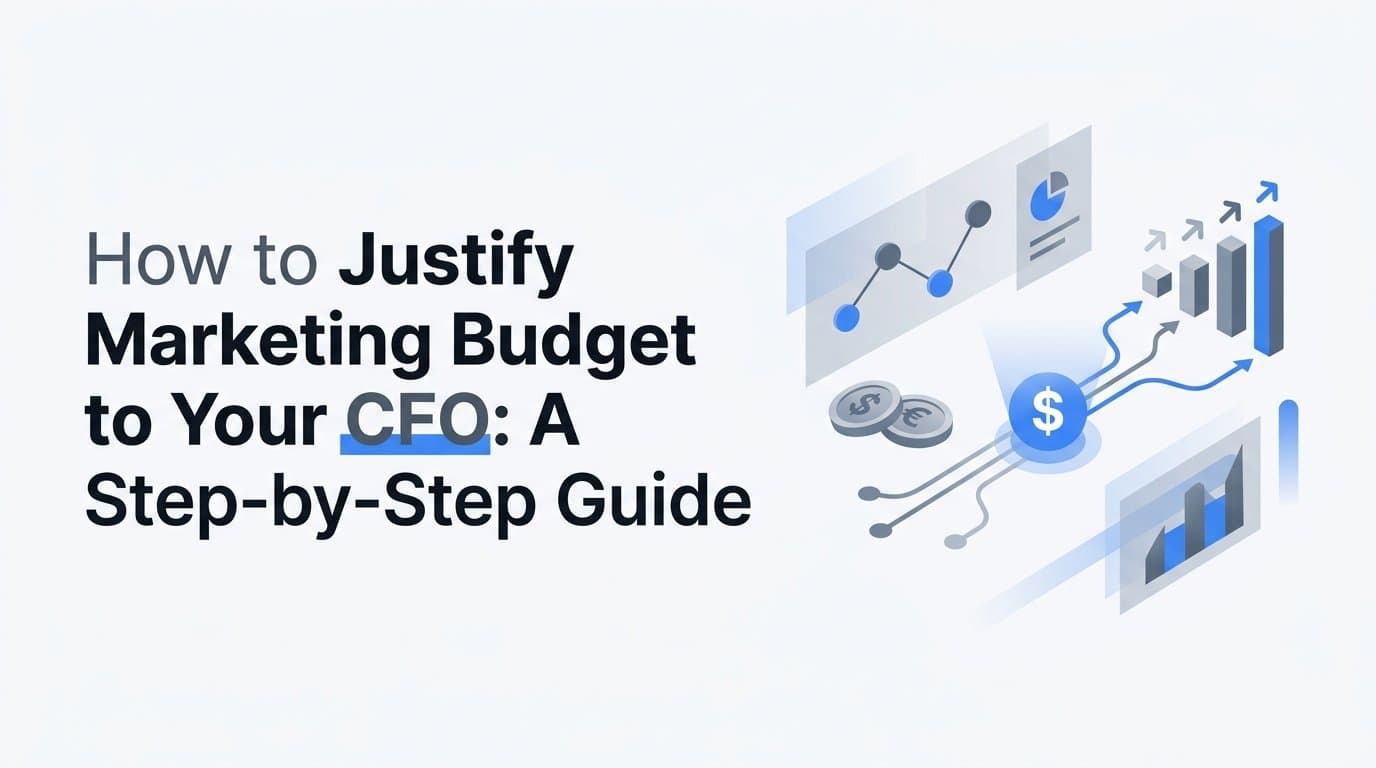
Every marketing leader has been in this position: you know your campaigns are working, but when the CFO asks you to prove it, the data feels scattered, incomplete, or unconvincing. Budget conversations with finance teams are no longer about gut instinct or brand awareness talking points. CFOs want to see a direct line from ad spend to pipeline and revenue.
This guide walks you through exactly how to build that case. You will learn how to organize your attribution data, translate marketing metrics into financial language, and present a budget justification that resonates with a numbers-driven audience.
Whether you are defending your current spend or making a case for increased investment, these steps will help you walk into that meeting with confidence and walk out with approval. The goal is not to win an argument. It is to build a shared understanding of marketing as a revenue function, backed by data your CFO can trust.
Here is the reality: finance leaders evaluate marketing as a cost center unless marketers proactively reframe it as a revenue driver. The language shift from "marketing metrics" to "revenue metrics" is the core challenge. And it starts before you ever open a slide deck. It starts with your data.
Step 1: Audit Your Current Attribution Data
Before you can justify a single dollar of marketing spend, you need to know what your data actually shows. Not what you think it shows. Not what the platform dashboards report. What your attribution model is actually capturing, and where it falls short.
Start by identifying which attribution model you are currently using. Many B2B SaaS companies default to last-click attribution because it is the simplest to implement. The problem is that last-click systematically undercredits top-of-funnel channels like paid social and content marketing. A prospect might discover your product through a LinkedIn ad, engage with a retargeting campaign, read three blog posts, and then convert after clicking a branded search ad. Last-click gives all the credit to branded search and makes LinkedIn look useless. That distorted picture leads to poor budget decisions.
Next, check whether your ad platform data connects to your CRM and revenue data, or whether they exist in separate silos. This is one of the most common challenges in B2B SaaS. Google Ads reports conversions one way, your CRM tracks leads another way, and your finance team sees revenue in a completely different tool. When these systems do not talk to each other, you end up presenting data from disconnected sources, which immediately reduces your credibility with a CFO who expects integrated reporting.
Flag any channels where conversion data is incomplete or unreliable. Browser-based pixel tracking has become increasingly unreliable due to ad blockers and privacy changes. If you are relying solely on client-side pixels, you may be missing a meaningful portion of your conversions. Server-side tracking and Conversion API integrations provide more complete data, which directly strengthens the accuracy of any ROI claims you make in a budget meeting.
Success indicator: You can clearly state which attribution model you are using, where your data has gaps, and what steps you have taken to address those gaps. If you cannot answer those three questions before walking into the CFO's office, you are not ready yet.
Step 2: Translate Marketing Metrics Into Financial Language
Here is something every marketer needs to internalize: CFOs do not think in CPCs, CTRs, or impressions. They think in cost per acquisition, pipeline contribution, and return on investment. If you walk into a budget meeting talking about click-through rates, you will lose the room within the first five minutes.
The translation work happens before the meeting. Take your key marketing metrics and map them to financial equivalents that connect directly to business outcomes.
MQLs to pipeline value: How many MQLs did you generate last quarter, and what is the average pipeline value of an MQL that converts to an opportunity? Multiply those together to show the pipeline your marketing activity is feeding.
CAC to LTV ratio: Your customer acquisition cost compared to your lifetime value is one of the most powerful unit economics metrics you can bring to a CFO conversation. If your blended CAC across all paid channels is significantly lower than your average LTV, that is a compelling argument for continued or increased investment.
Ad spend to closed-won revenue: This is the most direct line you can draw. How much did you spend on paid marketing last quarter, and how much closed-won revenue can be traced back to those efforts? Even a partial picture here is more persuasive than a slide full of engagement metrics.
Build a simple conversion rate bridge as part of your preparation. Show how many leads become opportunities, how many opportunities become customers, and what each customer is worth on average. This gives your CFO a clear view of the funnel economics and makes your marketing spend feel like a predictable input into a revenue machine, not a variable cost with uncertain returns.
One firm rule: avoid vanity metrics in your CFO presentation entirely. If a number does not connect to revenue or cost, leave it out. Impressions, follower counts, and organic reach have no place in a budget justification conversation. Every metric you include should answer the question, "so what does this mean for the business?"
Step 3: Build a Channel-by-Channel ROI Breakdown
Aggregate marketing ROI is a starting point, but it is not enough. CFOs will ask about individual channel performance, and if you are not prepared for that conversation, it signals that you do not have a full command of your data.
Create a clear view of spend versus return for each marketing channel. This means breaking out Google Ads, LinkedIn, Meta, content, email, and any other active channels into separate rows with their own spend, pipeline contribution, and revenue attribution figures.
The key distinction here is pipeline quality, not just lead volume. A channel that generates a high volume of low-quality leads that rarely convert is not a good investment, even if the cost per lead looks attractive. Show which channels are generating the highest quality pipeline by tracking lead-to-opportunity conversion rates and opportunity-to-close rates at the channel level.
This is where multi-touch attribution becomes essential. If you are only using last-click data, you will misrepresent the contribution of upper-funnel channels. Multi-touch attribution distributes credit across the full customer journey, giving you a more accurate picture of how channels work together to drive a conversion. A prospect might touch five different channels before becoming a customer. A multi-touch model acknowledges that reality.
Highlight payback periods by channel. For each channel, calculate how long it takes to recover the acquisition cost through revenue generated. Channels with short payback periods are strong candidates for increased investment. Channels with long payback periods or weak pipeline quality may need reallocation.
Common pitfall to avoid: Presenting only aggregate ROI hides underperforming channels behind the performance of your best channels. Your CFO will ask about individual channel performance. If you have not prepared for that question, you will appear to be obscuring information, even if that is not your intent. Transparency builds trust in budget conversations.
Step 4: Connect Ad Spend Directly to Pipeline and Revenue
This is the most powerful thing you can show a CFO: a direct line from a specific campaign to a closed deal. Not a correlation. Not an estimate. An actual attribution path that shows which campaigns influenced the opportunities currently in your sales funnel and which ones contributed to closed-won revenue.
Start by pulling pipeline attribution data. For each open opportunity in your CRM, identify which marketing campaigns or channels touched that prospect before they became an opportunity. Aggregate this across your full pipeline to show the total pipeline value that paid marketing has influenced. For B2B SaaS companies with longer sales cycles, this pipeline influence metric is often more meaningful than closed-won revenue alone, since deals may take months to close after the initial marketing touchpoint.
Then add revenue attribution. How much closed-won revenue from the last quarter can be traced back to paid marketing efforts? Break this down by channel and campaign where possible. Even a partial picture here is compelling. If you can show that a specific campaign influenced deals that closed for a meaningful amount of revenue, that is a direct answer to the question every CFO is really asking: "Is this spend worth it?"
If you have Stripe or CRM revenue data connected to your attribution platform, you can show the actual dollar amounts tied to specific channels and campaigns. This level of specificity is what separates a credible budget justification from a presentation full of marketing assumptions.
This is where platforms like Cometly become critical. Cometly connects your ad platform data to CRM events and revenue data, creating a single source of truth that shows exactly which ads and campaigns are driving pipeline and closed-won revenue. When you can pull a report that shows a specific LinkedIn campaign influenced a set of opportunities worth a specific dollar amount, and that some of those deals have already closed, you are speaking the CFO's language fluently.
The ability to track the full customer journey from ad click to closed deal removes the guesswork that makes finance teams skeptical of marketing spend. It transforms your budget request from a faith-based ask into a data-backed investment thesis.
Step 5: Model the Impact of Budget Changes
Most marketers walk into budget conversations prepared to defend the current spend. The stronger move is to show what happens if the budget is cut and what becomes possible if it is increased. Scenario modeling shifts the conversation from "can we justify this spend" to "what is the revenue risk of changing it."
Build a simple three-scenario model before your meeting.
Current spend scenario: Based on your current CAC, conversion rates, and pipeline contribution, what is the projected pipeline and revenue impact of maintaining the current budget over the next quarter or year?
Reduced spend scenario: If the budget is cut by a meaningful percentage, what is the projected reduction in pipeline? Use your historical conversion rates to calculate how many fewer leads, opportunities, and customers you would generate. Frame this as a revenue risk, not just a marketing inconvenience. If cutting the budget by a certain amount would reduce pipeline by a multiple of that amount, that is a compelling argument for maintaining investment.
Increased spend scenario: If the budget is increased, what additional pipeline and revenue does the model project? Ground this in your actual CAC and LTV data, not optimistic assumptions. If your current blended CAC is well below your average contract value, you can make a credible argument that additional spend will generate positive returns within a defined payback period.
The payback period calculation is particularly powerful when requesting budget increases. Show the CFO exactly how many months it takes to recover the cost of acquiring a new customer through the revenue that customer generates. If your payback period is short relative to your average contract length, additional marketing investment looks like a straightforward financial decision, not a speculative bet.
Use historical performance data to anchor your projections. Scenario models built on real conversion rates and actual CAC figures are far more credible than projections built on industry benchmarks or aspirational targets.
Step 6: Present With a Single Source of Truth
Fragmented data from multiple platforms creates doubt. A unified dashboard creates confidence. The way you present your data matters almost as much as the data itself.
Bring one clean report to your CFO meeting. That report should show ad spend, pipeline contribution, and revenue attribution in a single view. It should be clear, consistent, and easy to follow. If your CFO has to ask you to switch between tabs or reconcile numbers from different screenshots, the implicit message is that your data is not integrated and your reporting is not reliable.
Anticipate the questions your CFO will ask and have answers ready with data to back them up. The most common questions in budget justification conversations include: What is our blended CAC? What is the payback period on new customer acquisition? Which channel has the strongest ROI? What would happen to pipeline if we reduced spend? If you have gone through steps one through five, you should be able to answer all of these without hesitation.
Prepare for the follow-up questions too. CFOs often probe with "how confident are you in this data?" or "how are you accounting for deals that touched multiple channels?" Having a clear answer about your attribution methodology and its limitations actually builds credibility. Acknowledging where your data has gaps and explaining how you are addressing them shows that you understand your measurement environment, not that you are hiding something.
A platform that connects your ad accounts, CRM, and revenue data into a single attribution view removes the credibility gap that comes from presenting data from disconnected sources. Cometly's unified dashboard brings together ad spend, customer journey data, and revenue attribution so you can walk into any budget conversation with a single, coherent story. The AI recommendations layer also helps you identify which campaigns are performing strongest, giving you the supporting evidence to back up your channel-level claims.
When your data is integrated and your presentation is clean, the conversation shifts. You stop being a marketer defending a budget and start being a revenue leader presenting a growth plan.
Putting It All Together: Your CFO Budget Justification Checklist
You now have a repeatable framework for building a budget justification that speaks the CFO's language. Here is a quick checklist to confirm you are ready before that meeting.
Attribution audit complete: You know which attribution model you are using, where your data has gaps, and how you are addressing tracking limitations.
Metrics translated to financial language: Every metric in your presentation connects to revenue, cost, or business outcomes. Vanity metrics have been removed.
Channel ROI breakdown ready: You have a channel-by-channel view of spend versus return, with pipeline quality and payback period data for each.
Pipeline and revenue attribution connected: You can show which campaigns influenced open opportunities and which ones contributed to closed-won revenue.
Budget scenario model built: You have current, reduced, and increased spend scenarios grounded in actual CAC and conversion rate data.
Single source of truth dashboard prepared: Your presentation uses one integrated report, not data pulled from multiple disconnected tools.
The goal of this entire process is not to win an argument. It is to build a shared understanding of marketing as a revenue driver. When you show up with clean data, clear financial language, and a coherent story about how marketing spend connects to pipeline and revenue, you change the nature of the conversation.
Cometly makes this process repeatable. Instead of rebuilding your attribution story from scratch before every budget cycle, you have a live platform that connects your ad accounts, CRM, and revenue data in real time. That means every budget conversation starts from a position of strength, not scramble.
Ready to make every future budget conversation data-driven and defensible? Start your attribution audit today and see exactly which campaigns are driving your pipeline and revenue. Get your free demo and give your CFO the numbers they have been waiting to see.