Picture this: your team just wrapped up a campaign review. The numbers look incredible on the surface. Millions of impressions, strong reach, CPM trending down. Someone puts together a slide deck and the mood in the room is optimistic. Then someone asks the question nobody wants to answer: "So how much pipeline did we generate?"
Silence. The dashboard doesn't have that number. The CRM doesn't connect to the ad platform. And the revenue report from last quarter looks exactly the same as it did before the campaign launched.
This is one of the most common and costly disconnects in B2B SaaS marketing. Impressions are easy to celebrate because they are easy to measure. Revenue is hard to attribute because it requires infrastructure, integration, and a willingness to hold campaigns accountable to outcomes that matter to the business. Vanity metrics feel like progress. They just don't pay salaries.
None of this means impressions are useless. Awareness is real. Brand presence matters. The problem is when impressions become the goal rather than a signal on the way to a goal. In B2B SaaS, where deals take weeks or months to close and involve multiple stakeholders, the distance between an impression and a dollar of revenue is enormous. Bridging that gap requires attribution infrastructure, the right models, and a reporting mindset built around outcomes.
This article will walk you through exactly that: why impressions became the default metric, which metrics actually connect ads to revenue, how attribution models change what you optimize for, and how to build the infrastructure to track the full journey from first impression to closed deal.
Why Impressions Became the Default Marketing Currency
Impressions are appealing for a simple reason: they are always available. Every ad platform, regardless of format or placement, can count how many times an ad was displayed. There is no integration required, no CRM connection needed, no sales data involved. The number just appears in your dashboard the moment a campaign goes live.
This accessibility made impressions the universal language of digital advertising. They are easy to report upward, easy to compare across campaigns, and easy to use as proof that something is happening. When a marketing team needs to demonstrate activity, impressions are always there to fill the slide.
The problem runs deeper than convenience, though. Ad platforms are structurally incentivized to maximize impression delivery because that is how they generate revenue. Meta, Google, and LinkedIn make money when ads are shown. They are optimized to serve as many impressions as possible within your budget. That is not a criticism of those platforms; it is simply how their business models work. But it creates a natural misalignment between what the platform optimizes for and what your business actually needs.
When you optimize for impressions, you are aligning your goals with the platform's goals, not your company's goals. The platform wins when your ad is shown. Your company wins when a qualified prospect becomes a paying customer. Those two outcomes are not the same thing, and in many cases they require completely different optimization strategies.
For B2B SaaS companies, this misalignment is especially pronounced. A single enterprise deal might require dozens of touchpoints across weeks or months before any revenue registers. The impression that first introduced your product to a decision-maker might have been served three months before they signed a contract. Under impression-based reporting, that campaign looks the same whether it contributed to ten closed deals or zero.
There is also the question of what impressions actually measure: exposure, not engagement, not intent, and certainly not purchase. An impression tells you an ad was displayed. It says nothing about whether anyone noticed it, processed it, or took any action as a result. In a world where attention is scarce and ad fatigue is real, the gap between "ad was shown" and "ad influenced a buying decision" can be enormous.
Impressions are a starting point, not a destination. The challenge is building the measurement infrastructure to trace what happens after the impression is served.
The Metrics That Actually Connect Ads to Revenue
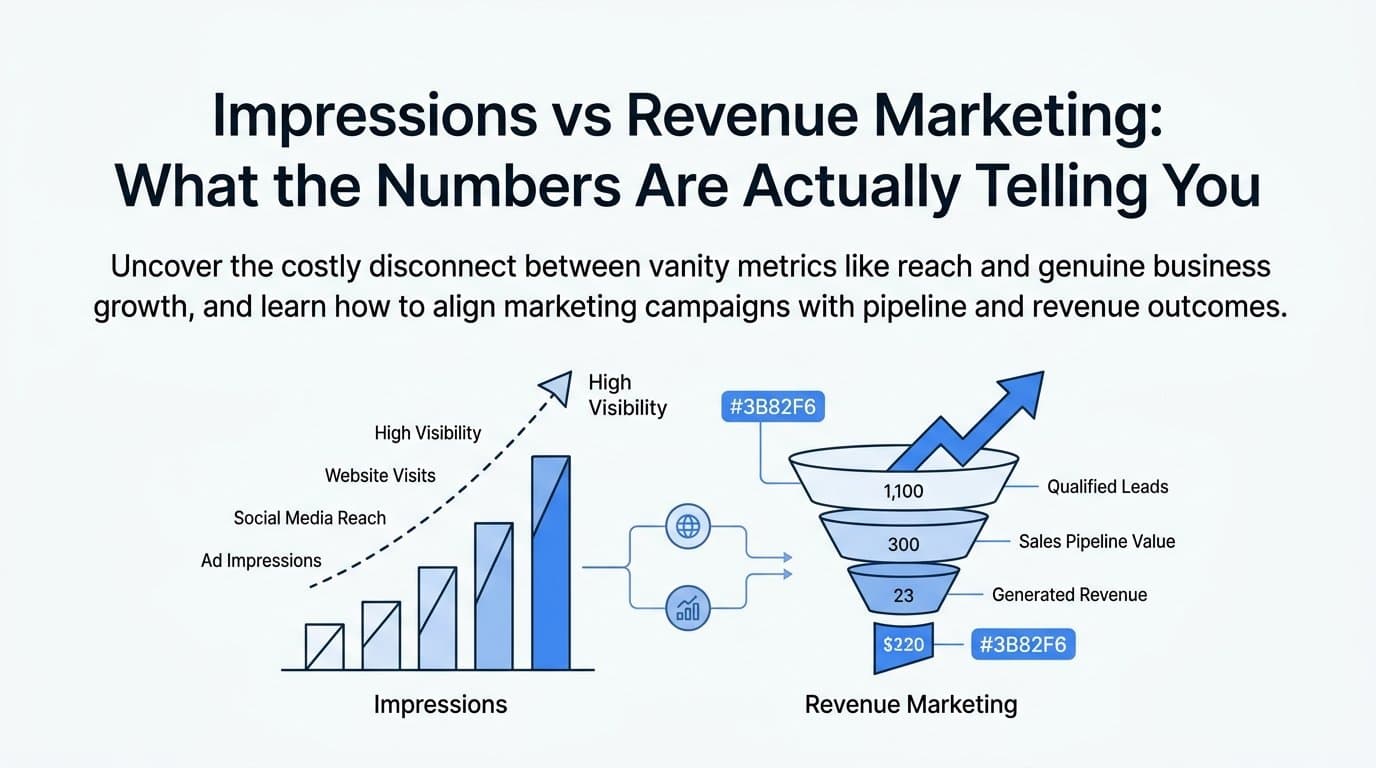
If impressions sit at one end of the marketing measurement spectrum, closed-won revenue sits at the other. Between them lies a chain of metrics that progressively move closer to business outcomes: clicks, leads, qualified leads, opportunities, pipeline value, and finally, revenue. The further along this chain you can measure, the more useful your data becomes for making budget decisions.
The distinction worth understanding here is the difference between activity metrics and outcome metrics. Activity metrics, like impressions, clicks, and reach, tell you what your campaigns are doing. Outcome metrics, like cost per qualified lead, pipeline influenced, and closed-won revenue attributed to specific campaigns, tell you what your campaigns are achieving. Activity metrics are easy to collect. Outcome metrics require infrastructure.
Cost per qualified lead is a significant step up from cost per click because it filters out traffic that was never going to convert. A campaign might generate thousands of clicks at a low cost per click but produce almost no qualified leads, making it expensive in the metrics that matter. Tracking this requires connecting your ad platform data to whatever process you use to qualify leads, whether that is a sales team review, a lead scoring model, or a combination of both.
Pipeline attribution goes further. This metric connects marketing activity to opportunities created in your CRM, assigning a revenue opportunity value to each campaign or channel based on the deals it influenced. For B2B SaaS companies with long sales cycles, pipeline attribution is often more actionable than waiting for closed-won revenue, because deals can take long enough to close that optimizing only on closed revenue would make your feedback loop too slow to be useful.
Closed-won revenue attribution is the ultimate outcome metric: actual dollars from deals that closed, traced back to the marketing touchpoints that influenced them. This is the number that answers the question every CFO is asking when they review the marketing budget.
Revenue attribution is the bridge that connects all of these metrics. Rather than looking at ad spend and revenue as two separate reports that happen to exist in the same company, revenue attribution traces the path from first impression to closed deal, assigning credit to each touchpoint along the way. Multi-touch attribution models are particularly valuable here because they distribute credit across the entire customer journey rather than collapsing the whole story into a single first or last interaction.
The shift from activity metrics to outcome metrics is not just a reporting change. It changes what you optimize for, which changes how you allocate budget, which ultimately changes how your campaigns perform.
How Attribution Models Change What You Optimize For
Here is where the impressions vs revenue marketing conversation gets genuinely interesting. The attribution model you use does not just measure performance; it actively shapes which campaigns you invest in and which ones you cut. Two teams with identical ad spend and identical results can reach completely opposite budget decisions depending on which attribution model they are using.
Last-click attribution is the most common default, and it is also the most misleading for B2B SaaS. Under last-click, 100% of the conversion credit goes to the final touchpoint before a lead converts or a deal closes. In practice, this almost always means retargeting campaigns and branded search terms get the credit, because those are the touchpoints that tend to happen closest to conversion. The awareness campaign that first introduced your product to a prospect three months ago gets zero credit, even though without it, the prospect would never have been in the funnel to retarget.
The practical consequence is that last-click attribution systematically under-funds the campaigns that generate awareness and demand, while over-funding the campaigns that capture demand that already exists. Over time, this creates a feedback loop where you cut the channels that fill the top of your funnel because they never show up in your attribution report, and then you wonder why retargeting audiences are shrinking.
First-touch attribution swings in the opposite direction. It gives all credit to the channel that first brought a prospect into the funnel, ignoring everything that happened between that initial awareness moment and the eventual conversion. This approach tends to over-credit paid social and display advertising, which often generate first impressions, while under-crediting the email sequences, demo requests, and sales conversations that actually closed the deal.
Neither extreme gives you an accurate picture of how your marketing actually works.
Multi-touch attribution models distribute credit across the entire customer journey. Linear attribution spreads credit equally across all touchpoints. Time-decay models give more credit to touchpoints closer to conversion. Position-based models give extra weight to the first and last touches while distributing the remainder across the middle. Data-driven attribution uses algorithmic analysis to assign credit based on which touchpoints statistically correlate with conversion.
For B2B SaaS companies, data-driven or multi-touch models typically provide the most accurate picture of how impression-generating campaigns contribute to eventual revenue. An awareness campaign on LinkedIn might never receive last-click credit for a single deal, but under multi-touch attribution, you can see that it consistently appears early in the customer journeys of your best accounts. That insight changes how you think about that campaign's value and whether it deserves more budget.
The model you choose is not just a technical decision. It is a strategic one that determines which campaigns your data tells you to scale and which ones it tells you to cut.
Building the Infrastructure to Track Impressions Through to Revenue
Understanding attribution models is one thing. Actually implementing them requires a tracking infrastructure that most B2B SaaS marketing teams have not fully built. The gap between knowing you should track revenue attribution and having the data to do it is where most teams get stuck.
The foundation is connecting your ad platforms to your CRM and website in a way that preserves the customer journey from first impression to closed deal. Browser-based pixel tracking was the standard approach for years, but it has become increasingly unreliable. Ad blockers, iOS privacy changes, and cookie restrictions mean that a significant portion of conversion events never make it back to the ad platform. When your pixel misses conversions, the platform's optimization algorithms get weaker signals, your attribution data has gaps, and your cost-per-revenue calculations are based on incomplete information.
Server-side tracking via Conversion APIs addresses this directly. Instead of relying on a browser pixel to fire when a user takes an action, server-side tracking sends event data directly from your server to the ad platform. Meta's Conversion API, Google's Enhanced Conversions, and similar implementations for other platforms allow you to capture events that browser-based tracking misses, improving match rates and giving the platforms better signal to optimize delivery.
First-party data enrichment is what makes server-side tracking genuinely powerful. When a lead fills out a form or a customer completes a purchase, you collect identifiers like email address and phone number directly. Enriching your conversion events with these first-party identifiers before sending them to ad platforms significantly improves the platforms' ability to match those events back to the impressions they served. This is how you close the loop between an impression delivered months ago and a conversion that just happened.
UTM parameter strategy is the connective tissue that ties ad platform data to your CRM data. Consistent, well-structured UTM parameters on every ad ensure that when a lead enters your CRM, you can trace exactly which campaign, ad set, and creative they came from. Without this, you have revenue data in your CRM and impression data in your ad platform, but no reliable way to connect them.
Event deduplication is a detail that becomes critical at scale. When you are running both browser-based pixels and server-side tracking simultaneously, the same conversion event can be reported twice, once from the browser and once from the server. Without deduplication logic, your conversion counts inflate, your cost-per-conversion calculations drop artificially, and your budget decisions get distorted. Clean deduplication ensures each conversion is counted exactly once across all reporting surfaces.
This infrastructure is not a one-time setup. It requires ongoing maintenance as platforms update their APIs, as your product changes, and as your sales process evolves. But it is the foundation without which revenue attribution is not possible.
Turning Attribution Data Into Budget Decisions
Once revenue attribution infrastructure is in place, the reporting conversation changes entirely. Instead of defending impression volume in a campaign review, you can walk into any budget discussion with actual return on ad spend and customer acquisition cost broken down by channel, campaign, and even individual ad creative.
True ROAS, calculated from closed-won revenue attributed to specific campaigns, tells you which channels are generating real returns and which ones are consuming budget without contributing to deals that close. This is a fundamentally different number from the ROAS your ad platform reports, which is typically based on platform-reported conversions that may not align with your CRM data or your actual revenue.
Attribution data also helps you distinguish between two types of impression-heavy campaigns that look identical on the surface but have very different business value. The first type generates impressions that genuinely contribute to pipeline: prospects see your ad, enter your funnel, and eventually appear in the customer journeys of deals that close. The second type generates impressions that consume budget without influencing any deals that actually close. Without attribution data, you cannot tell these two campaigns apart. With it, the difference is clear.
This is where AI-driven analysis of attribution data adds a layer of insight that manual reporting cannot easily surface. Patterns that span hundreds of customer journeys across months of data are difficult for humans to spot in a spreadsheet. An AI system analyzing the same data can identify, for example, that a LinkedIn campaign generating impressions consistently appears in the early stages of customer journeys for your highest-value accounts, even when that campaign never receives last-click credit. That finding would be nearly impossible to surface through manual analysis, but it completely changes how you should think about that campaign's budget allocation.
The practical output of attribution-driven budget decisions is a reallocation away from campaigns optimized for impressions and toward campaigns optimized for pipeline and revenue influence. Some campaigns that looked expensive on a cost-per-impression basis turn out to be your most efficient sources of closed revenue. Others that looked efficient on the surface turn out to have no measurable connection to deals that close.
From Impressions to Revenue: A Framework for B2B SaaS Teams
Pulling this all together into a practical operating model requires a shift in how marketing teams structure their reporting and their goals. The framework is straightforward, even if the implementation takes work.
Report impressions and reach as leading indicators of brand presence. These metrics tell you whether your campaigns are reaching the right audiences at the right scale. They are useful inputs, not success criteria. Track them, but do not optimize for them as primary goals.
Hold campaigns accountable to pipeline and revenue attribution as the primary performance standard. Every campaign should have a clear line of sight to either pipeline influenced or closed-won revenue attributed. If a campaign cannot demonstrate that connection after a reasonable period, that is a signal to investigate whether the audience, creative, or offer needs to change, not a reason to celebrate the impression volume.
Cometly connects ad platforms, CRM, and website data into a single attribution view, so teams can see exactly which campaigns and channels are driving leads and closed revenue, not just impressions. With server-side conversion tracking, Conversion API integration, and multi-touch attribution models built for B2B SaaS sales cycles, Cometly gives marketing teams the infrastructure to answer the question that actually matters: which ad spend is generating revenue?
The shift from impression-obsessed reporting to revenue-attributed decision-making is not a one-time project. It is an ongoing practice. Tracking setups need maintenance. Attribution models need to be revisited as your sales cycle evolves. Data pipelines need monitoring to catch gaps before they distort your reporting. The teams that do this consistently are the ones that can walk into a budget review with confidence, because they know which campaigns are working and which ones are not, and they have the data to prove it.
The Bottom Line on Impressions and Revenue
Impressions are a useful signal. They tell you your ads are being served and your brand is getting in front of people. But they are a dangerous goal, because optimizing for impressions optimizes for the platform's business model, not yours.
Revenue attribution is what separates marketing teams that grow companies from marketing teams that grow dashboards. It requires infrastructure: server-side tracking, Conversion API integrations, consistent UTM parameters, CRM connectivity, and attribution models aligned to your actual sales cycle. None of that is trivial, but all of it is achievable with the right tools and the right setup.
The B2B SaaS marketing teams that are winning right now are not the ones with the most impressions. They are the ones who can trace every dollar of ad spend to its contribution to pipeline and closed revenue, and make confident scaling decisions based on that data.
If your team is still reporting on impressions without a clear line to revenue, the gap between where you are and where you need to be is a tracking and attribution problem, and it is one you can solve. Get your free demo and start connecting your ad spend to actual pipeline and revenue with Cometly's attribution platform.