
When Apple introduced App Tracking Transparency, it fundamentally changed how marketers track conversions from iOS users. Pixel-based tracking became unreliable, attribution windows shortened, and ad platforms lost visibility into a significant portion of the customer journey.
For B2B SaaS marketing teams running paid campaigns on Meta, Google, or other platforms, the result was the same: inflated CPAs, underreported conversions, and budget decisions made on incomplete data. If your reported ROAS looks strong but your CRM tells a different story, iOS tracking gaps are likely the culprit.
This guide walks you through a practical, step-by-step process to improve conversion tracking for iOS traffic. You will learn how to shift from browser-side pixel tracking to server-side event tracking, configure your Conversion API correctly, prioritize and deduplicate events, and verify that your data is actually reaching ad platforms accurately.
Each step builds on the last, moving from foundational setup to advanced validation. By the end, your ad platforms will receive richer, more reliable conversion signals, your attribution models will reflect reality more closely, and your team will have the confidence to make spend decisions based on trustworthy data.
Whether you are starting from scratch or auditing an existing setup, this guide gives you a clear path forward.
Step 1: Audit Your Current iOS Tracking Gaps
Before you fix anything, you need to understand exactly what is broken. Jumping straight into implementation without a proper audit means you might solve the wrong problem or miss the areas where signal loss is hurting you most.
Start in your ad platform's event manager. In Meta Events Manager, review each conversion event and check whether it is firing browser-side only, server-side only, or both. Events marked as browser-only are your most vulnerable signals, since they rely entirely on the pixel firing in the user's browser, which ATT opt-outs can block.
Check your pixel health score: Meta Events Manager surfaces signal loss warnings directly in the interface. Look for flags indicating that a high percentage of your events are missing match parameters or showing low event match quality scores. Google Tag Manager and Google Ads diagnostics offer similar indicators under conversion tracking health. Understanding pixel tracking problems on iOS is essential before you attempt any fixes.
Compare platform data against your CRM: Pull your iOS conversion volume from your ad platform over the last 30 to 90 days, then compare it against leads, trials, or closed deals that originated from paid campaigns during the same period. A significant gap between what the ad platform reports and what your CRM shows is direct evidence of attribution loss driven by iOS restrictions.
Identify your highest-impact campaigns: Not all campaigns are equally affected. Campaigns targeting mobile-heavy audiences or running on placements where iOS users are more prevalent will show more pronounced gaps. Prioritize these for your fix so you recover the most valuable signal first.
Document your current event setup: Before making any changes, create a simple record of every conversion event you are currently tracking. Include the event name, the trigger condition, whether it fires browser-side or server-side, and what deduplication key (if any) is currently in use. If you are unsure why your conversions are not tracking correctly, this documentation step will often surface the answer. This documentation becomes your baseline and your safety net when you start making changes.
The goal of this audit is not just to find problems. It is to quantify them so you can measure the improvement after you implement the fixes in the steps that follow.
Step 2: Set Up Server-Side Conversion API Integration
Here is the core insight behind server-side tracking: when events fire from your server rather than the user's browser, iOS's App Tracking Transparency framework cannot block them. The event travels directly from your infrastructure to the ad platform's API, bypassing the browser entirely. That is why the Conversion API is the foundation of any serious iOS tracking fix.
Choose your implementation method: You have three main options. A direct API integration gives you the most control but requires developer resources. A middleware layer or tag management solution sits between your site and the ad platform and handles the server-side calls with less custom code. Understanding what server-side tracking is in marketing will help you choose the right approach for your team's technical capacity.
Configuring Meta's Conversions API: In Meta Events Manager, navigate to your pixel settings and select the option to set up the Conversions API. You will generate an access token and configure your server to send POST requests to Meta's Graph API endpoint. The critical requirement here is that your server-side events must use the same event names as your browser pixel. If your pixel fires a "Lead" event, your CAPI must also fire a "Lead" event. Mismatched names break deduplication and create data inconsistencies.
Your server-side events should include these parameters at minimum: event name, event time (Unix timestamp), event source URL, and user data signals. User data signals are what enable Meta to match the event to a specific user, and they include hashed email addresses, hashed phone numbers, the fbp cookie value, and the fbc click ID value. The more of these you pass, the higher your event match quality score will be.
Configuring Google Enhanced Conversions: Google's server-side solution works by sending hashed first-party customer data alongside your standard conversion tags. In Google Ads, navigate to your conversion action settings and enable Enhanced Conversions. You can implement this through Google Tag Manager or via the Google Ads API directly. The hashed data, typically email address, allows Google to match conversions that would otherwise be lost due to Safari's Intelligent Tracking Prevention and iOS cookie restrictions.
Before going live, use Meta's Test Events tool and Google's Tag Assistant to verify that your server-side events are arriving correctly. Check that all required parameters are present and that the events are appearing with the correct names and timestamps. Reviewing an advanced conversion tracking setup guide can help you avoid the most common configuration mistakes before launch.
Step 3: Implement Event Deduplication to Avoid Double Counting
Running both a browser pixel and a server-side Conversion API simultaneously is the recommended approach because it gives you maximum coverage. The browser pixel captures users who have opted into tracking, while the server-side event captures everyone else. But this dual-firing setup creates an immediate risk: if both fire for the same user action, the ad platform counts the conversion twice.
Double counting distorts your conversion data in ways that can seriously mislead your optimization decisions. Your campaigns will appear to generate more conversions than they actually do, your CPAs will look lower than they are, and your automated bidding algorithms will optimize toward an inflated signal. These ad tracking data discrepancy causes are among the most damaging issues a paid media team can face.
The solution is a consistent event ID: Every conversion event you fire should include a unique event ID parameter. When both the browser pixel and the server-side event carry the same event ID for the same user action, the ad platform recognizes them as duplicates and counts them only once. Generate this ID at the moment the conversion occurs on your server or application layer, then pass it to both the browser event and the server event simultaneously.
For Meta specifically: Pass the fbp (Facebook browser ID) and fbc (Facebook click ID) cookie values from the browser event through to your server-side CAPI event. These values help Meta link the browser and server events to the same user session, enabling accurate deduplication even when the event ID alone might not be sufficient.
For Google: Align your conversion action names precisely between your tag-based setup and your Enhanced Conversions implementation. For purchase or transaction events, use the order ID or transaction ID as your deduplication key. Google uses this identifier to recognize that two events representing the same transaction should be counted as one.
How to verify deduplication is working: In Meta Events Manager, look at the event detail view for your conversion events. Meta surfaces a duplicate event rate metric that shows what percentage of received events are being identified as duplicates. A healthy setup will show some duplication being caught and deduplicated. If your duplicate rate is zero, it likely means deduplication is not configured correctly and you may be missing matches rather than successfully deduplicating.
Common pitfall to avoid: Mismatched event names between your pixel and your CAPI will prevent deduplication from working even if your event IDs match perfectly. The ad platform matches on event name first. A pixel firing "Lead" and a CAPI firing "lead_form_submit" will never be deduplicated, regardless of how well your event IDs align.
Step 4: Prioritize and Configure Aggregated Event Measurement
Even with server-side tracking in place, Meta's Aggregated Event Measurement framework introduces an additional constraint specific to iOS 14.5 and later users. Understanding and configuring AEM correctly is essential for accurate campaign measurement and optimization. The history of how iOS 14 changed digital advertising provides important context for why these constraints exist.
Meta limits each verified domain to a maximum of eight conversion events that can be used for optimizing and reporting on campaigns targeting iOS users who have opted out of tracking. These eight slots are ranked in priority order, and only the highest-priority event that fires in a given session will be reported for opted-out iOS users.
Start with domain verification: Before you can configure AEM, your domain must be verified in Meta Business Manager. This is a prerequisite. Without a verified domain, you cannot set event priorities, and your iOS conversion reporting will be severely limited.
Rank your events strategically: Your event priority list should reflect your actual business funnel and campaign objectives. A typical B2B SaaS priority ranking might look like this:
1. Purchase or closed-won revenue (highest priority)
2. Qualified lead or sales-qualified lead
3. Demo request or trial signup
4. Content download or webinar registration
5. Email capture or newsletter signup
The logic here is straightforward: if an iOS user completes a demo request and also triggers a page view event in the same session, you want the demo request reported, not the page view. Ranking by funnel depth ensures your most valuable signals take precedence.
Align priorities with campaign objectives: If you are running a campaign optimized for trial signups, that event needs to be ranked high enough that it will be reported for iOS users. An event that is ranked sixth or seventh may rarely be reported if higher-priority events tend to fire in the same sessions.
Review and update your AEM configuration whenever your campaign strategy shifts or your funnel structure changes. This is not a set-once configuration. As you add new campaign objectives or adjust your funnel, your event priority list should reflect those changes.
Step 5: Enrich Your First-Party Data for Better iOS Signal Matching
Server-side tracking solves the delivery problem: your events reach the ad platform even when iOS restricts browser-level tracking. But the quality of those events depends heavily on how well the ad platform can match them to actual users. This is where first-party data enrichment becomes your competitive advantage.
iOS restrictions reduce the effectiveness of cookie-based matching signals. The fbp and fbc cookies are less reliable for opted-out users, and device identifiers are no longer accessible. What fills that gap is hashed first-party data: the email addresses and phone numbers your users voluntarily provide when they interact with your product or content. Understanding what first-party data tracking is and why it matters is foundational to this entire strategy.
Collect first-party signals at every key touchpoint: Every form submission, trial signup, demo request, and gated content download is an opportunity to capture an email address or phone number. These should be collected consistently and stored in a way that makes them accessible to your server-side event pipeline.
Pass hashed data through your CAPI and Enhanced Conversions setup: When a conversion event fires, include the user's hashed email and phone number as parameters alongside the event data. Both Meta and Google accept SHA-256 hashed versions of these identifiers. The hashing protects user privacy while still allowing the ad platform to match the event to a known user in their system.
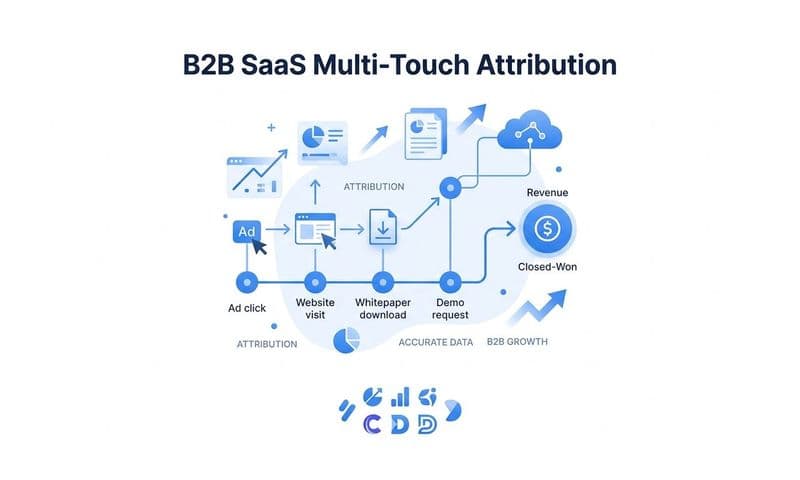
Use your CRM for offline conversion uploads: This is one of the most underutilized tactics for B2B SaaS teams. When a deal closes in your CRM, that closed-won event can be uploaded back to your ad platforms as an offline conversion, tied to the original ad click through the click ID that was captured at the lead stage. This closes the loop between ad spend and actual revenue, giving your campaigns credit for the full customer journey even when weeks or months pass between the first click and the final conversion. Teams that implement accurate revenue attribution tracking consistently report stronger ROAS visibility and more confident budget decisions.
Monitor your Event Match Quality score: Meta scores each event's match quality on a scale from zero to ten. A higher score means more of your server events are being successfully matched to Facebook users, which directly improves attribution accuracy for iOS traffic. After implementing first-party data enrichment, your match quality scores should improve measurably. If they do not, review which user data parameters you are passing and look for gaps.
Always hash PII using SHA-256 before transmission. Never send raw email addresses or phone numbers directly to ad platforms through your API calls.
Step 6: Validate Your Setup and Monitor Ongoing Accuracy
Implementation is only half the job. A server-side tracking setup that breaks silently is often worse than no setup at all, because it creates false confidence in data that is no longer accurate. Building validation and monitoring into your regular workflow is what separates teams that maintain reliable attribution from those that discover problems months too late.
Benchmark immediately after launch: Use Meta's Event Match Quality score and Google's Enhanced Conversions diagnostics to establish a baseline within the first week of your new setup going live. Record these scores so you have a reference point for future comparisons. A sudden drop in match quality or event volume is your early warning signal that something has broken.
Run a weekly CRM reconciliation: Every week, compare the conversion volume your ad platforms are reporting against the leads, trials, or deals recorded in your CRM for the same period. These numbers will never match perfectly due to attribution model differences, but they should be reasonably consistent. A widening gap between platform-reported conversions and CRM-verified conversions is a sign that your tracking setup needs attention. Reviewing common reasons why ad tracking is inaccurate can help you diagnose the root cause quickly.
Set up volume alerts: Configure alerts in your ad platforms or monitoring tools to notify you if conversion volume drops significantly day over day or week over week. A sudden drop often indicates a tracking break caused by a site update, a tag change, or an API authentication failure. Catching these quickly minimizes the data loss and prevents your bidding algorithms from optimizing on stale or missing signals.
Run a 30-day before-and-after comparison: Once your setup has been running for 30 days, compare your conversion data against the 30 days before your implementation. Look for increases in reported conversion volume, improvements in event match quality scores, and reductions in the gap between ad platform data and CRM data. This comparison gives you a concrete measure of the improvement your setup has delivered.
Stay current with platform and OS updates: Apple continues to evolve its privacy framework with each new iOS release, and both Meta and Google update their API specifications regularly. Assign someone on your team to monitor these updates and assess their impact on your tracking setup. What works today may require adjustment after the next major iOS release or API version change.
Using a unified attribution platform to cross-reference ad platform data against your actual pipeline and revenue gives you a single source of truth that makes this ongoing monitoring far more manageable than checking multiple platforms individually.
Putting It All Together: Your iOS Tracking Action Plan
Improving conversion tracking on iOS is not a single fix. It is a layered system where each component reinforces the others. Here is your quick-reference checklist for the full process:
1. Audit your tracking gaps: Identify which events are browser-side only, quantify the gap between ad platform data and CRM data, and document your current setup before making changes.
2. Implement server-side tracking: Configure Meta's Conversions API and Google's Enhanced Conversions to send events directly from your server, bypassing iOS browser restrictions.
3. Set up event deduplication: Use consistent event IDs and pass fbp and fbc values to prevent double counting when both browser and server events fire for the same user action.
4. Configure Aggregated Event Measurement: Verify your domain, rank your eight conversion events by funnel priority, and align your AEM configuration with your active campaign objectives.
5. Enrich with first-party data: Collect hashed email addresses and phone numbers at every key touchpoint, pass them through your CAPI setup, and use CRM data for offline conversion uploads.
6. Validate and monitor continuously: Benchmark your event match quality scores, reconcile platform data against your CRM weekly, and stay current with iOS and API updates.
The foundation of reliable iOS conversion tracking is server-side event delivery combined with first-party data enrichment. Together, they give ad platforms the signal quality they need to attribute conversions accurately, even as browser-level tracking continues to erode.
Cometly brings all of these steps together in one platform. It captures every touchpoint from ad click to closed-won revenue, connects your ad spend to pipeline through CRM integration, and feeds enriched, conversion-ready events back to Meta and Google through native server-side tracking. For B2B SaaS teams that need accurate attribution without building and maintaining custom infrastructure, it is the most direct path to closing the iOS attribution gap.
Start with the audit from Step 1. The gaps you find there will tell you exactly where to focus your effort first.
Accurate iOS tracking is not a one-time project. It is an ongoing practice. Build monitoring into your regular reporting cadence, revisit your configuration when platforms update their requirements, and treat your attribution data as a living system that needs consistent attention to stay reliable.
Ready to elevate your marketing game with precision and confidence? Discover how Cometly's AI-driven recommendations can transform your ad strategy. Get your free demo today and start capturing every touchpoint to maximize your conversions.