
You pull your campaign report on a Monday morning. Google Ads says you generated 47 conversions last week. Meta says 38. Your CRM shows 19 new leads. Three platforms, three completely different numbers, all supposedly measuring the same campaign.
If this scenario sounds familiar, you are not alone. Inconsistent conversion reporting is one of the most common frustrations in B2B SaaS marketing today, and it runs far deeper than a simple data hygiene problem. It is a strategic liability that quietly erodes budget decisions, poisons cross-team relationships, and makes it nearly impossible to know what is actually working.
The frustrating part is that each platform is technically telling the truth, at least from its own perspective. The problem is that each platform is measuring a different slice of reality using different rules, different windows, and different methodologies. When you try to combine those slices into a coherent picture, the numbers refuse to align.
For B2B SaaS teams running paid campaigns across multiple channels, this is especially costly. Your sales cycles are long. Your buyers touch multiple channels before converting. And your budget decisions depend on knowing which of those channels deserves credit. When your conversion data is fragmented and contradictory, every budget conversation becomes a debate and every optimization decision becomes a guess.
This article breaks down exactly why inconsistent conversion reporting happens, what it is costing you, and what you can do to build a measurement foundation that actually holds up. By the end, you will have a clear path from reporting chaos to a single, reliable source of truth for your conversion data.
Why Your Conversion Numbers Never Match Across Platforms
The first thing to understand is that platform-level conversion discrepancies are not a bug. They are a predictable outcome of how each platform is designed. Meta, Google Ads, and LinkedIn each operate as self-contained measurement systems with their own attribution logic, and none of them were built to agree with each other.
Here is the core problem: a single user journey often touches multiple platforms. A prospect sees your LinkedIn ad on Tuesday, clicks a Google retargeting ad on Thursday, and submits a form on Friday after a direct visit. LinkedIn claims the conversion because the user saw an ad within its view-through window. Google claims it because the user clicked within its attribution window. And your CRM records one new lead. You now have two platform-reported conversions for one actual conversion, and that gap compounds across every campaign you run.
This is what is often called self-attribution bias. Every ad platform has a financial incentive to show you strong results, and its attribution model is built to maximize the conversions it can claim. When you sum up platform-reported totals across channels, you will almost always get a number that significantly exceeds what your CRM or analytics tool recorded. Understanding Facebook ads reporting discrepancies is a useful starting point for seeing how this plays out in practice.
Attribution window mismatches make this worse. Meta's default attribution window includes both click-through and view-through conversions over different time periods. Google Ads has its own default windows. LinkedIn operates differently still. When one platform is set to a 7-day click window and another is set to a 28-day view-through window, they are simply measuring different things, even when tracking the same campaign targeting the same audience.
On top of this, browser-based pixel tracking has become increasingly unreliable. Apple's iOS privacy changes introduced App Tracking Transparency, which significantly reduced the ability of ad platforms to track user behavior across apps and websites. Add widespread ad blocker usage and tightening cookie restrictions across major browsers, and you have a situation where each platform's pixel is capturing a different subset of the same conversion events. Some conversions get recorded by one platform's pixel but not another's, not because one platform is wrong, but because each pixel is operating under different visibility constraints.
The result is a measurement environment where every platform is reporting partial, overlapping, and incompatible data. Without a layer that sits above all of these platforms and normalizes the data, inconsistency is not just likely. It is guaranteed.
The Strategic Cost of Acting on the Wrong Numbers
Inconsistent conversion data is not just an analytics headache. It has real consequences for how budgets are allocated, how teams collaborate, and how confidently leadership can evaluate marketing performance.
The most immediate cost is misallocated spend. When marketing teams optimize based on platform-reported conversions rather than actual pipeline or revenue, budget naturally flows toward the channels that look best on paper. But "looking best on paper" often means the channel with the most aggressive attribution window or the broadest definition of a conversion. A campaign that reports high conversion volume in the platform dashboard may be generating very little real pipeline when you look at CRM data. If you are scaling that campaign based on platform metrics alone, you are effectively optimizing for the appearance of performance rather than actual business outcomes.
The second cost is sales and marketing misalignment. This is one of the most corrosive effects of inconsistent conversion reporting, and it tends to play out in a very specific way. Marketing presents a report showing strong conversion volume. Sales pushes back because the leads do not match what the CRM shows. Both teams are looking at real data, but they are looking at incompatible versions of it. These conversations erode trust quickly, and they make attribution discussions contentious rather than collaborative. Using dedicated SaaS reporting tools that connect both teams to the same data can help defuse these conflicts before they damage cross-functional relationships.
When marketing cannot confidently explain why its numbers differ from what sales sees in the CRM, it loses credibility. And when sales does not trust marketing's conversion data, it becomes harder to align on shared pipeline goals, lead quality standards, and budget justifications.
The third cost is strategic paralysis. Inconsistent data makes it nearly impossible to evaluate attribution models accurately. If you cannot establish a reliable baseline of what actually converted and which touchpoints were involved, you cannot confidently answer the questions that matter most: Which channels deserve more investment? Which campaigns are driving pipeline versus just generating clicks? Where should you scale, and where should you cut?
Growth teams stuck in this position often default to gut instinct or political compromise rather than data-driven decisions. That is an expensive way to run a paid media program, especially in a market where every dollar of ad spend needs to be accountable.
The Technical Root Causes Behind the Discrepancy
Understanding why conversion numbers disagree at a strategic level is useful. But fixing the problem requires going one level deeper into the technical causes that create the discrepancy in the first place.
Duplicate conversion events: One of the most common and underappreciated technical causes is event duplication. Many teams implement both a browser-based pixel and a server-side Conversion API for the same platform, which is actually the right approach for data completeness. But if deduplication logic is not properly configured, the same conversion event can be fired by both the pixel and the server simultaneously, causing the platform to count it twice. This inflates reported conversion volume and makes optimization signals less reliable.
Pixel-only tracking gaps: Teams that rely solely on browser pixels are systematically undercounting conversions in ways they often do not realize. When a user submits a form, closes the browser before the confirmation page loads, switches devices between clicking an ad and converting, or has an ad blocker active, the pixel never fires. Server-side tracking captures these events because it sends conversion data directly from your server to the ad platform, bypassing browser-level restrictions entirely. Without it, your pixel data has blind spots that vary by audience, device, and browser, creating inconsistency that is difficult to diagnose. A deeper look at fixing conversion tracking gaps reveals just how many of these blind spots go undetected in typical setups.
UTM parameter breakage: This is a quieter but significant source of downstream reporting errors. When campaigns are launched without consistent UTM tagging, or when UTM parameters get stripped during redirects or landing page transitions, your analytics tool cannot correctly attribute the session to its originating source. A visit that should be tagged as coming from a paid LinkedIn campaign gets recorded as direct traffic. A conversion that should be credited to a specific Google Ads campaign gets lumped into an untagged bucket. This creates a second layer of reporting confusion on top of the platform-level discrepancies, and it compounds over time as untagged data accumulates in your analytics system.
Each of these technical issues contributes to the overall picture of inconsistency. And critically, they interact with each other. Duplicate events inflate some numbers while pixel gaps deflate others, and UTM misattribution scrambles the channel-level data that sits underneath both. Addressing only one of these issues without the others will reduce the problem but will not solve it.
How to Build a Single Source of Truth for Conversion Data
The path out of reporting chaos requires building a measurement foundation that sits above any individual platform's self-reported data. Here is what that looks like in practice.
Implement server-side tracking through Conversion APIs: Moving from pixel-only tracking to a server-side implementation is the single most impactful technical step you can take. Meta's Conversion API and Google's Enhanced Conversions both allow you to send conversion events directly from your server to the ad platform, capturing events that browser pixels miss due to privacy restrictions, ad blockers, or device switching. When implemented alongside your existing pixels with proper deduplication, server-side tracking produces a more complete and accurate signal without inflating your conversion counts.
Standardize attribution windows across platforms: Before you can compare performance across channels, you need to normalize the measurement framework. Choose a consistent conversion window attribution that makes sense for your sales cycle and apply it as your standard across all platforms. This will not eliminate platform-level discrepancies entirely, but it will ensure that when you compare Google Ads performance to Meta performance, you are at least looking at data measured over the same time horizon. Document your chosen windows and enforce them as a team standard when campaigns are set up.
Connect all data sources into a unified attribution layer: The most durable solution is to stop relying on any single platform's self-reported numbers as your source of truth and instead build a layer that aggregates data from your ad platforms, your CRM, and your website events. When a conversion is recorded in your CRM as a closed-won deal, that event should be traceable back to the specific ad touchpoints that influenced it, using data that no single platform could see on its own. This is what a unified attribution platform enables. It removes the need to reconcile conflicting platform reports because the ground truth lives in one place, not across four different dashboards.
Cometly is built specifically for this purpose. It connects your ad platforms, CRM pipeline data, and website event data into a single, real-time attribution view, so you can trace every conversion back to its originating touchpoints without relying on platform self-attribution.
Multi-Touch Attribution as the Antidote to Reporting Chaos
Even after you fix the technical infrastructure, you still face a modeling problem. How do you assign credit for a conversion that touched five different channels over six weeks? The answer to that question has a major impact on how consistent your reporting feels across teams.
Single-touch models like first-click or last-click attribution are simple, but they create their own version of inconsistency. When different teams use different single-touch models to evaluate the same campaigns, they will reach completely different conclusions about which channels are performing. The demand generation team using first-touch conversions will credit LinkedIn for a conversion that the performance team, using last-click attribution, credits to Google. Neither is wrong within its own model. But the disagreement makes attribution conversations feel unresolvable.
Multi-touch attribution distributes credit across every touchpoint in the customer journey, giving a proportional view of how channels work together rather than forcing a binary winner-takes-all assignment. This approach does not eliminate the need for judgment, but it does reduce the distortion caused by model mismatches between teams and platforms. Understanding multi-touch conversion value helps teams align on how to interpret shared credit across channels.
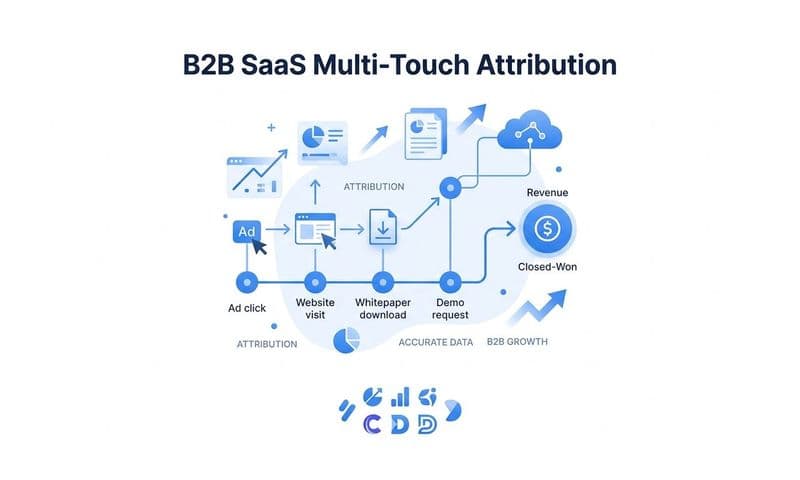
For B2B SaaS companies, multi-touch attribution is not just preferable. It is often the only model that accurately reflects how buying decisions actually happen. A prospect may engage with a LinkedIn thought leadership ad, download a resource from an organic search result, attend a webinar, and then convert after a sales outreach email. That journey spans weeks or months and involves touchpoints across paid, organic, and direct channels. No single platform has visibility into all of it, and no single-touch model can fairly represent it.
Common multi-touch models include linear attribution, which distributes credit equally across all touchpoints; time decay, which gives more credit to touchpoints closer to conversion; and position-based attribution, which weights the first and last touches more heavily while distributing remaining credit across the middle. Data-driven attribution, available in some platforms and analytics tools, uses algorithmic modeling to assign credit based on the actual contribution of each touchpoint to conversion probability.
The right model depends on your sales cycle length, the number of touchpoints in a typical journey, and what decisions the attribution data needs to support. The key is to choose one model and apply it consistently across your team, rather than letting each function use whatever model makes their channel look best.
From Clean Data to Confident Ad Decisions
All of the technical work of fixing inconsistent conversion reporting ultimately serves one goal: making better decisions about where to invest your marketing budget.
When your conversion data is clean, consistent, and tied to actual revenue rather than platform-reported metrics, the quality of your optimization decisions changes fundamentally. You can scale campaigns that are genuinely driving pipeline, not just campaigns that generate cheap clicks or high-volume form fills that never become opportunities. You can cut spend on channels that look productive in their own dashboards but show up as low-influence touchpoints when you look at the full customer journey. Reviewing best practices for tracking conversions accurately gives teams a practical checklist for closing the gaps that undermine this kind of confident decision-making.
There is also a compounding benefit to feeding better data back to the ad platforms themselves. Meta, Google, and other platforms use conversion signals to refine their audience targeting and bidding algorithms. When you send enriched, deduplicated conversion events back through the Conversion API, you are giving those algorithms a more accurate training signal. Over time, this improves the quality of the audiences the platform targets and the efficiency of its bidding, which means your ad spend works harder even before you make a single manual optimization change.
Perhaps most importantly, clean attribution data changes the nature of budget conversations with finance and leadership. When you can show a direct line from ad spend to pipeline to closed-won revenue, marketing stops being a cost center that needs to justify its existence and becomes a revenue driver with a demonstrable return. That shift in narrative is only possible when your conversion data is credible enough to withstand scrutiny.
Cometly is designed to make this possible. By connecting ad platform data, CRM events, and website behavior into a unified attribution view, it gives growth teams the accurate, real-time data they need to optimize with confidence and communicate results with credibility.
Putting It All Together
Inconsistent conversion reporting is not an unavoidable reality of running paid campaigns across multiple channels. It is a solvable problem with identifiable root causes and a clear path to resolution.
The discrepancy starts with platform self-attribution bias, where every ad platform claims credit for the same conversions using its own rules. It is amplified by browser-based pixel limitations that create uneven data capture across platforms. It is compounded by attribution window mismatches, duplicate conversion events, and inconsistent UTM tagging. And it is made worse by single-touch attribution models that force teams into contradictory conclusions about the same data.
The fix requires addressing each layer: implementing server-side tracking through Conversion APIs to capture what pixels miss, standardizing attribution windows to create comparable measurement frameworks, eliminating duplicate events through proper deduplication, and connecting all data sources into a unified attribution layer that sits above any individual platform's self-reported numbers.
Cometly is built specifically to solve this problem for B2B SaaS teams. It connects your ad platforms, CRM pipeline data, and website events into one accurate, real-time view of what is actually driving revenue. It captures every touchpoint, eliminates the guesswork from attribution, and gives your team the data confidence to scale what works and cut what does not.
If your conversion numbers are telling three different stories, it is time to build a foundation where they all tell the same one. Get your free demo and see how Cometly can bring clarity to your conversion data today.