

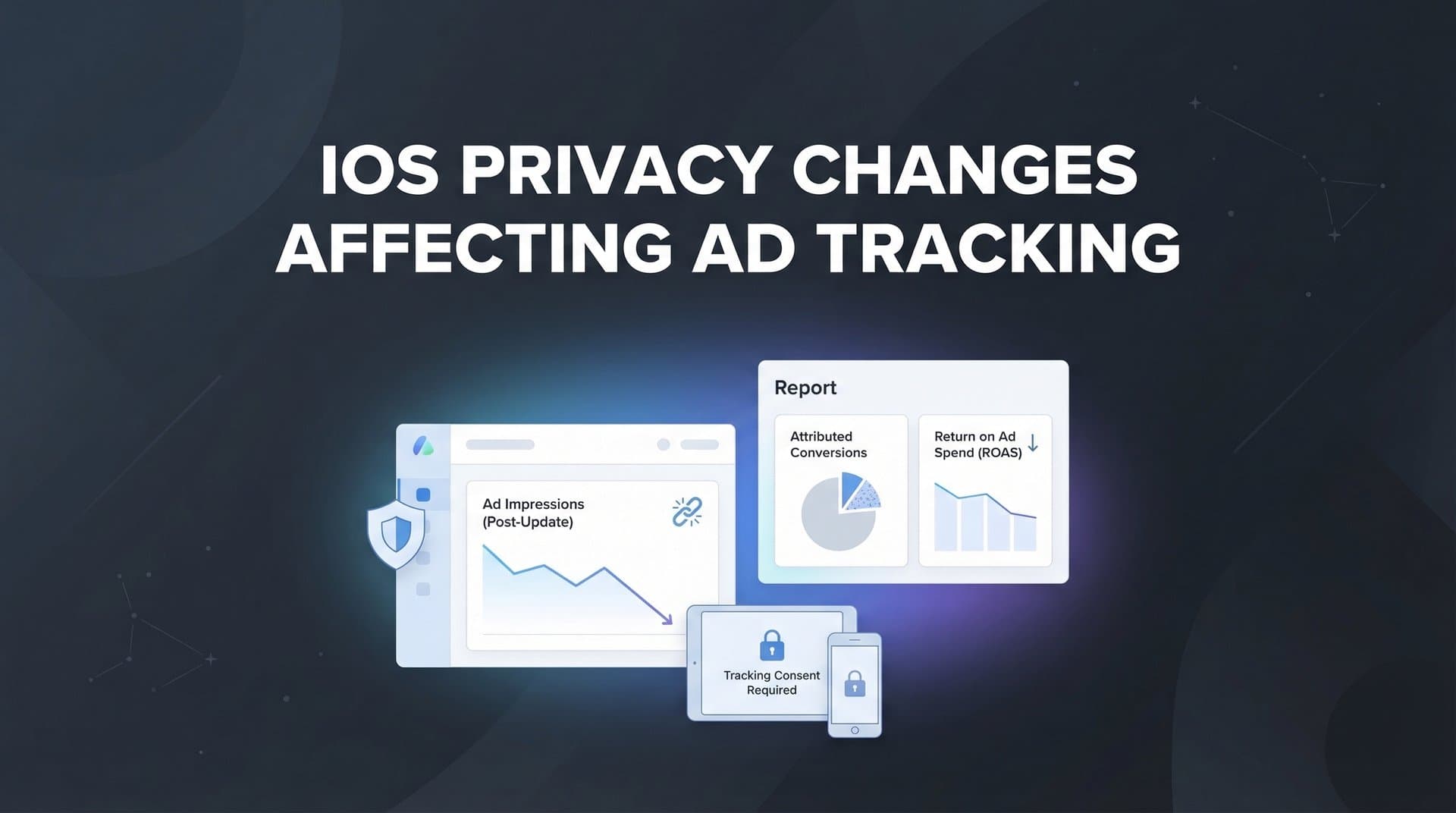
When Apple rolled out App Tracking Transparency in 2021, it didn't just change a few settings—it fundamentally rewrote how digital advertising works on mobile devices. Five years later, the impact is still reverberating through marketing departments everywhere. If you're running paid campaigns and watching your attribution data crumble, you're not alone.
The challenge isn't going away. Many marketers are still wrestling with incomplete conversion data, inflated customer acquisition costs, and attribution reports that feel more like guesswork than reliable intelligence. Your Facebook dashboard shows fewer conversions than your CRM. Your retargeting audiences have shrunk. Your lookalike campaigns don't perform like they used to.
But here's the reality: while some marketers are still struggling with these limitations, others have adapted—and they're thriving. This guide breaks down exactly what changed with iOS privacy updates, why traditional tracking methods no longer work, and how forward-thinking teams are building attribution strategies that actually deliver accurate data in 2026.
The ATT Framework: How Apple Rewrote the Rules of Mobile Tracking
App Tracking Transparency (ATT) changed everything by flipping the script on user consent. Before ATT, apps could track your activity across other apps and websites by default. You had to dig into settings to opt out—and most people never did. After ATT, apps must ask permission first. That simple shift transformed the entire mobile advertising ecosystem.
The technical mechanism behind this change centers on the IDFA—the Identifier for Advertisers. Think of IDFA as a unique ID tag attached to every iPhone. Advertisers used it to follow users across apps, building detailed profiles of behavior and preferences. When you clicked an Instagram ad and later made a purchase in a shopping app, IDFA connected those dots. It powered retargeting, attribution, and audience building.
With ATT, IDFA became opt-in. When users open an app for the first time after updating to iOS 14.5 or later, they see a prompt asking if they'll allow tracking. Most users decline. Industry observations suggest opt-in rates typically range from 15-25%, though this varies by app category and how the permission request is framed.
When users opt out, the consequences are immediate and severe for advertisers. The app can no longer access IDFA. It cannot track that user across other apps or websites. It cannot attribute conversions back to specific ad impressions. It cannot add that user to retargeting pools or use their behavior to build lookalike audiences.
This isn't a partial limitation—it's a complete blackout. Ad platforms lose visibility into post-click behavior entirely for opted-out users. You might spend $1,000 driving clicks to your app, and if those users opted out of tracking, you'll have zero insight into whether they converted, what they purchased, or how much revenue they generated. Understanding the full scope of iOS App Tracking Transparency impact is essential for adapting your strategy.
The IDFA deprecation didn't just affect attribution—it broke the feedback loop that ad platforms rely on to optimize campaigns. Facebook's algorithm learns which creative and targeting combinations drive conversions by analyzing conversion data. Google's Smart Bidding adjusts bids based on conversion likelihood. When 75-85% of users opt out, these systems are essentially flying blind.
Apple positioned ATT as a privacy win for consumers, giving them control over their data. For advertisers, it represented the end of an era. The granular, user-level tracking that powered modern digital advertising simply stopped working for the majority of iOS users. And since iOS represents a significant portion of mobile traffic—particularly among high-value demographics—the impact hit hard and fast.
The Ripple Effects: How These Changes Impact Your Ad Campaigns
The attribution gap is the first place most marketers notice the problem. Open your Facebook Ads Manager or Google Ads dashboard, and the conversion numbers look wrong. You know you're generating sales—your CRM and payment processor confirm it—but your ad platforms show a fraction of the actual conversions. This isn't a bug. It's the new reality of iOS privacy restrictions.
For a deeper dive into this space, see our advertising manager guide.
When users opt out of tracking, ad platforms cannot attribute their conversions back to specific ads, campaigns, or even channels. That sale from an opted-out user? It happened, but Facebook has no way to connect it to the ad impression that drove it. Your actual ROI might be 3X, but your dashboard shows 1.5X because half your conversions are invisible to the platform.
If you're evaluating vendors, our AI Instagram ad generator breakdown can help.
This creates a dangerous decision-making environment. You're making budget allocation choices based on incomplete data. You might pause a campaign that's actually profitable because the platform can't see its full impact. You might scale a campaign that looks good in the dashboard but is actually underperforming when you account for the full picture. Many advertisers are actively losing attribution data due to privacy updates without realizing the full extent.
Audience targeting took an equally severe hit. Retargeting campaigns used to be a reliable revenue driver—show ads to people who visited your site or added items to cart, and conversion rates would soar. But retargeting requires tracking users across apps and websites. When users opt out, you cannot add them to retargeting audiences. Your retargeting pools have shrunk dramatically, and the users you can still reach represent a skewed sample of your actual traffic.
Lookalike audiences, once a cornerstone of customer acquisition, have degraded significantly. These audiences work by analyzing your best customers and finding similar users. But if 75% of your customer data is invisible to Facebook due to ATT opt-outs, the lookalike algorithm is working with a limited, potentially biased sample. The audiences it builds are less accurate, less effective, and less profitable than they were before ATT.
The algorithm optimization challenge compounds these problems. Machine learning models need data—lots of it—to optimize effectively. Facebook's algorithm learns which creative resonates, which audiences convert, and which placements perform best by analyzing conversion signals. When those signals become sparse and delayed, the algorithm struggles.
Consider how this plays out in practice. You launch a new campaign targeting iOS users. In the pre-ATT world, Facebook would quickly gather conversion data, identify winning combinations, and optimize toward them within days. Now, with limited conversion visibility, the learning phase extends. The algorithm takes longer to optimize. Performance remains inconsistent. You burn budget while the platform fumbles in the dark. These iOS tracking limitations on Facebook Ads require a fundamentally different approach.
For a deeper dive into this space, see our Facebook ads software guide.
Smart Bidding strategies like Target CPA and Target ROAS rely on accurate conversion data to set optimal bids. When conversion data is incomplete, these automated strategies make poor decisions. They might bid too low on valuable users because the platform cannot see their conversions. They might bid too high on less valuable segments because the visible data is skewed.
The cost implications are real and measurable. Many advertisers have observed increases in customer acquisition costs since ATT rolled out. Part of this comes from reduced targeting precision. Part comes from algorithm inefficiency. Part comes from increased competition for the shrinking pool of trackable users. The result is the same: you're paying more to acquire each customer, and you have less visibility into whether it's actually working.
SKAdNetwork and Privacy-Preserving Measurement: Apple's Alternative
Apple didn't just take away IDFA and leave advertisers with nothing. They introduced SKAdNetwork (SKAN) as a privacy-preserving alternative for measuring app install campaigns. Understanding how SKAN works—and more importantly, where it falls short—is crucial for building a realistic attribution strategy.
SKAdNetwork provides aggregated, anonymized conversion data without revealing individual user behavior. When someone clicks an ad and installs an app, SKAN can report that conversion back to the ad network. But it does so in a way that preserves user privacy: the data is delayed, aggregated, and stripped of user-level details.
The technical mechanism involves conversion values—a 6-bit integer (0-63) that developers can use to encode information about post-install actions. You might assign a value of 10 for a registration, 30 for an add-to-cart, and 50 for a purchase. SKAN reports these values back to ad networks, but with significant limitations.
First, the reporting is delayed. SKAN uses randomized timer windows to prevent fingerprinting. You might wait 24-48 hours or longer to receive conversion data. This delay makes real-time optimization impossible. You cannot quickly test creative variations or adjust bids based on immediate performance. By the time you see the data, campaign conditions may have already shifted.
Second, the data is aggregated and anonymized. You cannot see individual user journeys. You cannot analyze which specific users converted or what path they took. You get campaign-level summaries: X installs, Y conversions, Z average conversion value. This makes it impossible to build detailed customer profiles or understand nuanced behavior patterns.
Third, the conversion value system is extremely limited. Six bits gives you 64 possible values to encode all post-install behavior. You must choose what to measure carefully. Do you prioritize purchase events? Revenue tiers? Engagement milestones? You cannot capture everything, so you're forced to make tradeoffs that limit your visibility into user behavior.
For app install campaigns, SKAN provides some value—it's better than complete blindness. But it cannot replace the granular, user-level attribution that marketers previously relied on. You can see that your campaign drove installs and some conversions, but you cannot identify which creative, audience, or placement performed best at a detailed level.
And here's the critical limitation: SKAdNetwork only works for app install campaigns. If you're driving traffic to a mobile website, SKAN provides zero value. If you're running lead generation campaigns, e-commerce campaigns, or any campaign that doesn't involve app installs, SKAN doesn't help you at all. You'll need to explore pixel tracking alternatives for iOS users to fill these gaps.
This is why SKAdNetwork, while useful in specific contexts, cannot be your complete attribution solution. It's one piece of a much larger puzzle. Marketers who rely solely on SKAN are still operating with massive data gaps, delayed insights, and limited optimization capabilities. You need additional measurement strategies to fill the holes that ATT created.
Server-Side Tracking: The Foundation of Modern Attribution
While Apple locked down device-level tracking, they left the door open for something more powerful: server-side tracking. This approach has become the foundation of accurate attribution in the post-ATT era because it operates entirely outside the browser and device restrictions that crippled traditional pixel-based tracking.
Traditional tracking relied on client-side pixels—small pieces of JavaScript code that fire when users visit your website or complete actions. These pixels run in the user's browser, subject to all the privacy restrictions Apple (and increasingly other platforms) have implemented. Ad blockers can block them. Privacy settings can disable them. ATT can prevent them from accessing identifiers needed for attribution.
Server-side tracking flips this model entirely. Instead of relying on code running in the user's browser, your server captures the data and sends it directly to ad platforms via server-to-server connections. The user's device never communicates directly with Facebook or Google—your server acts as the intermediary. Understanding the differences between Google Analytics vs server-side tracking helps clarify why this approach works.
Here's how this changes the game. When someone completes a purchase on your site, your server records that conversion event along with first-party data you've collected: email address, phone number, order details, customer ID. Your server then transmits this information directly to Meta's Conversions API or Google's enhanced conversions endpoint.
This approach bypasses all the browser-level restrictions that break pixel tracking. There's no JavaScript code for ad blockers to block. There are no cookies for privacy settings to reject. There's no IDFA for ATT to restrict. The data flows server-to-server, completely independent of the user's device configuration.
The technical shift is significant but manageable. Instead of dropping a pixel on your thank-you page and hoping it fires correctly, you integrate your server with ad platform APIs. When your database records a conversion, your server immediately sends that data to the appropriate platforms. This happens server-side, reliably, regardless of what's happening on the user's device.
First-party data becomes the cornerstone of this approach. You're collecting data directly from users—through account creation, form submissions, purchases, and authenticated interactions. This data belongs to you, not to ad platforms or device manufacturers. And because you're collecting it directly, you can ensure its accuracy and completeness. Implementing proper first-party data tracking setup is critical for success.
The quality improvement is substantial. Client-side pixels often fail to fire due to page navigation, slow loading, or user behavior. Server-side events fire reliably because they're triggered by server-side actions. When your database records a sale, your server sends the conversion event. There's no reliance on JavaScript execution or browser compatibility.
Server-side tracking also enables better data enrichment. You can send additional context that client-side pixels cannot access: customer lifetime value, product categories, subscription status, or any other data stored in your systems. This enriched data helps ad platforms optimize more effectively, even with limited user-level identifiers.
The implementation requires technical work—you need server-side infrastructure, API integrations, and proper data handling. But the payoff is worth it. Marketers using server-side tracking consistently report more complete attribution data, better algorithm performance, and more confident scaling decisions compared to those still relying solely on client-side pixels.
Building an iOS-Resilient Attribution Strategy
Understanding the problems is one thing. Building a strategy that actually works in 2026 requires combining multiple approaches into a cohesive attribution system. The marketers winning right now aren't relying on a single solution—they're orchestrating several complementary methods to capture the complete picture.
Start with Conversions API for Meta and enhanced conversions for Google. These server-side implementations should be your foundation, not an afterthought. CAPI allows you to send conversion events directly from your server to Meta, bypassing all browser-level restrictions. Enhanced conversions does the same for Google, using hashed first-party data to improve match rates and attribution accuracy.
The implementation matters. Simply enabling these features isn't enough—you need to send high-quality, enriched data. Include customer email addresses, phone numbers, and other identifiers that help platforms match conversions to ad interactions. The better your match rates, the more complete your attribution becomes. Proper attribution tracking setup ensures you're capturing every conversion signal.
Send events in real-time or near real-time. Delayed conversion data limits algorithm optimization capabilities. The faster ad platforms receive conversion signals, the faster they can adjust bidding and targeting. Set up your server infrastructure to transmit events immediately when they occur in your database.
Multi-touch attribution becomes essential when device-level tracking breaks down. Instead of crediting the last click before conversion, multi-touch models analyze the entire customer journey across devices, sessions, and channels. Someone might see your Facebook ad on their iPhone, research on their laptop, and purchase on their iPad. Single-touch attribution would miss most of this journey.
Implementing multi-touch attribution requires tracking infrastructure that can connect touchpoints across devices and sessions. This typically means using first-party identifiers—email addresses, customer IDs, or phone numbers—to stitch together the journey. When someone logs in or provides their email, you can connect their current session to previous interactions. Effective cross-device attribution tracking is essential for understanding the complete customer path.
Different attribution models suit different business contexts. Time decay gives more credit to recent touchpoints. Linear attribution distributes credit equally. Position-based models emphasize first and last touches. Test multiple models to understand which provides the most actionable insights for your specific customer journey. Exploring various attribution tracking methods helps you find the right fit.
The real power comes from comparing attribution models. When you can see how different models assign credit, you gain deeper understanding of channel roles. You might discover that Facebook initiates customer journeys while Google captures bottom-funnel conversions. This insight changes how you allocate budget and measure success.
AI-powered analytics help you make sense of fragmented data. Machine learning models can identify patterns that humans miss, especially when working with incomplete datasets. AI can predict true conversion rates by analyzing the relationship between visible and invisible conversions. It can identify high-performing audience segments despite limited tracking data.
Look for platforms that use AI to provide optimization recommendations based on your complete data picture—not just what individual ad platforms can see. When your attribution system connects all touchpoints and feeds that data into AI models, you get recommendations based on actual performance, not the fragmented view that Facebook or Google sees in isolation.
The key is integration. Your server-side tracking, multi-touch attribution, and AI analytics need to work together as a unified system. Data flows from your website and apps to your attribution platform, which enriches it, analyzes it, and sends conversion events back to ad platforms. This closed loop ensures everyone is working with the best available data.
Putting It All Together: Thriving in the Privacy-First Era
iOS privacy changes didn't just create temporary disruption—they permanently transformed digital advertising. The old playbook of dropping pixels and trusting platform attribution is dead. The marketers who accept this reality and adapt their strategies are the ones scaling confidently in 2026.
The adaptation path is clear: implement server-side tracking to bypass device restrictions, build first-party data collection into every customer interaction, and use multi-touch attribution to connect the full journey. These aren't optional nice-to-haves—they're the foundation of accurate measurement in the privacy-first era. Discovering privacy-compliant tracking alternatives gives you options that work within current regulations.
But implementation is where most marketers struggle. Building this infrastructure requires technical expertise, platform integrations, and ongoing optimization. You need server-side event handling, API connections to multiple ad platforms, identity resolution across devices, and analytics capable of making sense of fragmented data.
This is exactly why platforms like Cometly exist. Instead of cobbling together multiple point solutions and hoping they work together, you need a unified system that handles the entire attribution workflow. Server-side tracking that captures every touchpoint. AI-powered analytics that identify true revenue drivers despite data fragmentation. Conversion sync that feeds enriched data back to ad platforms, improving their optimization.
The difference shows up in your decision-making confidence. When you can see the complete customer journey—from first ad impression through every touchpoint to final purchase—you make better budget allocation choices. You scale campaigns based on actual performance, not incomplete platform reporting. You identify opportunities that competitors miss because they're still relying on fragmented data.
Accurate data isn't just about measurement—it's about competitive advantage. While other marketers are making decisions in the dark, you're operating with clarity. You know which campaigns drive revenue. You understand which channels play which roles. You can confidently scale what works and cut what doesn't.
Ready to elevate your marketing game with precision and confidence? Discover how Cometly's AI-driven recommendations can transform your ad strategy—Get your free demo today and start capturing every touchpoint to maximize your conversions.


