Picture this: your marketing team has been scaling a paid campaign for the past six weeks. The ad platform dashboard looks great. ROAS is climbing, cost per conversion is dropping, and the algorithm seems to be finding its stride. Then someone pulls the CRM report and the numbers don't match. Not by a little. By a lot.
This is not an edge case. It happens to marketing teams across industries, at every budget level, and it rarely gets flagged until the damage has already been done. The gap between what your ad platform reports and what your backend systems actually show is not a minor reporting quirk. It is a systematic leak that compounds quietly over time, draining budget, corrupting decisions, and preventing you from scaling what actually works.
Here is what makes tracking failures particularly dangerous: they do not just create messy reports. They actively cause lost revenue from tracking issues by feeding wrong signals to ad platform algorithms, redirecting budget toward underperforming channels, and masking the true performance of campaigns that deserve to be scaled. The problem is invisible until it becomes expensive.
This article breaks down where these revenue leaks originate, how they compound into serious budget waste, and what a reliable tracking infrastructure actually looks like. If you are running paid advertising at any meaningful scale, understanding this is not optional. It is the difference between growing efficiently and burning budget in the dark.
The Hidden Mechanics Behind Tracking Failures
To understand why tracking breaks down, you need to understand how most tracking systems are built. The dominant model for years has been client-side tracking: a pixel fires in the user's browser when they take an action, and that event gets sent to the ad platform. Simple in theory. Increasingly unreliable in practice.
Several forces have converged to make client-side tracking far less dependable than it once was. Browser privacy restrictions are a major factor. Safari and Firefox have been blocking third-party cookies for years. Chrome has been progressively tightening its own policies. Ad blockers, which a significant portion of web users now run by default, prevent pixels from firing altogether. When a pixel cannot fire, the conversion simply disappears from your data. Understanding what a tracking pixel is and how it works helps clarify why these failures occur so frequently.
Apple's App Tracking Transparency framework, introduced with iOS 14.5, added another layer of complexity. When users opt out of tracking on iOS devices, ad platforms lose the ability to connect ad clicks to downstream conversions on those devices. For advertisers running campaigns where a substantial portion of their audience uses iPhones, this creates a meaningful blind spot in reported performance.
Then there are the self-inflicted tracking failures: misconfigured pixels, broken UTM parameters, and inconsistent tagging conventions. A UTM parameter that drops off during a redirect. A pixel that fires on the wrong page. A campaign that launches without proper source tagging. These errors are common, often undetected for weeks, and they corrupt the data flowing into your analytics and ad platforms. If you are dealing with these issues, a guide on fixing tracking pixel firing issues can help you diagnose the root causes.
Cross-device and cross-platform attribution gaps add yet another dimension. A customer might click a Facebook ad on their phone during lunch, browse your site on their laptop that evening, and convert through a Google search the next morning. Without a system that connects these touchpoints, that journey gets fragmented. The Facebook ad gets no credit. The Google search gets all of it. And your budget decisions reflect a version of reality that never actually existed.
It is worth drawing a clear distinction between two types of tracking failures, because they create different problems. Data that is lost entirely means a conversion happened but was never recorded anywhere. Data that is misattributed means the conversion was recorded, but credited to the wrong source. Both are serious. Lost data starves your algorithms of the signals they need to optimize. Misattributed data actively misleads your decision-making by making the wrong channels look like winners.
Most tracking environments suffer from both simultaneously, which is what makes the problem so difficult to diagnose without a systematic approach.
How Broken Tracking Compounds Into Budget Waste
Here is where the revenue damage really accelerates. Ad platforms like Meta and Google do not just use your conversion data for reporting. They use it to power their optimization algorithms. Every conversion signal you send teaches the algorithm who is likely to convert, what they look like, and when to show them your ads. When that data is incomplete or inaccurate, the algorithm learns the wrong lessons and performance degrades over time.
Think of it as a feedback loop. You run ads. Conversions happen. The platform records some of them (not all). The algorithm adjusts targeting based on the incomplete picture. It starts finding audiences that look like the conversions it can see, which may not represent your actual best customers. Performance shifts in ways that are hard to explain. You make adjustments based on what the data shows. Those adjustments are built on a flawed foundation. The loop continues.
This is not a one-time hit. It is a compounding problem. The longer broken tracking runs, the more the algorithm drifts from optimal performance, and the harder it becomes to course-correct because the historical data used to inform decisions is already corrupted. This is precisely why fixing conversion tracking gaps should be treated as a revenue priority rather than a technical nice-to-have.
The budget misallocation problem is equally damaging. Consider a scenario where a customer converts after seeing a display ad, then a YouTube video, then clicking a paid search ad. If your tracking only captures the last click, all the credit goes to the search campaign. The display and video campaigns look like they are not performing. You reduce budget there and pour more into search. But search was capturing demand that display and video were generating. Now you have less demand to capture, and performance drops even though you thought you were optimizing.
This pattern plays out constantly in multi-channel advertising environments. Channels that contribute early in the customer journey look like underperformers because single-touch or platform-native attribution cannot see the full picture. Implementing proper cross-channel tracking is essential to understanding how these channels work together rather than evaluating them in isolation.
The impact on ROAS and CAC calculations is just as serious. If your ad platform is reporting conversions that your CRM does not recognize, your ROAS looks better than it is. You scale based on that inflated number. You commit more budget. And then the real revenue numbers come in and the math does not work. By that point, weeks of budget have been allocated based on a false signal.
True ROAS and accurate CAC require clean, complete conversion data connected to actual backend revenue. Without that connection, you are essentially flying with an instrument panel that shows what you want to see rather than what is actually happening.
Five Warning Signs Your Tracking Is Leaking Revenue
Tracking issues rarely announce themselves. They surface as subtle patterns that are easy to rationalize or overlook. Knowing what to look for is the first step toward catching them before they compound.
Significant gaps between ad platform conversions and CRM data: If your ad platforms are reporting conversions that are substantially higher than what your CRM or backend systems show, that gap is a red flag. Small discrepancies are normal due to attribution window differences, but gaps that grow consistently over time suggest a systematic tracking problem rather than a reporting quirk. Connecting your ad data to your CRM through proper revenue attribution is the most reliable way to identify and close these gaps.
Sudden drops in reported conversions without corresponding drops in actual sales: If your conversion reporting falls off a cliff but your sales team is not seeing a corresponding drop in closed deals or orders, your tracking likely broke somewhere. The inverse is also worth watching: if actual revenue drops but your ad platform is still reporting strong conversion numbers, you may be seeing phantom conversions or severe misattribution.
An unusual volume of conversions attributed to direct or unknown sources: When a large percentage of your conversions show up as direct traffic or have no source attached, it typically means your UTM parameters are breaking down somewhere in the journey. Traffic that should be attributed to specific campaigns is losing its tags and getting lumped into an untracked bucket. This makes it impossible to evaluate channel performance accurately. A solid understanding of UTM tracking and how it helps your marketing is critical to preventing this problem.
Ad platform performance declining despite no creative or targeting changes: When CPAs start climbing or ROAS starts falling without any obvious changes to your campaigns, one of the most common culprits is degraded conversion data quality. The algorithm is no longer receiving enough signal to optimize effectively. It is not that your ads stopped working. It is that the system optimizing your ads stopped getting the information it needs.
Inconsistent attribution across platforms for the same campaigns: If Meta is reporting one set of conversion numbers, Google is reporting another, and your analytics platform shows something entirely different for overlapping campaigns, you have an attribution inconsistency problem. Some of this is expected due to different attribution models, but large, unexplained discrepancies suggest your tracking setup is not telling a coherent story about what is actually happening.
Server-Side Tracking and Why It Changes the Equation
The most effective response to the client-side tracking crisis is a shift to server-side tracking. Understanding why requires a quick look at how the two approaches differ at a fundamental level.
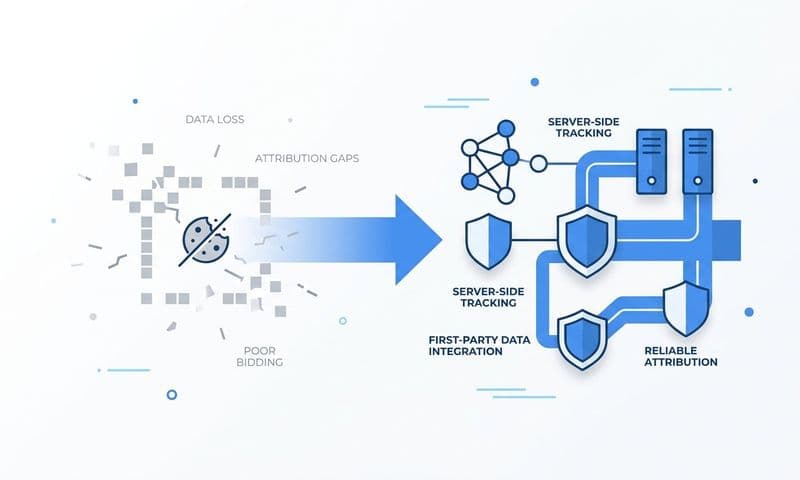
With client-side tracking, the conversion event is triggered by code running in the user's browser. If an ad blocker is running, the code gets blocked. If the browser restricts cookies, the event cannot be properly identified. If the user has opted out of tracking on their iOS device, the connection between the ad click and the conversion is severed. The browser is the weak link, and there are now many forces working to make that link weaker.
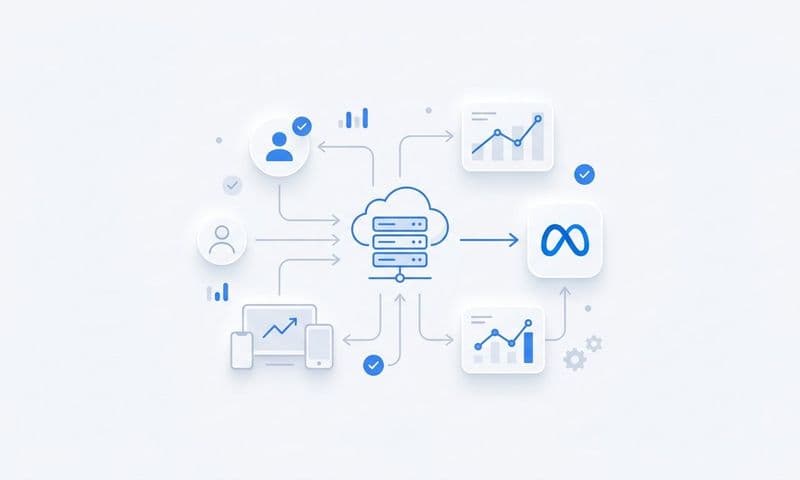
With server-side tracking, the conversion event is sent from your server directly to the ad platform's API. The browser is not involved in the transmission. Ad blockers cannot intercept it. Cookie restrictions do not apply. The event travels through a channel that is not subject to the same privacy-driven limitations that have made client-side tracking increasingly unreliable. For a deeper dive into the mechanics, this guide on why server-side tracking is more accurate explains the technical advantages in detail.
The practical result is that server-side tracking captures a meaningfully larger portion of actual conversions. Customers who would have been invisible to your pixel because they use an ad blocker or have strict browser privacy settings now show up in your data. The conversion signals flowing to your ad platforms become more complete and more accurate.
This matters enormously for algorithm performance. Ad platforms optimize based on the conversion signals they receive. More complete signals mean the algorithm has a better picture of who is converting and what those customers look like. It can find more of them. Targeting improves. Bidding becomes more efficient. The entire optimization engine runs better because it is working with better data.
This is the concept behind conversion sync: sending enriched, accurate conversion events back to platforms like Meta and Google so their algorithms can do their jobs effectively. When you feed the algorithm clean data, you are not just improving your reporting. You are actively improving campaign performance by giving the system the inputs it needs to optimize toward your real customers.
Server-side tracking also enables better data enrichment. Because the event passes through your server before being sent to the ad platform, you can attach additional context: customer lifetime value signals, lead quality scores, or revenue amounts. This allows ad platforms to optimize not just for volume of conversions but for the quality and value of those conversions. That is a significant upgrade from a pixel that can only tell the platform a conversion happened.
Implementing server-side tracking requires technical setup, but the investment pays off quickly for any team running paid campaigns at meaningful scale. Evaluating the best server-side tracking tools available is a good starting point for teams ready to make the transition. The alternative is continuing to optimize on incomplete data, which means continuing to leave revenue on the table.
Building an Attribution Framework That Protects Revenue
Server-side tracking solves a critical piece of the puzzle, but it is one component of a broader attribution framework. Protecting revenue at scale requires connecting the dots across your entire marketing stack.
The foundation is multi-touch attribution. Most customer journeys involve multiple interactions across multiple channels before a conversion happens. A framework that only looks at the last click, or that relies entirely on what a single ad platform reports, will always produce a distorted picture. Multi-touch attribution assigns credit across the touchpoints that contributed to a conversion, giving you a more accurate view of what is actually driving revenue. The ultimate guide to revenue attribution covers the different models and how to choose the right one for your business.
This matters for budget decisions in a direct way. When you can see that a certain channel consistently appears early in the journey for your highest-value customers, you know to protect that budget even if that channel does not look impressive on a last-click basis. Without multi-touch visibility, that channel looks like a cost center when it is actually a growth driver.
Consistent UTM conventions: Every campaign, ad group, and creative should be tagged with a consistent UTM structure that your entire team follows. This sounds basic, but UTM inconsistency is one of the most common sources of attribution gaps. When parameters are missing, misspelled, or formatted differently across campaigns, traffic gets misattributed or falls into the direct bucket. A documented tagging convention and regular audits to enforce it are non-negotiable.
CRM integration for full-funnel visibility: Your ad platform knows what happened before the click and immediately after. Your CRM knows what happened after that: whether the lead closed, how long the sales cycle was, and what the customer was actually worth. Connecting these two data sources gives you a full-funnel picture that links ad spend to real revenue rather than just to form fills or trial signups.
Regular data audits: Attribution frameworks drift. Pixels break. UTM parameters stop working after a site update. New campaigns launch without proper tagging. A recurring audit process that compares ad platform data against CRM and backend revenue data catches these issues before they compound into major misallocations.
Platforms like Cometly are built to bring all of these components together. Cometly connects your ad platforms, CRM, and website data to track the entire customer journey in real time. It captures every touchpoint, from the first ad click to the final conversion, and uses AI to identify which ads and campaigns are actually driving revenue. The AI-powered recommendations surface high-performing ads across every channel and provide actionable guidance for where to scale and where to pull back. That kind of visibility is what turns attribution from a reporting exercise into a genuine competitive advantage.
Practical Steps to Stop the Revenue Leak Today
Understanding the problem is the first step. Taking action is where the revenue recovery actually happens. Here is a practical starting point for closing the gaps in your tracking setup.
Audit your current tracking for pixel errors and UTM inconsistencies: Use your analytics platform to check for pages where your pixel is not firing, look for campaigns with missing or malformed UTM parameters, and compare conversion counts across your ad platforms and your backend systems. Document every discrepancy you find. The audit itself will often surface the most significant leaks quickly. A proper attribution tracking setup ensures you have the foundation in place to catch these issues systematically.
Implement server-side tracking to recover lost conversions: If you are still relying entirely on client-side pixels, prioritize moving to a server-side setup. This is the single highest-impact technical change you can make to improve data completeness. It does not replace client-side tracking entirely but works alongside it to capture conversions that would otherwise be lost to browser restrictions and ad blockers.
Set up conversion sync to feed better data back to ad platforms: Once you have more complete conversion data, send it back to Meta, Google, and any other platforms you are running. Enriched conversion events improve the algorithm's ability to optimize targeting and bidding, which translates directly into better campaign performance. This is not just a data quality improvement. It is a performance improvement.
Establish a regular reconciliation process: Set a recurring schedule, whether weekly or bi-weekly, to compare what your ad platforms are reporting against what your CRM and revenue systems show. Define acceptable thresholds for discrepancy and investigate anything that exceeds them. Catching a tracking issue two weeks after it starts is far less costly than catching it two months later.
Standardize your attribution model across the team: Make sure everyone who looks at campaign performance is using the same attribution model and understands its limitations. Disagreements about which channel gets credit are often rooted in different team members looking at different attribution windows or models. Alignment here prevents budget decisions from being made on mismatched data.
The Bottom Line on Tracking and Revenue
Lost revenue from tracking issues is not a one-time problem you solve and move on from. It is an ongoing drain that gets worse as your ad spend scales. Every dollar you add to a campaign that is running on broken data is a dollar that is being optimized toward the wrong outcome.
The good news is that this is a solvable problem. Server-side tracking recovers conversions that client-side pixels miss. Multi-touch attribution reveals the true customer journey instead of crediting the last click. CRM integration connects ad spend to real revenue. Conversion sync gives ad platform algorithms the accurate data they need to perform. And a regular reconciliation process ensures that when something breaks, you catch it quickly.
The goal is not just cleaner reports. It is a tracking infrastructure that captures every touchpoint, connects it to real revenue, and continuously feeds accurate signals back to the systems doing the optimization. That is what separates teams that scale efficiently from teams that scale their problems.
Start with an audit of your current tracking setup. Identify where the gaps are. Then build toward a system that gives you the full picture. If you want to see what that looks like in practice, Get your free demo of Cometly and discover how AI-driven attribution can help you capture every touchpoint, connect every conversion to real revenue, and finally stop leaving money on the table.