If you were running paid ads in 2021 and beyond, you probably remember the moment things stopped making sense. ROAS numbers collapsed. Conversion counts in Meta Ads Manager looked nothing like what your CRM was showing. Campaigns you knew were generating pipeline appeared to be failing on paper. You had not changed anything, yet the data told a completely different story.
This was not a platform glitch or a tracking error you could fix with a quick pixel reinstall. It was the direct consequence of Apple's App Tracking Transparency framework, which fundamentally changed how ad platforms could observe user behavior after an ad click. And while the initial shock hit hardest with iOS 14.5 in April 2021, the effects have compounded across every major iOS release since.
The frustrating part is that the underlying problem runs deeper than a single policy change. iOS updates did not create fragile ad measurement. They exposed it. Marketers who had been relying on browser-based pixels and third-party device identifiers to track conversions were already operating on a foundation with serious cracks. Apple's privacy framework just made those cracks impossible to ignore.
This article breaks down exactly what happened, what data went missing and why, and what a modern attribution strategy looks like for B2B SaaS teams who need to connect ad spend to real revenue, not just last-click pixel events. If you are still trying to recover visibility lost after the iOS updates, this is where to start.
How Apple's App Tracking Transparency Changed the Rules
Before iOS 14.5, ad platforms operated with a relatively seamless ability to follow a user from ad exposure to conversion. The mechanism behind this was the IDFA, or Identifier for Advertisers: a unique device-level identifier that Apple assigned to every iPhone and iPad. Ad platforms like Meta and Google used the IDFA to match an ad click on one app to a purchase or sign-up that happened on a different app or website. It was the connective tissue of mobile attribution.
The App Tracking Transparency framework changed this by requiring every app to explicitly ask users for permission before accessing the IDFA. The prompt is direct and unambiguous: it tells users that the app wants to track their activity across other companies' apps and websites. The majority of users, when presented with this choice, opted out. With opt-outs came the loss of the IDFA for those users, and with the IDFA gone, the traditional attribution chain between ad click and downstream conversion was broken.
It is important to understand that this was not a one-time event. iOS 14 introduced the framework. iOS 14.5 made the opt-in prompts mandatory for all apps. iOS 15, 16, and subsequent versions continued to tighten privacy controls, expanding restrictions on cross-site tracking, limiting link parameters used for attribution, and reducing the window in which ad platforms could observe user behavior. Each update layered new constraints on top of the last.
For ad platforms, the impact was immediate and significant. Meta, which had built much of its advertising infrastructure around the ability to track users across its family of apps and external websites, suddenly lost visibility into a large portion of its iOS user base. Google faced similar challenges. The conversion signals that ad platform algorithms depended on to optimize delivery, find lookalike audiences, and report accurate results were now incomplete by design.
For marketers, especially those running campaigns targeting B2B audiences on mobile, this translated into dashboards that no longer reflected reality. The data did not disappear from your business. It disappeared from your ad platform's view of your business. That distinction matters enormously when it comes to figuring out how to fix it. You can learn more about how iOS 14 changed digital advertising and why the effects continue to ripple through ad measurement today.
The Specific Data Gaps iOS Updates Created
Understanding what went missing requires looking at the problem from a few different angles: what the ad platforms stopped seeing, how they responded to fill those gaps, and what the downstream effects were on marketing decisions.
The most immediate loss was in attributed conversions. When a user clicked an ad on an iOS device and then completed a purchase or submitted a form, that conversion event could no longer be reliably tied back to the originating ad if the user had opted out of tracking. The result was a wave of unattributed conversions sitting in your CRM or analytics platform with no corresponding record in Meta Ads Manager or Google Ads.
Meta's response to this was Aggregated Event Measurement, a framework that limited advertisers to eight conversion events per domain and introduced statistical modeling to estimate conversions that could not be directly observed. This modeling fills gaps, but it is not the same as measured data. Modeled conversions introduce uncertainty into reporting, and that uncertainty compounds when you are making budget decisions based on what the platform shows you.
Meta also changed its default attribution windows in response to ATT. The previous standard of 28-day click attribution was replaced with 7-day click and 1-day view as the default. For B2B SaaS companies with buying cycles that often extend weeks or months, this change was particularly damaging. A prospect who clicked an ad and converted twelve days later would no longer appear in the attribution window at all, making campaigns targeting longer-cycle buyers look far less effective than they actually were.
The downstream business impact of these data gaps was significant. Marketing teams paused campaigns that were actually generating pipeline because the numbers looked bad. Budget was reallocated away from channels that were working toward channels that appeared to be working based on incomplete data. Ad platform algorithms, which rely on conversion signals to optimize delivery, were being fed fewer and noisier signals, which degraded targeting performance over time.
Cost-per-acquisition figures inflated not because campaigns got worse, but because the denominator shrank. Fewer observed conversions divided into the same ad spend produced alarming CPA numbers that did not reflect what was actually happening in the business. Teams that lacked a way to reconcile ad platform data with CRM pipeline data had no reliable way to know which number to trust. Understanding how to fix attribution discrepancies in data is an essential first step toward restoring confidence in your reporting.
Why the Pixel Was Already a Fragile Foundation
Here is something worth sitting with: browser-based pixels were already losing ground before Apple changed anything. iOS updates accelerated the decline, but the fragility was built in from the start.
Client-side tracking tools like the Meta Pixel work by executing JavaScript code in the user's browser when a specific action occurs, such as a page view, a form submission, or a purchase. That event is then sent from the browser to the ad platform. The problem is that this entire process depends on the browser cooperating, and increasingly, browsers do not cooperate.
Ad blockers prevent pixels from firing. Safari's Intelligent Tracking Prevention limits the lifespan of first-party cookies and blocks third-party tracking scripts. Firefox has similar protections. Even Chrome has been moving toward reduced cross-site tracking. By the time iOS 14.5 arrived, a meaningful portion of web traffic was already invisible to pixel-based tracking for reasons that had nothing to do with Apple. The full scope of pixel tracking problems on iOS goes well beyond what most teams initially realized when the framework first rolled out.
iOS updates did not create a new problem. They made an existing problem impossible to ignore by removing a large, predictable class of conversions from the observable dataset all at once.
For B2B SaaS companies specifically, pixel-only tracking was always a poor fit for how the buying process actually works. B2B buyers rarely convert in a single session on a single device. A prospect might click a LinkedIn ad on their phone, research the product on their work laptop, attend a webinar from a different browser, and then book a demo through a link in an email. A pixel sitting on your website can only see the moments when that prospect is actively browsing your site in a browser that has not blocked it. It cannot see the demo call. It cannot see the opportunity stage in your CRM. It cannot connect the ad click to the closed-won deal six weeks later.
This means that even before iOS changes, B2B SaaS marketers were making budget decisions based on a partial view of the customer journey. iOS updates shrank that view further. The response cannot simply be to restore the old pixel-based approach. The response has to be a fundamentally different tracking architecture.
Server-Side Tracking and the Conversion API: Restoring What Was Lost
The core technical solution to iOS-driven data loss is server-side tracking, and the primary implementation for Meta advertisers is the Conversions API, commonly called CAPI. Understanding why this works requires understanding what makes it different from the pixel.
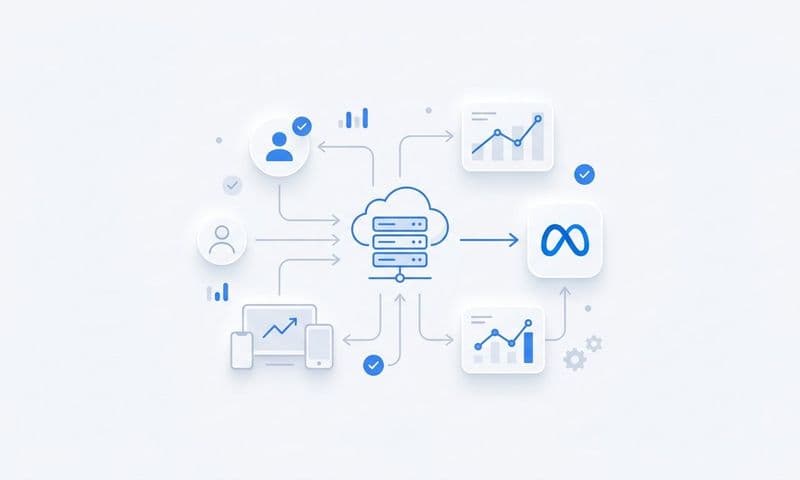
The Meta Pixel fires from the user's browser. This means it is subject to every browser restriction, ad blocker, and privacy setting that sits between the user's device and Meta's servers. CAPI bypasses all of that. Instead of relying on the browser to send event data, CAPI sends conversion events directly from your server to Meta's servers. The user's browser is not involved. iOS privacy settings are not involved. The data travels a completely different path.
This matters because server-side tracking captures events based on what actually happened in your systems, not what a browser script managed to report. A form submission that your server recorded is a form submission. A demo request that landed in your CRM is a demo request. These events exist in your infrastructure regardless of what device the user was on or what privacy settings they had enabled. CAPI lets you send those events to Meta with the first-party data you already have, such as hashed email addresses, phone numbers, and other identifiers that can be used to match conversions to Meta accounts without relying on the IDFA.
Google offers a parallel solution called Enhanced Conversions, which works on the same principle: using first-party data from your own systems to improve conversion matching in a privacy-restricted environment. Building a robust first-party data strategy is what makes both CAPI and Enhanced Conversions perform at their best.
One technical consideration when implementing CAPI alongside an existing pixel is event deduplication. If both the pixel and CAPI are firing for the same conversion event, you risk double-counting conversions in your reporting. Proper deduplication uses a shared event ID to tell the ad platform that two incoming events represent the same action, so only one is counted. This is not optional: running CAPI without deduplication will inflate your conversion numbers and corrupt the data quality you are trying to restore.
For B2B SaaS teams, server-side tracking also opens up the ability to send CRM-level events as conversion signals. Rather than only tracking form fills on a website, you can send events when a lead reaches a qualified stage, when a demo is completed, or when a deal is marked closed-won. This gives ad platform algorithms a much richer signal to optimize against, and it connects your ad spend to outcomes that actually matter to the business.
Rebuilding Attribution Across the Full Customer Journey
Fixing the technical tracking gap is necessary, but it is not sufficient on its own. Recovering from iOS data loss requires a strategic shift in how attribution is approached, not just a new data pipeline.
The old model treated attribution as a pixel problem: place a tag on your conversion page, see which ad got the last click, report ROAS. This model was always incomplete, and iOS updates made it untenable. The modern approach treats attribution as a data integration problem: connect your ad platforms, your CRM, and your website behavior into a unified view of the customer journey, and use that connected dataset to understand which touchpoints are actually driving revenue.
When you connect ad click data with CRM pipeline data, you can answer questions that pixel-only tracking could never address. Which campaigns are generating qualified pipeline, not just form fills? Which channels influence deals that close, even if they are not the last touch? What is the actual revenue contribution of a campaign that touches prospects early in the buying cycle but rarely gets credit in last-click models? This is precisely the kind of insight that B2B revenue attribution for SaaS is designed to surface across both sales-led and product-led growth motions.
This is where multi-touch attribution becomes strategically important. When some touchpoints are unobservable due to privacy restrictions, attribution models that distribute credit across multiple known touchpoints give a more complete picture than single-event tracking ever could. A first-touch model might credit the LinkedIn ad that introduced the prospect to your product. A linear model might distribute credit across the ad click, the content download, and the demo request. Neither model is perfect, but both are more accurate than pretending the last-click pixel event tells the whole story. Exploring the range of multi-touch attribution models available helps teams choose the framework that best fits their sales cycle and data maturity.
The key is having the data infrastructure to support these models. That means capturing first-party events at every stage of the funnel, connecting those events to individual customer journeys, and mapping them back to the ad interactions that started those journeys. This is not something a standalone pixel can do. It requires a platform that integrates across your entire marketing and sales stack.
For B2B SaaS companies, this kind of full-funnel attribution is not a nice-to-have. It is the only way to accurately measure the performance of campaigns that operate across long sales cycles with multiple decision-makers and touchpoints. Without it, you are making budget decisions based on a fraction of the available signal.
From Data Recovery to Competitive Advantage
Here is the part that often gets overlooked in conversations about iOS data loss: the marketers who rebuilt their tracking infrastructure in response to ATT did not just restore what they had before. They ended up with something significantly better.
Server-side tracking with enriched first-party data does more than fill attribution gaps. It improves the quality of the conversion signals you send back to ad platforms, which directly affects how well those platforms can optimize your campaigns. Meta measures this through Event Match Quality scores, which reflect how effectively incoming conversion events can be matched to Meta user accounts. Higher EMQ scores mean better audience matching, better delivery optimization, and better performance from your ad spend. Teams that have invested in first-party data activation consistently see stronger EMQ scores and more efficient campaign delivery as a result.
A pixel firing from a browser with limited cookie access sends a weak signal. A CAPI event that includes a hashed email address matched to a Meta account sends a strong one. The difference in EMQ between these two scenarios translates directly into how well Meta's algorithm can find and convert users who look like your best customers.
The same principle applies to Google's Enhanced Conversions. Richer, more accurate conversion data feeds the algorithm better inputs, which produces better outputs in the form of more efficient campaign delivery and improved targeting.
Beyond the algorithmic benefits, teams that rebuilt their attribution stack around first-party data and server-side tracking now have a measurement foundation that does not depend on third-party cookies or device identifiers. As browser cookie deprecation continues and privacy regulations evolve globally, this matters. The marketers who treated iOS data loss as a forcing function to modernize their infrastructure are not just better positioned today. They are better positioned for wherever privacy-first measurement goes next.
The competitive gap between teams running pixel-only tracking and teams running full server-side attribution with CRM integration is widening. The former are optimizing on incomplete data. The latter are feeding their ad platforms richer signals, making more accurate budget decisions, and connecting every marketing dollar to pipeline and revenue in a way that holds up to scrutiny. Leveraging the right ad tracking tools with accurate data is what separates teams that scale confidently from those perpetually second-guessing their numbers.
The Path Forward: First-Party Data, Full-Funnel Visibility
iOS updates did not just break a tracking pixel. They exposed how fragile ad measurement had always been when built on third-party identifiers and browser-dependent scripts. The IDFA was never a permanent foundation. Browser cookies were always going to erode. ATT accelerated a transition that was already underway and made the cost of inaction impossible to ignore.
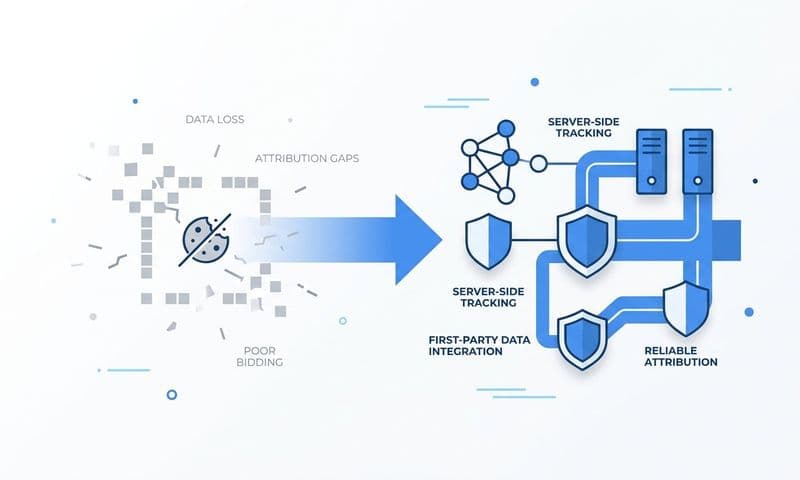
The path forward is clear: server-side tracking to capture conversion data that does not depend on browser cooperation or device permissions; first-party data that connects ad clicks to real business events like demo requests, pipeline stages, and closed-won revenue; and multi-touch attribution that gives credit to the full customer journey rather than just the last observable click.
This is exactly the infrastructure that Cometly is built to provide. Cometly connects your ad platforms, CRM, and website behavior into a single source of truth for marketing performance, capturing every touchpoint from the first ad click to closed-won revenue. It sends enriched, conversion-ready events back to Meta and Google through server-side integration, improving Event Match Quality and feeding ad platform algorithms the signals they need to optimize effectively. And it gives B2B SaaS marketing teams the multi-touch attribution models they need to understand which campaigns are actually driving pipeline, not just which ones got the last click before a form fill.
If your conversion data still looks broken after the iOS updates, or if you are making budget decisions based on what your ad platforms show you rather than what your CRM confirms, the problem is solvable. The tools exist. The strategy is clear. The only question is whether you act on it.
Start rebuilding your attribution foundation today. Get your free demo and see how Cometly captures every touchpoint, restores your conversion visibility, and connects your ad spend to the revenue outcomes that actually matter.