Every marketing leader knows the feeling. You've allocated budget across paid search, social, content, and events. Leads are coming in. Activity metrics look healthy. But when the CFO asks which channels are actually driving revenue, the honest answer is: you're not entirely sure.
This is the central tension of modern B2B SaaS marketing. Teams are generating data at scale, but that data rarely tells a coherent story about business impact. Clicks get tracked. Impressions get reported. And somewhere between the ad platform dashboard and the closed-won deal in the CRM, accountability breaks down.
The stakes are real. B2B SaaS companies operate with defined growth targets, finite budgets, and sales cycles that can stretch across months. In that environment, guessing which channels deserve more investment is not a strategy. It is a liability. Marketing teams that cannot connect their activity to pipeline and revenue will eventually face hard questions about their budget, their headcount, and their value to the business.
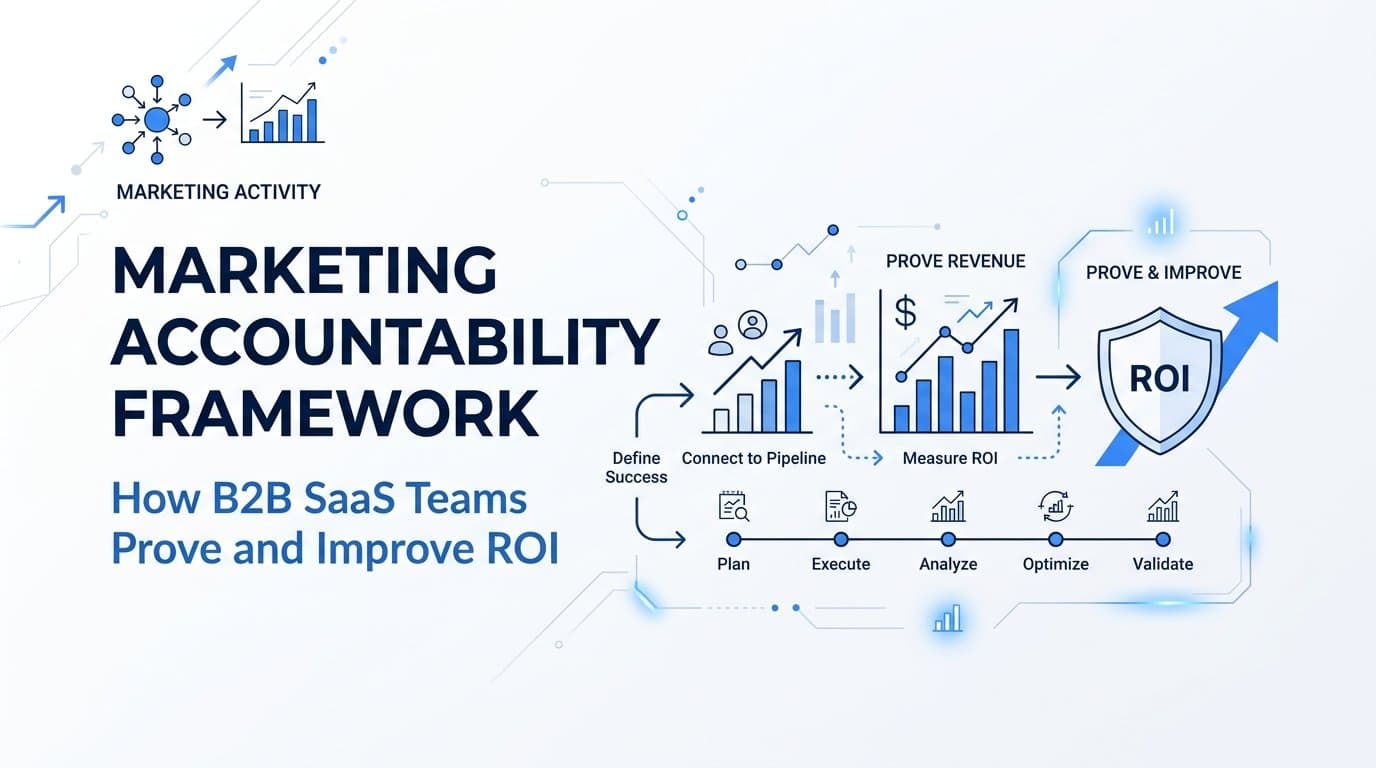
A marketing accountability framework changes that dynamic. It gives marketing teams a structured way to define what success looks like, measure it consistently, and communicate it in terms that resonate with sales, finance, and leadership. It is not just a reporting tool. It is a decision-making system that governs how marketing resources are allocated, evaluated, and optimized over time.
This article breaks down what a marketing accountability framework actually includes, how to build the measurement infrastructure that supports it, and how modern attribution and analytics platforms make the whole system work in practice. Whether you are starting from scratch or trying to fix a broken measurement approach, this is the foundation you need.
The Gap Between Marketing Activity and Business Outcomes
Most marketing teams are not short on data. They have access to ad platform dashboards, Google Analytics reports, email performance summaries, and CRM pipeline views. The problem is that none of these data sources talk to each other in a meaningful way. Each tool reports on its own slice of the customer journey, and no single view shows how all the pieces connect.
The result is a measurement vacuum. Marketing reports on what it can measure easily: clicks, impressions, sessions, form fills, and cost per lead. Leadership asks about pipeline contribution, revenue influence, and return on ad spend. These are fundamentally different conversations, and without a shared framework, they rarely converge.
This disconnect creates real operational problems. When channel performance is evaluated in isolation, teams tend to optimize for the metrics that look best in their own tools rather than the metrics that reflect actual business impact. A paid search campaign might show strong click-through rates and low cost per click while generating leads that never convert to qualified pipeline. A LinkedIn campaign might look expensive on a cost-per-click basis while consistently attracting the enterprise buyers that close at the highest contract values.
Last-click attribution makes this worse. When credit for a conversion flows entirely to the final touchpoint before a form fill or demo request, every channel that contributed earlier in the journey becomes invisible. Content that built awareness, retargeting ads that kept prospects engaged, and organic search that answered late-stage questions all go uncredited. Budget decisions made on last-click data systematically undervalue the channels that create demand and overvalue the channels that simply capture it.
Siloed tools compound the problem further. When ad data lives in one platform, CRM data lives in another, and revenue data lives in a third, connecting marketing activity to business outcomes requires manual work that rarely happens consistently. Spreadsheets get built, numbers get reconciled, and by the time a report lands in a leadership meeting, it is already outdated.
A marketing accountability framework is the structural solution to this problem. It does not just add another reporting layer. It defines the rules by which marketing performance gets measured, the attribution logic that determines how credit is assigned, the KPIs that connect marketing activity to business outcomes, and the cadence by which those metrics get reviewed and acted on. It bridges the gap between what marketing does and what the business needs to see.
Without this structure, marketing operates on intuition dressed up as data. With it, every budget decision has a defensible foundation.
The Four Pillars of a Real Accountability Framework
A marketing accountability framework is not a dashboard. It is a system with defined components that work together to govern how marketing performance is evaluated and how decisions get made. Most teams that try to build accountability without this structure end up with reports that look informative but do not actually drive action.
There are four core components that every effective framework includes.
Revenue-Tied KPIs: The framework starts with metrics that connect directly to business outcomes. This means moving beyond impressions and click-through rates to metrics like cost per qualified lead, pipeline influenced, revenue attributed per channel, and customer acquisition cost by source. These are the numbers that sales and finance care about, and they are the only metrics that make marketing accountable to business performance rather than just marketing activity.
A Consistent Attribution Model: Attribution is the engine at the center of any accountability framework. The model you choose determines which channels get credit for conversions and, by extension, which channels get budget. First-touch attribution gives full credit to the channel that generated initial awareness. Last-click gives full credit to the final touchpoint before conversion. Linear distributes credit equally across all touchpoints. Data-driven attribution uses algorithmic weighting based on actual conversion path data to assign credit more accurately.
For B2B SaaS, where buying journeys involve multiple stakeholders, multiple sessions, and multiple channels over weeks or months, multi-touch models almost always provide a more accurate picture of channel contribution than single-touch models. The specific model matters less than the consistency with which it is applied. Switching models mid-cycle makes trend analysis impossible and creates the illusion of performance changes that are really just measurement changes.
A Single Source of Truth: When marketing data, CRM data, and revenue data live in separate tools, accountability is theoretical. A real framework requires a unified data environment where all of these sources connect. This does not mean everyone uses the same dashboard. It means the underlying data is consistent, and when different teams pull numbers, they are working from the same foundation.
A Regular Reporting Cadence: Accountability requires rhythm. A framework that produces reports only when someone asks for them is not a framework. It is a reactive exercise. Effective accountability frameworks define when performance gets reviewed, who is in the room, and what decisions those reviews are designed to produce. Weekly channel reviews, monthly attribution analysis, and quarterly KPI recalibration create the cadence that keeps the framework operational rather than ornamental.
The distinction between a reporting dashboard and a true accountability framework is this: a dashboard displays numbers, while a framework governs decisions. The framework tells you not just what happened, but what to do about it.
Mapping the Full Customer Journey Before You Can Measure It
Here is the thing about B2B SaaS buyers: they almost never convert on the first touchpoint. A prospect might click a LinkedIn ad, read a blog post, attend a webinar, see a retargeting ad, run a Google search, and book a demo before ever entering your CRM as a qualified lead. That journey might span six weeks and a dozen interactions. And if your tracking infrastructure only captures the last click, you are measuring the final step of a long walk and calling it the whole trip.
Before you can build a marketing accountability framework that reflects reality, you need to understand the full shape of your customer journey. This means mapping every touchpoint category that a prospect might encounter from first awareness through closed-won revenue. For most B2B SaaS companies, that chain includes paid ads, organic search, direct traffic, email sequences, content downloads, free trial activations, demo requests, sales follow-up, and eventually a purchase or contract signature.
Gaps in this chain break accountability at the point where they occur. If your tracking captures ad clicks but loses the prospect when they visit your website organically two weeks later, you cannot connect that paid touchpoint to the eventual conversion. If your CRM records the demo request but does not know which campaign drove it, you cannot attribute pipeline to marketing channels. Each gap in the touchpoint chain is a place where credit gets misassigned or lost entirely.
This is where tracking infrastructure becomes a prerequisite for accountability, not an afterthought. Browser-based tracking has become increasingly unreliable. Cookie restrictions, iOS privacy changes, and ad blockers mean that a meaningful portion of user sessions go untracked when you rely solely on pixel-based measurement. The result is conversion data that understates actual performance and makes channels look less effective than they are.
Server-side tracking addresses this directly. Rather than relying on a browser pixel to fire when a user completes an action, server-side tracking sends conversion events directly from your server to ad platforms via Conversion API integrations. Meta's Conversion API, Google's Enhanced Conversions, and similar tools allow marketers to pass first-party conversion data back to ad platforms without depending on browser conditions. This improves data accuracy, strengthens the match between ad clicks and downstream conversions, and gives ad platform algorithms better signals to optimize toward.
First-party data is the foundation of this approach. When you capture conversion events using data your business owns, such as email addresses, user IDs, and CRM records, rather than relying on third-party cookies, your attribution data becomes more durable and more accurate over time. This is not just a technical preference. It is a strategic requirement for any team that wants their accountability framework to produce reliable insights rather than increasingly degraded estimates.
The practical implication is this: mapping the customer journey is not just a strategic exercise. It is a technical one. You need to know where your tracking fires, where it breaks, and how to close those gaps before your framework can produce numbers you can trust.
Setting the Metrics That Actually Matter for Accountability
Not all metrics are accountability metrics. Some metrics measure activity. Some measure efficiency. And some measure business impact. A marketing accountability framework is only as strong as its ability to distinguish between these categories and prioritize the ones that connect to revenue.
Vanity metrics are the ones that look good in a slide deck but do not tell you whether marketing is working. Impressions tell you how many times an ad was shown, not whether it influenced anyone to buy. Reach tells you how many unique users saw your content, not whether any of them became customers. Click-through rate tells you how compelling your ad creative is, not whether the traffic it generates converts to pipeline. These metrics have their place in creative and channel optimization, but they should never be the primary lens through which marketing accountability is evaluated.
Accountability metrics are different. They connect marketing activity to business outcomes in a way that sales and finance can validate. Cost per qualified lead measures efficiency at the point where marketing hands off to sales. Pipeline influenced measures how much of the active sales pipeline touched a marketing channel at some point in the journey. Revenue attributed per channel measures the closed-won revenue that can be traced back to specific marketing sources. Customer acquisition cost by channel tells you what you are actually paying to acquire a customer through each investment.
The key to making these metrics work is alignment. Marketing KPIs need to speak the same language as sales and finance goals. If sales is measured on qualified pipeline created and finance is measured on revenue efficiency, marketing accountability metrics need to connect to both. This means defining what "qualified" means in shared terms, agreeing on how pipeline influence is calculated, and establishing a common understanding of how revenue gets attributed across channels and time periods.
Pipeline attribution and revenue attribution are the north star metrics for B2B SaaS marketing accountability. Pipeline attribution answers the question: which marketing channels and campaigns contributed to opportunities that entered the sales pipeline? Revenue attribution answers: which channels and campaigns can be connected to deals that actually closed? When marketing can answer both questions with confidence, it has earned a seat at the revenue conversation rather than just the marketing conversation.
Getting there requires integrating marketing data with CRM data and, where possible, revenue data from platforms like Stripe. Without that integration, marketing teams can report on lead volume but not business impact. The metrics look busy, but they do not tell the story that leadership needs to hear.
Building the Reporting Layer That Drives Decisions
A marketing accountability framework needs a reporting structure that matches its ambition. If your attribution model is multi-touch but your reporting only shows last-click data from individual ad platforms, the framework is broken at the output layer. The reporting layer is where the framework becomes visible, and it needs to connect ad platform data, CRM data, and revenue data into a single, coherent view.
This unified view is harder to build than it sounds. Ad platforms report conversions using their own attribution windows and their own definitions of what counts as a conversion. CRMs track leads and opportunities using sales-defined stages. Revenue platforms track payments and subscriptions. Bringing these together requires a layer of integration that normalizes the data, resolves discrepancies, and presents a consistent picture of performance across the full customer journey.
Real-time reporting changes the nature of marketing accountability in a meaningful way. When teams running paid campaigns across Google Ads, Meta, and LinkedIn are waiting for monthly performance reports, they are making budget decisions based on information that is already weeks old. Campaigns that are underperforming continue to spend. Channels that are overdelivering do not get additional budget fast enough to capitalize on the momentum. Monthly snapshots create a lag between what is happening and what gets acted on.
Real-time reporting closes that lag. When you can see today how each campaign is performing against your accountability metrics, you can make adjustments this week rather than next month. For teams managing significant ad budgets, the difference between weekly and monthly optimization cycles can translate to meaningful improvements in efficiency over the course of a quarter.
This is where AI-driven analytics add genuine value. Managing large volumes of ad creative across multiple platforms generates more performance data than any team can manually review with the frequency that good optimization requires. AI can surface patterns in that data that human analysts would miss or find too slowly: campaigns that are trending toward underperformance before they visibly fail, creative fatigue signals that indicate when an ad set needs refreshing, and channel combinations that are producing outsized returns relative to spend.
The value of AI in this context is not replacing human judgment. It is accelerating the identification of what is working and what is not, so that the humans making budget decisions have better information faster. In a marketing accountability framework, that acceleration is the difference between proactive optimization and reactive reporting.
Operationalizing Accountability With the Right Infrastructure
A framework is only as strong as the data infrastructure supporting it. You can define the right KPIs, choose the right attribution model, and establish the right reporting cadence, but if the underlying data is incomplete, inconsistent, or siloed, the framework produces outputs that cannot be trusted. Most teams that struggle with marketing accountability are not struggling with strategy. They are struggling with infrastructure.
The practical reality is that most B2B SaaS marketing teams need a dedicated attribution platform to operationalize accountability at scale. Trying to build this infrastructure manually, by stitching together ad platform exports, CRM reports, and spreadsheet models, creates a system that is brittle, time-consuming to maintain, and almost impossible to keep consistent as the business grows and channels multiply.
Cometly is built specifically for this challenge. It connects your ad platforms, CRM, and website data to track the full customer journey in real time, from first ad click through closed-won revenue. Rather than forcing you to reconcile data across disconnected tools, Cometly creates a single source of truth where all of your marketing performance data lives together and speaks a common language.
The platform supports multiple attribution models, so you can compare how first-touch, last-click, linear, and data-driven models assign credit across your channels and make informed decisions about which model best reflects your actual buying journey. This is not just a reporting feature. It is a decision-making tool that lets you see how your channel mix looks under different measurement assumptions before committing to a budget allocation.
Cometly also handles the server-side tracking layer that modern attribution requires. Through Conversion API integrations with Meta, Google, and other platforms, it sends enriched, conversion-ready events directly from your server to ad platforms, bypassing browser limitations and improving the quality of the signals that ad platform algorithms use to optimize your campaigns. Better data in means better targeting out.
Beyond tracking and attribution, Cometly's AI-driven insights help surface which campaigns and channels are performing, which are underdelivering, and where budget reallocation would improve returns. This turns the reporting layer from a backward-looking summary into a forward-looking decision tool, which is exactly what a marketing accountability framework is designed to produce.
Importantly, the framework itself is an ongoing process, not a one-time setup. Attribution models need periodic review as the business scales and the channel mix evolves. KPIs need recalibration when sales cycles change or new products launch. Stakeholder alignment needs to be maintained as teams grow and leadership priorities shift. The infrastructure should support that evolution, not lock you into a static measurement approach that becomes outdated as the business changes.
The Bottom Line on Marketing Accountability
The difference between marketing teams that guess and marketing teams that grow with confidence comes down to structure. A marketing accountability framework is that structure. It defines what success looks like before budget is spent, measures performance in terms that connect to revenue, and creates the reporting rhythm that turns data into decisions.
The pillars covered in this article work together as a system. Accurate touchpoint capture across the full customer journey feeds reliable attribution data. Consistent attribution models translate that data into channel credit that reflects reality. Revenue-tied KPIs connect marketing performance to the metrics that sales and finance care about. Real-time reporting with AI-driven insights ensures that the framework drives proactive optimization rather than reactive summaries. And the right infrastructure makes all of it operational at scale.
The outcome is clarity. You know which ads are driving pipeline. You know which channels are generating revenue-ready leads. You know where to put more budget and where to pull back. That clarity is not just a reporting improvement. It is a competitive advantage for any B2B SaaS team operating in a market where budget efficiency and growth accountability are non-negotiable.
If you are ready to build that foundation, Cometly can serve as the data infrastructure your accountability framework needs. From multi-touch attribution and server-side tracking to AI-driven campaign insights and Stripe revenue integration, it connects every layer of your marketing data into one place. Get your free demo today and start seeing exactly which ads and channels are driving your revenue.