Most B2B SaaS marketing teams have invested heavily in automation. They have email sequences running around the clock, lead scoring models adjusting in real time, retargeting campaigns firing based on behavioral triggers, and CRM workflows nudging prospects through every stage of the funnel. The infrastructure is sophisticated. The problem is that very few of those teams can confidently answer a deceptively simple question: which of those automated touchpoints actually drove the deal?
That gap between automation activity and revenue accountability is more common than most marketers want to admit. Automation platforms are built to execute workflows efficiently. They tell you who opened an email, who clicked a link, and which sequence a prospect completed. What they rarely tell you is whether any of that activity meaningfully contributed to a closed opportunity or a qualified pipeline stage progression.
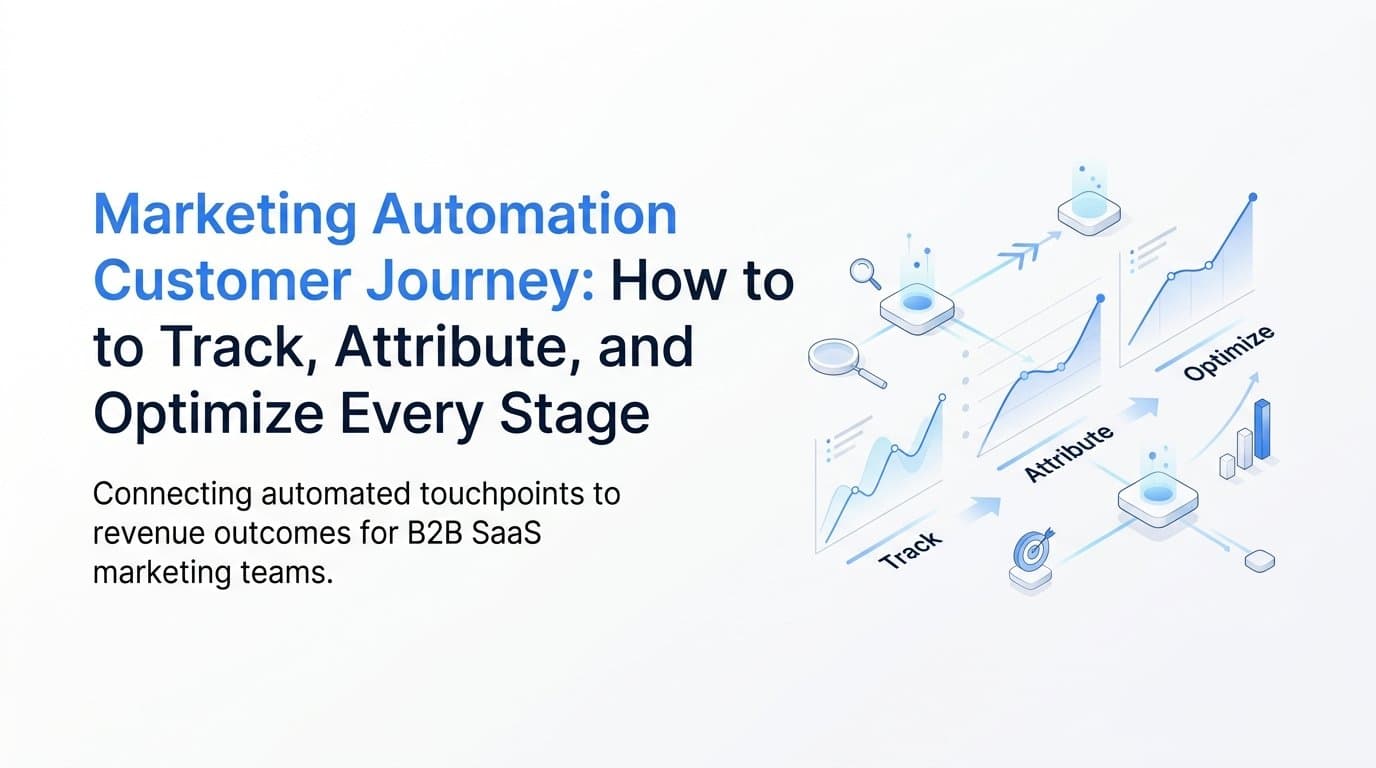
This is where the marketing automation customer journey becomes a strategic challenge rather than just an operational one. Mapping the journey is only the first step. Measuring what each automated interaction contributes to conversion is what separates teams that scale intelligently from teams that scale blindly. In this article, you will learn how automation shapes the modern B2B customer journey, how to map and instrument each stage, and how attribution turns that behavioral data into decisions you can act on with confidence.
The Automated Touchpoints Shaping Your B2B Customer Journey
Marketing automation does not replace the customer journey. It powers it. In B2B SaaS, automation is the mechanism that keeps your brand present across an extended buying process without requiring manual intervention at every step. Email nurture sequences introduce your product to prospects who showed early interest. Lead scoring models surface the accounts most likely to convert. Retargeting campaigns re-engage visitors who explored your pricing page but did not book a demo. CRM workflows trigger internal sales actions when prospects hit behavioral thresholds. Together, these automated systems create a continuous, orchestrated experience across weeks or months of evaluation.
The typical B2B SaaS customer journey moves through four broad stages. At the awareness stage, prospects discover your product through paid ads, organic search, content, or referrals. Automation here focuses on capturing attention and initiating contact, often through lead magnets, gated content, or introductory email sequences. At the consideration stage, prospects are actively researching solutions. Automation delivers educational content, comparison resources, and social proof to shape how they evaluate your product against alternatives. At the evaluation stage, prospects are narrowing their shortlist. Automation supports this with demo invitations, trial onboarding sequences, and personalized follow-ups tied to specific product behaviors. At the decision stage, automation helps close the loop with urgency-based messaging, pricing clarifications, and handoff workflows to sales.
Each stage has different goals and different signals. An email open at the awareness stage means something very different from a pricing page visit at the evaluation stage. Automation platforms can track both, but they treat them with similar weight unless you build logic that distinguishes intent signals from passive engagement.
The B2B journey is also inherently more complex than B2C because multiple stakeholders are involved. A single deal might involve a marketing champion, a technical evaluator, a finance approver, and an executive sponsor. Each of these individuals may interact with your automated touchpoints independently, and their collective journey shapes the buying decision. This multi-stakeholder reality means that a single contact-level view of automation activity is often insufficient. Account-level visibility, where you can see how multiple contacts from the same company are engaging across your automated channels, is what gives teams a realistic picture of where an account actually stands in the journey.
The longer the sales cycle and the more stakeholders involved, the more automated touchpoints accumulate before a deal closes. That accumulation is both an opportunity and a measurement challenge. More touchpoints mean more chances to influence the decision. It also means more complexity when you try to understand which of those touchpoints actually mattered.
Why Most Automation Strategies Fly Blind on Attribution
Here is the core problem with most automation stacks: they are optimized for execution, not measurement. The platforms that power your email sequences, lead scoring, and retargeting workflows are designed to deliver the right message at the right time. They are not designed to tell you which of those messages contributed to revenue. That distinction matters more than most teams realize.
When you look at your automation platform's reporting dashboard, you see engagement metrics. Open rates, click-through rates, sequence completion rates, unsubscribe rates. These numbers tell you how your automation is performing as a communication system. They do not tell you how it is performing as a revenue generation system. A nurture sequence with a strong open rate might be generating zero qualified pipeline. A sequence with mediocre engagement might be the consistent precursor to every enterprise deal you close. Without attribution, you have no way to know the difference.
The multi-touch problem makes this even more difficult in practice. Think about a typical B2B SaaS prospect journey. They click a LinkedIn ad and download a whitepaper. They receive a five-email nurture sequence over three weeks. They see a retargeted display ad after visiting your pricing page. They attend a product webinar. They receive a personalized outreach email from a sales rep. Then they book a demo. Which of those touchpoints deserves credit for the conversion?
Under last-click attribution, the answer is simple and wrong: the demo booking form gets all the credit. The LinkedIn ad that started the journey, the nurture sequence that built familiarity, the webinar that answered technical objections, all of those interactions are invisible in the attribution model. Budget decisions get made based on that incomplete picture. The LinkedIn ad gets defunded. The webinar program gets cut. The nurture sequence stays live or gets paused based on open rates rather than revenue contribution.
The consequence of blind automation is not just inaccurate reporting. It actively distorts your investment decisions. Teams reallocate budget away from high-impact touchpoints they cannot see toward touchpoints that are easy to measure but less influential. Underperforming sequences stay live because engagement metrics look acceptable. High-impact mid-funnel workflows get paused because they do not appear to generate direct conversions. The automation stack keeps running, but it is being optimized for the wrong signals.
This is the attribution gap that separates marketing automation as a tactical execution tool from marketing automation as a strategic growth lever. Closing that gap requires a different kind of infrastructure, one that connects automation activity to revenue outcomes rather than stopping at engagement metrics.
Mapping the Customer Journey Across Automated Channels
Before you can attribute revenue to your automation touchpoints, you need to know what those touchpoints are and where they fit in the journey. Customer journey mapping for automation-heavy B2B teams is not a whiteboard exercise. It is a data architecture exercise. The goal is to identify every automated interaction a prospect might have with your brand, from first ad click to closed deal, and instrument each one so it generates a trackable signal.
Start with your entry points. How do prospects first encounter your brand? Paid search ads, LinkedIn campaigns, organic content, partner referrals, and product review sites are all common entry points for B2B SaaS. Each entry point should be tagged with UTM parameters or source identifiers that persist through the journey. When a prospect clicks a paid ad and lands on your website, that source attribution should follow them into your CRM, into your email sequences, and into your analytics layer. If that connection breaks at any point, you lose the thread.
Next, map your nurture sequences and re-engagement triggers. Which email sequences fire after a prospect downloads content? Which retargeting audiences are built from website visitors who did not convert? Which lead scoring thresholds trigger a sales handoff? Each of these automated actions represents a touchpoint that should be captured as an event in your attribution layer, not just logged in your automation platform.
This is where first-party data and event tracking become essential. Your automation platform knows when it sent an email and whether it was opened. It does not know whether that prospect visited your pricing page three times in the same week, or whether they also engaged with a Google ad on the same day. Capturing those signals requires event tracking on your website and integration between your ad platforms, CRM, and analytics layer.
Touchpoint enrichment is the concept that brings this together. Rather than treating each channel's data in isolation, you combine behavioral signals from your website, ad platforms, and CRM into a unified view of each prospect's journey. When a contact in your nurture sequence also clicks a retargeted ad and then visits your demo booking page, you want all three of those interactions visible in a single timeline tied to that specific contact and account. That unified view is what makes attribution meaningful rather than theoretical.
The practical implication is that journey mapping and data instrumentation are inseparable. You cannot map a journey you cannot measure, and you cannot measure a journey you have not mapped. Building both in parallel, identifying touchpoints and then instrumenting them, is the foundation for accurate attribution across automated channels.
Attribution Models That Make Sense for Automated Journeys
Once your touchpoints are mapped and instrumented, the next question is how to assign credit across them. Attribution models are the frameworks that determine how conversion credit is distributed among the interactions that preceded a deal. For automation-heavy B2B SaaS journeys, choosing the right model is not a minor technical decision. It shapes how you evaluate every sequence, campaign, and channel in your stack.
First-touch attribution assigns all credit to the first interaction a prospect had with your brand. This model is useful for understanding which channels are best at generating awareness and initiating journeys. For a B2B SaaS company investing heavily in top-of-funnel paid campaigns, first-touch attribution helps you see which ads are actually starting conversations. The limitation is that it ignores everything that happened between that first click and the closed deal, which in a long sales cycle can be dozens of automated touchpoints.
Last-click attribution assigns all credit to the final interaction before conversion. This model is easy to implement and intuitive to explain, which is why it remains common. It is also consistently misleading for B2B journeys. The last click before a demo booking is rarely the interaction that convinced the prospect to book. It is usually just the most recent one. Last-click attribution systematically undercredits mid-funnel automation and overcredits bottom-of-funnel actions like branded search or direct navigation.
Linear attribution distributes credit equally across all touchpoints in the journey. This model acknowledges that multiple interactions contributed to the conversion without trying to rank their relative importance. For teams that want a simple, fair baseline model, linear attribution is a reasonable starting point. It surfaces mid-funnel touchpoints that last-click ignores, which makes it more useful for evaluating nurture sequences and retargeting campaigns.
Data-driven attribution is the most sophisticated option and the most valuable for B2B SaaS teams with long sales cycles and complex automation stacks. Rather than applying a fixed weighting rule, data-driven attribution uses historical conversion data to determine how much influence each touchpoint actually had on the outcome. Touchpoints that consistently appear in journeys that convert get higher credit. Touchpoints that appear equally in converting and non-converting journeys get lower credit. This model surfaces the interactions that are genuinely driving pipeline, not just the ones that happen to appear at the beginning or end of the journey.
The most useful practice is comparing models side by side. When you run first-touch, linear, and data-driven attribution on the same dataset, the differences reveal where credit is being misallocated. A mid-funnel email sequence that gets zero credit under last-click but appears consistently in data-driven attribution as a high-influence touchpoint is a sequence worth protecting and scaling. That kind of insight is only visible when you can compare models against real conversion data.
Connecting Automation Data to Pipeline and Revenue
Attribution models are only as useful as the data flowing into them. For B2B SaaS teams, closing the loop between automation activity and revenue outcomes requires integrating three distinct data sources: ad platform data, CRM pipeline data, and subscription or payment data. When these sources are unified in a single attribution layer, you can measure the revenue contribution of specific sequences, campaigns, and channels rather than relying on proxy metrics like MQLs or engagement scores.
The integration challenge starts with the CRM. Your CRM is where pipeline stage progressions are recorded, where deal values are tracked, and where closed-won opportunities are logged. If your attribution layer can read CRM events, it can connect automation touchpoints to actual pipeline movement rather than just lead generation. A nurture email sequence that consistently precedes a prospect moving from consideration to evaluation is contributing to pipeline progression, even if no conversion event fires at that moment. Capturing that signal requires your attribution layer to treat CRM stage changes as meaningful events, not just final conversions.
On the technical side, server-side tracking and Conversion API integrations have become essential for capturing automation-driven conversions accurately. Browser-based tracking has become less reliable as privacy regulations and browser restrictions limit what client-side scripts can observe. Server-side tracking captures conversion events directly from your server, bypassing browser limitations and ensuring that form submissions, demo bookings, and trial activations tied to automation touchpoints are recorded accurately. Meta's Conversion API and Google's Enhanced Conversions are the most widely used implementations, and they allow you to send enriched, first-party conversion data back to the ad platforms that are running your retargeting and acquisition campaigns.
This creates a feedback loop that benefits your entire automation stack. When accurate conversion data flows back to Meta or Google, the ad platform's own optimization algorithms improve. Your retargeting campaigns become more precise. Your lookalike audiences are built from higher-quality conversion signals. The automation touchpoints that were generating qualified pipeline now also contribute to better ad targeting, compounding their impact across the funnel.
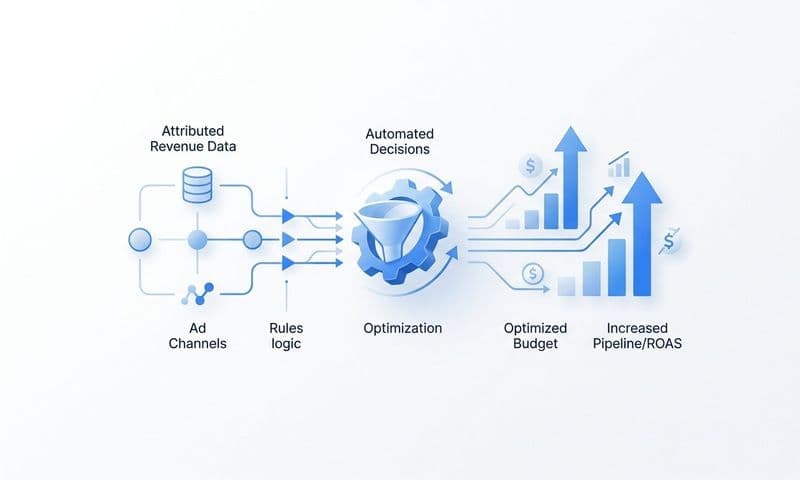
Revenue attribution tied to automation touchpoints enables a specific kind of decision-making that engagement metrics cannot support. You can identify which email sequences are generating qualified pipeline and scale them. You can pause workflows that consume resources without influencing revenue outcomes. You can reallocate budget from channels that look active but contribute little to revenue toward channels that consistently appear in high-value journeys. These are not incremental improvements. They are the kind of structural optimizations that change the trajectory of a marketing program.
Platforms like Cometly are built specifically to unify these data sources. By connecting ad platform data, CRM events, website behavior, and subscription revenue into a single attribution layer, Cometly gives B2B SaaS teams the visibility they need to evaluate their automation stack against the metric that actually matters: revenue generated, not emails sent.
From Automation to Attributable Growth
The framework is straightforward, even if the implementation requires discipline. Map the customer journey across every automated channel. Instrument each touchpoint so it generates a trackable signal. Apply an attribution model that fits your sales cycle and business goals. Connect the outputs to pipeline and revenue rather than stopping at engagement metrics. Repeat the cycle as your automation stack evolves.
What makes this framework powerful is not any single component. It is the connection between them. Journey mapping without instrumentation produces a diagram, not insights. Instrumentation without attribution produces data, not decisions. Attribution without revenue integration produces a report, not accountability. The value compounds when all four elements work together, creating a continuous loop from automated touchpoint to measurable revenue contribution.
Marketing automation reaches its full potential only when paired with attribution that shows which sequences, triggers, and channels actually move prospects through the funnel. Without that pairing, automation is activity. With it, automation becomes a measurable growth lever that you can optimize with confidence.
Cometly is built to be that attribution layer. It connects your ad platforms, CRM events, and website behavior into a single source of truth, giving automation-driven teams the data they need to understand which touchpoints are generating pipeline and which are generating noise. With AI-driven recommendations surfacing patterns across your automated touchpoints, Cometly moves your team from reactive reporting to proactive optimization. You can see which sequences precede high-value conversions, which channels consistently appear in closed-won journeys, and where your automation investment is generating the strongest return.
Automation without attribution is activity without accountability. If you cannot trace a workflow back to pipeline and revenue, you cannot optimize it with confidence. The good news is that the infrastructure to close that gap exists, and it is more accessible than most teams assume.
Start by auditing your current automation stack. Ask whether you can connect each active workflow to a measurable revenue outcome. If the answer is no, that is the gap worth closing first. Get your free demo and see how Cometly connects your customer journey data so you can finally see which automated touchpoints are driving growth and scale the ones that do.