Most B2B SaaS marketing teams are running too many tools. There is a reporting dashboard that does not talk to the CRM. There is an attribution tool that conflicts with the ad platform data. There is a separate analytics layer sitting on top of all of that. The result is fragmented data, wasted budget, and marketing decisions made on incomplete information.
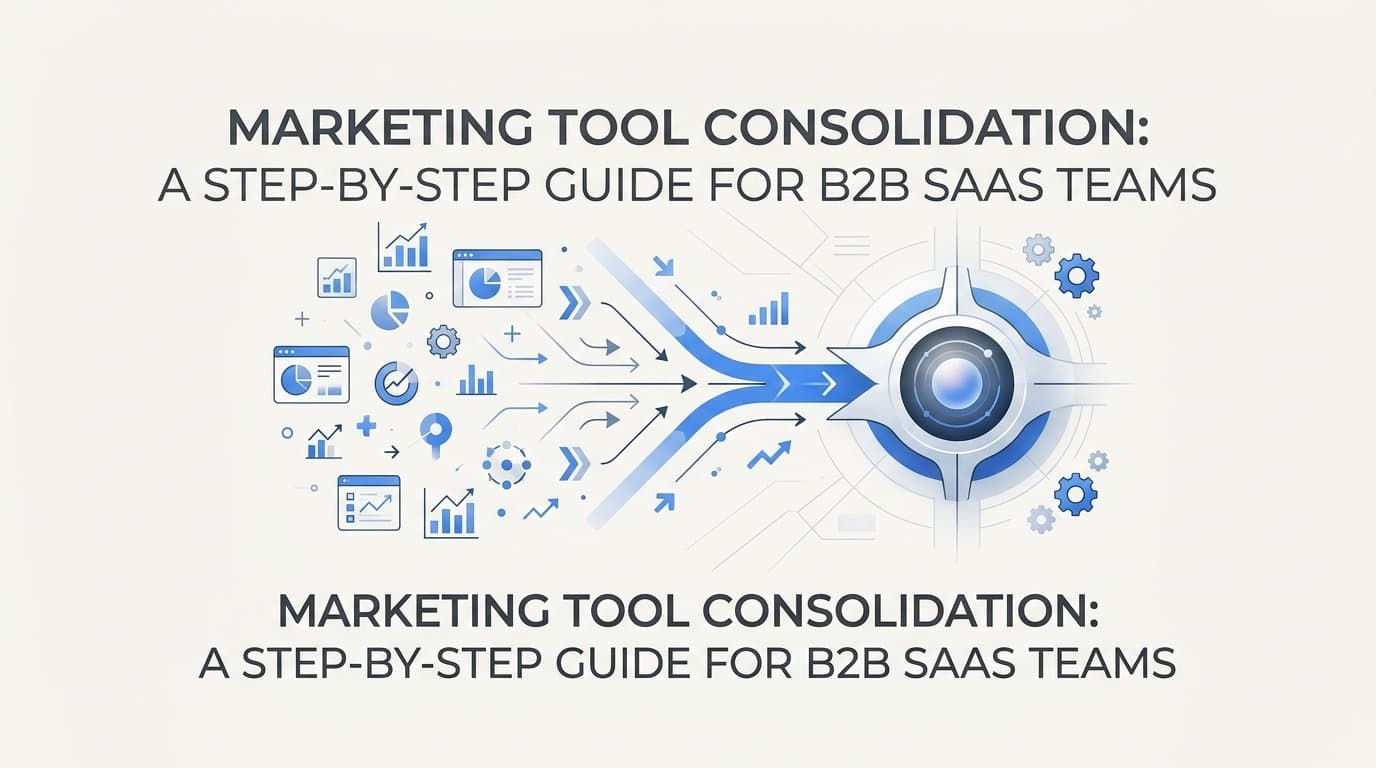
Marketing tool consolidation is the process of auditing, streamlining, and unifying your marketing stack so every tool earns its place and your data tells a consistent story. Done right, consolidation does not mean losing capability. It means gaining clarity.
You stop paying for overlapping features, eliminate data silos, and build a single source of truth that your entire team can trust. Instead of spending hours reconciling conflicting dashboards, your team spends time acting on reliable insights.
This guide walks B2B SaaS marketing teams through a practical, step-by-step consolidation process. From auditing your current stack to selecting a unified attribution platform, each step is designed to produce a leaner, more effective marketing operation.
Whether you are a growth leader frustrated by conflicting reports or a marketing ops manager trying to reduce tool sprawl, this guide gives you a clear path forward. Let's get into it.
Step 1: Audit Every Tool in Your Current Marketing Stack
You cannot consolidate what you have not fully inventoried. The first step is creating a complete picture of every marketing tool currently in use across your team, including tools owned by individual contributors or departments that are not centrally tracked or billed through a shared account.
Start by pulling your finance team's software spend records. Then survey your team directly, because many point solutions get adopted at the individual level and never make it onto the official tool list. You will often find tools that have been running quietly for months with no clear owner.
For each tool you identify, document the following:
Function: What does this tool actually do? Be specific. "Analytics" is too broad. Note whether it tracks conversions, reports on ad performance, manages email sequences, or handles something else entirely.
Ownership and usage: Who uses this tool, how often, and for what specific tasks? A tool used daily by three people is very different from a tool that was set up once and rarely opened.
Data collected: What data does this tool capture, and where does that data live? Does it sync to your CRM, export to a spreadsheet, or sit in a closed ecosystem?
Annual cost: Include all tiers, seat fees, and any add-ons. Tools that seem cheap individually can add up significantly across a full stack.
Integrations: What other tools does it connect to, and are those integrations actively working or were they set up and never validated?
Once you have this information for every tool, look for overlap. You may find multiple platforms tracking conversions, multiple dashboards reporting on the same campaigns, or several tools performing similar audience segmentation functions. Flag all of these.
Also flag tools with poor adoption rates or tools that were set up for a specific campaign or initiative and never properly sunset. These are the easiest wins in any consolidation effort.
Success indicator: You have a complete spreadsheet with every tool, its function, its annual cost, and its usage frequency before moving to the next step.
Step 2: Map Your Data Flows and Identify Gaps
An inventory tells you what tools you have. A data flow map tells you how information actually moves through your stack, and where it breaks down. This step is where you start to understand the real cost of tool sprawl: not just the subscription fees, but the blind spots in your data.
Start at the beginning of the customer journey and trace the path forward. When a prospect clicks an ad, what happens? Where does that click data go? Does it flow into your attribution tool, your CRM, your ad platform, or all three? And do those three systems agree on what happened?
Follow the data through every stage: ad click, landing page visit, form fill, lead creation in the CRM, sales activity, opportunity creation, and closed-won revenue. At each handoff point between tools, ask whether the data transfers cleanly or whether something gets lost.
Common breakdowns to look for include:
Attribution stops at the lead: Many B2B SaaS teams track leads accurately but lose visibility once a prospect enters the sales process. The ad that drove the original click never gets credit for the revenue it influenced.
Lead source gets overwritten: CRMs often overwrite the original lead source when a contact is updated or re-engaged. If your attribution relies on CRM lead source fields, this is a significant data integrity problem.
Conflicting conversion counts: Your ad platform reports one number, your attribution tool reports another, and your analytics platform reports a third. This usually comes down to different attribution windows, different conversion definitions, or double-counting across tools.
Invisible touchpoints: Organic visits, retargeting impressions, email clicks, and direct traffic are often tracked inconsistently or not at all. These gaps mean your attribution model is working with incomplete data.
Document every gap and conflict you find. This is not just about identifying redundancy. It is about understanding what you are currently flying blind on, which is critical context for deciding what to keep versus what to replace.
Success indicator: A visual or documented map of your data flow with gaps and conflicts clearly marked, ready to inform the next step.
Step 3: Define the Core Capabilities Your Stack Must Cover
Before you start cutting tools, you need to define exactly what your consolidated stack must be able to do. This is the step most teams skip, and it is why many consolidation efforts either go too far and lose critical capabilities, or do not go far enough and leave the real problems intact.
Start with your non-negotiable capabilities. For most B2B SaaS marketing teams, these include: conversion tracking across all channels, multi-touch attribution modeling, ad performance reporting, CRM integration, pipeline and revenue attribution, and audience data feeds back to ad platforms for optimization.
Then separate must-have capabilities from nice-to-have features that have been bundled into tools you are currently paying for. Just because a tool offers a feature does not mean you need it or use it. Be honest about what your team actually relies on versus what sounded useful at the time of purchase.
Your attribution requirements deserve particular attention. Think carefully about which attribution models matter for your business:
First-touch attribution: Gives full credit to the channel that first introduced a prospect to your brand. Useful for understanding top-of-funnel performance.
Last-click attribution: Gives full credit to the final touchpoint before conversion. Often misleading in long B2B sales cycles.
Linear attribution: Distributes credit evenly across all touchpoints. A reasonable starting point for understanding full-funnel influence.
Multi-touch and data-driven attribution: Weights touchpoints based on their actual influence on conversion. The most accurate approach for complex B2B buying journeys.
For most B2B SaaS teams, the goal is connecting ad spend directly to pipeline and closed revenue, not just leads. If your current stack cannot do this, that capability gap should be at the top of your requirements list.
Finally, involve your sales, revenue ops, and finance stakeholders at this stage. The consolidated stack needs to serve the full funnel, not just top-of-funnel marketing metrics. Getting alignment now prevents pushback later when you are ready to deprecate tools that other teams depend on.
Success indicator: A written capability checklist that every candidate tool will be evaluated against, signed off by all relevant stakeholders.
Step 4: Evaluate Consolidation Candidates Against Your Capability Checklist
With your capability checklist in hand, you are ready to evaluate which tools in your current stack can absorb the functions of tools you plan to cut, and which gaps require a new platform to fill.
The goal here is not to find the most tools. It is to find the fewest tools that cover the most ground without sacrificing depth. A platform that natively handles conversion tracking, multi-touch attribution, customer journey analytics, and ad platform integrations in one place is fundamentally more valuable than four separate tools that each do one of those things, especially when those four tools do not share data cleanly.
When evaluating platforms, go beyond the feature checklist and assess integration depth. There is a meaningful difference between a tool that claims broad integrations and one that offers 70-plus native integrations connecting your ad platforms, CRM, and payment processor in a way that actually flows data reliably in both directions. Shallow API connections that require manual exports or third-party middleware are a sign that the integration story is more marketing than reality.
Server-side tracking and Conversion API support should be a hard requirement, not a nice-to-have. Browser-based tracking continues to lose reliability as ad blockers become more common and browser privacy changes restrict cookie-based measurement. A platform without server-side capabilities is building your attribution on an increasingly unstable foundation.
Assess whether the platform supports AI-driven insights that surface which campaigns and channels are actually driving revenue. When your team is no longer spending time manually reconciling data across six different tools, that time needs to go somewhere productive. AI-driven recommendations that tell you where to scale and where to cut replace hours of manual cross-referencing with actionable direction.
Also evaluate the platform's ability to feed enriched conversion data back to ad platforms like Meta and Google. This closes the loop between your attribution data and the algorithms optimizing your campaigns, which directly improves ad performance over time.
After your evaluation, narrow your options to a shortlist of two to three platforms that cover the majority of your capability checklist with minimal overlap between them.
Success indicator: A shortlist of two to three platforms scored against your capability checklist, with a clear rationale for each candidate.
Step 5: Build Your Consolidation Roadmap and Sequence the Migrations
One of the most common mistakes in marketing tool consolidation is trying to do everything at once. Consolidating your entire stack simultaneously creates reporting gaps, risks losing historical data, and overwhelms your team during a period when they need to stay focused on running campaigns.
Instead, sequence your migrations deliberately. Start with the tools that have the most overlap and the lowest migration risk. Standalone reporting dashboards that duplicate data already available in your ad platforms or CRM are typically the easiest place to begin. These can often be deprecated quickly without any meaningful data loss.
Your attribution platform migration requires more care. Plan to run your new platform in parallel with your existing attribution and tracking tools for a defined period, typically 30 to 60 days. This parallel running phase lets you validate data accuracy, identify any gaps in coverage, and build confidence in the new platform before you fully cut over.
For each tool being deprecated, assign a migration owner who is responsible for exporting historical data, validating that the replacement tool covers the necessary functions, and executing the cutover on the agreed date. Every migration should have a rollback plan in case something goes wrong.
Before you begin executing the roadmap, communicate the plan to all stakeholders. Explain what is changing, why the consolidation is happening, and what the new workflow looks like for each team. People resist change when it feels sudden or unexplained. A clear communication plan reduces friction significantly.
Success indicator: A documented migration roadmap with sequenced phases, named owners, cutover dates, and validation criteria for each tool being replaced.
Step 6: Implement Your Core Attribution Layer First
The attribution platform is the foundation of your consolidated stack. Everything else depends on it. Implement it before deprecating any other tools so you have a reliable data baseline in place before you start removing existing tracking.
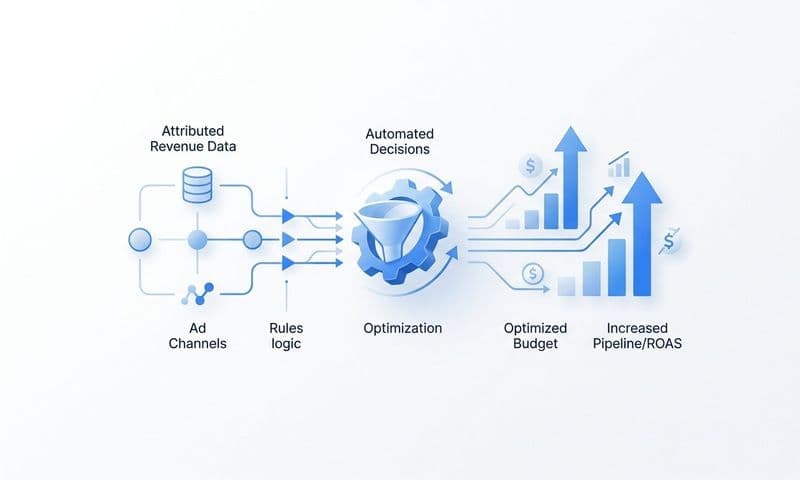
Begin with server-side tracking and Conversion API integrations. Connect your attribution platform to Meta, Google, and any other ad platforms you run. Server-side tracking ensures that conversion data is captured accurately regardless of what is happening at the browser level, giving you a more complete and durable record of campaign performance.
Next, connect your CRM. This is the step that transforms your attribution from lead-level reporting to revenue attribution. When your CRM syncs with your attribution platform, you can trace every deal back to the marketing touchpoints that influenced it, giving you a true picture of which channels and campaigns are driving pipeline and closed revenue, not just form fills.
If you use Stripe or another payment processor, integrate it as well. Connecting ad spend directly to closed revenue through your payment processor gives you a genuine ROI view by channel and campaign. This is the data that finance and leadership actually care about, and it is the data that most B2B SaaS marketing teams currently cannot produce because their stack was never built to connect these dots.
During this implementation phase, run attribution model comparisons. Look at how first-touch, last-click, linear, and data-driven models interpret the same conversion data differently. Understanding these differences helps your team align on which model to use for which decisions, and prevents the confusion that comes from different stakeholders referencing different attribution outputs.
Before you move on to deprecating other tools, validate that your attribution platform is capturing every touchpoint across the customer journey. Compare its output to your legacy tools. If there are gaps, resolve them now rather than discovering them after you have already cancelled the tools that were filling those gaps.
Success indicator: Your attribution platform is live, integrated with your ad platforms and CRM, and producing conversion data that matches or exceeds what your legacy tools were capturing.
Step 7: Deprecate Redundant Tools and Establish Your New Operating Rhythm
With your attribution layer validated and your roadmap in place, you are ready to begin deprecating tools according to your sequence. Work through the list methodically, one migration at a time, following the process you defined in Step 5.
Before canceling any tool, export and archive historical data. Even if you do not need it today, past performance benchmarks are valuable for year-over-year comparisons, board reporting, and understanding long-term trends. Losing historical data is one of the most common and most avoidable mistakes in consolidation projects.
As each tool is deprecated, update your team's reporting workflows to use the consolidated stack. Do not assume people will figure out the new process on their own. Document where to find data, how to pull reports, and how to interpret the attribution outputs your new platform produces. Clear documentation reduces the informal workarounds that tend to create new tool sprawl over time.
Establish a regular cadence for reviewing your stack going forward. A quarterly audit is a practical mechanism for catching new tool sprawl before it rebuilds the problem you just solved. People will continue to adopt point solutions for specific needs. The goal is not to prevent all new tools, but to evaluate them against your capability checklist before they become permanent fixtures.
Use the AI-driven insights in your attribution platform to guide ongoing spend decisions. Which campaigns are driving the most pipeline? Which channels have the highest return on ad spend when measured against closed revenue rather than leads? These are the questions your consolidated stack should now be able to answer quickly, replacing the manual cross-referencing that tool sprawl previously required.
Track the downstream impact of consolidation over time. Reduced tool costs, faster reporting cycles, and improved confidence in marketing data are all measurable outcomes that demonstrate the value of the work your team put into this process.
Success indicator: Your team is operating from a single source of truth, redundant tools are cancelled, and marketing decisions are being made from unified, accurate data.
Putting It All Together
Marketing tool consolidation is not a one-time project. It is a discipline. The teams that benefit most from consolidation are the ones that treat their stack as a strategic asset, auditing it regularly and ensuring every tool either contributes to a unified data picture or gets cut.
The seven steps in this guide give you a repeatable framework: audit what you have, map your data flows, define what you actually need, evaluate your options, sequence your migrations, implement your attribution layer first, and then deprecate what no longer earns its place.
The outcome is a leaner stack that costs less, produces more reliable data, and enables faster, more confident decisions. For B2B SaaS marketing teams, the most impactful consolidation move is typically replacing fragmented tracking and reporting tools with a single attribution platform that connects ad spend to pipeline and revenue.
Cometly is built exactly for this purpose. It gives you multi-touch attribution, server-side conversion tracking, AI-driven insights, and 70-plus native integrations in one place. You can capture every touchpoint from the first ad click through to closed-won revenue, feed enriched conversion data back to Meta and Google to improve ad platform optimization, and get AI-powered recommendations on where to scale and where to cut.
If you are ready to stop reconciling conflicting dashboards and start making decisions from a single source of truth, Get your free demo and see how Cometly can anchor your consolidated marketing stack.