Marketing is generating leads. Sales is closing deals. But somewhere between the first ad click and the closed-won deal, the data falls apart. Revenue growth feels real but hard to explain, and when leadership asks which channels are actually driving pipeline, the answer is usually a shrug, a spreadsheet, or a heated debate between marketing and sales.
This is the operational reality for many B2B SaaS companies, and it is exactly the problem that both Marketing Operations (MOps) and Revenue Operations (RevOps) are designed to solve. The challenge is that these two frameworks solve it differently, at different levels of organizational scope, and with different implications for how your marketing data flows and how attribution actually works.
Understanding the difference between MOps and RevOps is not just an org-chart exercise. It shapes how your team tracks campaigns, how attribution data moves through your systems, and ultimately how growth leaders make decisions about where to invest. If you are a marketer, a revenue leader, or anyone trying to build a more accountable go-to-market engine, this guide is for you.
Two Functions, One Goal: Understanding the Core Difference
At their core, both MOps and RevOps exist to make revenue growth more predictable and more measurable. But they approach that goal from very different angles, and confusing one for the other leads to structural problems down the line.
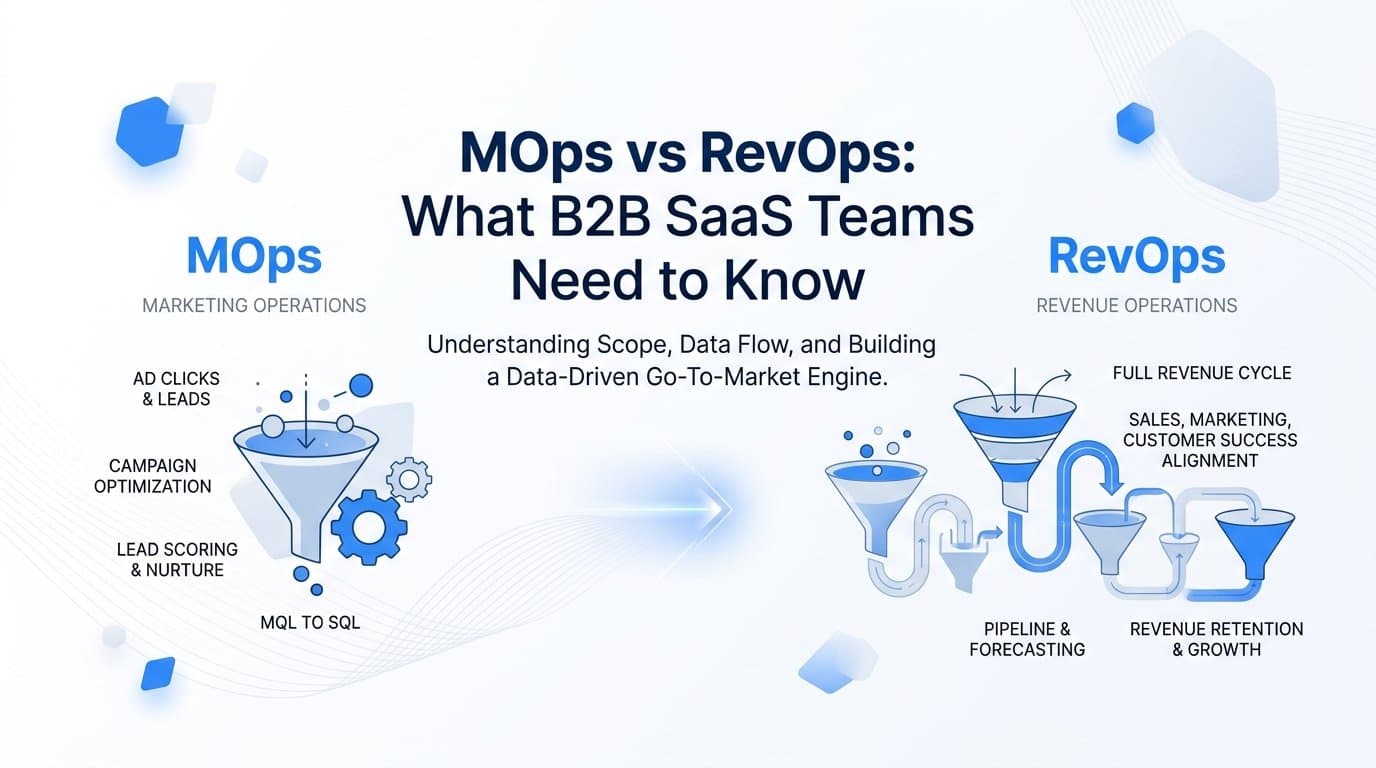
Marketing Operations (MOps) is the specialized function responsible for the systems, processes, data, and technology that power marketing execution. Think of MOps as the engine room of your marketing team. MOps professionals own the marketing technology stack, campaign infrastructure, lead lifecycle management, data governance within marketing systems, and the analytics and reporting that tell marketers whether their campaigns are working.
MOps is deeply technical. It is the team that sets up your tracking pixels, manages your marketing automation platform, maintains CRM integrations, and ensures that the data flowing out of your campaigns is accurate enough to make decisions on. Without a strong MOps function, even the most creative marketing strategy falls apart at the execution layer.
Revenue Operations (RevOps) is a broader organizational model. Rather than sitting inside marketing, RevOps operates across marketing, sales, and customer success, aligning all three operational functions under a shared framework. The goal is to create a unified revenue engine where data, processes, and reporting are consistent across the entire customer lifecycle.
The critical distinction is scope. MOps is a specialized discipline within marketing. RevOps is a cross-functional operating model that often absorbs or coordinates with MOps as one of its component functions. A company can have a mature MOps team without having RevOps. But a mature RevOps function almost always includes a strong MOps capability as part of its structure.
Here is a practical way to think about it: MOps builds and maintains the marketing machine. RevOps connects that machine to the rest of the revenue engine. Both are necessary. Neither is a replacement for the other. The question is not which one to choose, but understanding where you are in your operational maturity and what your team actually needs right now.
For B2B SaaS companies specifically, this distinction matters because the customer journey is long, multi-touch, and spans multiple systems. A prospect might encounter your brand through a paid ad, attend a webinar, read a case study, and engage with a sales rep across several touchpoints before converting. Capturing and connecting that journey requires both the technical precision of MOps and the cross-functional visibility of RevOps.
What Marketing Operations Actually Owns
If you want to understand MOps, start with the question: what breaks when MOps is absent? The answer is almost everything related to marketing execution and data accuracy.
MOps teams own a wide range of responsibilities, and each one has a direct impact on the quality of data your marketing and revenue teams rely on.
Marketing Technology Stack Management: MOps professionals are the administrators and architects of your marketing tech stack. They evaluate, implement, and maintain the tools your marketing team uses, from marketing automation platforms to ad platform connectors to attribution software. When a new tool needs to be integrated, MOps owns that process.
Campaign Operations: Beyond strategy, MOps handles the operational execution of campaigns. This includes building workflows in your automation platform, managing email programs, setting up landing pages, and ensuring that every campaign is instrumented correctly before it goes live.
Lead Scoring and Routing: MOps designs the logic that determines how leads are scored based on behavior and firmographic data, and how they are routed to the right sales reps. This is a high-stakes responsibility because poor lead scoring leads directly to sales and marketing misalignment.
Data Hygiene: Marketing databases degrade over time. MOps teams manage data quality, deduplication, enrichment, and governance to ensure that the data your marketing team is working with is accurate and reliable.
Marketing Analytics and Attribution: This is where MOps intersects most directly with revenue visibility. MOps teams own the conversion tracking infrastructure: the pixels, form tracking, CRM integrations, and attribution configurations that determine how campaign performance is measured. Every downstream decision about where to invest marketing budget depends on the accuracy of this layer.
The typical MOps tech stack in a B2B SaaS company includes a marketing automation platform, a CRM connector, ad platform integrations, and increasingly, a dedicated attribution tool that sits across all of these systems. The reason data accuracy at this layer is so critical is simple: garbage in, garbage out. If your tracking is broken, your attribution is wrong. If your attribution is wrong, your budget decisions are wrong.
This is why MOps is not just a support function. It is the operational foundation that determines whether marketing can credibly demonstrate its impact on revenue. A MOps team that owns clean, connected tracking infrastructure gives leadership the data they need to make confident investment decisions. A MOps team that is under-resourced or under-prioritized creates data gaps that compound over time and eventually make attribution nearly impossible.
How RevOps Expands the Operational Scope
RevOps did not emerge in a vacuum. It emerged as a direct response to a specific problem that B2B SaaS companies kept running into as they scaled: siloed operations across marketing, sales, and customer success that created friction, inconsistent data, and misaligned incentives.
Here is what that friction looks like in practice. Marketing has its own tools, its own reporting, and its own definition of a qualified lead. Sales has its own CRM views, its own pipeline metrics, and its own opinion about lead quality. Customer success has its own health scores, its own churn data, and its own understanding of what makes a good customer. Each team is optimizing for its own goals, but none of them are looking at the same data. The result is a revenue engine where the parts do not connect.
RevOps addresses this by unifying operations across all three functions under a shared framework. What that means in practice:
A Shared Data Model: RevOps establishes consistent definitions and data structures across the full customer lifecycle. Lead stages, opportunity stages, customer health metrics, and revenue attribution are all defined and measured the same way across every team.
Consistent Pipeline Reporting: Instead of marketing reporting on MQLs, sales reporting on opportunities, and customer success reporting on NRR in isolation, RevOps creates a unified pipeline view that connects all of these metrics into a single narrative about revenue health.
Revenue Forecasting: With a shared data model and consistent reporting, RevOps enables more accurate revenue forecasting by connecting leading indicators from marketing (pipeline generation, campaign performance) to lagging indicators from sales (close rates, deal velocity) and customer success (expansion revenue, churn).
Cross-Functional Process Design: RevOps designs and maintains the processes that govern how leads move from marketing to sales, how customers move from sales to customer success, and how feedback flows back through the system.
Importantly, RevOps does not replace MOps. It elevates it. In many mature B2B SaaS companies, MOps becomes a specialized team within a broader RevOps structure. MOps handles the marketing-specific systems, tracking infrastructure, and campaign analytics. RevOps handles the connective tissue: the shared data model, the cross-functional reporting, and the process alignment that makes the whole system work together.
Think of it as a hierarchy of operational scope. MOps is the specialist. RevOps is the coordinator. When both are functioning well and working from the same data, the revenue engine runs cleanly. When they are misaligned or operating independently, the gaps between them become the source of your attribution problems.
Where MOps and RevOps Intersect on Attribution
Attribution is where the relationship between MOps and RevOps becomes most consequential, and most fragile.
MOps owns the tracking infrastructure. It is responsible for capturing how leads are generated, which campaigns they came from, and what touchpoints they encountered before converting. This data lives in pixels, form submissions, UTM parameters, CRM fields, and the integrations that connect ad platforms to your marketing automation system.
RevOps needs that data to flow accurately into pipeline and revenue reporting. Revenue leaders need to answer questions like: which marketing channels are generating the pipeline that actually closes? What is the true cost per acquisition when you trace ad spend all the way to closed-won revenue? Which campaigns are driving high-quality leads versus high-volume leads that never convert?
These questions cannot be answered without accurate attribution data moving cleanly from MOps systems into RevOps reporting. And this is exactly where misalignment creates problems.
The most common attribution gap in B2B SaaS looks like this: a lead is generated by a paid search campaign, captured in the marketing automation platform with the correct source data, and then handed off to sales. But when the opportunity is created in the CRM, the lead source data does not carry over correctly. By the time the deal closes, the attribution is lost. Marketing reports strong campaign performance based on lead volume. Sales reports a pipeline that has no clear marketing source. Neither team has the data to resolve the disagreement, and leadership cannot calculate true marketing ROI.
This gap is not a technology problem. It is an alignment problem. When MOps and RevOps operate independently, with different data models and different reporting structures, attribution breaks at the handoff points between systems.
What good alignment looks like is a shared data model where every touchpoint from the first ad click to the closed-won deal is captured, connected, and visible to both marketing and revenue leadership. This requires MOps to build tracking infrastructure that is designed with RevOps visibility in mind: consistent lead source fields, reliable CRM integrations, and attribution data that persists through every stage of the customer lifecycle.
It also requires RevOps to treat MOps attribution data as a first-class input into pipeline and revenue reporting, not an afterthought. When both functions are working from the same data layer, marketing can demonstrate its contribution to revenue with confidence, and sales can trust that the leads it receives are well-sourced and well-tracked.
Choosing the Right Structure for Your B2B SaaS Stage
The MOps versus RevOps question is not just conceptual. It has practical implications for how you structure your team and where you invest your operational resources. And the right answer depends heavily on where your company is in its growth journey.
When MOps-First Makes Sense
Early-stage B2B SaaS companies typically have one primary growth lever: marketing. The priority is generating demand, capturing leads, and building the tracking and automation foundations that will support future scale. At this stage, a dedicated MOps function, or even a single strong MOps practitioner, is often the highest-leverage operational investment you can make.
The focus at this stage should be on getting the fundamentals right: reliable conversion tracking, clean CRM integrations, basic attribution that tells you which channels are driving leads, and marketing automation that can scale with your campaigns. Worrying about cross-functional alignment between marketing, sales, and customer success is premature if you do not yet have solid marketing infrastructure to align.
When RevOps Becomes Necessary
Growth-stage companies face a different set of problems. Sales and marketing misalignment starts creating real revenue leakage. Attribution breaks across the funnel as the customer journey becomes more complex. Leadership cannot get a single view of pipeline health because every team is reporting from a different system with different definitions.
This is when RevOps becomes necessary. Not because MOps was wrong, but because the operational scope has expanded beyond what a marketing-focused function can address alone. RevOps provides the cross-functional framework that connects marketing's tracking data to sales pipeline reporting and customer success metrics, creating the unified view that growth-stage companies need to make confident investment decisions.
The Practical Signal to Watch For
If your marketing team cannot trace ad spend to closed revenue, that is a sign your operational model needs to evolve. If your sales team regularly disputes the quality of marketing-sourced leads and neither team has the data to resolve the disagreement, that is another clear signal. These are not just communication problems. They are symptoms of a broken data layer and misaligned operational structures.
Many B2B SaaS companies land on a hybrid model: MOps as a specialized team within a broader RevOps structure. This allows marketing to maintain deep technical expertise in its own systems while contributing to a shared operational framework that serves the full revenue engine.
Building the Data Foundation That Makes Either Model Work
Here is the honest truth about the MOps versus RevOps debate: the choice of organizational model matters less than the quality of your underlying data. Whether you are running a lean MOps function or a fully integrated RevOps structure, everything depends on accurate, connected marketing data that flows from ad platforms through to CRM and revenue records.
Without that data foundation, neither model can deliver on its promise. MOps teams cannot report accurate campaign performance if tracking is broken. RevOps teams cannot build reliable pipeline attribution if lead source data disappears at the CRM handoff. The organizational structure is just a framework. The data is what makes it real.
This is where modern attribution tools play a critical role. Attribution platforms serve as the connective layer between MOps execution and RevOps visibility. They capture touchpoints across every channel, enrich conversion events with the context needed for accurate attribution, and feed that data back to both ad platforms and revenue dashboards. They are the infrastructure that makes the handoff between MOps and RevOps seamless rather than leaky.
For B2B SaaS teams specifically, the requirements are demanding. The customer journey is long and multi-touch. Server-side tracking is increasingly necessary as browser-based tracking becomes less reliable. CRM integration needs to be deep enough that attribution data persists through every stage of the funnel. And the data needs to be visible in real time, not just in weekly reports.
This is exactly the problem Cometly is built to solve. Cometly connects your ad platforms, CRM events, and website data into a single source of truth that both MOps and RevOps teams can rely on. From the first ad click to the closed-won deal, every touchpoint is captured and connected. Marketing can see which campaigns are driving real pipeline. Revenue leadership can trace ad spend to closed revenue with confidence. And the AI-driven insights surface which ads and channels are actually performing, so you can scale what works and cut what does not.
Cometly also feeds enriched, conversion-ready data back to ad platforms like Meta and Google, improving targeting and optimization so your campaigns get smarter over time. Whether your team is MOps-focused, RevOps-aligned, or somewhere in between, the data layer Cometly provides is what makes the whole system function with accuracy and accountability.