Most B2B SaaS deals don't die because of a bad product. They die because sales teams built their entire strategy around one person, and that person went quiet, changed roles, or lost internal support at exactly the wrong moment. It happens constantly, and the damage is rarely visible until the deal is already gone.
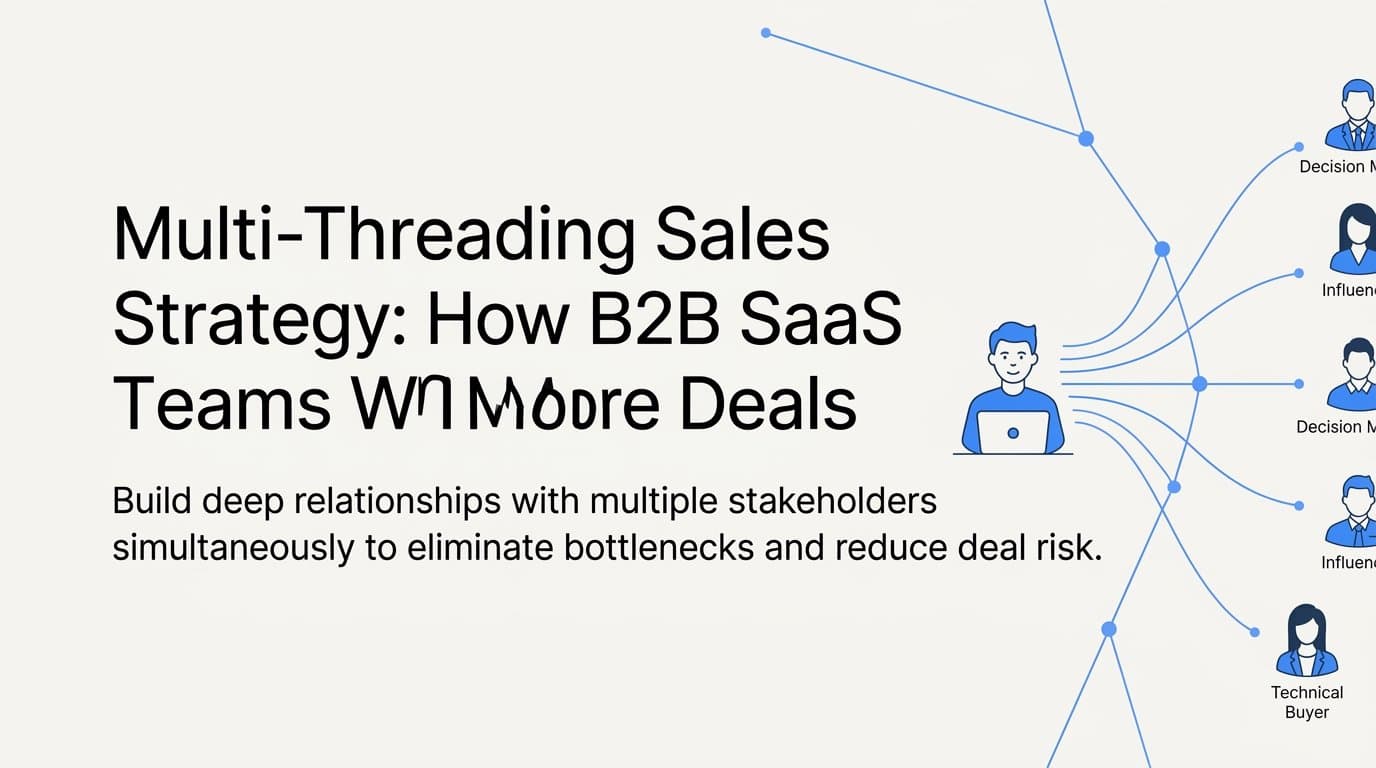
This is the core problem that multi-threading sales strategy is designed to solve. Multi-threading is the practice of building meaningful relationships with multiple stakeholders inside a single target account at the same time, so no single contact becomes the bottleneck between your team and a closed deal.
Modern B2B buying committees have grown significantly in size and complexity. Purchasing decisions in mid-market and enterprise SaaS now routinely involve stakeholders from finance, operations, IT, and executive leadership, each with their own priorities, objections, and influence over the final outcome. Relying on a single champion to navigate that internal landscape on your behalf is a strategy built on hope, not process.
This article breaks down everything you need to know about multi-threading: what it is, why single-threaded selling puts your pipeline at risk, how to build a multi-threading playbook your team can actually execute, and how marketing attribution data connects the entire strategy together so you can measure what's working and optimize from there.
Why Single-Threaded Selling Is a Risk You Can't Afford
Single-threaded selling means your entire relationship with an account runs through one contact. That person is your champion, your internal advocate, and your primary source of information about what's happening inside the buying process. When things go well, it feels efficient. When things go wrong, you have nothing to fall back on.
The risks are specific and predictable. First, deal stagnation. When your single contact goes dark, whether they're overwhelmed, reassigned, or simply deprioritizing your deal, you have no other path into the account. You're left sending follow-up emails into a void, watching a deal that looked healthy quietly decay in your pipeline.
Second, loss of internal advocacy. Champions change roles. They get promoted, they move to different departments, or they leave the company entirely. When that happens in the middle of a sales cycle, a single-threaded deal effectively starts over. The new contact has no context, no relationship with your team, and no emotional investment in the outcome. You've lost months of work.
Third, and perhaps most damaging, is the blind spot problem. If you only talk to one person, you only understand one perspective on the buying decision. You may have no idea that the CFO has concerns about pricing, that the IT team has integration questions that haven't been addressed, or that a senior executive is skeptical of the category entirely. Your champion may not even know about these objections. By the time they surface, it's often too late to address them effectively.
B2B buying decisions now involve input from multiple departments as a matter of course. Finance needs to approve the budget. IT needs to evaluate the technical fit. Operations or end users need to validate that the product will actually work in their daily workflows. Leadership often wants strategic alignment before signing off. One relationship, no matter how strong, is rarely sufficient to navigate all of those layers simultaneously.
This creates what you might call deal vulnerability: a pipeline that looks healthy on the surface but is actually fragile because it depends on a small number of connections that could break at any time. For sales and marketing leaders trying to forecast accurately, a pipeline full of single-threaded deals is not a pipeline you can trust. The deals that appear most advanced may be the most exposed.
What Multi-Threading Sales Strategy Actually Means
Multi-threading is not about sending more emails or adding more contacts to a sequence. That distinction matters, because a lot of teams confuse volume with strategy. Spray-and-pray outreach to everyone in an org chart is not multi-threading. It's noise, and it will damage your reputation with the account faster than it will open doors.
True multi-threading is deliberate. It means identifying the key stakeholders involved in or influencing a buying decision, understanding the distinct role each person plays, and building genuine relationships with each of them through relevant, personalized engagement. The goal is not to have more conversations. The goal is to have the right conversations with the right people, in a coordinated way.
To execute this well, you need to understand the typical stakeholder map in a B2B SaaS deal. While every organization is different, most complex purchases involve four core personas:
The Economic Buyer: This is the person who controls the budget and ultimately signs off on the purchase. They're often a VP, Director, or C-suite executive. They care about ROI, business outcomes, and strategic fit. They may not be involved in the day-to-day evaluation, but their approval is non-negotiable.
The Technical Evaluator: This stakeholder is responsible for assessing whether your product can actually work within the company's existing infrastructure. In SaaS, this is often an IT lead, a solutions architect, or a technical product manager. They care about integrations, security, data handling, and implementation complexity.
The End User Champion: This is the person who will use your product most directly and whose daily work will be most affected by the decision. They often have significant informal influence because their adoption determines whether the purchase delivers value. They care about usability, workflow impact, and whether the tool actually makes their job easier.
The Executive Sponsor: This stakeholder provides strategic air cover for the purchase. They may not be deeply involved in the evaluation, but they lend credibility and organizational weight to the initiative. Engaging them early can accelerate deals significantly, particularly in enterprise accounts where internal politics matter.
Understanding these roles changes how you approach an account. Instead of trying to get one person to carry your deal through the organization, you're building a network of informed, engaged stakeholders who each have a reason to support the purchase from their own perspective. That's what makes multi-threading genuinely powerful: it distributes your risk and amplifies your internal advocacy at the same time.
Building Your Multi-Threading Playbook Step by Step
Knowing that multi-threading matters and actually executing it consistently are two different things. The gap between them is usually a missing playbook. Here's how to build one your team can follow.
Start with account mapping before outreach begins. Before your team sends a single email or makes a single call, invest time in understanding the account's organizational structure. Who are the decision-makers? Who are the influencers? Who controls the budget, and who will be responsible for implementation? Use LinkedIn, company websites, CRM data, and any intelligence from existing contacts to build a map of the relevant stakeholders and their reporting relationships. Assign ownership of each stakeholder relationship to a specific team member so there's no ambiguity about who is responsible for what.
Tailor your messaging by persona, not by account. This is where most multi-threading efforts break down. Teams identify multiple stakeholders but send them variations of the same generic message. That approach fails because each persona has fundamentally different priorities and objections.
The CFO wants to understand cost efficiency, payback period, and how your solution compares to alternatives in terms of financial return. The IT lead wants to know about your API architecture, your security certifications, and how implementation will affect their existing stack. The end user wants to understand how the product will change their daily workflow, whether it will be intuitive to adopt, and whether it will genuinely reduce friction in their work. Generic messaging that tries to speak to everyone ends up resonating with no one.
Coordinate internally so your team moves as one unit. Multi-threading creates complexity inside your own organization as well as inside the account. If your sales rep is telling the CFO one thing about pricing while marketing is running ads with different messaging to the IT lead, you're creating confusion that will undermine trust. Sales, marketing, and customer success need to operate from a shared view of the account: which stakeholders have been engaged, what content each has received, where each relationship stands in the buying journey, and what the next step is for each persona.
This coordination requires a shared system of record. Your CRM needs to capture contact-level engagement, not just account-level activity. And your marketing team needs visibility into which stakeholders are active so they can support the right personas with the right content at the right time. Without that alignment, multi-threading becomes chaotic rather than strategic.
Set a cadence for stakeholder engagement reviews. Multi-threading is not a one-time activity. It requires ongoing attention to make sure all key relationships are being maintained and that no stakeholder has gone dark without the team noticing. Build regular check-ins into your sales process where the team reviews the status of each stakeholder relationship and identifies gaps that need to be addressed before the deal advances.
How Marketing Fuels Multi-Threading With the Right Content and Channels
Sales cannot execute a multi-threading strategy alone. The volume of personalized engagement required across multiple stakeholders at multiple accounts simultaneously is simply too high for a sales team to handle through direct outreach alone. Marketing has to play an active role, and that means creating content and running campaigns specifically designed to support multi-threaded deals.
The starting point is persona-specific content. If your content library consists primarily of generic product pages and broad-topic blog posts, it will not serve a multi-threading strategy well. You need assets that speak directly to the concerns of each stakeholder type.
Executive briefs and business case templates for C-suite buyers who need to understand strategic value and financial return without wading through technical detail.
Technical documentation and integration guides for IT evaluators who need to assess feasibility and implementation complexity before they can recommend the product internally.
ROI calculators and benchmark reports for finance stakeholders who need to quantify the expected return and compare it against the cost of the investment.
Product walkthroughs and workflow guides for end users who want to see exactly how the product will fit into their daily work before they become advocates for the purchase.
Beyond content, paid advertising can be a powerful tool for reaching multiple stakeholders within the same target account simultaneously. Account-based marketing tactics allow marketing teams to serve different messages to different roles within a defined list of target accounts. A VP of Finance at a target company might see a message about cost efficiency and ROI, while the IT Director at the same company sees a message about integration capabilities and security. This kind of coordinated, persona-aware advertising amplifies the multi-threading effort your sales team is running in parallel.
The critical requirement is visibility. Marketing needs to know which content and channels are actually influencing each stakeholder, not just which assets are getting the most overall traffic. Without that granularity, it's impossible to optimize. You might be investing heavily in a channel that reaches end users but completely missing the economic buyers who are the ultimate decision-makers. Attribution data is what closes that gap, and we'll cover that in detail in the next section.
Attribution Data: The Missing Link in Multi-Threading Execution
Here's the attribution challenge that multi-threading creates: when multiple stakeholders from the same account are interacting with different content across different channels over an extended buying cycle, the data gets complicated fast. A VP of Marketing clicks on a LinkedIn ad. A CFO downloads a ROI calculator from your website. An IT Director attends a webinar. A Director of Operations reads a case study. All of these touchpoints belong to the same account journey, but they're scattered across different people, different channels, and different moments in time.
If your attribution model can't connect those dots, you're flying blind. Single-touch attribution models like last-click or first-click are particularly inadequate here. Last-click attribution would credit only the final touchpoint before a deal closes, completely ignoring the CFO's research, the IT Director's webinar attendance, and the VP of Marketing's initial ad click that started the whole conversation. You'd have no idea which marketing efforts actually influenced the deal, which means you'd have no basis for investing more in what's working or cutting what isn't.
Multi-touch attribution is the approach that matches the reality of multi-threaded deals. Instead of assigning all credit to one touchpoint, multi-touch attribution distributes credit across all the interactions that contributed to a deal, giving your team a complete picture of how marketing influenced each stakeholder throughout the buying journey. This is not just more accurate. It's fundamentally different information that changes how you allocate budget, create content, and support your sales team.
For B2B SaaS teams executing a multi-threading strategy, this level of visibility requires a platform that can connect data across multiple sources. Your ad platforms show you who clicked on what. Your CRM shows you which contacts are associated with which accounts and where deals stand in the pipeline. Your website analytics show you which pages and assets are being consumed. The challenge is that these data sources don't naturally talk to each other at the contact level, which is exactly the level of granularity you need for multi-threading.
This is where Cometly becomes directly relevant. Cometly connects your ad platforms, CRM data, and website behavior into a single unified view, giving B2B SaaS teams the ability to see every touchpoint across every stakeholder in a target account. When a CFO at a key account downloads your pricing guide after seeing a LinkedIn ad, and a week later the IT Director visits your integration documentation page after clicking a retargeting ad, Cometly captures both of those events and connects them to the same account's pipeline journey.
That means your marketing team can see exactly which channels and content types are influencing which stakeholder personas across your target accounts. They can identify where the gaps are, which personas are being reached and which are being missed, and make confident decisions about where to invest to support the multi-threading strategy. Instead of guessing whether your ABM campaigns are working, you have real data connecting ad spend to pipeline engagement at the contact level.
Measuring Whether Your Multi-Threading Strategy Is Working
Executing a multi-threading strategy without measuring it is like running a campaign without tracking conversions. You need specific metrics that tell you whether your team is actually building the stakeholder coverage required to win complex deals, not just whether individual conversations are happening.
The most important indicators of a healthy multi-threading strategy include:
Engaged contacts per account: How many stakeholders at each target account have had meaningful interactions with your team or your content? A deal with one engaged contact is single-threaded regardless of how many names are in your CRM. You want to see multiple contacts showing active engagement signals.
Stakeholder coverage score: Are you represented across the key personas in each account? If you have strong relationships with end users but no engagement from the economic buyer or IT evaluator, your coverage is incomplete and your deal is at risk. Track coverage by persona type, not just by headcount.
Deal velocity compared to single-threaded deals: Deals with broader stakeholder engagement tend to move through the pipeline differently than single-threaded deals. Track whether your multi-threaded deals are progressing faster, stalling less frequently, and converting at different rates compared to accounts where you have only one active relationship.
Win rate by number of active relationships: Over time, this metric will tell you a great deal about the minimum stakeholder coverage required to win deals in your market. If deals with three or more engaged stakeholders consistently outperform deals with one or two, that's a signal to set coverage thresholds as part of your qualification criteria.
Pipeline attribution data adds another layer of insight here. It can reveal which accounts are genuinely multi-threaded versus which ones only appear to be based on CRM records. An account might have five contacts logged in your CRM, but if attribution data shows that only one of them has engaged with any marketing content in the last ninety days, the real coverage is much thinner than it looks on paper. That distinction matters enormously for forecasting accuracy.
Attribution insights also help you identify specific gaps to act on. If finance stakeholders at a target account have never interacted with any of your content, that's a clear signal to create or promote assets specifically designed for that persona and to make sure those assets are being served to the right audience through your ABM campaigns. The data moves you from reactive to proactive, which is exactly the posture you need to sustain a multi-threading strategy at scale.
Putting It All Together
Multi-threading is not an advanced tactic reserved for enterprise sales teams with large headcounts and unlimited budgets. It is the baseline requirement for selling effectively into any B2B SaaS deal where more than one person influences the outcome, which is most deals worth winning.
The core argument is straightforward: single-threaded selling creates fragile pipelines that are difficult to forecast and easy to lose. Multi-threading distributes your risk, amplifies your internal advocacy, and gives your team multiple paths to a closed deal. But execution requires more than good intentions. It requires account mapping, persona-specific messaging, internal coordination between sales and marketing, and clear visibility into which touchpoints are influencing which stakeholders at each stage of the buying journey.
Marketing plays a critical role in this strategy, but only when it's equipped with the right data. Persona-specific content, targeted ABM campaigns, and coordinated messaging across channels are all powerful tools. Without attribution data connecting those efforts to actual pipeline movement at the contact level, though, marketing is operating on assumptions rather than evidence.
Cometly gives B2B SaaS teams the full-funnel visibility they need to support multi-threading at scale. By connecting ad platform data, CRM events, and website behavior into a single source of truth, Cometly makes it possible to see every touchpoint across every stakeholder in your target accounts and to make confident, data-driven decisions about where to invest to move deals forward.
If you're ready to give your team that kind of visibility, Get your free demo today and see how Cometly can help you capture every touchpoint, understand what's really driving revenue, and scale your multi-threading strategy with confidence.