Here is a situation that plays out constantly inside growth-stage SaaS companies. Marketing is celebrating a record month of MQLs. Sales is complaining that the leads are low quality. Customer success is watching churn tick up and wondering why no one flagged the mismatch earlier. And the CFO is asking a simple question that no one can answer cleanly: what is our marketing actually producing?
Each team has data. The problem is that none of it connects. Marketing measures what happens before the handoff. Sales measures what happens after. Customer success measures what happens long after that. And somewhere in the gaps between those three views, the actual revenue story gets lost.
Revenue operations exists to close those gaps. It is the structural layer that unifies marketing, sales, and customer success under shared data, shared processes, and shared accountability for revenue outcomes. But understanding what RevOps does is only part of the picture. How a RevOps team is actually built, who owns what, and how the structure scales with the business, those are the questions that determine whether RevOps delivers real results or just adds another layer of overhead.
This article breaks down the revenue operations team structure in practical terms: the roles, the hierarchy, how it evolves by company stage, and why getting the attribution layer right is the foundation everything else depends on.
Why Revenue Operations Exists in the First Place
The traditional go-to-market structure was not designed with unified revenue visibility in mind. It was designed around functional efficiency. Marketing optimizes for lead volume. Sales optimizes for pipeline and close rate. Customer success optimizes for retention and expansion. Each team has its own tools, its own metrics, and its own definition of success.
The result is data fragmentation at scale. Marketing reports on MQLs, but has limited visibility into which leads actually closed. Sales tracks pipeline, but cannot easily connect that pipeline back to the specific campaigns or channels that generated it. Customer success monitors churn and NRR, but operates largely downstream from the decisions that shaped the customer relationship in the first place.
No single team owns the full revenue picture. And when leadership asks which channels are actually driving growth, the answer requires pulling data from three different systems, reconciling conflicting definitions, and making judgment calls that introduce error at every step.
Revenue operations was built to solve this structurally. The core premise is straightforward: if marketing, sales, and customer success are all contributing to revenue, then there should be one operational layer that serves all three, maintains the shared data foundation, and holds accountability for the metrics that span the entire customer lifecycle.
For B2B SaaS companies specifically, this is not a nice-to-have. Buyer journeys in B2B SaaS are long, involve multiple stakeholders, and touch many channels before a deal closes. A prospect might engage with a paid ad, attend a webinar, read three blog posts, get an outbound sequence, and have four discovery calls before signing. Understanding which of those touchpoints drove the deal, and which ones are worth investing in again, requires operational infrastructure that no single functional team can build on its own.
RevOps provides that infrastructure. It creates the shared data layer, the shared process standards, and the shared reporting framework that allows leadership to make confident decisions about where to invest and where to pull back. Without it, GTM teams are essentially flying with three separate instruments that are not calibrated to each other.
The Core Roles Inside a RevOps Team
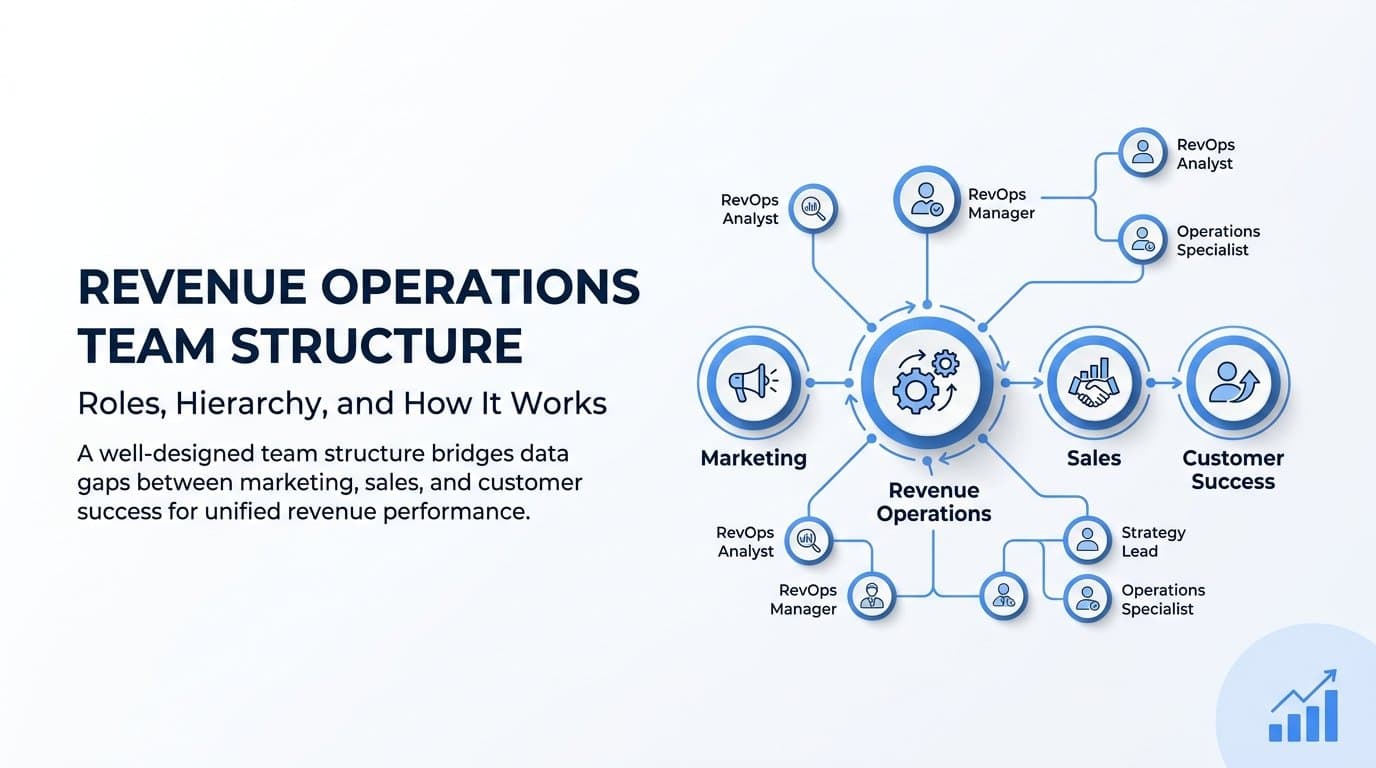
A well-structured RevOps team is not a single generalist sitting between sales and marketing. It is a layered function with clear ownership at every level. The specific titles vary by company, but the role types are consistent across most B2B SaaS organizations that have built RevOps intentionally.
VP or Head of Revenue Operations: This is the senior leader who owns the RevOps strategy, drives cross-functional alignment, and reports directly to the CEO or CRO on revenue performance. Their job is not to manage tools. It is to ensure that the entire GTM motion is operating from a shared understanding of what is working and why. They set the standards for how revenue is measured, own the executive reporting cadence, and make the structural decisions about how the ops function is organized.
Revenue Operations Managers and Analysts: Sitting below the VP, these roles own specific functional areas. In a mature RevOps team, you typically see a Marketing Operations Manager, a Sales Operations Manager, and a Customer Success Operations Manager. Each of these roles serves their respective GTM function while operating within the shared data standards, shared tooling, and shared reporting infrastructure that RevOps maintains. They are not embedded in their functional teams reporting to a marketing or sales leader. They report into RevOps, which is what gives the function its cross-functional leverage.
Revenue Systems Manager: This role is often underestimated but is critical to making everything else work. The Revenue Systems Manager owns the CRM as the system of record, manages the health of integrations across the tech stack, and ensures that data is flowing correctly between platforms. When ad platform data does not match CRM data, when attribution numbers look off, or when a new tool needs to be integrated without breaking existing workflows, this is the person who owns the fix. Without this role, RevOps teams spend an enormous amount of time firefighting data quality issues instead of generating insights.
Revenue Analytics: In growth-stage and scale-stage teams, a dedicated analytics function often sits within RevOps. This team owns the reporting layer, builds the dashboards that leadership relies on, and conducts the deeper analysis that answers questions like which channels produce the best pipeline-to-close rates, or where in the funnel conversion is breaking down.
The key design principle across all of these roles is shared infrastructure with functional expertise. Each person understands the specific needs of their GTM counterpart, but they operate from the same data standards and report into the same RevOps leadership. That is what makes the function coherent rather than just a collection of ops people sitting in different corners of the org chart.
How RevOps Teams Are Structured by Company Stage
One of the most common mistakes SaaS leaders make when building RevOps is trying to replicate the structure of a company two or three stages ahead of them. The right RevOps structure depends heavily on where the company is in its growth trajectory.
Early-Stage SaaS: Seed to Series A
At this stage, the priority is getting the foundation right, not building a department. Most early-stage companies bring on a single RevOps hire who is a strong generalist: someone who can set up and maintain the CRM, establish basic attribution tracking, configure lead routing, and build the reporting infrastructure that will scale with the business.
This person is not specialized. They are doing marketing ops, sales ops, and some CS ops work simultaneously. The goal at this stage is to establish clean data habits and a reliable system of record before the company scales. Attribution basics matter here because the decisions made about channel investment in the early stages tend to compound. Getting the tracking right from the start avoids the painful data cleanup projects that plague companies who defer this work.
Growth-Stage SaaS: Series B to Series C
This is where RevOps starts to look like a real team. As the GTM motion becomes more complex and the volume of data increases, the generalist model breaks down. The company needs functional specialists who can go deep on marketing ops, sales ops, and post-sale operations while still operating from shared standards.
A dedicated analytics function often emerges at this stage as well, because leadership is now making larger budget decisions and needs more rigorous analysis to support them. The VP or Head of RevOps becomes a critical hire at Series B, providing the strategic leadership that keeps the function aligned with business priorities rather than just managing tools and processes.
Scale-Stage SaaS: Series D and Beyond
At scale, RevOps becomes a full department with sub-teams and, in some cases, a Center of Excellence model where RevOps sets standards and tooling while embedded ops roles sit within their respective business units. This hybrid structure is common at larger organizations where the marketing, sales, and CS teams have grown large enough to have their own operational needs that require dedicated support.
The organizational debate at this stage is often between a centralized model, where all ops roles report to the RevOps leader, and a federated model, where ops roles are embedded in their business units but coordinate through shared standards and a RevOps council. Both models work. The centralized model provides stronger data consistency and cross-functional leverage. The federated model provides faster responsiveness to the needs of individual GTM teams. Most scale-stage companies land somewhere in between.
Where Marketing Attribution Fits Into the RevOps Structure
Of all the responsibilities that live within a RevOps team, marketing attribution is consistently one of the most difficult and most consequential. It is the function that answers the question every CFO and CEO eventually asks: what is our marketing actually producing in terms of pipeline and closed revenue?
The marketing ops function within RevOps owns attribution. That means owning the attribution model selection, the conversion tracking setup, and the integrity of data flowing from ad platforms into the CRM. It sounds technical, and parts of it are. But the business impact is strategic. Without accurate attribution data, RevOps cannot produce reliable revenue forecasts, cannot identify which channels to scale, and cannot make confident budget recommendations to leadership.
Pipeline attribution and revenue attribution are distinct, and best-in-class RevOps teams track both. Pipeline attribution assigns credit for opportunities created. Revenue attribution assigns credit for deals that closed. A channel might generate a lot of pipeline but close at a low rate. Another channel might generate fewer opportunities but close consistently at high value. You cannot see that distinction without tracking both layers.
Attribution model selection also matters significantly in B2B SaaS contexts. Single-touch models like first-touch or last-click attribution are easy to implement but misleading when buyer journeys involve many touchpoints over weeks or months. Multi-touch models, including linear attribution, time-decay attribution, and data-driven attribution, distribute credit across the journey in ways that more accurately reflect how deals actually progress. Each model has tradeoffs, and the right choice depends on the company's sales cycle length and channel mix.
The marketing ops owner within RevOps is responsible for making that model selection deliberately, implementing it consistently, and ensuring that the data feeding into it is accurate. That last part is where many teams struggle, because the data quality problem is upstream of the attribution problem.
The Tools and Data Infrastructure RevOps Teams Rely On
A RevOps team is only as good as the data infrastructure it operates on. The tools matter, but the architecture of how those tools connect matters more.
The CRM is the system of record for most RevOps teams. It is where lead and contact data lives, where opportunities are tracked, and where the handoffs between marketing, sales, and customer success are documented. CRM data quality is a RevOps responsibility, and it is one that requires ongoing attention. Duplicate records, missing fields, and inconsistent data entry all degrade the reliability of every report and forecast that depends on CRM data.
Marketing automation platforms handle campaign execution and feed lead activity data back into the CRM. The integration between the marketing automation platform and the CRM is one of the most important data flows in the RevOps stack, and it is also one of the most common sources of data quality problems when not maintained carefully.
The attribution and analytics layer is where the revenue story comes together. This is the tool that connects ad platform data, website behavior, and CRM events into a single view of how marketing activity translates to pipeline and revenue. Without this layer, RevOps teams are reconciling data manually across multiple platforms, which is slow, error-prone, and does not scale.
Server-side tracking and Conversion API integrations have become increasingly important infrastructure for RevOps teams. Browser-based tracking through pixels and cookies has become less reliable as ad blockers, browser privacy updates, and iOS changes have reduced signal quality. First-party data strategies, where conversion events are captured server-side and sent directly to ad platforms via APIs, now represent the standard for teams that need accurate, complete data flowing back to Meta, Google, and other platforms.
This matters for RevOps because the ad platform data that feeds into attribution reporting is only as accurate as the tracking that captures it. If conversion events are being missed or misattributed because of browser-side tracking gaps, the attribution model is working with incomplete inputs. The Revenue Systems Manager and marketing ops function within RevOps share responsibility for ensuring that the tracking infrastructure is reliable at the source.
Platforms like Cometly are built specifically to serve this function within the RevOps stack. By connecting ad platforms, CRM data, and website events into a unified attribution layer with server-side tracking and Conversion API support, Cometly gives RevOps and marketing teams the accurate, real-time data they need to answer the questions that matter: which channels are driving pipeline, which campaigns are closing revenue, and where budget should go next.
Building a RevOps Team That Actually Drives Revenue
Knowing the structure is one thing. Building it in a way that actually produces results is another. Here are the principles that separate RevOps teams that drive revenue from those that just manage processes.
Start with clear ownership before you hire: Before adding headcount to RevOps, define who is responsible for data quality, who owns the tech stack, and who reports on revenue performance. Ambiguity in these areas creates the same fragmentation that RevOps was built to solve. A small team with clear ownership will outperform a larger team where accountability is blurry.
Establish shared metrics that span all three GTM functions: The most powerful thing a RevOps team can do early is agree on a shared set of metrics that marketing, sales, and customer success all report against. Pipeline attribution by source, cost per pipeline dollar, and revenue by channel are examples of metrics that force cross-functional alignment because they cannot be gamed by any single team. When everyone is working from the same numbers, the conversations shift from defending departmental performance to solving shared problems.
Invest in the attribution layer early: This is the recommendation that gets deferred most often and regretted most consistently. Attribution infrastructure is the foundation that makes forecasting, budget allocation, and channel optimization possible. Teams that build it early have a compounding advantage: every quarter of accurate attribution data makes the next quarter's decisions more confident. Teams that defer it spend years making budget decisions based on incomplete or misleading data.
Treat data quality as a continuous process, not a one-time project: CRM hygiene, integration health, and tracking accuracy all degrade over time if they are not actively maintained. Build regular data quality reviews into the RevOps operating cadence. Assign ownership. Set standards. The teams that maintain clean data consistently are the ones whose attribution models, forecasts, and dashboards leadership actually trusts.
Choose the right structure for your stage: Resist the temptation to over-engineer the org structure before the company is ready for it. A single strong generalist at Series A will outperform a complex departmental structure that the company cannot yet support. Build the structure that matches where you are, with the architecture in mind for where you are going.
Putting It All Together
Revenue operations is not just a team. It is a data and process layer that makes the entire go-to-market motion more predictable. When it is built well, marketing, sales, and customer success stop operating in silos and start operating as a coordinated system with shared visibility into what is driving growth.
The revenue operations team structure, from the VP who owns strategy to the systems manager who keeps data flowing cleanly, is designed to serve one outcome: a reliable, connected view of how marketing activity translates to pipeline and how pipeline translates to revenue. Attribution is the connective tissue that makes that view possible. Without it, RevOps can align processes and manage tools, but it cannot answer the questions that actually move the business forward.
For B2B SaaS companies building or improving their RevOps function, the investment in accurate attribution infrastructure is not a technical detail. It is the foundation that every other RevOps initiative, from forecasting to budget allocation to channel optimization, depends on.
If you are ready to give your RevOps and marketing teams the accurate, real-time attribution data they need to make confident revenue decisions, Get your free demo of Cometly today and see how it connects every touchpoint from first ad click to closed-won revenue in a single, coherent view.