
You launch a campaign, the pixel fires, and conversions start rolling in. Everything looks great in the ad platform dashboard. Then you open your CRM and the numbers tell a completely different story. Leads that the pixel counted as conversions never made it into the pipeline. Revenue the ad platform claims credit for does not match what actually closed. Sound familiar?
This disconnect is not a reporting quirk or a minor data discrepancy. It is the core problem with pixel based tracking, and it is getting worse. Browser-side pixels were built for a simpler internet where cookies flowed freely, users stayed on one device, and privacy settings were an afterthought. That internet no longer exists.
Today's privacy landscape has fundamentally changed the rules. Browser restrictions, ad blockers, consent requirements, and cross-device behavior have exposed the structural limits of a tracking model that depends entirely on a user's browser cooperating at exactly the right moment. For B2B SaaS marketing teams running complex, multi-touch campaigns with long sales cycles, these limits translate directly into wasted budget, poor optimization signals, and attribution data that actively misleads decision-making.
This guide breaks down exactly what is breaking, why it matters more for B2B SaaS than almost any other context, and what a modern tracking approach looks like when it is built around how buyers actually behave.
How Pixel Tracking Actually Works (And Where It Starts to Break)
A pixel is, at its core, a snippet of JavaScript that lives in your browser. When a user lands on a page or completes an action, that script executes in the browser environment, captures event data, and sends it back to the ad platform. The entire process depends on the browser being willing and able to run that script without interruption.
Think of the data chain like a relay race with several handoffs. A user clicks an ad, lands on your page, the browser loads the page and all its scripts, the pixel fires, the event is captured, and the ad platform logs a conversion. Every one of those steps is a potential point of failure. A slow page load might mean the user bounces before the script executes. A blocked script means the pixel never fires at all. A privacy setting might prevent the data from being transmitted even if the script runs.
What makes this particularly dangerous is that data loss from pixel failures is invisible. There is no error notification when a pixel fails to fire. No alert in your ad platform dashboard. No warning in your tag manager. The conversion simply disappears from reporting, and the marketer has no way of knowing it happened. The gap between actual business results and what the ad platform reports grows silently, one missed conversion at a time.
This invisibility is what makes pixel based tracking problems so difficult to diagnose. You cannot see what you are not measuring. If your pixel is missing a meaningful portion of conversions, your cost-per-acquisition looks artificially high, your best-performing campaigns look like underperformers, and your optimization decisions are built on incomplete data. The ad platform's algorithm, which depends on conversion signals to learn and improve, is working with a distorted picture of reality. Understanding how to fix tracking pixel firing issues is an essential first step toward recovering that lost data.
The browser-side execution model was a reasonable approach when it was designed. Scripts loaded quickly, cookies persisted reliably, and most users accessed the web from a single desktop browser. That environment no longer reflects how modern buyers behave, and the tracking infrastructure built on top of it has not kept pace with how dramatically things have changed.
The Five Core Pixel Based Tracking Problems Marketers Face Today
Understanding the specific failure modes of pixel tracking helps clarify why patching individual problems is not enough. These are not isolated bugs. They are structural limitations that compound each other.
Ad Blockers and Browser Privacy Features: Safari's Intelligent Tracking Prevention (ITP) has been progressively tightening restrictions on cross-site tracking and cookie lifespans since its introduction, and Firefox has implemented similar protections. These are not fringe features used by a small minority. They are default behaviors in major browsers that limit how long tracking data can persist and restrict what third-party scripts can do. Ad blockers go further, preventing pixel scripts from loading entirely. The B2B SaaS audience, which skews toward technical and professional users, is among the most likely to use these tools. This means the segment of buyers most valuable to your pipeline is also the segment least likely to be tracked accurately by a browser pixel. The impact of these restrictions mirrors the pixel tracking problems on iOS that have forced many marketers to rethink their entire measurement approach.
Cross-Device and Cross-Browser Attribution Gaps: A B2B buyer researches your product on a mobile phone during lunch, reads a case study in a browser at home that evening, and then completes a demo request on a work laptop three days later. Pixel based tracking treats each of these sessions as entirely separate, unrelated events. There is no native mechanism to stitch them into a single journey. The result is fragmented attribution that either misses the conversion entirely or assigns it to the wrong touchpoint, giving credit to the last click that happened to be tracked rather than the full sequence of interactions that actually drove the decision.
Cookie Deprecation and Consent Friction: Third-party cookies have been the backbone of pixel-based attribution for years, and their deprecation is an ongoing, well-documented industry shift. As consent banners become standard practice and users who decline tracking opt out of pixel-based measurement, the data a pixel can collect continues to shrink. Users who decline tracking are invisible to pixel-based systems, yet they still convert. Their revenue still counts in your CRM. Their absence from your ad platform data creates a systematic bias toward underreporting the impact of your campaigns. Following best practices for tracking conversions accurately becomes critical when cookie-based signals are no longer reliable.
Page Load Failures and Tag Misfires: Pixels depend on JavaScript executing correctly before a user navigates away from a page. On fast clicks, form submissions that redirect immediately, or single-page application transitions, the pixel may never have enough time to fire. Tag management misconfigurations add another layer of risk, where a tag fires on the wrong event, fires multiple times, or fails silently due to a conditional rule that was set up incorrectly. These are not rare edge cases. They are common occurrences in any reasonably complex web implementation.
Bot Traffic and Data Inflation: Pixel based tracking problems do not only manifest as data loss. They can also inflate data. Pixels fire on any page load, including automated crawlers, bots, and click fraud. This inflates event counts and can distort conversion data in ways that make campaigns appear more effective than they actually are. When bot-generated events mix with real conversion data, the signal quality that feeds ad platform optimization algorithms degrades significantly.
Why These Problems Hit B2B SaaS Teams Harder Than Most
Every marketing team using pixel-based tracking faces these challenges. But B2B SaaS teams face them at a scale and complexity that makes the impact disproportionately severe.
Consider the buying cycle. A B2B SaaS deal might involve ten or more touchpoints across weeks or months before a prospect converts. Every one of those touchpoints is an opportunity for pixel tracking to lose the thread. A pixel might capture the first click and the final form fill, but everything in between, the retargeting impressions, the content downloads, the webinar registrations, the direct visits, goes unrecorded or unconnected. The result is attribution data that tells a story with most of the chapters missing.
The audience itself compounds the problem. B2B buyers are more privacy-conscious than average consumers and more likely to operate in environments specifically designed to restrict tracking. Corporate networks often route traffic through proxies. Security-conscious employees use VPNs. IT-managed browsers may have ad blocking enforced at the network level. The very characteristics that define your ideal customer, technical sophistication, professional environment, security awareness, are the same characteristics that make them the hardest to track with a browser pixel.
Then there is the fundamental gap between what a pixel measures and what a B2B SaaS business actually cares about. A pixel can log a form fill. It can record a demo request or a trial sign-up. What it cannot do is tell you whether that lead became a sales-qualified opportunity, whether it progressed through the pipeline, or whether it ultimately closed as revenue. Pipeline and revenue attribution require connecting ad data to CRM outcomes, and that connection is simply outside the scope of what a browser-side pixel can accomplish natively. Tracking closed won revenue back to its originating campaign is where pixel-based systems fundamentally fall short.
For B2B SaaS marketing teams, this means decisions about budget allocation, channel mix, and campaign optimization are routinely made on data that reflects only a fraction of the actual customer journey. Campaigns that generate strong pipeline but have long lead-to-close cycles look like underperformers in pixel-based reporting. Channels that drive top-of-funnel awareness but rarely capture the final conversion get cut. The feedback loop between ad spend and revenue outcomes breaks down entirely.
How Server-Side Tracking and Conversion APIs Close the Gap
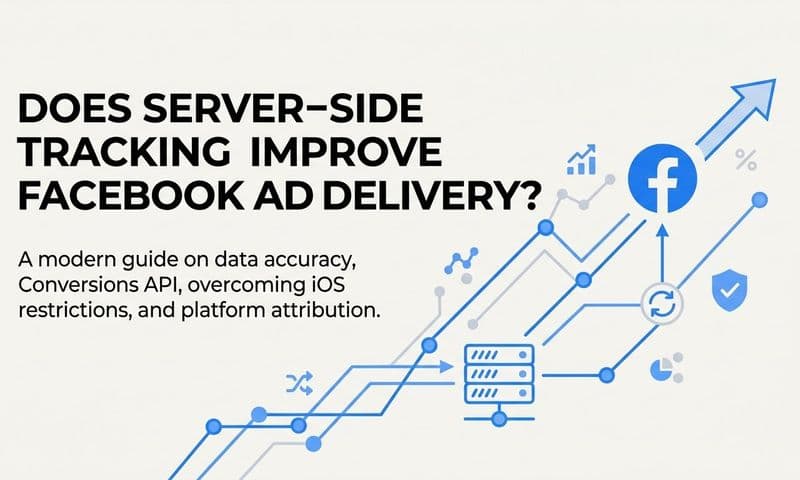
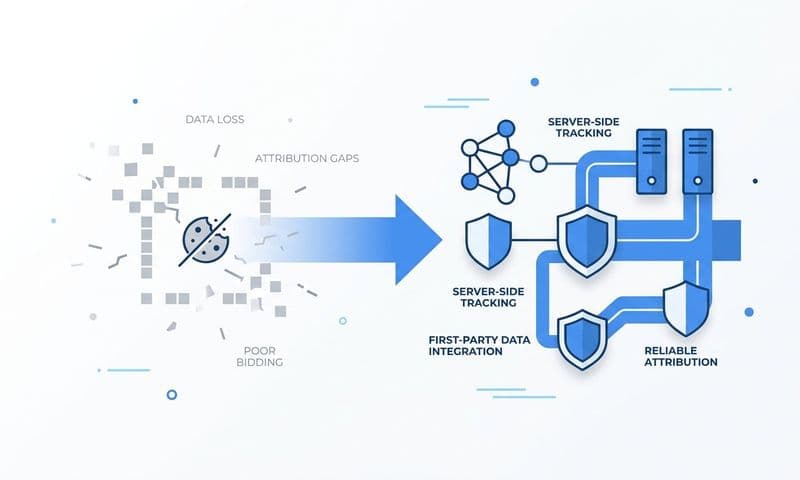
The fundamental fix for pixel based tracking problems is to move the conversion event out of the user's browser and onto a server you control. This is the core principle behind server-side tracking, and it addresses the root cause of most pixel failures rather than patching individual symptoms.
In a server-side model, when a user completes an action, your server captures the event and sends it directly to the ad platform. Because this process does not depend on the user's browser loading and executing a JavaScript snippet, it is not affected by ad blockers, ITP restrictions, or browser privacy settings. The conversion data travels from your server to the ad platform's server, bypassing the browser environment entirely. Understanding why server-side tracking is more accurate helps clarify why this architectural shift produces meaningfully better attribution data.
Conversion APIs make this server-to-server communication possible at scale. Meta's Conversion API (CAPI) and Google's Enhanced Conversions are real, documented tools designed specifically to address browser-side tracking limitations. They allow marketers to send first-party event data directly from their server to the ad platform, enriching the conversion signal with data that a browser pixel could never access. This enriched signal improves the ad platform's targeting and optimization algorithms, which in turn improves campaign performance.
The key advantage of this approach is first-party data enrichment. A browser pixel can only capture what happens in the browser at the moment of the event. A server-side system can attach CRM data, user identifiers, lead scores, and downstream revenue events to each conversion. This means the signal you send to Meta or Google is not just "a form was submitted" but "a form was submitted by a user who matches these CRM attributes, and this lead later became a qualified opportunity worth this pipeline value." That is a fundamentally richer and more actionable signal. Reviewing a server-side tracking implementation guide can help teams understand the practical steps required to make this transition.
It is worth being clear about what server-side tracking does not solve on its own. It addresses the data loss caused by browser restrictions and ad blockers. It does not automatically solve cross-device attribution or connect ad spend to closed-won revenue without additional CRM integration. Those require a more complete tracking architecture, which is where the real opportunity lies for B2B SaaS teams.
Building a Tracking Stack That Reflects Real Revenue
Solving pixel based tracking problems is not about replacing one tool with another. It is about building a layered tracking architecture where each component addresses a specific gap and the whole system connects ad spend to actual revenue outcomes.
Connect Ad Data to CRM Outcomes: The most important shift is extending your tracking beyond the form fill. This means integrating your ad platform data with your CRM so that pipeline stages, opportunity values, and closed-won revenue flow back into your attribution reporting. When a lead that originated from a paid campaign moves through the pipeline and closes, that revenue should be attributable to the specific campaign, ad set, and creative that started the journey. This connection transforms attribution from a traffic-measurement exercise into a genuine revenue intelligence function. Building a proper attribution tracking setup is what makes this level of visibility possible.
Implement Event Deduplication: When you run both a browser pixel and a server-side event for the same conversion, there is a real risk of double-counting. If both the pixel and the server-side event fire for the same form submission, the ad platform may log two conversions for one real action. Deduplication logic prevents this by assigning a unique event ID to each conversion and instructing the ad platform to ignore duplicate events with the same ID. This is a standard practice in server-side tracking implementations, and it is essential for maintaining data accuracy when running a hybrid approach during transition.
Use Multi-Touch Attribution: Last-click attribution, which is what most pixel-based systems default to, assigns all credit to the final touchpoint before conversion. In a B2B SaaS buying cycle with ten or more interactions, this systematically undervalues every channel that contributed to the decision except the last one. Multi-touch attribution models, whether linear, time-decay, or data-driven, distribute credit across the touchpoints that actually influenced the outcome. This gives you a more accurate picture of which channels and campaigns are genuinely moving buyers through the funnel, not just which ones happened to be present at the moment of conversion. Exploring the best marketing attribution platforms for revenue tracking can help teams identify the right solution for their specific needs.
Enrich Conversion Signals for Ad Platform AI: Modern ad platforms use machine learning to optimize targeting and bidding. The quality of that optimization depends entirely on the quality of the conversion signals you feed them. When you send enriched, first-party conversion data that includes downstream CRM events and revenue values, the ad platform's algorithm learns to find more buyers who look like your best customers, not just buyers who look like people who filled out a form. This creates a compounding improvement in campaign performance over time.
Putting It All Together: From Broken Pixels to Accurate Attribution
Pixel based tracking problems are not going away. Browser privacy restrictions will continue to tighten. Cookie-based tracking will continue to erode. The gap between what pixels report and what your CRM shows will continue to grow if you rely on a browser-side tracking model that was not built for today's privacy landscape or B2B buying behavior.
The shift from browser-dependent, pixel-only tracking to a server-side, first-party data model is not simply a technical upgrade. It is a strategic necessity for any B2B SaaS team that wants to make accurate decisions about where to invest marketing budget. Without it, you are optimizing campaigns based on a fraction of your actual conversion data and crediting channels based on which ones happened to be visible to a browser script rather than which ones actually drove revenue.
This is exactly the problem Cometly is built to solve. Cometly connects your ad platforms, CRM, and website into a single source of truth, capturing every touchpoint from the first ad click to closed-won revenue. Its server-side tracking and Conversion API integration bypass the browser restrictions that cause pixel data loss, while its CRM integration extends attribution beyond the form fill to reflect actual pipeline and revenue outcomes. The result is enriched conversion data sent back to Meta, Google, and other ad platforms, improving their optimization algorithms and your campaign performance simultaneously.
With Cometly's AI-driven recommendations, you can identify which campaigns and channels are genuinely driving revenue, scale what is working with confidence, and stop wasting budget on channels that look good in pixel-based reporting but do not contribute to closed-won deals.
If your ad data and CRM are telling different stories, the pixel is likely the reason. Get your free demo and see how Cometly gives you the accurate, real-time attribution data your team needs to scale with confidence.