Something shifted permanently in digital marketing, and most teams are still catching up. The signals you used to rely on, the pixels that fired reliably, the cross-site identifiers that stitched together a user journey, the third-party cookies that powered your retargeting and attribution, have been systematically dismantled by browser vendors, operating system makers, and regulators over the past several years.
The result? Ad platforms report conversion numbers that don't match your CRM. ROAS figures look healthy in Meta Ads Manager while pipeline tells a different story. Budget decisions get made on incomplete data, and the channels that actually drive revenue quietly go unrecognized while easily measurable bottom-funnel tactics absorb disproportionate spend.
This is not a temporary glitch or a platform bug you can troubleshoot away. The privacy changes impacting tracking represent a structural transformation in how the web works. For B2B SaaS marketing teams, where sales cycles are long, buyer journeys cross multiple sessions and devices, and attribution has always been complex, the stakes are especially high.
This article breaks down exactly what changed, what it broke, and how forward-thinking marketing teams are rebuilding their measurement infrastructure to make smarter, more defensible decisions. The good news: this problem is solvable. But it requires a fundamentally different approach to tracking, data, and attribution.
The Privacy Shift That Rewrote the Rules of Digital Tracking
The changes didn't happen overnight, and they didn't come from a single source. What marketers are dealing with today is the result of several converging forces, each significant on its own, but compounding into something much larger when they interact.
Apple started the most visible disruption with Intelligent Tracking Prevention (ITP) in Safari, which began progressively restricting third-party cookie lifespans starting in 2017. Each subsequent update tightened the restrictions further, eventually capping cookie lifespans and limiting the cross-site tracking that advertisers had relied on for years. Then came App Tracking Transparency (ATT) with iOS 14.5, which required apps to explicitly request user permission before tracking activity across apps and websites. The opt-out rates were significant enough to reshape how mobile advertising measurement worked almost overnight.
Google's trajectory has been slower but equally directional. The Privacy Sandbox initiative signaled the deprecation of third-party cookies in Chrome, the world's most widely used browser. While the timeline has shifted multiple times, the underlying commitment to reducing third-party cookie reliance remains firm. Firefox and Brave have implemented aggressive third-party cookie blocking by default. The regulatory layer reinforces the technical one: GDPR in Europe and CCPA in the US have created legal frameworks that require user consent for many forms of tracking, further constraining what marketers can capture even when browsers technically allow it.
To understand why this matters, it helps to be precise about what third-party cookies and device identifiers actually did. They enabled a specific set of capabilities that modern digital marketing was built around: cross-site tracking that followed users from your blog to a competitor's site to a review platform and back; audience targeting that allowed ad platforms to build behavioral profiles across millions of sites; frequency capping that prevented the same user from seeing the same ad dozens of times; and conversion attribution that connected an ad impression or click to a downstream purchase or sign-up, even when significant time had passed between the two events.
Remove those capabilities and you don't just lose some data. You lose the connective tissue of the customer journey. A user who clicks a LinkedIn ad, reads your blog three days later, signs up for a webinar a week after that, and then converts on a demo request two weeks later represents a journey with four touchpoints across multiple sessions. In a traditional pixel-based tracking environment, you might capture all four. In today's environment, you might capture one or two, and the ones you miss are often the ones that initiated the journey.
This is what creates compounding blind spots. Each individual restriction eliminates some data. But because real customer journeys cross multiple sessions, devices, and platforms, the gaps multiply rather than add. A single user journey that would have been fully visible three years ago can now be largely invisible to traditional tracking methods.
What Breaks When Tracking Breaks: The Attribution Gap Explained
The most immediate symptom marketers notice is the discrepancy between what ad platforms report and what actually happened in the business. Meta Ads Manager shows conversions that don't appear in your CRM. Google Ads reports a cost-per-acquisition that seems too good relative to the pipeline your sales team is actually working. These aren't rounding errors. They reflect a genuine measurement failure with real consequences for how you allocate budget.
Several specific failures contribute to this attribution gap. Underreported conversions occur when client-side pixels fail to fire because a browser blocked the script, a user denied consent, or an ad blocker intercepted the request. The conversion happened, but the platform never received the signal. Inflated cost-per-acquisition figures emerge when some conversions are captured and others aren't, distorting the denominator in your efficiency calculations. Misattributed revenue happens when the only touchpoint that gets tracked is the final one, so credit flows to the last click rather than to the channels that built awareness and intent across the full journey.
Last-click bias becomes particularly pronounced in a privacy-constrained environment. The touchpoints most likely to survive tracking restrictions are the most recent and most direct ones: a branded search click, a direct visit, a bottom-funnel retargeting ad. The touchpoints most likely to go dark are the earlier, upper-funnel ones: the display ad that first introduced your brand, the content piece that educated a prospect, the paid social campaign that generated initial interest. When mid-funnel touchpoints disappear from your data, last-click attribution doesn't just oversimplify the journey. It actively misleads you about where value is being created.
B2B SaaS companies face a more severe version of this problem than most. Consider the typical buying journey: a prospect sees a LinkedIn ad, reads a comparison article, attends a webinar, downloads a case study, watches a demo video, and finally books a call, all over a period of six to twelve weeks, often across multiple devices, sometimes involving two or three people from the same company. Each transition between sessions is an opportunity for tracking to fail. Each device switch creates a new anonymous user in your pixel data. Each week that passes increases the likelihood that cookie restrictions have expired the identifiers that would have linked those sessions together.
The business consequence is direct and serious. When marketers cannot see which channels are actually driving pipeline and revenue, budget allocation defaults to what's measurable rather than what's effective. Bottom-funnel channels that produce easily trackable conversions attract disproportionate investment. Upper-funnel programs that build brand awareness and generate early-stage demand get cut because their contribution can't be demonstrated in platform dashboards. Over time, this creates a measurement-driven feedback loop where the channels that are hardest to track get defunded, even if they're generating significant pipeline that eventually closes.
For B2B SaaS teams that are trying to scale efficiently, this isn't just a measurement problem. It's a growth strategy problem. The decisions you make about where to invest marketing budget are only as good as the data informing them. When that data has systematic gaps, the decisions have systematic flaws. Understanding how to fix conversion tracking gaps is one of the most important investments a marketing team can make.
Server-Side Tracking and Conversion APIs: The Technical Fix
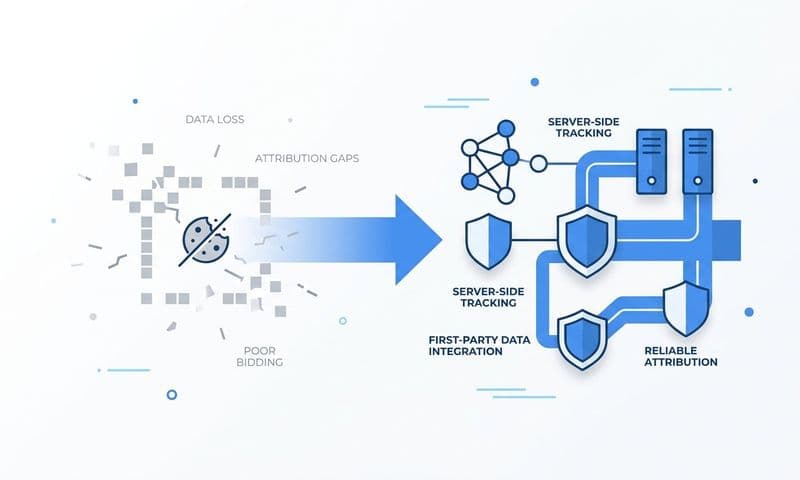
The core insight behind server-side tracking is straightforward: if the browser is the problem, stop relying on the browser. Client-side pixels work by embedding a script in your webpage that fires when a user takes an action. That script runs in the browser environment, which means it's subject to every restriction the browser imposes: ITP, ad blockers, consent management platform denials, and script-loading failures. Any one of these can prevent the conversion event from being captured.
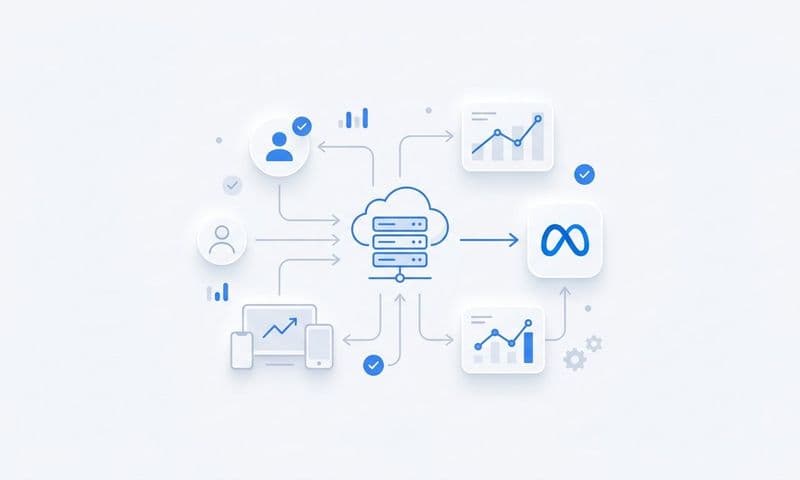
Server-side tracking moves that event transmission out of the browser entirely. Instead of a pixel firing in the user's browser and sending data to the ad platform, your server receives the conversion signal and transmits it directly to the ad platform's API. The user's browser is no longer in the chain. Browser restrictions, ad blockers, and cookie limitations become irrelevant because the data never passes through the browser environment at all. The benefits of server-side tracking extend well beyond simply bypassing browser restrictions.
The two primary implementations marketers need to understand are Meta's Conversions API (CAPI) and Google's Enhanced Conversions. Meta's CAPI allows businesses to send web events, app events, and offline events directly from their server to Meta, bypassing the browser-based pixel entirely or running alongside it. Google's Enhanced Conversions works similarly, allowing businesses to send hashed first-party customer data alongside conversion tags to improve the match rate between conversion events and actual Google users.
Both implementations rely on hashed first-party data to improve what's called the match rate: the percentage of conversion events that the ad platform can successfully match to a real user profile in its system. When a user fills out a form on your site, they provide an email address. That email address can be hashed (converted into an anonymized string) and sent alongside the conversion event. Meta or Google then attempts to match that hashed email against their user database. A successful match means the platform can attribute that conversion to a specific user's ad exposure history, even if the browser-level tracking that would have made the connection automatically is no longer functioning.
Higher match rates translate directly into better attribution and better ad optimization. When ad platforms receive enriched, matched conversion data, their bidding algorithms have more accurate signals to work with. This isn't just about measurement accuracy. It affects actual campaign performance because the algorithms that drive automated bidding depend on conversion signals to optimize toward the right users.
There is one critical technical detail that separates accurate server-side setups from problematic ones: event deduplication. When you run both a browser pixel and a server-side event simultaneously for the same conversion, there's a risk that the ad platform receives two signals for a single conversion and counts it twice. Deduplication logic, typically implemented using a unique event ID that matches the browser event to the server event, tells the platform to treat these as the same conversion and count it only once.
Getting deduplication right is not optional. Without it, your conversion counts inflate, your cost-per-acquisition appears artificially low, and your bidding algorithms optimize toward a distorted signal. Proper server-side implementation requires careful attention to this detail from the start. Teams looking for the right tools should evaluate the top server-side tracking tools available to find the best fit for their stack.
First-Party Data Strategy: Building a Tracking Foundation That Lasts
Server-side tracking solves the transmission problem. First-party data strategy solves the underlying data ownership problem. These two approaches work together, and neither is sufficient without the other.
First-party data is data that your business collects directly from its own customers and prospects: form submissions, CRM records, email interactions, product usage events, and subscription data. Unlike third-party data, first-party data lives in systems your business controls. Browser restrictions don't apply to it because it was never dependent on cross-site tracking or third-party identifiers. A user who fills out a demo request form and gives you their email has created a direct data relationship with your business that no browser update can erase.
The strategic shift this requires is significant. For years, many B2B SaaS marketing teams operated with a relatively passive approach to data collection: run ads, let pixels capture what they could, and rely on ad platforms to stitch together the attribution story. That approach is no longer viable. The teams that will have accurate measurement going forward are the ones that treat data collection as an active, intentional discipline. Every form, every gated content piece, every product sign-up, and every sales interaction is an opportunity to capture a first-party signal that can anchor attribution and improve ad platform match rates. Following best practices for tracking conversions accurately is essential to making this work at scale.
Data enrichment extends the value of raw first-party records. When a prospect fills out a form and provides only their name and email, that's a useful but limited signal. Enrichment appends additional attributes: job title, company size, industry, technology stack, behavioral intent signals from third-party data providers. The result is a richer user profile that ad platforms can match back to real users more accurately, and that your own segmentation and personalization efforts can use more effectively.
The most powerful configuration is a unified customer data layer that connects your CRM, ad platform data, and website behavior through a single system of record. This is what makes it possible to trace a complete customer journey from the first ad click to a closed-won deal, even as browser-level tracking degrades. When your CRM knows that a specific contact became a customer, and your attribution system can connect that contact back to the ad campaigns and touchpoints that influenced their journey, you have a measurement foundation that doesn't depend on cookies or third-party identifiers.
For B2B SaaS teams, connecting CRM data to ad platform data is particularly valuable because it enables revenue-based customer attribution. Instead of optimizing toward form fills or trial sign-ups, you can optimize toward the leads that actually converted to paying customers. This distinction matters enormously when the gap between a marketing-qualified lead and closed revenue can span months and involve significant qualification effort.
Adapting Attribution Models for a Privacy-First World
Even with server-side tracking and strong first-party data practices in place, some touchpoints will remain invisible. The goal of modern attribution isn't perfect data capture, because that's no longer achievable. The goal is a model that makes the best possible use of the data you do have and distributes credit in a way that reflects how your customers actually make decisions.
Last-click attribution was always a simplification. In a privacy-constrained environment, it becomes actively misleading. The reason is structural: the touchpoints most likely to survive tracking restrictions are the most recent and most direct ones. Branded search clicks, direct visits, and bottom-funnel retargeting ads tend to be captured because they happen in controlled environments close to the conversion event. The touchpoints most likely to go dark are the earlier ones that built awareness and intent. When you run last-click attribution on this incomplete data set, you're not just ignoring upper-funnel contribution. You're systematically attributing credit to channels that benefited from work done by channels you can no longer see.
Multi-touch attribution addresses this by distributing credit across all tracked touchpoints in the customer journey. Rather than giving 100% of the credit to the final click, it allocates credit across every interaction that contributed to the conversion. This gives marketers a more complete picture of which channels are generating pipeline, even when some touchpoints are missing from the data. It also creates stronger justification for upper-funnel investment, because the contribution of awareness-stage content and paid social campaigns becomes visible in the attribution data rather than being absorbed into last-click credit for branded search. Choosing the right marketing attribution platform for revenue tracking is critical to making multi-touch models work in practice.
Data-driven attribution models take this further by using statistical analysis of actual conversion patterns to assign credit weights, rather than applying fixed rules. Instead of assuming that every touchpoint contributes equally, or that the first and last touchpoints deserve more credit than middle ones, data-driven models examine which combinations of touchpoints are associated with higher conversion rates and weight credit accordingly. These models become more valuable as tracking environments become noisier, because they're designed to find signal in imperfect data rather than assuming the data is complete.
The practical implication for B2B SaaS marketing teams is that attribution model selection is now a strategic decision, not just a technical one. The model you choose shapes the budget decisions you make. A team running last-click attribution will consistently undervalue the channels that initiate and nurture buyer journeys. A team running multi-touch attribution with strong first-party data and server-side tracking will have a more accurate picture of where pipeline actually comes from, and will make better investment decisions as a result. Teams ready to act on this should review how to build a proper attribution tracking setup from the ground up.
Turning Privacy Constraints Into a Competitive Advantage
Here's the reframe that changes how you should think about all of this: the teams that struggle most with privacy changes impacting tracking are the ones who were relying on the path of least resistance. Pixel fires, platform-reported conversions, and last-click dashboards were always an approximation of reality. Privacy restrictions have made that approximation less reliable, but they've also created an opportunity for the teams willing to invest in better infrastructure.
The marketers who build robust server-side tracking, invest in first-party data collection, and implement multi-touch attribution now have a durable measurement advantage over competitors who are still trying to patch their pixel setups. That advantage compounds over time. Every month of clean first-party data, every enriched conversion event sent to Meta and Google, every CRM-connected revenue attribution adds to a measurement foundation that gets more accurate and more useful as it grows. Exploring privacy-compliant tracking alternatives is a smart starting point for teams building this foundation.
There's also a direct performance benefit to better data, not just a measurement benefit. When Meta and Google receive enriched, server-side conversion events with strong match rates, their bidding algorithms have better signals to optimize against. This means the AI that drives automated bidding can identify and target higher-quality users more effectively. Teams that feed better data to ad platform AI don't just measure better. They often perform better, because the optimization loop is running on more accurate inputs.
The modern measurement stack for B2B SaaS marketing teams looks like this: server-side tracking and Conversion API integrations that capture conversions regardless of browser restrictions; a first-party data strategy that creates direct data relationships with prospects and customers; CRM integration that connects marketing touchpoints to actual revenue outcomes; and multi-touch attribution that distributes credit across the full customer journey. Together, these capabilities create what platform-reported metrics have never provided: a single source of truth for which ads and channels are actually driving pipeline and revenue.
This is not a theoretical aspiration. It's a practical infrastructure that forward-thinking B2B SaaS marketing teams are building right now. The ones who build it earliest will have the clearest picture of their marketing performance and the most defensible basis for budget decisions as privacy restrictions continue to tighten.
The Bottom Line: Better Data, Smarter Decisions
Privacy changes have not made tracking impossible. They've made lazy tracking obsolete. The era of passive pixel-based measurement, where you dropped a script on your site and let the ad platforms figure out attribution, is over. But the marketers who respond by investing in server-side infrastructure, first-party data ownership, and multi-touch attribution will end up with more accurate, more defensible measurement than they had in the cookie era.
The path forward is clear: move conversion event transmission server-side to bypass browser restrictions, build direct data relationships with your prospects and customers, connect your CRM to your ad data so revenue attribution flows back to the campaigns that earned it, and use attribution models that reflect the complexity of real B2B buying journeys rather than flattening them into a single last click.
Cometly is built specifically for this challenge. It connects your ad platforms, CRM, and website data in real time, uses server-side tracking and Conversion API integrations to recover lost attribution, and gives B2B SaaS marketing teams a single source of truth for which ads and channels are actually driving revenue. From first ad click to closed-won deal, every touchpoint gets captured, every conversion event gets matched, and every budget decision gets made on accurate data.
If your current attribution setup is leaving gaps in your data and uncertainty in your budget decisions, it's time to build the measurement infrastructure that the privacy-first era actually requires. Get your free demo today and start capturing every touchpoint to maximize your conversions.