
You've done everything right. The campaigns are live, the budget is allocated across Google and Meta, and leads are showing up in your CRM. But when you open your analytics dashboard, the numbers don't add up. A significant chunk of conversions appear under direct traffic. Your paid channels look like they're underperforming. And your attribution reports seem to tell a completely different story than your actual pipeline.
If this sounds familiar, Safari's Intelligent Tracking Prevention is likely the hidden variable breaking your data.
ITP is not a bug or a temporary glitch. It is a deliberate, browser-level privacy feature built into Safari by Apple's WebKit team. And because it operates silently at the browser level, most marketers don't realize it's actively eroding their attribution data until the damage to budget decisions is already done.
For B2B SaaS companies, the consequences are especially serious. Your sales cycles can span weeks or months. Your buyers often research solutions across multiple sessions before converting. When ITP expires the cookies that connect those sessions, the early touchpoints that actually influenced the decision simply vanish from your reports. What remains is a distorted picture of which channels are working and which aren't.
This article breaks down exactly how ITP works, why it creates such significant problems for multi-touch attribution, why traditional pixel-based tracking cannot solve it, and what a modern, durable tracking architecture actually looks like. By the end, you'll have a clear framework for diagnosing whether ITP is affecting your data and a practical path toward fixing it.
Understanding this issue is not just a technical exercise. It directly affects where you invest your marketing budget and how confidently you can defend those decisions.
How Apple's ITP Works Against Your Tracking Stack
Intelligent Tracking Prevention was introduced by Apple in Safari 11 back in 2017, and it has been updated and tightened in nearly every major Safari release since. The core purpose is privacy protection: limiting the ability of advertisers and analytics tools to track users across websites without their explicit consent.
In practice, ITP does this by restricting how cookies can be stored and used across browsing sessions. The mechanism has two primary layers that matter for marketers.
The first layer targets third-party cookies. Safari blocks third-party cookies by default, which means any tracking script that relies on a cookie set by an external domain, such as an ad network or analytics provider, cannot persist across sites. This is the restriction that gets the most attention, but it is only part of the story.
The second layer is more subtle and more damaging for B2B attribution: ITP also restricts first-party cookies set via JavaScript. Starting with ITP 2.1, cookies written using document.cookie in the browser are capped at a seven-day expiration. In cases where ITP detects cross-site tracking behavior, that window can drop to just 24 hours.
Think about what that means for a B2B sales cycle. A prospect clicks your Google ad on a Monday, lands on your website, and a first-party cookie is written to track that session and attribute the visit to your campaign. They browse your pricing page, maybe download a resource, and leave without converting. They come back two weeks later, ready to start a trial. In a normal attribution setup, that conversion would be credited back to the original Google ad click. But if that prospect was using Safari, the cookie from week one is long gone. The conversion registers as direct traffic, and your paid search campaign gets no credit.
This is not an edge case. Safari holds a substantial share of browser usage globally, particularly among mobile users on iPhone and iPad and professionals using Mac computers. For B2B SaaS companies targeting knowledge workers, marketing leaders, and technical buyers, a large portion of your audience is likely browsing in Safari. That makes ITP a material business problem, not a niche concern for privacy researchers.
ITP has also introduced link decoration protection, which attempts to classify URLs containing tracking parameters as potential tracking vectors. This affects how values like fbclid, gclid, and UTM strings persist after a user navigates away from a landing page, creating additional gaps in session-level attribution.
The trajectory here is also important. Apple has consistently made ITP more restrictive over time, not less. Any tracking strategy that does not account for these restrictions is being built on an eroding foundation.
The Attribution Data Problems ITP Creates for B2B Marketers
The most immediate symptom of ITP in your analytics is what looks like a surge in direct traffic. When cookies expire before a user converts, analytics tools lose the thread connecting that session back to the original source. The visit gets labeled as direct because there is no referral data or campaign parameter to attribute it to. Your direct channel inflates, and your paid channels shrink.
This misattribution cascades through every layer of your reporting.
For multi-touch attribution models, the problem compounds quickly. First-touch attribution depends on correctly capturing the very first interaction a prospect had with your brand. If that initial ad click happened in Safari and the cookie expired before conversion, first-touch attribution assigns credit to whatever channel the prospect used when they finally converted, typically branded search or direct. The original paid campaign that generated awareness gets nothing.
Linear and time-decay models fare no better. These models distribute credit across multiple touchpoints throughout the journey. But if ITP has erased the early touchpoints, the model is distributing credit across an incomplete journey. The output looks mathematically correct but is based on fundamentally incomplete data.
The downstream consequence is misguided budget allocation. Channels that are genuinely driving awareness and early-stage engagement appear to underperform because their contribution is invisible in your attribution data. Meanwhile, channels that tend to capture last-click credit, such as branded search or retargeting, appear to over-deliver. You end up defunding the channels that are actually building your pipeline and over-investing in channels that are simply present at the end of a journey someone else started.
For B2B SaaS companies managing significant ad budgets, this is not a minor reporting inconvenience. It is a structural distortion that shapes how marketing leaders justify spend, how teams prioritize channel investment, and how growth strategies get built quarter over quarter.
There is also a subtler problem worth naming: ITP erodes your confidence in the data itself. When you cannot trust that your attribution reports reflect reality, every decision becomes more uncertain. You start second-guessing channel performance, questioning whether your experiments are producing real signals, and losing the ability to make the clear, data-backed arguments that drive organizational buy-in for marketing investment.
The compounding effect across a long B2B sales cycle makes this worse than it would be in a short-cycle business. A seven-day cookie window might be adequate for an e-commerce purchase that happens within a single session. It is completely inadequate for a SaaS evaluation that involves multiple stakeholders, several return visits, and a decision timeline measured in weeks.
Why Client-Side Pixels Cannot Solve This Problem
The instinct for many marketers when they discover attribution gaps is to add more tracking. Install the Meta Pixel. Add the Google Tag. Layer in additional scripts. This approach feels logical, but it runs directly into the structural limitation that makes ITP so difficult to work around: all of these tools are client-side technologies.
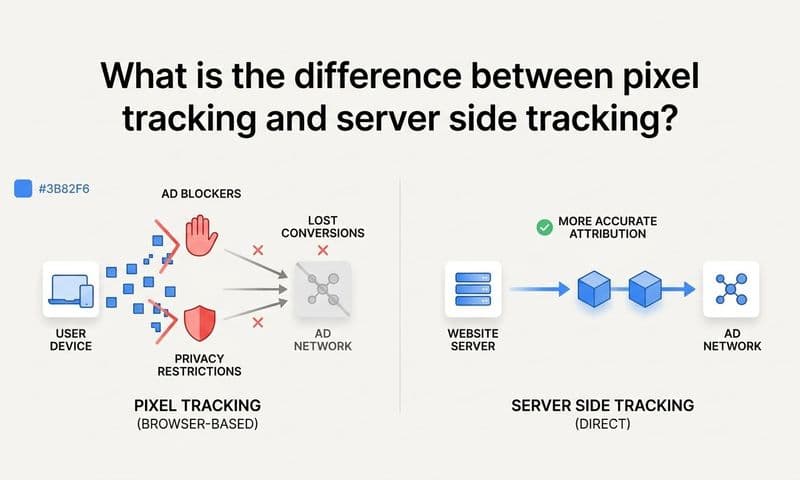
Client-side tracking means the tracking code runs in the user's browser. When a visitor lands on your page, JavaScript executes, reads and writes cookies, and sends event data to the ad platform. The entire mechanism depends on the browser cooperating. When Safari's ITP restricts how those cookies are stored or shortens their lifespan, the pixel cannot override that. It is operating within the rules the browser sets.
The Meta Pixel, for example, relies on a cookie called _fbp to identify users and match events back to ad campaigns. ITP caps that cookie's lifespan when it is set via JavaScript, which means the Pixel loses the ability to connect a conversion back to the original ad click once the cookie expires. The Pixel is still firing. It is still sending data. But the data it sends is disconnected from the original attribution chain. Understanding how tracking pixels work makes it clear why browser-level restrictions create such fundamental limitations.
Google Tag and the gclid parameter face similar challenges. When a user clicks a Google ad, a gclid value is appended to the URL to track that click. ITP's link decoration protection can classify this as a tracking vector and limit how that value persists. If the gclid doesn't survive the session or the cookie storing it expires before conversion, Google Ads loses the ability to attribute the conversion to the correct campaign.
UTM parameters face a related issue. They are present in the URL at the moment of the first visit, but they rely on being stored in a cookie or session storage to persist across subsequent visits. When ITP expires that storage, a returning visitor who converts appears to arrive without any campaign context, even if their original visit was tagged correctly.
The core problem is architectural. Client-side tracking has a structural ceiling: it will always be vulnerable to browser-level restrictions. And those restrictions are tightening across the industry. Firefox's Enhanced Tracking Protection operates on similar principles. The broader privacy trend is moving in one direction, and building your attribution stack entirely on client-side technology means building on a foundation that is being systematically reduced.
Adding more pixels or adjusting tag configurations can help at the margins, but it cannot solve a problem that exists at the browser level. The solution requires moving the tracking infrastructure outside the browser entirely.
Server-Side Tracking and Conversion APIs as the Modern Fix
Server-side tracking works by removing the browser from the data chain. Instead of relying on JavaScript running in Safari to send event data to an ad platform, server-side tracking sends that data directly from your server to the platform's API. The browser never touches the conversion data. ITP has nothing to restrict.
This is the foundational shift that makes server-side tracking durable against ITP and future browser privacy changes. The event happens, your server captures it, and the data travels from your infrastructure to the ad platform through a server-to-server connection. Safari's cookie policies are irrelevant to that transaction.
Meta's Conversion API, commonly called CAPI, is the primary implementation of this approach for Meta advertising. Instead of relying solely on the browser-based Meta Pixel, CAPI allows you to send conversion events, including lead form submissions, trial signups, and CRM stage changes, directly from your server to Meta's API. Meta can then match those events to users in its system using first-party identifiers like email addresses or phone numbers, rather than depending on a cookie that ITP may have expired.
Google's Enhanced Conversions operates on the same principle for Google Ads. When a conversion event occurs, Enhanced Conversions sends hashed first-party data, such as a user's email address collected at the point of conversion, directly to Google's servers. This allows Google to match the conversion back to the ad click without needing the gclid cookie to survive the entire attribution window.
First-party data is the key concept that makes all of this work. When a user fills out a form on your website, submits a trial signup, or completes any action that requires them to identify themselves, you collect data that belongs to you. That data is not subject to ITP because it is not a third-party cookie or a JavaScript-set tracking value. It is information your user gave you directly. Using that data to power server-side attribution is inherently more resilient than any cookie-based approach.
It is worth noting that when you run both client-side pixels and server-side tracking simultaneously, which is often the right approach during a transition, event deduplication becomes important. Without it, the same conversion event can be counted twice in your ad platform reporting: once from the pixel and once from the server-side event. Properly implemented deduplication logic ensures each conversion is counted once, keeping your reporting accurate. Exploring the full range of server-side tracking benefits helps teams understand why this architecture is worth the implementation investment.
Server-side tracking does not eliminate the need for thoughtful implementation. It requires proper event mapping, first-party data collection at key touchpoints, and integration between your tracking infrastructure and your ad platforms. But it solves the fundamental problem that client-side tracking cannot: it operates outside the reach of browser-level restrictions.
Building an ITP-Resilient Attribution Setup
A resilient attribution architecture has several interconnected components, and understanding how they fit together is as important as understanding any individual piece.
Server-Side Event Collection: This is the foundation. Every meaningful conversion event, from form submissions and trial signups to demo requests and CRM stage progressions, should be captured at the server level. This ensures the event data exists independently of what any browser does with cookies or tracking parameters.
First-Party Cookie Implementation: Where cookies are still used, they should be set server-side via HTTP response headers rather than via JavaScript. Cookies set this way are not subject to ITP's seven-day cap because they are treated as server-set first-party cookies. Implementing this via a subdomain or CNAME configuration associated with your own domain gives these cookies greater longevity and keeps them within your first-party context.
CRM-Level Data Syncing: For B2B SaaS companies, the conversion that matters most is rarely the initial form fill. It is the qualified lead, the opportunity created, the closed deal. Connecting your ad platform data to your CRM at the server level means attribution can persist through the entire funnel. Even if Safari erased the cookie between the first ad click and the eventual trial signup, if you have a first-party identifier, such as an email address, you can connect that signup back to the original campaign through server-side identity resolution.
This is where the architecture becomes genuinely powerful for B2B attribution. Identity resolution happening outside the browser is not subject to ITP at all. When a prospect clicks an ad, you capture identifiers at the server level. When they convert weeks later and provide their email, you match that email back to the original session data stored in your system. The attribution chain is preserved regardless of what Safari did to the cookies in between.
Cometly is built specifically for this architecture. It captures every touchpoint from the initial ad click through to CRM events and revenue data, using server-side infrastructure to maintain attribution accuracy across the entire B2B sales cycle. Because it connects your ad platforms, CRM, and website data at the server level, Safari users are attributed correctly even when their journey spans multiple sessions over weeks. The platform also integrates with Stripe revenue data, so you can see which campaigns are driving not just leads but actual closed-won revenue, which is the number that ultimately justifies ad spend.
For teams running campaigns across Meta, Google, LinkedIn, and other channels, having a single source of truth that is not degraded by ITP changes the quality of every decision you make. You stop guessing which channels are working and start seeing the complete picture.
The goal of this architecture is not to circumvent privacy protections. It is to build tracking that is based on first-party data and server-side infrastructure, which is both more privacy-respecting and more technically durable than cookie-dependent approaches.
Measuring the Impact of ITP on Your Current Data
Before rebuilding your tracking stack, it helps to understand how much damage ITP is actually doing to your current data. A structured diagnostic approach can surface the gaps and give you a baseline to measure improvement against.
Compare Direct Traffic by Browser: Pull a browser breakdown report in your analytics platform and compare the proportion of direct traffic across Safari versus Chrome or Firefox users. If Safari users show a significantly higher rate of direct traffic and unattributed sessions, that is a strong signal that ITP is expiring cookies before those users convert and stripping the attribution context from their sessions.
Look for Unattributed Conversion Spikes: Check your conversion reports for periods where unattributed or direct-attributed conversions spike without a corresponding increase in organic or direct channel activity. These spikes often correlate with campaign activity in paid channels, which suggests those conversions are actually paid-driven but are being misclassified because the attribution chain was broken by ITP.
Audit Session Window Lengths for Safari Users: If your analytics tool allows you to segment by browser, compare the average time between first session and conversion for Safari users versus other browser users. If Safari users show unusually compressed attribution windows relative to your known sales cycle length, it suggests that multi-session journeys are being collapsed or that early sessions are being dropped entirely.
Check Conversion Event Match Quality: In Meta Events Manager, each conversion event receives a match quality score that reflects how effectively Meta can match the event back to a user in its system. Low match quality scores, particularly for events that should have strong data, are often a direct indicator of ITP-related data loss. The same diagnostic exists in Google Ads through Enhanced Conversions coverage reporting. These scores give you a concrete, quantifiable signal of how much data you are currently losing. Reviewing best practices for tracking conversions accurately can help you establish the benchmarks needed to measure improvement after implementation.
Compare Channel Performance Across Browser Segments: If you can segment channel performance by browser, look for paid channels that appear to underperform specifically among Safari users compared to Chrome users. A paid social campaign that shows strong conversion rates among Chrome users but weak rates among Safari users is likely suffering from ITP attribution loss rather than actual performance differences.
This diagnostic work does two things. It helps you understand the scale of the problem you are dealing with, and it gives you a before-and-after benchmark when you implement server-side tracking and Conversion APIs. Seeing match quality scores improve and unattributed conversions decrease after implementation is how you confirm that your fix is working.
Moving Forward: Building Attribution That Lasts
Safari ITP is not going away. If anything, the trajectory of browser privacy features points toward more restriction over time, not less. Apple has updated ITP consistently since its introduction, and the broader industry trend toward privacy-first browsing means that any tracking strategy built on third-party cookies and client-side JavaScript is working against the current.
The path forward is clear. Move your tracking infrastructure to the server side. Implement Conversion APIs for your key ad platforms. Build your attribution around first-party data that you own and control. Connect your ad platform data to your CRM and revenue data so attribution persists through the full B2B sales cycle, regardless of what any browser does with cookies mid-journey.
This is not just a technical upgrade. It is a strategic investment in the quality of your marketing data. When your attribution is accurate, your budget decisions improve. When your budget decisions improve, your growth becomes more predictable and defensible.
Cometly is built for exactly this reality. It offers server-side tracking, Conversion API integration with Meta and Google, full-funnel attribution from first ad click to closed-won revenue, and a single source of truth that is not degraded by Safari ITP or any other browser privacy change. B2B SaaS teams using Cometly can trust their attribution data across the entire sales cycle, including for the Safari users who represent a significant portion of professional audiences.
If your current attribution setup is showing signs of ITP-related data loss, now is the time to address it. The diagnostic steps outlined above will show you where the gaps are. The architecture described here will show you how to close them.
Get your free demo today and start capturing every touchpoint to maximize your conversions.