Most B2B SaaS marketers can open their dashboard and see traffic numbers, lead counts, and conversion rates. What they cannot see is the actual path a buyer took to get there. That gap between what the data shows and what really happened is one of the most expensive blind spots in modern marketing.
The customer journey in B2B SaaS is not a clean, linear progression from ad click to signed contract. It is a winding process that unfolds across weeks or months, involves multiple stakeholders, and touches a dozen different channels before a deal ever closes. A buyer might discover your product through a LinkedIn ad, forget about it for two weeks, find you again through a Google search, read three blog posts, get a peer recommendation in a Slack community, and finally visit your pricing page directly before booking a demo.
Every one of those interactions shaped the decision. But most attribution setups only see one or two of them.
Understanding the customer journey is not just a conceptual exercise. It is the foundation of every smart marketing decision you make. Which channels deserve more budget? Which campaigns are actually influencing pipeline? Which touchpoints are closing deals versus just generating clicks? You cannot answer any of those questions accurately without a clear picture of how buyers actually move from awareness to revenue. This article breaks down what the customer journey really looks like in B2B SaaS, why tracking it is so difficult, and how the right infrastructure transforms journey data into confident, revenue-driven decisions.
The Gap Between the Journey You Assume and the One That Actually Happened
There is a version of the customer journey that lives in most marketing decks: a neat funnel with awareness at the top, consideration in the middle, and decision at the bottom. Buyers enter at the top, progress steadily downward, and emerge as customers at the other end. It is a satisfying model. It is also rarely how B2B buying actually works.
Real buyers loop back. They enter the funnel, go quiet for weeks, re-engage after a trigger event, involve a new stakeholder who starts the research process over, and then circle back to a vendor they evaluated months ago. The journey is nonlinear, often asynchronous, and shaped by forces that happen entirely outside your visibility, such as internal budget conversations, competing priorities, and peer conversations you will never see in your analytics.
This creates a dangerous gap between the journey a marketer assumes happened and the journey that actually happened. When that gap is wide, the consequences are real. Ad spend gets allocated to channels that appear to drive conversions but are actually just capturing demand created elsewhere. Channels that do the heavy lifting of awareness and nurturing get cut because they do not show up at the point of conversion. Credit gets misassigned, budgets get misallocated, and growth stalls.
The building blocks of any customer journey are touchpoints: every interaction a buyer has with your brand before converting. These span both paid and organic channels. A touchpoint might be a paid search ad, an organic blog post, a LinkedIn sponsored post, a nurture email, a retargeting ad, a sales call, a product review on G2, or a direct visit to your website. Each one contributes something to the buyer's perception and decision-making process.
The problem is that most teams track only the touchpoints that are easy to measure. Browser-based pixels capture some interactions. CRM records capture others. But the full picture, the complete sequence of touchpoints that actually led to a closed deal, is almost never assembled in one place. That missing picture is exactly what makes customer journey tracking both so difficult and so valuable.
The Core Stages of the B2B Customer Journey
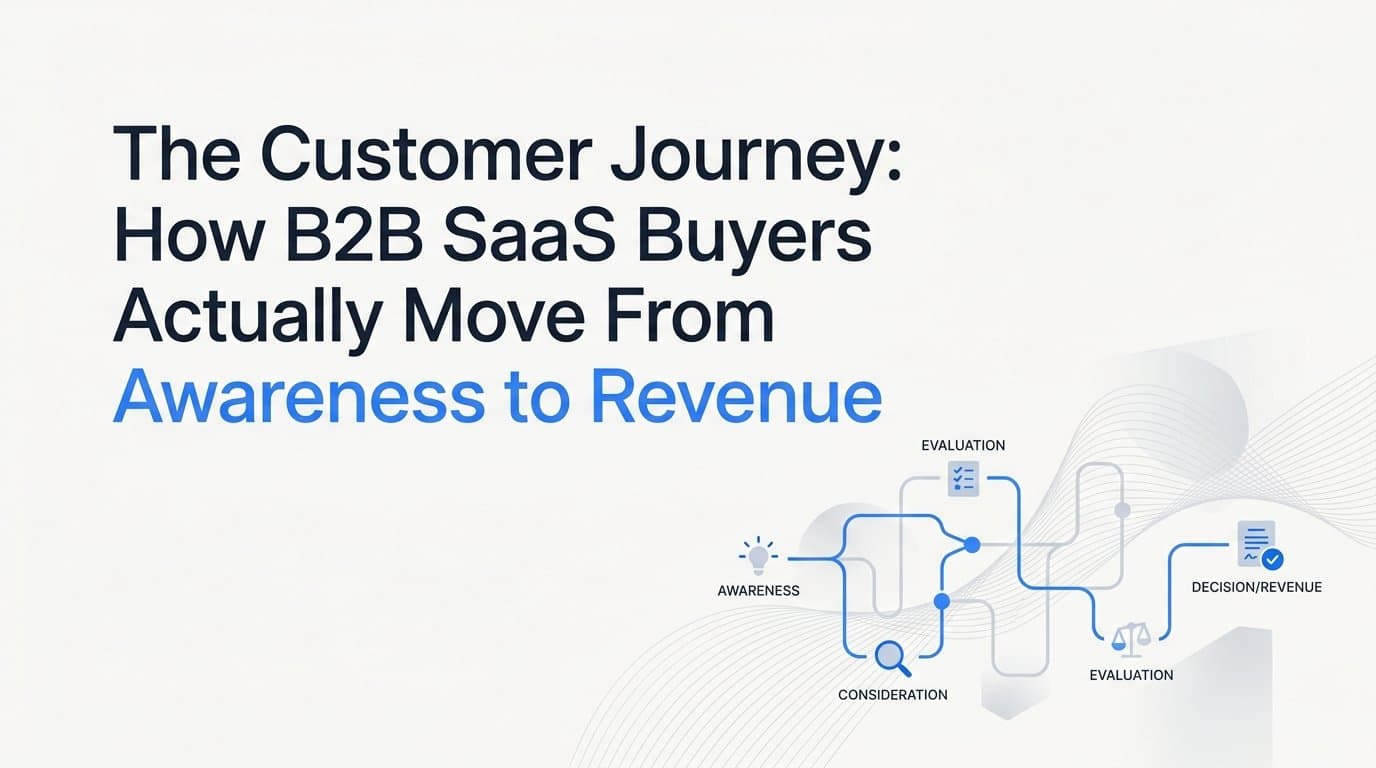
Even though the journey is nonlinear, it does move through recognizable stages. Understanding those stages helps marketers align their channels, content, and measurement strategies to where buyers actually are in their thinking.
Awareness: This is where the journey begins. A buyer recognizes they have a problem or a gap, and they start looking for information. They are not yet evaluating vendors. They are trying to understand the problem itself. At this stage, content like blog posts, thought leadership, social media, and paid awareness campaigns do the most work. The goal is to be present and credible when the buyer first starts asking questions.
Consideration: Now the buyer understands the problem and is actively evaluating solutions. They are comparing options, reading reviews, watching demos, and talking to peers. This is where comparison content, case studies, detailed product pages, and retargeting campaigns become relevant. Multiple stakeholders often enter the picture at this stage, each with their own criteria and concerns.
Decision: The buyer has narrowed their options and is moving toward commitment. Pricing conversations, sales calls, free trials, and procurement processes happen here. The final touchpoints before conversion often look like direct traffic, branded searches, or sales-assisted interactions, which is why last-touch attribution tends to credit these channels disproportionately.
Expansion and Retention: This stage is frequently left out of journey mapping, but it is critical for B2B SaaS businesses. After the initial close, satisfied customers become a source of upsell revenue, contract expansion, and referrals. A customer who champions your product inside their organization or recommends it to a peer in their network creates new journeys that your attribution model will likely never connect back to the original relationship. Ignoring this stage means undervaluing retention and customer success as marketing assets.
Each stage maps to different channels and content types, and treating all touchpoints as equally valuable is a strategic mistake. A LinkedIn awareness ad and a pricing page visit are both touchpoints, but they play completely different roles in the journey. Measuring them with the same weight distorts your understanding of what is actually working and where your investment should go.
How Multiple Touchpoints Shape a Single Buying Decision
To make this concrete, consider how a typical B2B SaaS buyer might actually move through a purchase decision. The journey rarely starts with intent. It often starts with a problem that has not yet been fully named.
A marketing director at a growing SaaS company sees a LinkedIn ad about marketing attribution. They scroll past it, but the concept sticks. A few days later, they search on Google for "how to track marketing ROI" and land on a blog post. They read half of it, get pulled into a meeting, and close the tab. A week later, a retargeting ad surfaces on a news site they visit regularly. This time they click through, browse the product page, and leave without converting. Two weeks pass. A peer mentions the tool in a Slack community. That peer recommendation carries more weight than anything the company has shown them directly. The director visits the pricing page directly, books a demo, and eventually signs.
In that journey, there were at least six distinct touchpoints across five different channels. The LinkedIn ad started the process. The blog post built credibility. The retargeting ad re-engaged. The peer recommendation accelerated trust. The direct visit closed the loop. Which one deserves credit for the conversion?
This is where the limitations of first-touch and last-touch attribution become clear. First-touch attribution would give all the credit to the LinkedIn ad, rewarding awareness but ignoring everything that followed. Last-touch attribution would credit the direct visit, rewarding the final action but ignoring everything that built the relationship. Neither model tells the full story. Neither model gives you an accurate basis for deciding where to invest next.
The situation becomes even more complex when you factor in dark social: the touchpoints that happen in channels you cannot track at all. Word-of-mouth recommendations in private Slack communities, mentions in podcasts, conversations at industry events, LinkedIn DMs between peers, these interactions influence buying decisions but leave no traceable footprint in your analytics. Acknowledging these blind spots is important because it means even the best attribution setup will have gaps. The goal is not perfect data. It is the most complete picture you can build.
Why Accurate Journey Tracking Remains a Technical Challenge
Even if you understand the customer journey conceptually, capturing it accurately in your data is genuinely hard. Several technical barriers make precise tracking difficult, and they have become more significant in recent years.
Browser-based tracking has eroded. Safari's Intelligent Tracking Prevention, Firefox's privacy settings, and the growing use of ad blockers all limit what browser-side pixels can capture. A buyer might interact with your brand across multiple sessions, but if their browser blocks or expires tracking cookies between visits, those sessions appear as separate, unconnected users in your data. Cross-device behavior compounds this further. A buyer who sees an ad on their phone, researches on their laptop, and converts on a work computer may look like three different users to your analytics platform.
Data fragmentation is another significant problem. Your ad platforms, your CRM, your website analytics, and your product data all exist in separate systems with separate tracking logic. Each ad platform reports conversions using its own attribution windows and models, which means the sum of conversions reported across Meta, Google, and LinkedIn will almost always exceed your actual conversion count. This platform-level discrepancy is a well-known issue in the industry, and it makes it nearly impossible to understand the true contribution of each channel without a unified tracking layer.
Server-side tracking and Conversion APIs have emerged as the modern solution to these problems. Instead of relying on a browser pixel to fire when a user takes an action, server-side tracking sends conversion events directly from your server to the ad platform. Meta's Conversion API, Google's Enhanced Conversions, and similar integrations capture events that browser pixels miss entirely. This approach is more reliable, more accurate, and less vulnerable to the privacy and technical limitations that have degraded pixel-based tracking.
The practical implication is that teams still relying primarily on browser-side pixels are working with incomplete data. They are making budget and optimization decisions based on a partial view of the customer journey, and the gaps in that view are not random. They tend to systematically undercount the touchpoints that happen earlier in the journey, which means awareness and mid-funnel channels get less credit than they deserve.
Attribution Models and What They Reveal About the Journey
Attribution models are the lens through which you interpret the customer journey. The model you choose does not change what actually happened. It changes what you see, and that difference has direct consequences for how you allocate budget and optimize campaigns.
First-touch attribution assigns all conversion credit to the first interaction a buyer had with your brand. It is useful for understanding which channels are best at generating initial awareness and pulling new buyers into the funnel. The limitation is that it ignores everything that happened after that first interaction, which can make nurture channels look like they contribute nothing.
Last-touch attribution assigns all credit to the final interaction before conversion. It is simple to implement and easy to understand, but it tends to over-credit direct traffic, branded search, and bottom-of-funnel sales touchpoints while ignoring the channels that built awareness and trust over weeks or months.
Linear attribution distributes credit evenly across all touchpoints in the journey. This is more representative than single-touch models, but it treats a brand awareness ad and a pricing page visit as equally important, which is rarely accurate.
Data-driven attribution uses actual conversion patterns from your data to assign credit based on how much each touchpoint statistically contributed to the outcome. When you have sufficient data volume, this model tends to produce the most accurate picture of what is actually driving revenue. It surfaces the channels and campaigns that genuinely influence decisions rather than just appearing at convenient moments in the journey.
The model a team uses will directly shape which channels get more budget and which get cut. A team running last-touch attribution will consistently over-invest in bottom-of-funnel channels and under-invest in awareness. A team using data-driven attribution will see a more complete picture and allocate spend in proportion to actual influence. This is not a minor difference. Over time, it compounds into significantly different growth trajectories depending on which model is guiding decisions.
Turning Customer Journey Insights Into Revenue Decisions
Understanding the customer journey is only valuable if it changes how you make decisions. The real payoff comes when journey data moves from a conceptual framework into an operational tool that shapes budget allocation, campaign optimization, and revenue forecasting.
The first shift is moving from click-based measurement to pipeline and revenue attribution. Most marketing teams measure success at the lead level: cost per lead, lead volume, conversion rate. But in B2B SaaS, a lead that never becomes pipeline is not a success. Journey data that connects marketing activity all the way to closed-won revenue reveals which channels and campaigns are actually generating business, not just generating activity. This distinction matters enormously when making decisions about where to invest next quarter.
The second shift is using journey data to improve ad targeting at the platform level. When you send enriched, accurate conversion signals back to Meta, Google, and LinkedIn through server-side integrations, you give their optimization algorithms better information to work with. Instead of optimizing toward surface-level events like form fills or page views, the platform can optimize toward the buyers who actually convert into revenue. This improves targeting quality over time and increases the return on every dollar of ad spend.
The third shift is identifying which parts of the journey have gaps. If your data shows that buyers consistently drop off between the consideration and decision stages, that is a signal to invest in content, retargeting, or sales enablement that bridges that gap. If certain awareness channels are generating high volumes of leads that never progress to pipeline, that is a signal to reassess quality, not just quantity. Journey data makes these patterns visible in a way that siloed, platform-level reporting cannot.
This is exactly the problem Cometly is built to solve. Cometly connects your ad platforms, CRM, and website behavior into a unified view of the customer journey, tracking every touchpoint from the first ad click to closed-won revenue. It supports multiple attribution models so you can analyze the journey through different lenses, uses server-side Conversion API integrations to capture the touchpoints that browser pixels miss, and connects revenue data from tools like Stripe directly to your ad performance. The AI layer surfaces which campaigns and channels are genuinely driving pipeline, so you can scale what works with confidence rather than guessing based on incomplete data. For B2B SaaS teams that need a single source of truth across their entire marketing stack, Cometly provides the infrastructure to turn customer journey insights into real revenue decisions.
Putting It All Together
The customer journey is the most important framework a B2B SaaS marketing team can understand, because every attribution decision, budget allocation, and campaign optimization flows from it. When you see the journey clearly, you make better decisions. When you are working from a partial or distorted picture, you are essentially optimizing in the dark.
The core insight is this: the journey is nonlinear, multi-touchpoint, and shaped by interactions that happen across channels you may not even be tracking. A buyer's path from first awareness to signed contract involves more touchpoints, more stakeholders, and more time than most attribution setups are designed to capture. Closing that gap requires the right tracking infrastructure, the right attribution model, and a unified view that connects your ad data to your CRM and revenue systems.
The teams that invest in understanding the full customer journey are the ones that allocate budget more accurately, optimize campaigns more effectively, and grow revenue more predictably. The teams that rely on last-touch attribution and fragmented platform data are making expensive decisions based on an incomplete map.
If you are ready to see the complete picture of how your buyers move from awareness to revenue, Get your free demo of Cometly today and start tracking every touchpoint that matters.