

Picture this: a prospect sees your LinkedIn ad on their phone during a lunch break. Intrigued, they pull up your website on their work laptop a few hours later to dig into your features and pricing. That evening, sitting on the couch with a tablet, they fill out your demo request form. One person, one buying journey, three devices.
To most analytics tools, that looks like three completely separate anonymous users. The LinkedIn ad gets no credit for starting the journey. The laptop research session floats in a vacuum. And the demo conversion gets attributed to whatever the last referral source was on the tablet, which might be a direct visit or an organic search with no clear connection to your paid campaigns.
This is the cross-device tracking problem, and for B2B SaaS marketing teams, it is not a minor inconvenience. It is a structural blind spot that distorts your attribution data, misallocates your ad budget, and makes your customer journey look far simpler than it actually is. When your revenue reporting is built on fragmented device sessions rather than unified buyer journeys, every optimization decision you make is working from an incomplete picture.
This article breaks down how tracking customers across multiple devices actually works, why the traditional approaches are breaking down, and what a modern cross-device strategy looks like in practice. Whether you are trying to understand where your pipeline is really coming from or figure out why your top-of-funnel campaigns seem to generate no measurable return, this is the foundation you need.
Why the Multi-Device Buyer Journey Breaks Traditional Analytics
Legacy analytics platforms were built around a simple assumption: one browser session equals one user. Every time someone visits your site, the analytics tool drops a cookie or assigns a session identifier tied to that specific browser on that specific device. It has no way of knowing whether the person browsing on Chrome on a MacBook is the same person who visited from Safari on an iPhone two days earlier.
The result is duplicate, disconnected user profiles for the same individual. In your analytics dashboard, that high-intent buyer who touched your brand five times across three devices looks like five separate low-intent visitors who each bounced after one or two pages. The signal that should look like a strong, progressing buyer journey gets scattered into noise.
The attribution failures this creates are significant. First-touch credit often goes to the wrong channel entirely, because the device where initial discovery happened may never be connected to the eventual conversion. Last-click attribution over-credits whichever touchpoint happened to be the final one on the converting device, even if that touchpoint was a simple branded search that the buyer only performed because of earlier top-of-funnel exposure. Conversion paths appear shorter and simpler than they actually are, because the device-switching steps in the middle go unrecorded.
For B2B SaaS companies specifically, this problem is compounded by the nature of the buying process itself. B2B purchases rarely involve a single decision-maker acting impulsively. They involve multiple stakeholders, extended evaluation periods that can span weeks or months, and deliberate research across multiple sessions. A buyer might discover your product through a paid social ad, return several times to read documentation and comparison content, attend a webinar, discuss internally with colleagues, and then finally book a demo. That journey almost certainly spans multiple devices.
When your analytics cannot stitch those sessions together, you end up systematically undervaluing the channels that initiate and nurture deals. Top-of-funnel paid social, content marketing, and awareness campaigns tend to touch buyers early, often on mobile, and rarely appear as the last click before conversion. Without cross-device visibility, those channels look like they produce nothing, and budget gets shifted toward lower-funnel touchpoints that are really just capturing demand that was built elsewhere.
The compounding effect over time is a marketing strategy increasingly optimized for the last step of the journey while the earlier steps that actually generate demand go unfunded. Understanding SaaS revenue attribution is the prerequisite for breaking that cycle.
The Two Core Methods: Deterministic vs. Probabilistic Tracking
There are two fundamentally different approaches to cross-device identity resolution, and understanding the distinction between them is essential for building a tracking strategy that fits your business.
Deterministic tracking works by using authenticated identity signals to stitch device sessions together with high confidence. When a user submits a form with their email address, logs into your product, or is matched to a record in your CRM, that event creates a known identity anchor. Any session that can be tied to that same identity, whether through a hashed email, a user ID, or a login event, gets connected to the same unified profile regardless of which device or browser was used.
This is the gold standard for cross-device tracking. Because it is grounded in actual identity data rather than inference, it is highly accurate. If someone fills out a demo request on their tablet using the same email address that was captured when they clicked a LinkedIn ad on their phone, those two sessions can be definitively linked. The connection is not a guess; it is a verified match.
The limitation of deterministic tracking is data availability. It only works when users authenticate. In B2B SaaS funnels, that typically means form submissions, product sign-ups, and CRM contact records. Early in the buyer journey, before any authentication event has occurred, deterministic tracking has nothing to work with. A first-time visitor browsing anonymously on mobile is invisible to this approach until they take an action that reveals their identity.
Probabilistic tracking fills that gap by using statistical modeling to infer cross-device identity. Rather than relying on a known identifier, it looks at shared signals across sessions: the same IP address, similar device characteristics, matching browser fingerprints, comparable behavioral patterns, and timing correlations. When multiple signals align across two sessions, the system assigns a probability that they belong to the same person.
The advantage of probabilistic tracking is coverage. It can make reasonable inferences about users who have not yet authenticated, extending cross-device visibility earlier into the buyer journey. The trade-off is accuracy. Because it is based on inference rather than verified identity, it introduces a margin of error. Two people at the same office sharing an IP address might be incorrectly merged into a single profile. A user who switches VPNs might appear as two separate users.
For most B2B SaaS marketing teams, the practical answer is to use both approaches in combination. Deterministic matching anchors the identity graph wherever authenticated signals exist, and probabilistic modeling fills in the gaps for anonymous sessions earlier in the journey. The deterministic signals take precedence when available, and probabilistic inferences are treated as lower-confidence connections that still add meaningful context to the overall picture.
The key takeaway is that neither method alone solves the cross-device problem completely. A robust strategy requires an infrastructure that can capture identity signals as early as possible, leverage them deterministically when available, and use probabilistic modeling to extend coverage across the anonymous portions of the journey. Platforms built around cross-channel tracking implementation are designed specifically to handle this complexity.
Server-Side Tracking and First-Party Data: The Modern Foundation
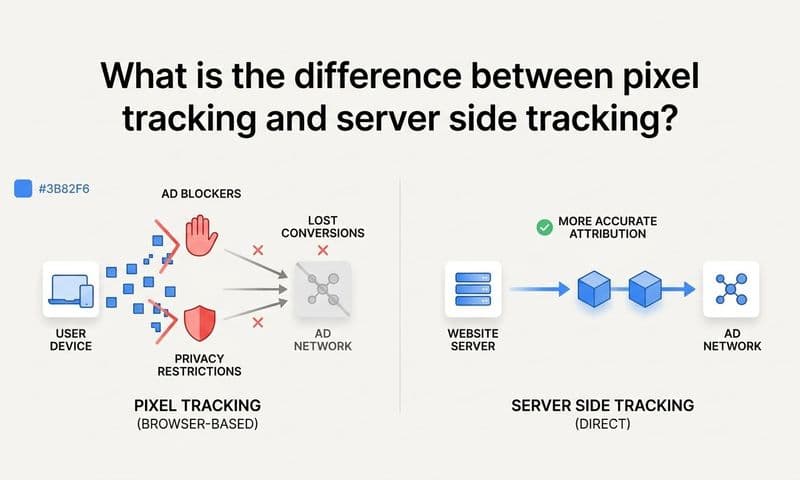
For years, the standard approach to tracking customers across multiple devices relied heavily on browser-based pixels and third-party cookies. A pixel fires when a page loads, a cookie stores the session identifier, and the ad platform or analytics tool uses that cookie to recognize the user on their next visit. It was imperfect for cross-device tracking from the start, but it worked reasonably well within a single browser on a single device.
That foundation has been eroding steadily. Apple's App Tracking Transparency framework significantly reduced the availability of cross-app tracking signals on iOS devices. The ongoing deprecation of third-party cookies in major browsers has further limited what client-side pixels can reliably capture. Ad blockers, which are widely used among the technical and professional audiences that many B2B SaaS companies target, prevent pixels from firing altogether in a meaningful percentage of sessions. The result is a growing gap between what actually happens in your funnel and what your client-side tracking infrastructure can see. A cookieless tracking solution has become essential for teams that want reliable data in this environment.
Server-side tracking addresses this by moving the event collection logic off the browser and onto your own servers. Instead of relying on a pixel in the user's browser to fire and transmit data to an ad platform, your server receives the event data directly and forwards it to the relevant platforms through a server-to-server connection. Because this transmission happens at the server level, it is not affected by browser restrictions, ad blockers, or cookie policies. The data gets through reliably regardless of the user's device or browser settings.
First-party data is the fuel that makes server-side tracking powerful in the context of cross-device identity resolution. First-party data refers to identity signals and behavioral events that your business collects directly: form submissions, product login events, CRM contact records, and purchase confirmations. Because this data comes from direct interactions with your own systems, it is not subject to third-party cookie restrictions. You own it, and it carries authenticated identity signals that can anchor cross-device stitching.
Conversion APIs bring these two elements together in a practical way. Meta's Conversion API (CAPI) and Google's Enhanced Conversions are server-to-server event transmission tools that allow you to send conversion data directly from your server to the ad platform, bypassing the browser entirely. Critically, these server-side events can carry hashed identity signals such as email addresses and phone numbers, which the ad platforms use to match events back to their own user profiles across devices.
When a user who clicked a Meta ad on their phone later converts on their desktop, a server-side event carrying their hashed email allows Meta to connect that conversion back to the original ad click, even though the devices are different and no client-side cookie persisted between them. The signal quality that was being lost to browser restrictions gets restored through the server-side channel. Understanding why server-side tracking is more accurate than client-side methods is critical for any team building a durable attribution infrastructure.
For B2B SaaS teams serious about tracking customers across multiple devices, implementing server-side tracking alongside Conversion API integrations is no longer optional. It is the infrastructure layer that makes everything else work reliably.
Stitching the Journey Together: From Ad Click to Closed Revenue
Understanding the theory of cross-device tracking is useful. Understanding how it actually works in practice, step by step through a real B2B buying journey, is where it becomes actionable.
Consider how the mechanics of identity stitching work across a typical B2B SaaS funnel. When a prospect clicks a paid ad on their mobile device, a UTM parameter is captured in the landing page URL and stored in your tracking system alongside whatever session identifiers are available at that point. At this stage, the user is likely anonymous. You have a device session and a traffic source, but no authenticated identity to anchor it to.
A few days later, that same prospect visits your site on their work laptop and downloads a whitepaper, submitting their email address in the process. That form submission creates an authenticated identity event. Your tracking system can now attach a known identity to this session. If your server-side tracking is configured correctly, it can also attempt to match this email back to the earlier mobile session using probabilistic signals or any deterministic link that exists in the data.
The prospect then books a demo from their tablet. Another authenticated event, another opportunity to stitch the session into the unified profile. When they eventually become a closed-won deal in your CRM, that revenue event gets connected to the same identity record, and the full journey becomes traceable: the mobile ad click that started it, the content engagement on the laptop that deepened interest, the demo booking on the tablet that moved them into the pipeline, and the CRM deal that represents actual revenue.
This unified customer journey view transforms what your marketing team can understand about performance. Instead of seeing a mobile session that went nowhere, a laptop session with no clear source, and a tablet conversion attributed to direct traffic, you see a complete picture of which channels and touchpoints actually influenced the deal. The LinkedIn ad that initiated the journey gets appropriate credit. The content that sustained engagement gets recognized. The demo request gets attributed correctly within the context of the full path.
Multi-touch attribution is the framework that makes this cross-device data actionable at scale. Rather than assigning all credit to the first or last touchpoint, multi-touch attribution distributes credit across all the touchpoints in a buyer's journey, regardless of which device was used at each stage. This is only meaningful if the underlying data connects those touchpoints to a single buyer profile. Cross-device tracking is the prerequisite; multi-touch attribution platforms are what you use to act on the unified data once you have it.
Without cross-device stitching, multi-touch attribution models are working with an incomplete picture and distributing credit across fragments of journeys rather than complete ones. With it, the attribution model reflects how buyers actually behave, and the credit distribution guides budget decisions that are grounded in reality.
What Accurate Cross-Device Data Unlocks for Marketing Teams
When your tracking infrastructure can reliably connect buyer journeys across devices, it changes what your marketing team is capable of. The benefits are not abstract; they show up in specific, high-stakes decisions that directly affect revenue.
Better ad spend allocation: One of the most consistent patterns that emerges when teams gain cross-device visibility is the discovery that top-of-funnel mobile channels are driving far more pipeline than their last-click numbers suggest. Paid social campaigns on LinkedIn or Meta often initiate high-value deals on mobile, but the conversion event happens days later on a desktop device after additional research. Without cross-device tracking, those mobile campaigns appear to produce no conversions. With it, you can see their true contribution to the pipeline and invest accordingly rather than systematically defunding the channels that generate initial demand.
Improved audience targeting and ad platform optimization: Ad platforms like Meta and Google use the conversion signals you send them to train their optimization algorithms. When those signals are incomplete or fragmented because of cross-device gaps, the algorithm is working with a distorted picture of what a high-value conversion looks like. When you send enriched, identity-resolved conversion events through server-side channels, the algorithms receive better data. They can identify patterns in the audiences that actually convert, find similar users across devices, and optimize delivery more effectively. The feedback loop between your conversion data and the ad platform's targeting engine improves in direct proportion to the quality and completeness of the signals you provide. Teams that focus on improving ad tracking accuracy consistently see stronger algorithmic performance as a result.
Accurate pipeline and revenue attribution: For B2B SaaS companies, the ultimate measure of marketing effectiveness is not clicks or leads; it is revenue. Connecting cross-device journey data to CRM pipeline stages and closed-won deals lets growth teams report on true marketing ROI rather than relying on last-click approximations that systematically misrepresent how deals were actually generated. This matters enormously when making the case for budget, justifying channel investments, or evaluating the performance of specific campaigns against pipeline and revenue outcomes rather than surface-level engagement metrics. Tracking closed-won revenue back to its originating touchpoints is where cross-device attribution delivers its highest business value.
Platforms like Cometly are built specifically to deliver this kind of visibility. By connecting ad platform data, CRM records, and website behavior into a single unified view, Cometly gives marketing teams the cross-device attribution data they need to understand which sources actually convert, identify high-performing campaigns with AI-driven recommendations, and feed enriched conversion signals back to Meta and Google to improve algorithmic targeting. The result is a clearer picture of what is driving revenue and a more efficient path to scaling what works.
Building a Cross-Device Tracking Strategy That Actually Works
Knowing why cross-device tracking matters is the starting point. Building the infrastructure to actually do it requires a deliberate approach that prioritizes the right elements in the right order.
Prioritize identity capture early in your funnel: The deterministic approach to cross-device stitching depends on authenticated identity signals, and those signals only exist when users take an action that reveals who they are. The earlier in your funnel you can capture an email address, CRM ID, or product login, the more of the buyer journey you can stitch together with high confidence. This means designing your funnel to create low-friction identity capture opportunities: content downloads, webinar registrations, free trial sign-ups, and newsletter subscriptions all create authentication events that anchor the rest of the journey. Every touchpoint before that first identity capture is subject to probabilistic inference. Every touchpoint after it can be deterministically linked.
Implement server-side event tracking alongside your CRM and ad platforms: Client-side pixels alone are no longer sufficient for reliable cross-device data. Building server-side tracking into your infrastructure ensures that conversion events flow reliably to your analytics and ad platforms regardless of browser restrictions, ad blockers, or device switching. Connecting your CRM to your server-side event pipeline means that when a contact progresses through pipeline stages or closes as a deal, those events can be transmitted back to ad platforms as enriched conversion signals, closing the loop between ad spend and revenue. Reviewing the full range of server-side tracking benefits makes clear why this infrastructure investment pays for itself quickly.
Use an attribution platform that creates a single source of truth: Even with strong tracking infrastructure, cross-device data can end up siloed across your ad platforms, your CRM, and your website analytics if you do not have a layer that unifies them. Manually reconciling data from Google Ads, Meta, LinkedIn, your CRM, and your web analytics is time-consuming, error-prone, and structurally incapable of producing the unified buyer journey view you need. An attribution platform that connects all of these data sources, resolves identity across them, and presents a coherent view of cross-device performance eliminates that manual reconciliation problem and makes cross-device attribution actionable at the speed your team needs to make decisions.
The combination of these three elements: early identity capture, server-side event tracking, and a unified attribution platform, creates the infrastructure foundation for tracking customers across multiple devices in a way that is durable, accurate, and operationally sustainable.
The Bottom Line on Cross-Device Attribution
Tracking customers across multiple devices is not a technical luxury for well-resourced teams. It is a strategic necessity for any B2B SaaS marketing organization that wants to understand where its pipeline is actually coming from and make confident decisions about where to invest.
The combination of deterministic identity resolution, server-side tracking, and a unified attribution platform gives your team the visibility to see the full buyer journey, not just the last step on the converting device. It corrects the systematic undervaluation of top-of-funnel channels, improves the quality of signals you send to ad platform algorithms, and connects marketing activity to revenue outcomes in a way that last-click attribution never can.
Teams that invest in this infrastructure today are building a compounding advantage. Better data leads to better optimization decisions. Better optimization decisions lead to more efficient spend and stronger pipeline. And stronger pipeline data feeds back into better audience signals, creating a cycle of improvement that widens the gap between data-driven teams and those still working from fragmented, device-siloed analytics.
Cometly is built to make this possible for B2B SaaS marketing teams. It connects every touchpoint from the first ad click to closed-won revenue, unifies your ad platform data, CRM records, and website behavior into a single source of truth, and uses AI to surface the insights and recommendations that help you scale what is working. If you are ready to move beyond last-click approximations and start making decisions based on the full buyer journey, Get your free demo and see how Cometly can transform your attribution strategy.