
Podcast advertising has become a serious channel for B2B SaaS companies trying to reach focused, high-intent audiences. Niche shows attract the exact buyers you want, and host-read ads carry a level of trust that banner ads and sponsored posts rarely achieve. But here is the problem: podcast attribution is genuinely hard.
Unlike paid search or social ads, podcast conversions do not follow a clean digital path. A listener hears your ad during their morning commute, closes the app, and might visit your site three days later by typing your URL directly into a browser. That visit shows up as direct traffic in your analytics, with no connection to the podcast episode that drove it. Without a deliberate tracking setup, you are flying blind on whether your audio spend is generating pipeline or just generating awareness you cannot measure.
The good news is that this problem is solvable. Podcast attribution is not as precise as search attribution, but it does not have to be a black box either. By layering multiple tracking signals together, you can build a system that gives you a reliable, defensible read on performance.
This guide walks you through a practical, step-by-step process for tracking podcast ad conversions accurately. You will learn how to set up unique landing pages, implement UTM parameters, configure conversion events, and connect podcast attribution data to your broader marketing analytics. Each step builds on the last, so by the time you finish, you will have a repeatable system that ties podcast listener behavior to real revenue outcomes. That means your team can make confident decisions about which placements to scale and which to cut.
Whether you are running your first podcast campaign or trying to clean up attribution on placements that are already live, this process will give you the structure you need to measure what actually matters: pipeline and revenue, not just downloads and traffic.
Step 1: Define Your Conversion Goals Before You Launch
Before you set up a single tracking pixel or build a landing page, you need to be clear on what you are actually trying to measure. This sounds obvious, but it is the step most teams skip, and it creates measurement problems that are difficult to fix after a campaign is live.
Start by identifying which actions count as a conversion for your podcast campaign. For most B2B SaaS companies, the relevant conversion events are form submissions, trial signups, demo requests, or direct purchases. The right answer depends on your sales motion. If you have a product-led growth model, a trial start might be your primary conversion. If you run a sales-assisted model, a demo booking is probably more meaningful.
Once you have identified your conversion events, map each one to a specific stage in your funnel. A page visit to your podcast landing page is a micro-conversion that signals awareness. A form fill is a mid-funnel conversion. A closed deal is the ultimate outcome. Tracking all three gives you visibility into where podcast-sourced leads are progressing and where they are dropping off.
One of the most important decisions you will make upfront is your attribution window. Podcast listeners rarely convert immediately. They hear an ad, finish their commute, go about their day, and might come back to your site a week later when they finally have time to look you up. A 30-day attribution window is a reasonable starting point for most B2B podcast campaigns, though you may want to extend this to 60 days if your sales cycle is longer.
Before your campaign launches, document your baseline conversion rates from other channels. What is your current cost per lead from paid search? What is your average lead-to-opportunity rate from social campaigns? These benchmarks give you something to compare against when you evaluate podcast performance. Without them, you have no reference point for whether your results are strong or weak.
Here is a pitfall worth flagging early: if you evaluate podcast ads using last-click attribution, they will almost always appear to underperform. Podcast is typically an upper-funnel awareness channel. Listeners rarely convert on the first visit. In a last-touch model, the credit goes to whatever channel the listener interacted with right before converting, which is often a branded search or a retargeting ad. Multi-touch attribution platforms, which we will cover in Step 6, is the right model for this channel.
Step 2: Create Dedicated Landing Pages for Each Podcast Placement
The single most important tactical decision in podcast attribution is creating a unique landing page for every placement you run. This is how you separate podcast-driven traffic from everything else in your analytics, even when listeners navigate directly to your site without clicking a link.
The structure is straightforward. For each podcast or ad placement, create a unique URL path on your domain. Something like yoursite.com/podcastname or yoursite.com/showname works well. The URL needs to be short, memorable, and easy to spell aloud, because the host will be reading it on air and listeners will be typing it from memory, often hours after they heard the ad.
Keep the landing page messaging consistent with what the host says in the ad. If the host describes your product as a tool for tracking marketing ROI and mentions a specific offer, the landing page should reflect that framing. Consistency between the ad read and the landing page reduces friction and improves conversion rates. A listener who arrives expecting one thing and finds something different will often leave without converting.
Vanity URLs serve as the listener-facing entry point, but they should not be the final destination in your tracking setup. Set up a redirect from your vanity URL to a UTM-tagged destination URL. This way, when a listener types yoursite.com/podcastname into their browser, they are automatically redirected to a URL that carries UTM parameters your analytics platform can read. We will cover UTM structure in the next step, but the redirect setup is part of your landing page configuration.
Make sure your conversion tracking is firing correctly on this page. Every meaningful action, including the page load itself, a form submission, and a thank-you page visit, should trigger a conversion event. If you are using a pixel-based setup, verify that the pixel is installed on the page and that events are firing as expected. If you are using server-side tracking, confirm that your server-side events are capturing visits from direct navigation, which is exactly how most podcast-driven traffic will arrive.
Test the full user journey before your campaign goes live. Open an incognito browser, type the vanity URL manually, and walk through the conversion flow. Confirm that the redirect fires, the UTM parameters are appended, and the conversion event is recorded in your analytics platform. This five-minute test can save you from discovering a conversion tracking gap after you have already spent budget on a placement.
One more consideration: if you are running ads on multiple podcasts simultaneously, each placement needs its own unique URL. Combining placements under a single landing page makes it impossible to evaluate individual podcast performance, which defeats the purpose of building this tracking system in the first place.
Step 3: Build a UTM Tagging System for Podcast Campaigns
UTM parameters are the backbone of your podcast attribution system. They tell your analytics platform exactly where a visitor came from, which campaign brought them, and which specific placement or episode was responsible. Without consistent UTM tagging, your podcast traffic will either blend into your direct traffic bucket or show up as miscellaneous referral traffic with no useful context.
Here is a recommended UTM structure for podcast campaigns:
utm_source: Use a consistent value like "podcast" to identify the channel. This separates podcast traffic from paid search, social, and email in your source reports.
utm_medium: Use "audio" to distinguish podcast placements from other podcast-adjacent formats like streaming radio or video.
utm_campaign: Use the podcast name or a standardized abbreviation. For example, "growth-pod" or "b2b-saas-show". This lets you filter by specific podcast across your analytics reports.
utm_content: Use the episode number, air date, or ad slot identifier. For example, "ep142-midroll" or "2026-05-15-preroll". This is where you capture granular placement-level data that helps you compare performance across individual episodes or ad positions.
The key to making this system work is consistency. If one team member uses "Podcast" with a capital P and another uses "podcast" in lowercase, your analytics platform will treat them as two separate sources. Build a shared campaign tracking spreadsheet that documents every UTM string you create, along with the corresponding podcast name, episode, and air date. This becomes your campaign registry and makes it easy to pull accurate reports later.
Apply UTM tags to the redirect destination behind your vanity URL. When a listener types yoursite.com/podcastname, the redirect should send them to yoursite.com/landing-page?utm_source=podcast&utm_medium=audio&utm_campaign=podcastname&utm_content=ep142. Your analytics platform reads those parameters and records the visit with full campaign attribution.
Connect your UTM data to your CRM so that leads generated from podcast campaigns are tagged at the contact level from the moment they enter your funnel. This is critical for B2B SaaS companies because the conversion journey often spans weeks and involves multiple touches. If a podcast-sourced lead comes back through a branded search two weeks later and fills out a demo form, you want that lead record in your CRM to reflect the original podcast source, not just the most recent touchpoint.
Cometly's UTM tracking resources cover this flow in depth, including how UTM parameters map to attribution reports and how to connect campaign data to pipeline and revenue outcomes. Building this foundation correctly from the start makes every downstream analysis more reliable.
Step 4: Set Up Conversion Events and First-Party Tracking
Landing pages and UTM tags get listeners into your funnel. Conversion event tracking is what tells you what they did once they arrived. This step is where many podcast attribution setups fall apart, because teams rely on pixel-based tracking that was designed for a world with reliable third-party cookies and consistent browser behavior. That world no longer exists.
Configure conversion events for every action that matters in your funnel. At minimum, you want to track page visits to your podcast landing pages, form submissions, trial starts, and demo bookings. Each of these events should be captured with enough context to identify which podcast campaign and placement drove the action.
Browser-based pixels have significant limitations for podcast attribution specifically. Podcast listeners often arrive through direct navigation, typing a URL they heard on audio rather than clicking a link. Browsers treat direct navigation differently from referral traffic, and in many cases, the original referral context is lost entirely. Add to this the growing use of ad blockers, privacy-focused browsers, and iOS privacy features that restrict pixel tracking, and you have a recipe for substantial data loss.
Server-side tracking solves this problem. By capturing conversion events at the server level rather than relying on a browser-side pixel, you collect data that is not subject to ad blocker interference or browser restrictions. When a listener visits your vanity URL and the redirect fires, a server-side event can capture that visit regardless of the browser or device being used.
Conversion API integrations take this a step further. Platforms like Meta's Conversions API and Google's Enhanced Conversions allow you to send first-party event data directly from your server to the ad platform. This improves the quality of conversion data that flows back into your ad platform's optimization algorithms, which matters if you are running retargeting campaigns alongside your podcast placements.
Verify your conversion event setup by testing the complete user journey before your campaign launches. Use a staging environment or a test user account to walk through the flow from vanity URL to thank-you page. Confirm that each event fires, that the event data includes campaign parameters, and that the data appears correctly in both your analytics platform and your CRM.
Tie your conversion events back to your ad spend data. When you can see cost per acquisition at the campaign and placement level, you have the information you need to make budget decisions with confidence. Without this connection, you are left guessing whether a podcast placement is generating a positive return.
Step 5: Use Promo Codes as a Secondary Attribution Signal
Even with dedicated landing pages and server-side tracking, some podcast-driven conversions will slip through the cracks. A listener might hear your ad, search for your brand on Google, and convert through a paid search click. Your UTM data will credit the search campaign, and the podcast gets no recognition. Promo codes are the simplest way to capture these conversions.
Assign a unique promo code to each podcast placement and instruct the host to mention it during the ad read. The code should be easy to remember and clearly tied to the show, for example "GROWTHPOD" or "SAASSHOW20". When a listener redeems the code at checkout or during signup, your CRM or billing platform records the redemption as a conversion event linked to that specific podcast.
Promo codes function as a self-reported attribution signal. The listener is telling you, through their behavior, that the podcast ad influenced their decision. This captures conversions that would otherwise be attributed to a different channel or show up as unattributed direct traffic.
Cross-reference promo code redemptions with UTM-tagged traffic to build a more complete picture of podcast-driven conversions. If a placement generates 40 UTM-tagged visits and 15 promo code redemptions, and only 8 of those redemptions came from UTM-tagged sessions, you know that at least 7 conversions would have been missed by URL tracking alone. This cross-referencing also helps you calibrate how much your UTM data is undercounting podcast performance.
For placements where neither the vanity URL nor the promo code generates significant data, lift analysis can help estimate incremental impact. Compare your baseline conversion rates during the weeks before a podcast campaign to conversion rates during and after the campaign period. An increase in branded search volume, direct traffic, or overall conversion rate during the campaign window is a signal that the podcast is generating awareness, even if it is not showing up cleanly in your attribution reports.
Store promo code redemption data alongside your UTM and CRM records so all attribution signals are visible in one place. When you review campaign performance, you want to see UTM-tagged conversions, promo code redemptions, and lift estimates together rather than in separate reports that require manual reconciliation.
Step 6: Connect Podcast Attribution Data to Your Revenue Analytics
Tracking leads from podcast campaigns is a good start. But for B2B SaaS companies, the real question is whether those leads are turning into pipeline and closed revenue. A podcast placement that generates a high volume of low-quality leads is not performing well, even if the cost per lead looks attractive. You need to see the full funnel.
Pull your podcast campaign data, UTM traffic records, promo code redemptions, and CRM lead records into a single attribution platform. When all of these data sources are connected, you can trace a podcast-sourced lead from their first visit through every subsequent touchpoint to the point where they become a customer. This is what revenue attribution actually looks like in practice.
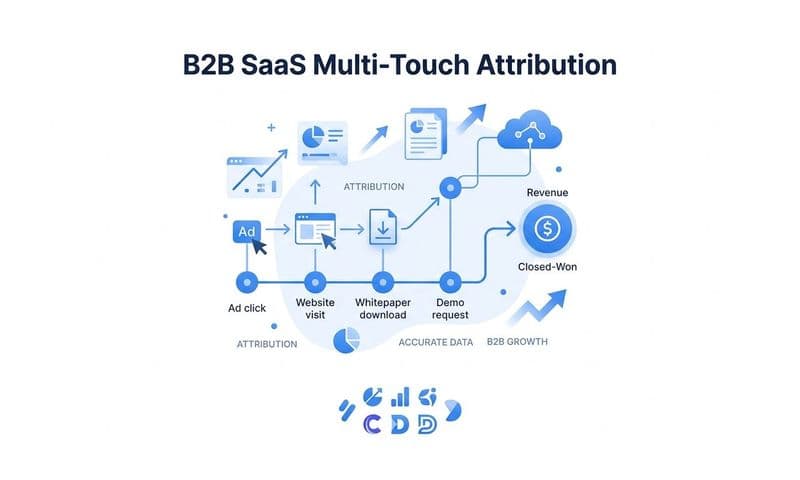
Apply a multi-touch attribution model so podcast touchpoints receive appropriate credit even when the listener converts through a different channel later. In a linear multi-touch model, credit is distributed across all touchpoints in the customer journey. In a time-decay model, more credit flows to touchpoints closer to the conversion. Either approach is more accurate than last-touch for a channel like podcasting, which typically influences awareness and consideration rather than triggering the final conversion click.
Compare podcast-sourced leads against leads from paid search and social, looking at quality metrics, not just volume. What is the average deal size for podcast-sourced leads? How does their lead-to-opportunity conversion rate compare to other channels? How long does it take them to close? These comparisons tell you whether podcast is attracting the right buyers, not just any buyers.
Track leads through the full funnel from first touch to closed revenue so you can calculate true pipeline and revenue attribution for each placement. A podcast that generates five closed deals worth a combined value of significant contract value may be far more valuable than a paid search campaign generating ten times the lead volume at a lower close rate.
Cometly connects ad spend, CRM data, and conversion events into one view, making it straightforward to see which podcast placements are generating pipeline and which are not. Rather than building manual reports that pull data from multiple disconnected platforms, you get a single source of truth that reflects the complete customer journey from first podcast touchpoint to closed-won revenue.
Set up a reporting cadence so you review podcast attribution data on a consistent schedule. Reviewing results weekly after a new episode airs gives you timely feedback on performance and helps you catch tracking issues before they compound across multiple placements.
Step 7: Analyze Results and Scale What Works
Once your tracking system is running and you have enough data to evaluate, the final step is turning that data into decisions. This is where the investment in proper attribution setup pays off directly.
Evaluate each podcast placement using three core metrics: cost per lead, cost per qualified opportunity, and revenue attributed. Cost per lead tells you about top-of-funnel efficiency. Cost per qualified opportunity tells you about lead quality. Revenue attributed tells you whether the channel is actually generating return on investment. All three together give you a complete picture of placement performance.
Look at both immediate conversions and delayed conversions within your attribution window. A placement that generates few conversions in the first week but shows a steady stream of attributed leads over the following 30 days may be performing better than a placement that drives a quick spike followed by nothing. Podcast attribution requires patience and a longer evaluation horizon than most digital channels.
Use your attribution data to negotiate with podcast partners. If a specific show is consistently generating qualified pipeline at a strong cost per opportunity, you have data to justify increasing your investment or negotiating a preferred rate. If a placement is generating traffic but no pipeline, you have data to justify pausing or discontinuing it. This is a significant advantage over teams that are making placement decisions based on download numbers alone.
Test different ad formats and call-to-action offers to identify what drives the highest conversion rate. Host-read ads typically outperform produced spots in terms of listener trust, but the best offer and landing page experience can vary significantly by audience. Test a free trial offer against a demo request offer on different placements and compare the downstream conversion rates, not just the click-through rates.
Feed your podcast conversion data back into your broader channel mix analysis. Understanding how podcast fits alongside paid search, social, and content in your overall attribution model helps you allocate budget across channels more intelligently. Podcast may be driving first-touch awareness that is then captured and closed by retargeting campaigns. Seeing that relationship in your attribution data helps you understand the true interdependence of your channels.
Document your findings after each campaign cycle. Record which placements performed, what attribution window produced the most accurate results, and what conversion events were most predictive of downstream revenue. Future campaigns should start with these benchmarks rather than rebuilding from scratch every time.
Putting It All Together
Tracking podcast ad conversions requires more intentional setup than most digital channels, but the payoff is clear visibility into whether your audio spend is generating real pipeline. By combining dedicated landing pages, UTM tagging, server-side conversion events, promo codes, and multi-touch attribution, you build a system that captures the full picture of how podcast listeners become customers.
The key is connecting every signal, from the first vanity URL visit to the closed deal, into one attribution view. No single method captures everything on its own. The strength of this system comes from layering multiple signals and reconciling them in a single platform where you can see the complete customer journey.
Cometly is built to do exactly that. It connects your ad platforms, CRM, and conversion events so you can see which podcast placements are driving revenue, not just traffic. With multi-touch attribution, server-side tracking, and real-time pipeline reporting, you get the clarity to make confident budget decisions across every channel in your mix.
Use this checklist to confirm your setup is complete before your next podcast campaign goes live:
Define conversion goals and attribution window: Know what you are measuring and over what time period before you spend a dollar.
Build unique landing pages for each placement: One URL per podcast, with a redirect to a UTM-tagged destination.
Apply UTM tags to all podcast destination URLs: Use a consistent naming convention and store it in a shared tracking document.
Configure server-side conversion events: Do not rely on browser pixels alone for a channel where direct navigation is the norm.
Assign unique promo codes to each placement: Capture the conversions that URL tracking misses.
Connect all data sources to your attribution platform: Ad spend, CRM data, UTM traffic, and promo code redemptions in one place.
Set a reporting schedule: Review results consistently so you can act on the data while it is still relevant.
Ready to see exactly which podcast placements are driving pipeline and revenue? Get your free demo and start capturing every touchpoint with the precision your ad spend deserves.