

You've done everything right. You've built the campaigns, dialed in the targeting, and set a healthy budget. But when you pull the conversion data, something feels off. The numbers are lower than expected, attribution looks inconsistent, and your ad platform's optimization seems to be flying blind. You tweak creatives, adjust bids, and test new audiences, but the underlying data problem doesn't go away.
Here's a cause that rarely makes it onto the troubleshooting checklist: VPNs. As VPN adoption grows across professional and enterprise environments, a meaningful portion of your traffic, often your highest-value B2B buyers, is becoming increasingly invisible to traditional pixel-based tracking. The result is conversion data with structural gaps, attribution models that don't reflect reality, and ad platforms optimizing toward signals that are already incomplete.
This isn't a niche technical problem. It's a quiet but significant drag on ad ROI for B2B SaaS teams who depend on accurate conversion data to make budget decisions. When your buyers are enterprise professionals who routinely connect through corporate VPNs, the interference isn't occasional. It's systemic.
In this article, you'll get a clear picture of how VPN blocking conversion tracking actually works, why B2B SaaS marketers feel the impact most acutely, and what modern tracking infrastructure, including server-side tracking and Conversion API integrations, can do to recover the signal you're losing right now.
How VPNs Interfere With Your Conversion Data
To understand the problem, it helps to understand how browser-based conversion tracking works in the first place. When a user clicks your ad and lands on your site, a tracking pixel fires in their browser. That pixel captures information like the user's IP address, cookie data, referrer URL, and session identifiers, then sends it back to the ad platform. This chain of events is how platforms like Meta and Google connect an ad click to a downstream conversion.
VPNs break this chain in several ways. The most direct is IP masking. A VPN routes a user's traffic through an intermediary server, replacing their real IP address with one belonging to the VPN provider. When your pixel fires, it captures the VPN server's IP, not the user's. This can cause conversions to be attributed to the wrong geographic region, mismatched against the original ad click, or dropped entirely because the session data no longer aligns.
Beyond IP masking, VPNs can disrupt the referrer data that tracking pixels rely on to connect a conversion back to a specific campaign or channel. When traffic passes through a VPN tunnel, referrer headers can be stripped or altered, severing the link between the originating ad click and the on-site action you're trying to measure.
Corporate VPNs add another layer of complexity. Many enterprise IT environments configure VPNs to filter outbound traffic, blocking third-party scripts and tracking pixels as a matter of policy. This means the pixel never fires at all. It's not that the data is incomplete. It's that the tracking mechanism is actively prevented from executing in the user's browser environment.
For B2B SaaS marketers, this is particularly damaging because the buyers most likely to be on corporate VPNs are also the ones you most want to track. A senior decision-maker at a mid-market company, browsing your site from their company laptop during work hours, is probably connected through a corporate VPN. That's a high-intent visit that may leave no trace in your ad platform's conversion data.
The compounding effect is worth noting. VPN interference doesn't just affect individual conversion events. It degrades the session-level data that connects multiple touchpoints across a buying journey. When a user's IP changes between sessions because they're switching VPN servers, cookies can fail to match across visits, making it harder to stitch together the full path from first ad click to demo request or trial sign-up.
The result is a tracking environment where some of your most valuable traffic is systematically underrepresented in the data your ad platforms use to optimize campaigns.
Why B2B SaaS Teams Are Hit Hardest
Not every business feels VPN-related tracking gaps equally. Consumer brands selling to general audiences may see some impact, but the effect is relatively contained. For B2B SaaS companies, the structural characteristics of their audience and their buying cycle make VPN interference far more damaging.
Start with the audience profile. B2B buyers, particularly in enterprise and technology sectors, are among the most likely professional groups to use VPNs regularly. Many organizations require VPN usage as a standard IT policy for anyone accessing company systems remotely. In practice, this means a substantial portion of your target audience is connecting to the internet through a VPN every time they browse from a work device. This isn't a fringe behavior. It's the default working environment for a large segment of the B2B buyer population.
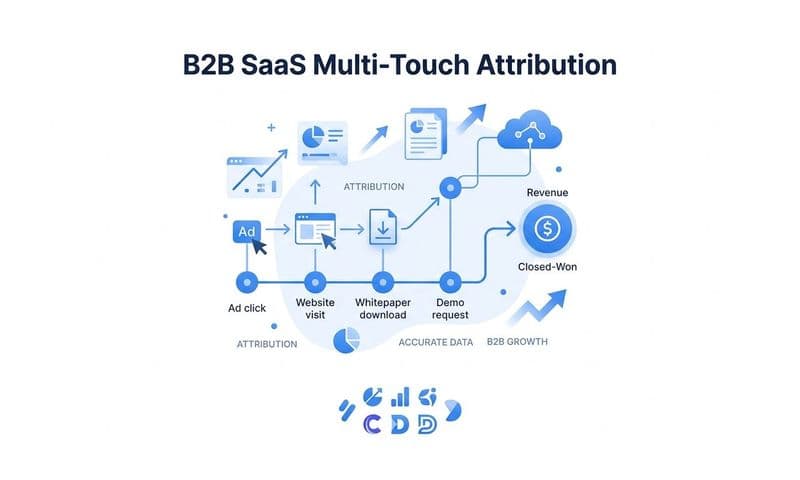
The buying cycle creates a second layer of exposure. B2B SaaS purchases rarely happen in a single session. A typical journey might involve multiple visits over several weeks: an initial ad click, a few organic searches, a return visit after a sales email, a demo, and then a closed deal. Each session where the buyer is on a VPN represents a potential gap in the attribution chain. Over a buying cycle that spans many touchpoints, those gaps accumulate.
Think about what this means for attribution. If your pixel successfully captures the first touchpoint but loses the conversion event because the buyer was on a corporate VPN during the demo sign-up, your ad platform has no record that the campaign contributed to that conversion. The channel that drove the initial interest gets no credit. Over time, this causes systematic undervaluation of the campaigns and channels that are actually generating pipeline.
The inverse problem is equally damaging. Channels whose audiences happen not to use VPNs will appear to perform better in your pixel-based data, not because they're genuinely more effective, but because their conversions are more consistently captured. This creates a false performance hierarchy that can lead marketing teams to shift budget away from high-performing enterprise channels toward channels that simply have better tracking coverage.
Corporate network environments can compound the problem further. Firewalls, proxy settings, and content filtering tools used by enterprise IT departments can block third-party tracking scripts independently of VPN usage. For B2B SaaS teams targeting enterprise accounts, the combination of VPN interference and corporate network restrictions means a significant portion of their highest-value traffic may be generating little to no usable conversion data.
The bottom line is that B2B SaaS marketers are operating in an environment where their most important audience is also the hardest to track accurately with traditional pixel-based methods.
Pixel-Based Tracking vs. Server-Side Tracking: Understanding the Difference
The core vulnerability of pixel-based tracking is that it depends entirely on the user's browser environment to execute. When a conversion event happens, a JavaScript snippet fires in the browser, collects data from the client side, and sends it to the ad platform. Every step in that process is exposed to interference from VPNs, ad blockers, browser privacy settings, and corporate network policies.
Safari's Intelligent Tracking Prevention, Firefox's Enhanced Tracking Protection, and similar browser-level privacy features have been eroding cookie-based tracking for years. VPNs add another layer of disruption on top of these existing vulnerabilities. The result is a tracking infrastructure that was built for a less privacy-constrained internet and is increasingly mismatched with the reality of how professional audiences browse today.
Server-side tracking takes a fundamentally different approach. Instead of relying on the user's browser to capture and transmit conversion data, server-side tracking moves that logic to your own infrastructure. When a conversion event occurs, your server captures the relevant data and sends it directly to the ad platform. The user's browser, VPN status, and network environment are no longer part of the equation.
This is the core principle behind Conversion APIs like Meta's CAPI and Google's Enhanced Conversions. Both platforms have built these tools specifically to address signal loss from browser-side tracking limitations. When you implement a Conversion API, you're establishing a direct server-to-server connection between your infrastructure and the ad platform. Conversion events are transmitted through this channel regardless of what the user's device or network is doing.
Because server-side tracking doesn't depend on JavaScript executing in the browser, VPN interference simply isn't a factor. The event is captured at the server level, where your application has full visibility into what happened, and transmitted to the ad platform through a channel that VPN routing cannot disrupt.
One important implementation detail: when running both pixel-based and server-side tracking simultaneously, which is often recommended to maximize coverage, you need to handle event deduplication carefully. Ad platforms use deduplication logic to avoid counting the same conversion twice when they receive it from both the pixel and the Conversion API. Proper deduplication requires passing consistent event identifiers across both channels so the platform can match and deduplicate them correctly.
The practical implication is straightforward. If your current tracking setup relies primarily or exclusively on browser pixels, you have a structural blind spot that VPNs are actively exploiting. Server-side tracking and Conversion API integration are the mechanisms that close that gap.
The Attribution Blind Spots VPNs Create
VPN-related tracking gaps don't just mean missing data points. They create compounding distortions across your entire attribution picture that can fundamentally mislead your marketing strategy.
Ad platforms like Meta and Google use conversion signals to train their machine learning models. The more accurate and complete the conversion data you send them, the better their algorithms can identify high-value audiences, optimize bidding, and allocate delivery toward users most likely to convert. When VPN interference reduces the volume and accuracy of conversion signals, those algorithms are working with degraded inputs. The result is higher CPAs, less precise audience targeting, and optimization that drifts away from your actual best customers.
Attribution models that rely on browser-based data will systematically misrepresent performance across channels. A paid search campaign that primarily reaches enterprise buyers using corporate VPNs will appear to underperform relative to a display campaign that reaches a more consumer-like audience with better pixel coverage. The actual revenue contribution of each channel may be the reverse of what the data suggests, but your attribution model can't tell you that because it's only seeing the conversions it can track.
This is where first-party data becomes critical. When browser-based tracking fails, the only reliable way to connect a conversion back to its originating ad interaction is through identifiers that exist in your own systems. Capturing UTM parameters and click IDs server-side at the point of form submission, storing them in your CRM alongside the lead or customer record, and using that data to match conversion events back to ad interactions gives you an attribution path that doesn't depend on continuous cookie-based tracking across sessions.
For example, if a user clicks a LinkedIn ad, lands on your site, and submits a demo request form, capturing the LinkedIn click ID in your CRM at the point of form submission creates a persistent record of that ad interaction. Even if subsequent sessions are obscured by VPN usage, you have the data needed to attribute the conversion correctly.
Without this kind of first-party data infrastructure, VPN-related gaps in your attribution chain are essentially permanent. You lose not just the individual conversion events but the ability to reconstruct the customer journey retroactively. Over time, this means your understanding of which campaigns are driving pipeline becomes increasingly unreliable, and the budget decisions you make based on that understanding carry proportionally more risk.
Practical Steps to Recover Conversion Signals Lost to VPNs
Recovering the conversion signal that VPNs are causing you to lose requires a shift in how you think about tracking architecture. Browser pixels should be treated as one input among several, not the primary or sole source of conversion data. Here's how to build a more resilient setup.
Implement server-side event tracking and Conversion API integrations: This is the foundational step. Setting up Meta CAPI and Google Enhanced Conversions allows you to send conversion data directly from your server to the ad platform, bypassing the browser layer entirely. When a lead submits a form, a trial sign-up completes, or a deal closes in your CRM, those events can be transmitted server-side with full fidelity regardless of whether the user was on a VPN during their session.
Capture and store click IDs server-side at the point of conversion: Ad platforms assign click IDs to every ad interaction. Meta uses fbclid, Google uses gclid, and other platforms have their own equivalents. When a user arrives on your site after clicking an ad, capture that click ID server-side and store it in your CRM alongside the lead or customer record. This creates a durable link between the ad interaction and the downstream conversion that doesn't depend on cookies surviving across sessions.
Store UTM parameters server-side at the point of form submission: UTM parameters passed through the URL can be captured when a user submits a form and stored in your CRM. This gives you campaign-level attribution data that persists in your own systems, independent of what the ad platform's pixel was able to track. Even if the pixel missed the conversion, you have the data needed to reconstruct attribution manually or through your analytics platform.
Audit your tracking coverage by comparing data sources: Pull conversion counts from your ad platforms and compare them against the lead and customer records in your CRM for the same time period. If your CRM shows significantly more conversions than your ad platforms are reporting, that discrepancy is a direct indicator of tracking gaps, many of which are likely caused by VPN interference or ad blockers. The size of the gap tells you how much signal you're currently losing.
Use first-party identifiers for server-side event matching: When sending conversion events through a Conversion API, include first-party identifiers like hashed email addresses alongside the event data. Ad platforms can use these identifiers to match the server-side event to a user in their system, improving match rates and attribution accuracy even when cookie-based data is absent.
These steps won't eliminate every tracking gap, but they create a significantly more resilient attribution infrastructure that can maintain accuracy even as VPN usage continues to grow across professional audiences.
How Cometly Closes the Gap Left by VPNs
Building and maintaining a server-side tracking infrastructure that integrates with multiple ad platforms, connects to your CRM, and handles event deduplication correctly is a significant technical undertaking. This is the problem Cometly is built to solve.
Cometly uses server-side conversion tracking and Conversion API integration to capture the events that browser pixels miss. When a conversion happens, whether it's a form submission, a trial sign-up, or a closed deal recorded in your CRM, Cometly captures that event at the server level and transmits it to your ad platforms through direct API connections. VPN usage, ad blockers, and browser privacy settings don't affect this process because the tracking logic operates independently of the user's browser environment.
The platform connects your ad platforms, CRM data, and website events in a single attribution layer. This means Cometly can stitch together the customer journey even when individual touchpoints are obscured by VPN interference. A user who clicked a Google ad in session one, returned through direct traffic in session two while on a corporate VPN, and submitted a demo request in session three can still be attributed correctly because Cometly is matching events using first-party identifiers and server-side data rather than relying on an unbroken cookie chain.
Cometly's AI analyzes performance across every channel and surfaces recommendations based on attribution data that reflects actual revenue contribution, not just what the pixel happened to capture. This means the campaigns you're told to scale are the ones genuinely driving pipeline, not just the ones with the best pixel coverage.
The enriched conversion data Cometly sends back to Meta, Google, and other ad platforms also improves the quality of the signals those platforms use for algorithmic optimization. Better input data means better audience targeting, more efficient bidding, and ad delivery that trends toward your actual high-value buyers rather than the subset of them that pixel-based tracking can see.
For B2B SaaS teams running paid programs against enterprise audiences, this isn't a marginal improvement. It's the difference between making budget decisions based on a partial picture and making them based on a complete one.
Building Attribution That Holds Up in the Real World
VPN blocking conversion tracking is a structural challenge, not a configuration error you can fix with a quick settings change. As VPN adoption continues to grow across professional and enterprise environments, the gap between what browser pixels capture and what's actually happening in your funnel will only widen. For B2B SaaS marketers whose buyers are among the most likely to use VPNs, that gap is already significant.
The solution isn't to work harder at optimizing a tracking infrastructure that's fundamentally mismatched with your audience. It's to move to a tracking architecture that doesn't depend on the user's browser environment to capture conversion data. Server-side tracking and Conversion API integrations are the modern standard for accurate attribution in a privacy-constrained world, and they're the only reliable way to recover the signal that VPNs are causing you to lose.
With complete, accurate conversion data flowing to your ad platforms, you get better algorithmic optimization, more reliable attribution, and budget decisions grounded in what's actually driving revenue rather than what happens to be trackable with a browser pixel.
If you're ready to close the gap and build an attribution foundation that holds up against VPN interference, ad blockers, and the full range of browser privacy restrictions your B2B audience brings with them, Get your free demo and see how Cometly can help you capture every conversion signal and scale the campaigns that are genuinely driving your pipeline.