
You set a budget. You launch the campaigns. You watch the spend climb. And then you wait for the results that never quite seem to match what Facebook is telling you. If this sounds familiar, you are not alone. Wasted ad spend on Facebook is one of the most common frustrations among growth-focused marketing teams, and it rarely comes down to just picking the wrong creative or targeting the wrong demographic.
The deeper problem is structural. Most teams are flying partially blind because the data feeding their decisions is incomplete, misattributed, or disconnected from actual revenue outcomes. Facebook reports one set of numbers. The CRM shows another. And somewhere in between, a meaningful portion of the budget evaporates without a trace.
This article breaks down exactly where that waste comes from, why the reporting tools you rely on can mislead you, and what a more accurate approach to tracking and attribution looks like. Whether you are running a lean growth team at a B2B SaaS company or managing paid social at scale, understanding these dynamics is the first step toward spending smarter.
The Hidden Drain: Where Facebook Ad Budgets Actually Go
Not all wasted spend is obvious. Some of it shows up in the metrics you can see, and some of it hides behind numbers that look perfectly healthy on the surface.
The most visible forms of waste are familiar to anyone who has audited a Facebook account. Broad audience targeting without strong conversion signals causes your budget to spread thin across users who have little intent to buy. Irrelevant placements, such as Audience Network inventory or low-quality mobile app environments, can consume a surprising share of spend while delivering minimal value. And campaigns running outside of peak conversion windows, when your target audience is least likely to engage or take action, quietly burn budget around the clock.
But here is the more insidious problem: Facebook's algorithm is only as good as the signals you feed it. When conversion data is weak, delayed, or inaccurate, the algorithm cannot distinguish between a user likely to become a paying customer and one who will click through, bounce, and never return. It optimizes for the events it can measure, and if those events are low-quality proxies for real business outcomes, the targeting decisions compound the waste.
Think of it like training a model on bad data. The algorithm learns the wrong patterns, finds the wrong audiences, and keeps optimizing toward outcomes that look good in a dashboard but do not translate to pipeline or revenue.
This brings us to the distinction between visible waste and invisible waste. Visible waste is easy to spot: high CPMs, low click-through rates, poor engagement. Invisible waste is far more dangerous. It occurs when campaigns appear to perform well inside Ads Manager, generating conversions at a reasonable cost per result, but those conversions never become qualified leads, opportunities, or closed deals. The numbers look fine. The business outcomes do not.
For B2B SaaS teams in particular, this invisible waste can persist for months before anyone notices. A campaign generating a steady stream of form fills looks like a success until someone cross-references those leads against CRM data and finds that the close rate is near zero. By that point, the budget has already been reallocated toward scaling what appeared to be a winner. Understanding your SaaS marketing spend benchmarks can help you identify when something is genuinely off before it compounds.
The starting point for fixing this is recognizing that waste is not always loud. Sometimes it hides behind metrics that were never designed to measure what actually matters to your business.
Why Facebook Ads Manager Tells an Incomplete Story
Facebook Ads Manager is a powerful tool, but it is also a tool with a built-in perspective. And that perspective is not always aligned with how your business actually generates revenue.
For side-by-side comparisons, see our best Facebook ads preview tools roundup.
Start with the attribution window. By default, Facebook attributes a conversion to an ad if a user clicked on it within the last seven days or viewed it within the last day. This is a relatively generous window, and it means that any conversion happening in that period gets credited to Facebook, regardless of what other touchpoints may have influenced the decision. When your Google Analytics, CRM, or other analytics tools use different attribution logic, the numbers diverge. Marketers are often left reconciling two completely different conversion counts for the same time period, and the gap can be substantial.
This is not a bug. It is how Facebook's native reporting is designed. But it creates a real problem when marketers use Ads Manager as their primary source of truth for campaign performance. Campaigns that appear profitable based on Facebook's reported cost per conversion may look very different when evaluated against actual downstream outcomes. These Facebook ads reporting discrepancies are one of the most common sources of misallocated budget.
The second layer of the problem is tracking reliability. Browser-based pixel tracking, which has historically been the foundation of Facebook conversion measurement, has been significantly degraded by privacy changes. Apple's iOS updates introduced App Tracking Transparency, which allows users to opt out of cross-app tracking. A large portion of iOS users have done exactly that. Combined with the widespread use of ad blockers and increasing browser-level cookie restrictions, the pixel is now capturing a meaningfully smaller share of conversion events than it did even a few years ago.
Meta has publicly acknowledged this in its own documentation and has actively encouraged advertisers to implement the Conversions API as a complement to the pixel. When pixel data is incomplete, the algorithm's understanding of who is converting becomes distorted. It may continue optimizing toward audiences that were performing well historically but are no longer representative of your actual converters.
The feedback loop this creates is costly. Marketers see campaigns that look like they are performing because Ads Manager is reporting conversions. They scale those campaigns. But because the conversion data feeding the algorithm is degraded, the algorithm cannot find the right users at scale. Costs rise, quality declines, and the gap between reported performance and real business outcomes widens further.
Understanding this dynamic is critical before making any budget decisions based on what Facebook is telling you.
The Attribution Gap That Costs B2B Teams the Most
B2B SaaS companies face a specific version of this problem that is more acute than what most B2C advertisers deal with. It comes down to time.
In B2B, a prospect might click a Facebook ad today, download a piece of content, enter a nurture sequence, attend a webinar, have a discovery call, and then close as a customer weeks or months later. That journey involves multiple touchpoints across multiple channels. Last-click attribution, which credits the final interaction before conversion, would likely give all the credit to the sales outreach or the organic search visit that happened right before the deal closed. The Facebook ad that started the journey gets nothing.
Short attribution windows make this worse. If your attribution window only looks back seven days, the Facebook ad that introduced a prospect to your brand three months ago is invisible. It looks like it generated no value, even though it may have been the catalyst for the entire relationship. Mapping the full Facebook customer journey is essential to understanding which touchpoints are actually driving revenue.
This is why multi-touch attribution matters so much for B2B teams. Models that distribute credit across all the touchpoints in a customer journey, whether through linear, time-decay, or data-driven approaches, give you a far more accurate picture of how Facebook fits into the full acquisition story. You start to see not just whether Facebook is generating clicks, but whether those clicks are entering a journey that eventually produces revenue.
The other critical piece is connecting ad data to CRM data. Without that integration, you are essentially managing two separate realities. Facebook tells you it generated a hundred leads last month. Your CRM tells you you closed five deals. But which of those five deals came from Facebook? Which came from organic search? Which came from a referral? Without the connection between ad platform data and CRM records, you cannot answer those questions.
This matters enormously for budget allocation decisions. A Facebook campaign might be generating high lead volume but low pipeline value, meaning the leads are real but they are not the right leads. Another campaign might generate fewer leads but a higher proportion of qualified opportunities that actually close. Without revenue-level data tied to specific campaigns, ad sets, and creatives, you cannot distinguish between the two. Reviewing the best Facebook attribution solutions available can help you find the right model for your sales cycle.
For B2B SaaS teams with sales cycles measured in weeks or months, this attribution gap is not a minor reporting inconvenience. It is a fundamental barrier to understanding what is actually driving growth.
Server-Side Tracking: Recovering the Signal You Are Losing
The practical solution to degraded pixel tracking is server-side event tracking, specifically the Meta Conversions API, or CAPI. Understanding why it works differently from browser-based tracking helps clarify why it matters so much for campaign performance.
Browser-based pixel tracking works by placing a small piece of JavaScript on your website that fires events, such as page views, form submissions, or purchases, directly from the user's browser to Facebook. The problem is that this process is vulnerable to everything happening in that browser environment: ad blockers that prevent the script from loading, iOS restrictions that limit data sharing, and cookie policies that reduce the information passed along with each event. Exploring Facebook pixel alternatives can help you understand what options exist beyond browser-based tracking.
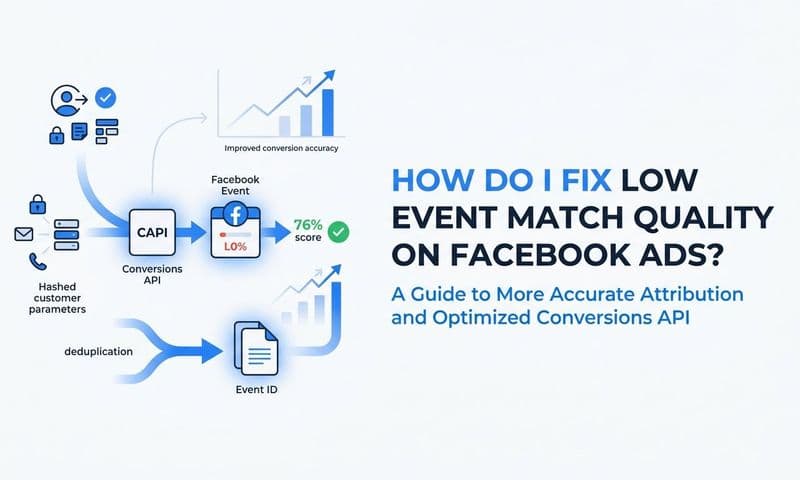
Server-side tracking through CAPI works differently. Instead of relying on the browser to send data to Meta, your server sends conversion events directly to Meta's API. This happens outside the browser entirely, which means it is not affected by ad blockers or browser-level privacy restrictions. The data is more complete, more reliable, and can be enriched with first-party information that helps Meta match events to users more accurately.
Meta's own guidance recommends running CAPI alongside the pixel, not as a replacement, to maximize event match quality and reduce the gap created by browser-side signal loss. When the algorithm receives richer, more accurate conversion data, it can do its job more effectively. It finds users who actually resemble your real converters rather than approximating based on incomplete signals.
The downstream impact on campaign performance is significant. When Facebook's algorithm is working with accurate data, it makes better decisions about who to show your ads to, when to show them, and how to allocate budget across your audience. Impressions shift toward users with genuine intent. The cost per meaningful conversion tends to improve. And crucially, the data you see in Ads Manager begins to align more closely with what you observe in your CRM and revenue tools.
For B2B SaaS teams, this also means you can start sending more meaningful conversion events back to Facebook. Rather than optimizing for a page view or a form fill, you can pass events tied to qualified pipeline stages or revenue milestones. Learning how to sync conversion data to Facebook Ads is one of the highest-leverage technical steps you can take to improve algorithm performance. This trains the algorithm to find users who are more likely to become actual customers, not just leads who fill out a form and disappear.
Warning Signs That Budget Is Being Wasted Right Now
You do not always need to wait for a full attribution audit to know that spend is leaking. There are patterns in your campaign data that signal waste in real time, if you know what to look for.
Rising frequency with declining ROAS: When the same users see your ad repeatedly, engagement drops and costs rise. If your frequency is climbing but your return on ad spend is moving in the opposite direction, your audience is saturated and your budget is being consumed without proportional return. Creative refresh and audience expansion are the immediate levers.
Cost per lead increasing without pipeline growth: If your cost per lead is rising but your CRM is not showing a corresponding increase in qualified opportunities, the leads you are generating are becoming less valuable over time. This often signals audience exhaustion, targeting drift, or a mismatch between what your ad promises and what your landing page delivers.
Significant gap between Facebook-reported conversions and CRM-recorded leads: This is one of the clearest indicators of a tracking or attribution problem. If Facebook claims it generated significantly more conversions than your CRM has on record for the same period, your pixel is likely over-attributing, your attribution windows are too generous, or both. This gap needs to be understood before you make any scaling decisions.
Ad creative fatigue: Creative fatigue is one of the quietest budget drains in paid social. As your audience sees the same ad repeatedly, click-through rates decline, CPMs rise as Facebook recognizes lower engagement, and your overall campaign efficiency degrades. Many teams underestimate how frequently creative needs to be refreshed, particularly in smaller audience segments where frequency builds quickly.
Audience overlap between ad sets: When multiple ad sets within a campaign target overlapping audiences, your campaigns effectively compete against each other in the same auction. This drives up your own CPMs and fragments budget efficiency. Facebook's Audience Overlap tool can surface this problem, but many teams do not check it regularly enough.
Each of these signals points to a different type of waste, and each has a different fix. The common thread is that they all require you to look beyond the top-line metrics and examine the underlying data with a critical eye. A structured approach to Facebook ads optimization gives you a repeatable framework for catching these issues before they compound.
Connecting Facebook Campaigns to Real Revenue Outcomes
Everything discussed so far points toward a single conclusion: the only way to truly eliminate wasted ad spend on Facebook is to connect your ad data to real revenue outcomes. Not form fills. Not Ads Manager conversions. Actual closed revenue.
This requires integrating your ad platform data with your CRM and, where applicable, your revenue tools. When a lead enters your CRM from a Facebook campaign, you need to carry that attribution data through the entire sales process so that when a deal closes, you can trace it back to the specific campaign, ad set, and creative that first touched that prospect. This is the foundation of a closed-loop attribution system. Understanding how Facebook ads attribution works at each stage of the funnel is critical to building that system correctly.
Integrating revenue data from tools like Stripe adds another layer of clarity. When you can see which Facebook campaigns are generating customers who pay, retain, and expand, versus campaigns generating leads who churn quickly or never convert at all, your budget allocation decisions become fundamentally different. You stop optimizing for cost per lead and start optimizing for cost per dollar of recurring revenue.
AI-driven attribution analysis takes this further. Rather than manually reviewing campaign data across multiple platforms, AI can surface patterns in your data that human analysis would miss. It can identify which specific combinations of campaigns, ad sets, and creatives are most predictive of downstream revenue, and flag where budget is flowing toward activity that looks productive on the surface but does not correlate with closed deals.
This is exactly the problem Cometly is built to solve for B2B SaaS teams. Cometly connects your Facebook ad data, CRM records, and revenue data into a single source of truth, tracking every touchpoint from the first ad click through to closed-won revenue. It supports multi-touch attribution models that reflect the complexity of B2B buying journeys, and it uses AI-driven recommendations to surface which campaigns are actually driving pipeline and which are consuming budget without producing proportional return.
With server-side tracking through the Conversions API integration, Cometly also ensures that the conversion signals feeding Facebook's algorithm are accurate and enriched, improving ad delivery optimization and reducing wasted impressions. The result is a tighter feedback loop between your ad platform and your revenue data, giving your team the confidence to scale what works and cut what does not.
Putting It All Together
Wasted ad spend on Facebook is not primarily a creative problem or a targeting problem, though both can contribute. At its core, it is a data problem. When the signals feeding your campaigns are incomplete, when your attribution windows do not reflect how B2B buyers actually behave, and when your ad platform data is disconnected from CRM and revenue outcomes, you are making budget decisions based on an incomplete and often misleading picture.
The path forward involves three things working together. First, recover the conversion signal you are losing through server-side tracking and the Meta Conversions API. Second, adopt attribution models that reflect the full length and complexity of your customer journey rather than crediting only the last click or the most recent interaction. Third, connect your Facebook data to actual revenue outcomes so you can evaluate campaigns not on lead volume but on the value they generate for the business.
When these pieces are in place, the picture changes. You can see which campaigns are genuinely driving pipeline, which audiences are worth scaling, and where budget is quietly leaking without producing return. That clarity is what separates teams that grow efficiently from teams that keep increasing spend without understanding why results are not improving.
If your team is ready to move from surface-level reporting to real revenue attribution, Get your free demo and see how Cometly gives you a complete, accurate view of which Facebook campaigns are driving pipeline and revenue for your business.