Picture this: your marketing team reviews last month's numbers, sees strong ROAS across your paid channels, and decides to increase the budget. Confidence is high. The data looks good. Then the quarterly pipeline review happens, and the numbers tell a completely different story. Deals are thin, revenue is stalling, and nobody can explain the gap.
This scenario plays out regularly across B2B SaaS marketing teams, and the root cause is almost never the strategy. It is the tracking. Ad platforms report what they can see, and when your tracking infrastructure is incomplete, they paint an optimistic picture that does not match reality. You end up making budget decisions based on data that is, at best, partial and, at worst, actively misleading.
Wasted ad spend from poor tracking is not a small inefficiency you can afford to ignore. In B2B SaaS, where customer acquisition costs are high, sales cycles are long, and each closed deal carries significant revenue weight, misattributed budget compounds quickly. Reinvesting in the wrong channels cycle after cycle does not just waste money once. It systematically starves your best-performing channels while feeding the ones that generate noise instead of revenue.
What follows is a clear breakdown of why tracking breaks down, how poor attribution translates directly into wasted budget, and what a modern tracking infrastructure actually looks like. The goal is not just to understand the problem but to give you a concrete path to fixing it. Because once you can see exactly which touchpoints drive revenue, every budget decision gets sharper, faster, and more defensible.
The Hidden Cost of Flying Blind on Ad Data
When your tracking is broken or incomplete, the first casualty is your sense of reality. Ad platforms are not trying to mislead you. They simply report on the data they receive. If your pixel misses conversions, if CRM events never get sent back to the platform, or if attribution windows are misconfigured, the platform fills in the gaps with its best guess. The result is reported ROAS that looks healthy while your actual pipeline tells a different story.
This creates a false sense of performance that is genuinely dangerous. Teams see green numbers on their dashboards, feel confident in their channel mix, and allocate more budget accordingly. There is no alarm bell. The misattribution is invisible until someone compares marketing-reported results against finance-reported revenue and notices the gap.
That gap, by the way, is one of the clearest signals that a tracking problem exists. When your marketing team is reporting strong acquisition numbers and your finance team is reporting sluggish revenue growth, the instinct is often to question the strategy: wrong messaging, wrong audience, wrong offer. But in many cases, the strategy is not the problem. The measurement is. You are optimizing for signals that do not correlate with the outcomes that actually matter.
The compounding nature of this problem is what makes it so costly. Budget decisions happen on a cycle. If you allocate more spend to Channel A because it appears to be driving conversions, and that allocation is based on inflated or incomplete data, you will repeat that mistake next cycle and the cycle after that. Meanwhile, Channel B, which is genuinely influencing late-stage deals but not getting credit in your attribution setup, gets quietly defunded. Over time, the gap between what you are spending and what you are earning widens, and it is very difficult to diagnose without the right infrastructure in place.
The uncomfortable truth is that wasted ad spend on wrong channels is not a line item you can easily spot. It hides inside your reported numbers, disguised as performance. Fixing it requires moving beyond platform-native dashboards and building a data layer that connects ad spend to actual revenue outcomes.
Why Tracking Breaks Down in B2B SaaS Environments
B2B SaaS buying journeys are structurally complex. A prospect might click a LinkedIn ad in week one, spend the next three weeks reading blog posts and watching product demos, attend a webinar, and then finally convert via a branded Google search six weeks later. If your attribution setup only captures the last click, Google Search gets all the credit. LinkedIn, content, and the webinar get nothing. Your budget decisions reflect that distorted picture.
Last-click attribution is not just imprecise in this context. It is structurally misleading. The longer and more multi-touch your sales cycle, the more damage a single-touch attribution model does to your budget decisions. B2B SaaS companies typically have some of the longest and most complex buying journeys in digital marketing, which means the problem is especially acute here.
But the issues go beyond attribution model choice. Browser privacy changes have significantly degraded the reliability of client-side pixel tracking over the past several years. Safari's Intelligent Tracking Prevention, Firefox's enhanced privacy protections, and Apple's App Tracking Transparency framework have all reduced the ability of third-party pixels to reliably capture conversion events. When a prospect converts after browsing in a privacy-protected environment, your pixel may never see it. The conversion happens. Your tracking just does not know about it.
Ad blockers compound this further. A meaningful portion of B2B audiences, particularly technical buyers and decision-makers, use ad blockers that prevent pixel-based scripts from firing entirely. These are often exactly the high-value prospects you most want to track, and they are systematically invisible to client-side tracking setups.
Then there is the data silo problem. Most B2B SaaS teams are running ad platforms, a CRM, a marketing automation system, and a website analytics tool that were never designed to talk to each other natively. Ad click data lives in one place. Lead data lives in another. Pipeline stages and closed-won revenue live in the CRM. Without a system that actively connects these data sources, marketers end up optimizing for top-of-funnel metrics like clicks, impressions, and MQLs because those are the signals they can actually see. Whether those MQLs ever become customers is a question the data cannot answer.
This is the core structural challenge for B2B SaaS attribution: the events that matter most, pipeline creation and closed-won revenue, happen downstream of the touchpoints that ad platforms can easily observe. Bridging that gap requires deliberate infrastructure, not just better dashboards.
The Specific Ways Poor Tracking Wastes Your Budget
Understanding that poor tracking causes waste is one thing. Understanding exactly where the money leaks helps you prioritize what to fix first. There are three primary mechanisms through which incomplete attribution translates into direct budget waste.
Over-investment in high-volume, low-quality channels: When your attribution setup measures success by click volume, MQL count, or form fills rather than pipeline contribution and closed revenue, you naturally gravitate toward channels that generate lots of top-of-funnel activity. Some channels are very good at generating volume and very poor at generating buyers. Without lead-to-revenue attribution connecting those initial interactions to actual deals, you have no way to distinguish between the two. Budget flows toward noise because noise looks like signal when your measurement stops at the form fill.
Under-investment in high-performing channels: This is the less obvious but equally damaging flip side. Channels that consistently influence late-stage deals, accelerate pipeline velocity, or show up repeatedly in the journeys of your highest-value customers are often invisible in last-click or single-touch attribution models. They rarely capture the first or last touch. They operate in the middle of the journey, building trust and reinforcing intent. Without multi-touch attribution that gives them appropriate credit, these channels are systematically underfunded. You are cutting your best performers because you cannot see what they are doing.
Creative and campaign optimization based on flawed signals: This one is subtle but significant. Modern ad platforms like Meta and Google use machine learning to optimize delivery. Their algorithms learn from the conversion signals you send them. If those signals are incomplete, delayed, or disconnected from actual revenue outcomes, the algorithms optimize toward the wrong thing. They find more people who fill out forms, not more people who become customers. Over time, your audience targeting drifts away from high-value buyers and toward high-volume form-fillers. Every dollar you spend becomes slightly less efficient, and the degradation is gradual enough that it is easy to miss until the cumulative impact becomes undeniable.
Each of these mechanisms represents a different layer of the same problem: budget decisions made without accurate attribution data produce systematically suboptimal outcomes. The good news is that each of them is solvable with the right tracking infrastructure.
Server-Side Tracking and First-Party Data: The Foundation of Accurate Attribution
If client-side pixel tracking is increasingly unreliable, the logical response is to move conversion tracking to an environment that is not subject to browser limitations. That is exactly what server-side tracking does.
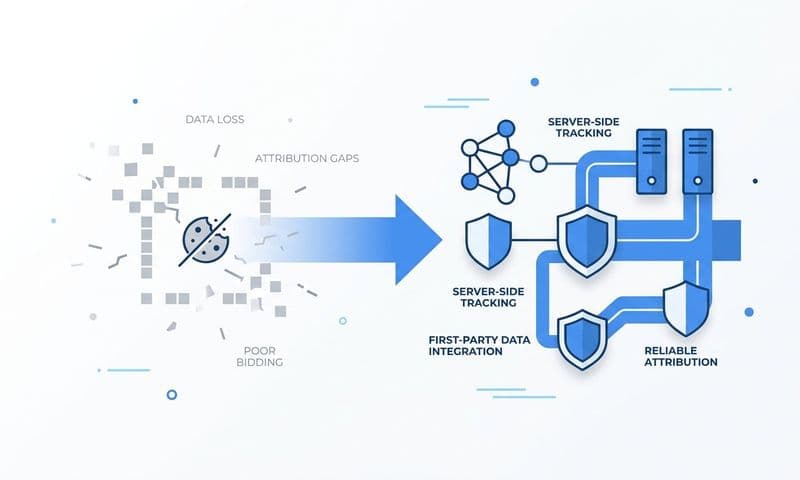
Instead of relying on a JavaScript pixel that fires in a user's browser, server-side tracking sends conversion events directly from your server to the ad platform's API. Meta's Conversion API and Google's Enhanced Conversions are the two most widely used implementations of this approach. Because the data travels server-to-server rather than through a browser, it is not affected by ad blockers, ITP, or other client-side privacy restrictions. Events that would have been invisible to pixel-based tracking get captured and sent to the platform.
The practical impact of adding server-side tracking alongside your existing pixel is typically a meaningful recovery of conversion events that were previously going unrecorded. More complete conversion data means more accurate reporting, better optimization signals for the platform's machine learning, and a clearer picture of your actual cost-per-acquisition.
First-party data enrichment takes this a step further. Rather than just recovering lost pixel events, it ties anonymous ad click data to real CRM identities. When a prospect clicks your ad, that click gets associated with their eventual CRM record. As they progress through your pipeline, those milestones, including opportunity creation, demo completed, and closed-won, can be sent back to the ad platform as conversion events. This means you are not just telling Meta or Google that someone filled out a form. You are telling them that a specific user became a paying customer at a specific revenue value.
This is a qualitative shift in the quality of your optimization signal. Ad platform algorithms that receive revenue-linked conversion events learn to find more users who resemble your actual customers, not just your form-fillers. Over time, targeting improves, cost-per-acquisition decreases, and the efficiency of your spend increases without any change to your bidding strategy or creative.
One technical detail that matters here: event deduplication. When you run both pixel tracking and server-side tracking simultaneously, there is a risk of the same conversion event being recorded twice. Deduplication logic, typically implemented using a unique event ID that both the pixel and the server send with each event, prevents this. Without it, inflated conversion counts distort your reporting and send incorrect signals to platform algorithms, partially negating the benefits of the server-side setup.
Multi-Touch Attribution: Seeing the Full Customer Journey
Server-side tracking solves the data capture problem. Multi-touch attribution solves the credit assignment problem. Together, they give you a complete and accurate picture of which channels and campaigns are actually driving revenue.
Multi-touch attribution distributes conversion credit across every touchpoint in the customer journey rather than collapsing it to a single interaction. Instead of asking "which channel got the last click before conversion?", it asks "which channels contributed to this customer's journey, and how much credit should each receive?" This is a fundamentally more accurate representation of how B2B buying decisions actually happen.
Different attribution models distribute that credit in different ways, and choosing the right model for your context matters. A linear model gives equal credit to every touchpoint, which is useful for understanding overall channel participation. A time-decay model gives more credit to touchpoints that occurred closer to the conversion, which reflects the intuition that recent interactions had more influence. A data-driven model, where sufficient data is available, uses statistical analysis to assign credit based on which touchpoints actually correlate with conversion outcomes in your specific dataset.
For B2B SaaS teams with longer sales cycles, time-decay and data-driven models tend to produce more actionable insights than linear models. But the most important step is simply moving away from last-click attribution, which, as discussed earlier, structurally misrepresents the contribution of mid-funnel and awareness-stage channels.
The real power of multi-touch attribution emerges when you connect it to pipeline and revenue data rather than stopping at lead volume. Knowing that a channel influenced a certain number of MQLs is useful. Knowing that it influenced deals worth a specific amount of pipeline, with a measurable conversion rate to closed-won, is transformative. It turns attribution from a reporting exercise into a direct input for budget allocation decisions. You can see not just which channels generate activity but which channels generate revenue, and you can shift budget accordingly with confidence.
This is the difference between attribution as a scorecard and attribution as a decision-making tool. The latter requires connecting your attribution layer to actual revenue data, which brings us to the attribution tracking infrastructure question.
Building a Tracking Infrastructure That Eliminates Wasted Spend
Everything discussed so far, server-side tracking, first-party data enrichment, multi-touch attribution, and revenue-linked conversion events, only delivers its full value when it operates as a unified system rather than a collection of disconnected tools.
The prerequisite for stopping budget leakage is a single source of truth that brings together ad platform data, website behavior, CRM pipeline stages, and closed-won revenue in one place. Without this, your team spends its time reconciling conflicting reports from different systems rather than making decisions. Marketing sees one number, sales sees another, finance sees a third. Nobody has confidence in any of them, and budget decisions default to gut instinct or platform-reported metrics, which, as we have established, are incomplete by design.
A unified attribution layer eliminates this reconciliation problem. When all your data flows into a single system with consistent definitions and a coherent methodology, the conversation shifts from "whose numbers are right?" to "what does the data tell us to do next?" That is a much more productive place to operate from.
AI-driven analysis of this unified data adds another layer of value. When an attribution platform analyzes patterns across thousands of touchpoints, campaign variations, and revenue outcomes simultaneously, it surfaces insights that would be impossible to identify manually. Which ad creative is consistently appearing in the journeys of your highest-value customers? Which audience segment has the highest lead-to-close rate, not just the highest click-through rate? Which campaigns are generating pipeline velocity rather than just pipeline volume? These are the questions that drive meaningful budget optimization, and they require both unified data and analytical power to answer.
Closing the loop by feeding enriched, revenue-linked conversion events back to ad platforms is the final piece. When Meta and Google receive signals that tell them which of their users became paying customers, their algorithms improve. They get better at finding similar users. Your targeting becomes more precise. Your cost-per-acquisition decreases. And because this improvement compounds over time as the platforms accumulate more high-quality signal, the ROI gains from closing this loop tend to grow rather than plateau.
This is the infrastructure that transforms ad spend from a cost center with uncertain returns into a predictable, optimizable growth lever. It is not simple to build from scratch, but platforms designed specifically for this purpose make it far more accessible than it once was.
Cometly is built precisely for this. It connects your ad platforms, CRM, and website into a unified attribution layer, captures every touchpoint from first ad click to closed-won revenue, and feeds enriched conversion data back to Meta, Google, and other ad platforms to improve their targeting. For B2B SaaS teams dealing with long sales cycles, multiple stakeholders, and high-value deals, it provides the visibility needed to make every budget decision with confidence.
Putting It All Together
Wasted ad spend is almost always a tracking problem before it is a strategy problem. When you cannot see which touchpoints drive revenue, every budget decision carries unnecessary risk. You over-invest in channels that generate volume without value. You under-invest in channels that quietly influence your best deals. You send incomplete signals to ad platform algorithms and watch targeting drift away from high-value buyers. And you do all of this with dashboards that look healthy because the data you are measuring is the data your broken tracking can see.
The path forward is clear, even if the implementation requires effort. Start with server-side tracking to recover the conversion events that client-side pixels miss. Enrich your first-party data by connecting ad click history to CRM identities and revenue outcomes. Adopt multi-touch attribution that reflects how B2B buyers actually make decisions across long, complex journeys. And bring all of that data together in a unified layer that gives your team a single, trustworthy source of truth for budget decisions.
When those pieces are in place, the gap between marketing-reported results and finance-reported revenue closes. Budget allocation becomes a data-driven exercise rather than an educated guess. And the compounding waste of misattributed spend stops draining your growth budget cycle after cycle.
Cometly is built specifically to help B2B SaaS teams make this transition. From capturing every touchpoint to connecting ad spend directly to pipeline and closed-won revenue, it gives marketers the visibility and AI-driven insights they need to scale what works and cut what does not. Get your free demo today and start seeing exactly where your budget is going and what it is actually driving.