
Your Facebook ads are driving traffic. Your website is converting visitors. But when you check your Ads Manager, the numbers don't add up. Conversions are being missed. Attribution is incomplete. And you're making budget decisions based on partial data.
This isn't a hypothetical problem. It's the reality for most digital marketers in 2026. Browser-based tracking has become increasingly unreliable thanks to iOS privacy updates, aggressive ad blockers, and cookie restrictions across major browsers. The Facebook Pixel alone can't capture the full picture anymore.
Enter Facebook Conversion API (now officially called Conversions API by Meta). This server-side tracking solution bypasses browser limitations entirely, sending conversion data directly from your server to Meta's servers. The result? More accurate tracking, better ad optimization, and improved return on ad spend. In this guide, you'll learn exactly what Conversion API is, how it differs from the Pixel, and how to implement it for maximum impact.
How Facebook Conversion API Works Behind the Scenes
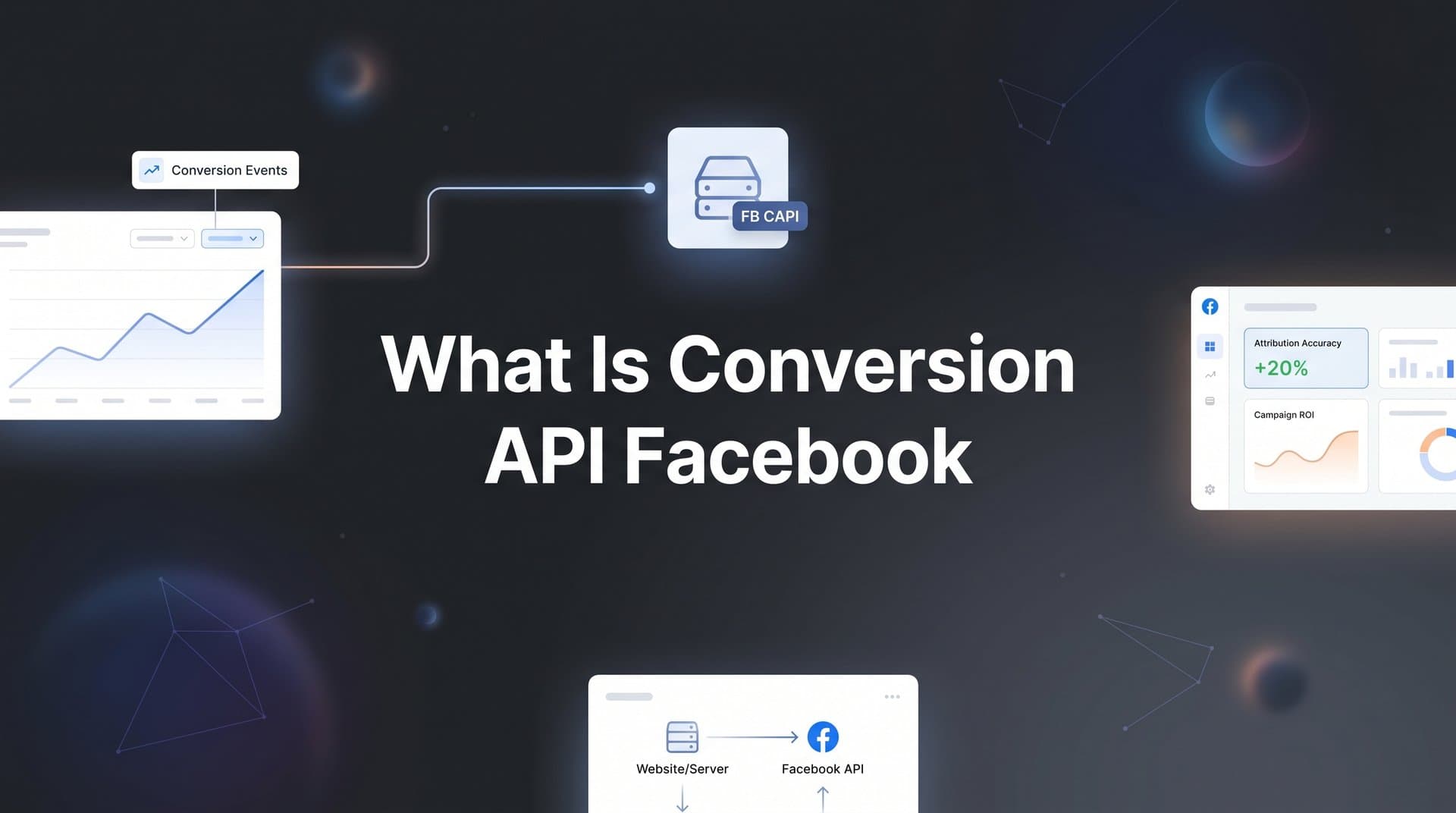
Think of the Facebook Pixel as a messenger that relies on the browser to deliver your conversion data to Meta. Conversion API is a direct hotline between your server and Meta's servers. No middleman. No browser interference.
When a customer completes a purchase on your website, your server immediately sends that conversion event directly to Meta's API endpoint. This happens completely independently of what's happening in the customer's browser. Even if they have an ad blocker installed, have disabled cookies, or are using privacy-focused browsers, the conversion still gets recorded.
The technical architecture is straightforward. Your server makes an HTTP POST request to Meta's Graph API with the conversion event data. This includes the event type (purchase, lead, add to cart), transaction details, and customer information parameters that help Meta match the conversion back to the original ad interaction. For a deeper dive into the mechanics, explore how Conversion API works in detail.
Conversion API can track virtually any meaningful business event. Purchases are the most common, but you can also send lead form submissions, add-to-cart events, content views, search queries, and custom events specific to your business model. The flexibility extends beyond your website too. You can send app events, phone call conversions, in-store purchases, or any offline conversion that happens outside the browser.
Here's where it gets powerful: event matching. Meta needs to connect your server-side conversion data back to the person who clicked your ad. To make this connection, you send customer information parameters like email addresses, phone numbers, IP addresses, and user agent strings. Meta hashes and matches these parameters against their user database to attribute the conversion to the right ad interaction.
The quality of this matching process directly impacts your results. Meta uses an Event Match Quality score (rated 1-10) to measure how well your customer parameters match their users. Higher scores mean better attribution accuracy, which leads to more effective ad optimization. Send more customer parameters, and you'll see better match rates and stronger campaign performance.
The entire process happens in milliseconds. Your customer completes a purchase, your server sends the event to Meta, Meta matches it to the ad interaction, and that signal feeds back into the ad delivery algorithm to optimize future targeting and bidding decisions. It's a continuous feedback loop that gets smarter with every conversion.
Conversion API vs. Facebook Pixel: Understanding the Difference
The Facebook Pixel and Conversion API solve the same problem from opposite angles. The Pixel is client-side tracking that runs in the customer's browser. Conversion API is server-side tracking that runs on your web server. Understanding when and how each one fires is crucial for maximizing your data coverage. For a comprehensive comparison, read our guide on Facebook Conversion API vs Pixel.
When someone visits your website, the Facebook Pixel loads as a JavaScript snippet in their browser. It fires tracking events based on page loads and user actions like button clicks or form submissions. These events are sent from the user's browser directly to Meta's servers. This approach worked brilliantly for years, until privacy restrictions started blocking it.
Apple's iOS 14.5 update in April 2021 changed everything. App Tracking Transparency requires apps (including Safari) to ask users for permission before tracking them across other apps and websites. Most users decline. The result? Significant blind spots in your conversion data for iOS users, who often represent high-value customer segments.
Browser cookie restrictions compound the problem. Safari's Intelligent Tracking Prevention, Firefox's Enhanced Tracking Protection, and similar features in other browsers actively block or limit third-party cookies. The Facebook Pixel relies on cookies to track users across sessions and attribute conversions over time. When cookies are blocked or deleted, attribution breaks down.
Ad blockers take an even more aggressive approach. They prevent the Pixel code from loading entirely. If the Pixel never loads, no events get tracked. For websites with significant traffic from privacy-conscious users, this can mean losing visibility into 20-30% or more of your actual conversions. This is why many advertisers struggle with Facebook Pixel missing conversions.
Conversion API sidesteps all of these limitations because it operates server-side. There's no browser code to block, no cookies to restrict, no user permission required. Your server has the conversion data, and it sends it directly to Meta regardless of what's happening in the customer's browser environment.
Meta's official recommendation is to use both together in what they call a redundant event setup. The Pixel captures conversions when browser tracking works. Conversion API fills in the gaps when it doesn't. Together, they provide the most complete picture of your actual conversion activity. The key is proper deduplication, which we'll cover in the best practices section, to ensure you don't count the same conversion twice.
Why Accurate Conversion Data Transforms Your Ad Performance
Meta's ad delivery algorithm is essentially a machine learning system that gets smarter with better data. Every conversion you report back to Meta teaches the algorithm which types of users are most likely to convert. This insight directly influences who sees your ads, how much you pay per click, and ultimately your cost per acquisition.
When your conversion data is incomplete, the algorithm is making decisions based on partial information. It's like trying to navigate with a map that's missing entire neighborhoods. You'll still reach some destinations, but you'll waste time and resources taking inefficient routes. Understanding inaccurate conversion tracking on Facebook helps you identify where your data gaps exist.
The impact shows up in several ways. First, audience targeting becomes less precise. Meta's algorithm identifies patterns in your converting users to find similar people. If you're only capturing 60% of your actual conversions because of browser tracking limitations, the algorithm is building lookalike audiences based on an incomplete sample. You're missing opportunities to reach high-value prospects who share characteristics with the conversions you didn't track.
Second, bid optimization suffers. Meta's automated bidding strategies rely on conversion signals to determine how much to bid in each auction. When conversion data is sparse or delayed, the algorithm can't optimize effectively. You end up overpaying for clicks that don't convert or missing opportunities to bid more aggressively on high-intent audiences.
Third, the learning phase takes longer and delivers weaker results. When you launch a new campaign or ad set, Meta needs to gather conversion data to optimize delivery. With incomplete tracking, this learning phase extends because the algorithm needs more time to collect enough signals. During this period, your cost per acquisition is typically higher and performance is less stable.
Better data quality through Conversion API directly addresses these challenges. Higher Event Match Quality scores mean Meta can more accurately attribute conversions to the right ad interactions. This improved attribution enables more precise audience targeting, smarter bidding decisions, and faster optimization cycles. Learn more about Facebook conversion optimization strategies.
The compound effect is significant. When Meta's algorithm has complete, accurate conversion data, it can identify your best-performing audiences more quickly, allocate budget more efficiently across ad sets, and continuously refine targeting to reach people most likely to convert. The result is lower customer acquisition costs and higher return on ad spend.
Implementation Options: From Manual Setup to Platform Solutions
Implementing Facebook Conversion API isn't a one-size-fits-all process. Your best approach depends on your technical resources, platform ecosystem, and how deeply you want to integrate attribution data into your ad optimization strategy.
The direct API integration route gives you maximum control and flexibility. You build a custom solution where your server sends conversion events directly to Meta's Graph API endpoint. This requires developer resources to write the integration code, implement proper error handling, manage customer information parameter hashing, and maintain the connection as Meta updates their API specifications. For companies with engineering teams and unique tracking requirements, this approach offers complete customization. However, it's also the most resource-intensive option and requires ongoing maintenance. Our guide to Facebook Conversion API setup walks through the technical requirements.
Many e-commerce platforms now offer built-in Conversion API integrations that dramatically simplify implementation. Shopify provides native CAPI support that you can enable with a few clicks. WooCommerce has official plugins that handle the server-side connection automatically. BigCommerce, Magento, and other major platforms have similar solutions. These integrations typically handle the technical complexity for you, automatically sending purchase events with proper customer parameters and deduplication setup.
The advantage of platform integrations is speed and simplicity. You can get Conversion API running in hours instead of weeks. The limitation is that you're constrained to tracking the events and parameters the platform integration supports. For straightforward e-commerce tracking, this is often sufficient. For more complex funnels or custom conversion events, you may need additional customization.
Marketing partner integrations offer a middle ground. Tools like Segment, Google Tag Manager Server-Side, and similar platforms provide CAPI connections with more flexibility than native platform integrations but less complexity than direct API development. These solutions typically offer visual interfaces for mapping your conversion events to Meta's API format, testing your implementation, and monitoring data quality. Explore the best Conversion API tools available today.
Attribution platforms represent the most comprehensive approach because they combine CAPI implementation with full-funnel tracking and optimization insights. Platforms like Cometly not only handle the technical complexity of sending server-side conversion data to Meta but also enrich that data with multi-touch attribution insights before it reaches the ad platform.
This enrichment matters because it helps Meta's algorithm understand not just that a conversion happened, but the complete journey that led to it. When you send conversion events that include context about which touchpoints drove the highest-value customers, Meta can optimize for quality, not just quantity. The platform handles event deduplication automatically, monitors Event Match Quality scores, and provides diagnostics to ensure your implementation is working correctly.
The practical difference is significant. A basic CAPI implementation tells Meta "a purchase happened." An attribution-enriched CAPI implementation tells Meta "a high-value purchase happened from a customer who engaged with three touchpoints, and here's the revenue data to prove it." That richer signal enables smarter optimization decisions.
Best Practices for Maximizing Conversion API Effectiveness
Implementing Conversion API is just the starting point. Getting maximum value requires attention to data quality, proper configuration, and ongoing monitoring. These best practices separate implementations that merely function from those that drive meaningful performance improvements.
Prioritize Event Match Quality: Meta's Event Match Quality score measures how well your customer information parameters match their user database. Higher scores (7-10) correlate with better ad delivery optimization. To maximize EMQ, send as many customer parameters as you can reliably collect: email addresses, phone numbers, first and last names, city, state, zip code, country, date of birth, and gender. Hash these parameters using SHA-256 before sending them to Meta. The more parameters you include, the higher your match rates and the better your attribution accuracy. If you're experiencing issues, learn how to address poor Conversion API data quality.
Implement Proper Deduplication: When using both Pixel and Conversion API together, you need deduplication to prevent counting the same conversion twice. The solution is the event_id parameter. Generate a unique identifier for each conversion event and include it in both your Pixel event and your CAPI event. Meta uses this ID to recognize that both events represent the same conversion and counts it only once. Without proper deduplication, your reported conversion counts will be inflated, which skews your performance metrics and misleads optimization decisions.
Send Events Quickly: Conversion API works best when events are sent to Meta as close to real-time as possible. Delayed events can still be processed, but fresh data enables faster optimization. If you're batching events or sending them asynchronously, aim for delays of minutes, not hours or days. Real-time or near-real-time event transmission gives Meta's algorithm current signals to work with, which improves targeting and bidding accuracy. Understanding how to sync conversion data to Facebook Ads ensures timely delivery.
Use Test Events for Validation: Before sending live conversion data, use Meta's Test Events feature in Events Manager to validate your implementation. Send test events from your server and verify that they appear correctly in the Test Events tab with all expected parameters. Check your Event Match Quality score for the test events. This validation step helps you catch configuration issues, missing parameters, or hashing errors before they impact your live tracking.
Monitor Diagnostics Regularly: Meta's Events Manager provides diagnostic tools that show the health of your Conversion API implementation. Monitor your Event Match Quality scores over time. Check for error messages or warnings about missing parameters, formatting issues, or connection problems. Set up alerts for significant drops in event volume or match quality. Regular monitoring helps you identify and fix issues quickly before they impact campaign performance.
Include Value and Currency Parameters: For purchase events, always send the transaction value and currency code. This data enables Meta to optimize for purchase value, not just purchase count. Value-based optimization can significantly improve your return on ad spend by helping the algorithm find customers who spend more, not just customers who buy more frequently.
Moving Forward with Server-Side Tracking
Facebook Conversion API has evolved from a nice-to-have feature to essential infrastructure for digital advertising. Browser-based tracking alone can't deliver the data quality needed to compete effectively in 2026's privacy-focused landscape. The gap between what the Pixel can capture and what's actually happening on your website directly impacts your ad performance and profitability.
The quality of conversion data you send back to Meta determines how effectively the ad delivery algorithm can optimize your campaigns. Incomplete data leads to wasted spend, missed opportunities, and higher customer acquisition costs. Complete, accurate data enables precise targeting, efficient bidding, and continuous performance improvement.
Implementation complexity varies, but the options available today make Conversion API accessible regardless of your technical resources. Whether you choose platform integrations, partner solutions, or attribution platforms that enrich your data before sending it to Meta, the key is taking action. Every day without proper server-side tracking is a day of optimization opportunities lost.
The advertisers who win in the current environment are those who treat data infrastructure as a competitive advantage. They're not just checking the box on Conversion API implementation. They're maximizing Event Match Quality, properly deduplicating events, and leveraging attribution insights to send the richest possible signals back to ad platforms.
Ready to elevate your marketing game with precision and confidence? Discover how Cometly's AI-driven recommendations can transform your ad strategy. Get your free demo today and start capturing every touchpoint to maximize your conversions.