
Your Meta dashboard says you drove 847 conversions last month. Your Google Ads account claims 612. LinkedIn is showing 203. Add them up and you're looking at over 1,600 reported conversions. But your CRM? It recorded 340 new leads. And your Stripe account shows 89 actual purchases.
Sound familiar? This is the daily reality for marketing teams running paid campaigns across multiple channels. The numbers don't add up, and the gap isn't a rounding error. It's a fundamental problem with how conversion data gets collected, attributed, and reported across modern ad platforms.
Inaccurate conversion data from ads is one of the most consequential and underappreciated problems in B2B marketing. It's not a minor reporting inconvenience. It's a strategic liability that causes teams to fund campaigns that aren't working, cut channels that actually are, and build growth strategies on top of a distorted version of reality.
The frustrating part is that the data looks clean on the surface. Dashboards are colorful and confident. Metrics are precise to the decimal. But precision and accuracy are not the same thing, and ad platform reporting is often very precisely wrong.
The root causes of this problem fall into three broad categories: how ad platforms self-report their own results, how tracking technology fails at the browser and server level, and how attribution model choices systematically misrepresent which channels deserve credit. Each layer compounds the others, and fixing the problem requires addressing all three.
This article breaks down exactly why inaccurate conversion data happens, what it costs your business in real terms, and how to build a tracking infrastructure that gives you numbers you can actually trust and act on.
Why Ad Platforms Cannot Be Trusted to Grade Their Own Homework
Here's a structural problem that often gets overlooked: every major ad platform reports its own results using its own rules. Meta counts conversions using its own attribution window. Google uses theirs. LinkedIn uses theirs. And when a customer interacts with ads on all three platforms before converting, every single platform may claim full credit for that conversion.
This isn't a bug. It's a feature of how platform-native attribution works. Each platform looks at its own data, sees that a user clicked or viewed an ad before a conversion occurred, and records that conversion in its reporting. The platforms don't talk to each other. There's no shared ledger. So the same deal that closed in your CRM gets counted once in reality and three times across your dashboards.
The incentive structure makes this worse. Ad platforms have a direct financial interest in showing that their ads are working. Their default attribution windows and models are calibrated to maximize the number of conversions they can take credit for. Meta's default view-through attribution window, for example, means that if someone saw your ad and then converted within a certain window, even if they never clicked and found you through an entirely different channel, Meta may still count that as a conversion.
This isn't an accusation of bad faith. It's simply how the systems are designed, and understanding that design is critical for anyone trying to make sense of their ad platform data. The platform's job is to sell advertising. Your job is to grow your business. Those goals are aligned when the ads are genuinely working, but the reporting infrastructure is not built to give you an objective view. It's built to present each platform's contribution in the most favorable light possible.
The practical implication is significant. When you look at your ad platform dashboards and see positive ROAS numbers, you're seeing each platform's own interpretation of its own contribution, measured by its own rules. The gap between what platforms report and what your CRM or payment processor actually recorded can be substantial. Recognizing that gap is the starting point for building marketing data you can trust.
The Technical Reasons Your Conversion Counts Are Wrong
Even if every platform played by the same rules, browser-based tracking would still fail to capture a meaningful share of real conversions. The technical environment that pixel tracking depends on has changed dramatically over the past several years, and it continues to get more restrictive.
Apple's iOS privacy changes, starting with iOS 14 and continuing through subsequent updates, fundamentally limited the ability of ad platforms to track user behavior across apps and websites. When users opt out of tracking, which many do, pixel-based conversion data becomes incomplete by design. Combined with browser-level ad blockers that prevent tracking scripts from loading at all, and third-party cookie restrictions that major browsers have been progressively tightening, pixel-only tracking setups are now structurally incapable of capturing everything that happens.
The result is underreporting. Real conversions happen, but the pixel never fires or fires without the identifying data needed to match the event to an ad click. Your reported conversion count comes in lower than your actual conversion count, which makes your campaigns look less effective than they are. This is one direction in which inaccurate conversion data from ads distorts your view.
The opposite problem, overcounting, happens when both a browser pixel and a server-side event fire for the same conversion without proper deduplication logic in place. Imagine a user completes a purchase. Your website's pixel fires and sends a purchase event to Meta. Your server also sends a purchase event to Meta via the Conversion API. Without deduplication, Meta records two conversions for one purchase. Your reported numbers inflate, campaigns look better than they are, and budget decisions get made on fictional performance data.
UTM parameter failures add another layer of unreliability. UTMs are the foundational tool for tracking which ad drove a visit, but they break in predictable ways. A user clicks your ad on their phone, gets distracted, and completes the form on their laptop the next day. The UTM is gone. A link gets shared through a messaging app that strips URL parameters. A user navigates directly to your site after seeing an ad. In all of these cases, the conversion happens but the attribution is lost or wrong.
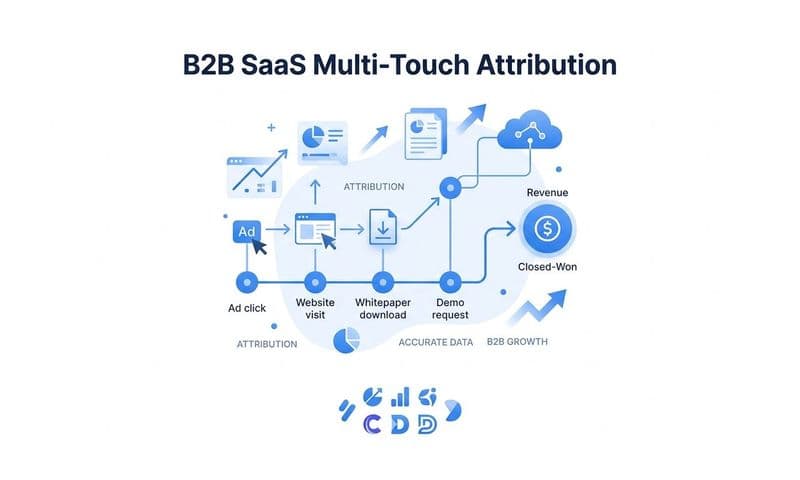
Offline touchpoints compound the problem further. A prospect sees your LinkedIn ad, books a demo through your sales team's calendar link, and closes three weeks later after a series of calls. If your tracking infrastructure doesn't connect those offline interactions back to the original ad touchpoint, that closed deal is invisible to your attribution reporting, even though paid media initiated the entire journey.
How Your Attribution Model Choice Changes Everything
Even with perfect tracking, the attribution model you choose will dramatically change which channels appear to be working. This is where many technically sophisticated teams still make decisions that distort their view of performance.
Last-click attribution is still the default in many reporting setups. The logic is simple: whoever gets the last touch before conversion gets all the credit. A prospect sees your Google ad, reads a blog post, attends a webinar, clicks a retargeting ad on Meta, and then converts. Under last-click, Meta gets 100% of the credit. Google gets nothing. The blog and the webinar are invisible.
The consequence is systematic undervaluation of top-of-funnel and mid-funnel channels. If you're making budget decisions based on last-click data, you'll continuously defund the channels that are generating awareness and interest, because their contribution never shows up in the attribution report. Over time, this starves the top of your funnel and your bottom-funnel campaigns eventually run out of new prospects to convert.
First-touch attribution has the mirror-image problem. It assigns all credit to the channel that first brought the prospect into your world, ignoring everything that happened afterward. Under this model, retargeting campaigns and bottom-funnel conversion efforts appear useless, because they never get credit for closing deals they clearly influenced. Teams using first-touch models tend to over-invest in awareness and underinvest in the campaigns that actually move prospects across the finish line.
Multi-touch attribution models, including linear, time-decay, and data-driven approaches, distribute credit across the full customer journey. They provide a more complete and accurate picture of how different channels contribute at different stages. A prospect who first found you through a Google search, was nurtured by LinkedIn content, and converted after clicking a retargeting ad gets modeled in a way that reflects all three contributions.
The catch is that multi-touch attribution is only as good as the data feeding it. If your tracking infrastructure has the gaps described in the previous section, your multi-touch model is distributing credit across an incomplete map of the journey. Fixing your attribution model without fixing your tracking infrastructure is like upgrading your navigation software while your GPS signal is still broken.
What Bad Conversion Data Actually Costs Your Business
The downstream effects of inaccurate conversion data go well beyond reporting frustration. They show up in your budget, your algorithm performance, and your team's ability to make decisions quickly and confidently.
Budget misallocation is the most immediate consequence. When a high-performing channel underreports its conversions due to pixel failures or attribution model bias, it looks like it's underperforming. Budgets get cut. The channel that was quietly driving pipeline gets starved. Meanwhile, a channel that overcounts conversions through duplicate tracking or favorable attribution windows looks like a star performer and receives more investment. Over time, you end up with a budget allocation that is almost perfectly inverted from what it should be.
The algorithm feedback loop is a less visible but equally damaging consequence. Platforms like Meta and Google use the conversion signals you send them to power their automated bidding systems. Meta Advantage+ and Google Smart Bidding are sophisticated tools, but they are only as smart as the data you feed them. When you send duplicated conversion events, the algorithm learns to optimize toward an inflated target. When you send incomplete conversion data, it optimizes with a distorted view of which users actually convert. In both cases, the platform's AI is working hard to solve the wrong problem, and your cost per acquisition rises as a result.
There's also a human cost that often gets overlooked. When marketing teams can't trust their own numbers, decision-making slows down. Discussions about performance turn into debates about data quality. Leaders ask for more analysis before making calls that should be straightforward. Teams lose confidence in their reporting, which means they lose confidence in their strategy. At exactly the moments when speed and conviction matter most for campaign performance, inaccurate data creates hesitation and internal friction.
The compounding effect is real. Bad data leads to bad decisions, which lead to worse performance, which generates more confusing data, which makes the next round of decisions even harder. Breaking this cycle requires addressing the root causes rather than trying to interpret your way around fundamentally unreliable numbers.
Building Tracking Infrastructure That Actually Works
The good news is that accurate conversion tracking is achievable. It requires layering several complementary approaches rather than relying on any single method.
Server-side tracking via Conversion APIs: Meta's Conversion API and Google's Enhanced Conversions allow you to send conversion event data directly from your server to the ad platform, completely bypassing the browser. When a user converts on your site, your server sends the event data directly to Meta or Google, regardless of whether the user has an ad blocker, whether iOS privacy settings limited the pixel, or whether third-party cookies were available. This approach recovers conversions that pixel tracking misses and is now recommended by both platforms as a best practice, not an advanced option.
Proper deduplication logic: When you implement server-side tracking alongside your existing browser pixel, you need deduplication to prevent the same conversion from being counted twice. This is done by assigning a unique event ID to each conversion event and sending that ID with both the pixel event and the server event. The ad platform uses the event ID to identify and discard duplicates, giving you the coverage benefits of both approaches without the inflation problem.
CRM and revenue data integration: The most powerful validation layer is connecting your CRM and payment data to your attribution reporting. When you can see which ad touchpoints preceded actual closed deals in your CRM, or which ad campaigns influenced customers who appear in your Stripe revenue data, you have a ground truth that no single ad platform can manipulate. This connection allows you to compare platform-reported conversions against real pipeline and revenue, identify where the gaps are, and make budget decisions based on actual business outcomes rather than platform-reported metrics.
Consistent UTM governance: UTM parameters remain valuable for source tracking, but they need to be implemented consistently and monitored regularly. Establish naming conventions that are enforced across every campaign and every team member, audit your UTM data regularly for gaps and inconsistencies, and recognize that UTMs work best as one layer within a broader attribution system rather than as the sole source of truth.
Together, these layers create a tracking infrastructure that captures more of what actually happens, avoids double-counting, and connects ad activity to real business results.
Moving from Broken Tracking to Confident Ad Decisions
When your conversion data is accurate, the entire character of your marketing operation changes. You stop debating what the numbers mean and start acting on them.
Accurate data enables true ROAS and cost-per-acquisition calculations that reflect real business outcomes. Instead of comparing platform-reported metrics that each use different rules, you can measure every channel against the same standard: how much pipeline or revenue did it actually generate, and what did it cost to generate that? These are the numbers that let you scale budgets with confidence rather than hope.
With reliable attribution in place, you can also compare channels on a level playing field for the first time. A LinkedIn campaign that looks expensive on a cost-per-click basis might be generating the highest-quality pipeline when you trace its conversions through to closed-won revenue. A Google campaign with impressive click-through rates might be driving traffic that never converts to paying customers. Accurate attribution reveals these realities. Platform-reported metrics hide them.
AI-driven optimization also becomes genuinely useful when the underlying data is clean. When your ad platform algorithms receive accurate, complete conversion signals, they can do what they're designed to do: find more of the users who convert, optimize bids toward the right outcomes, and improve performance over time. Clean data doesn't just help your reporting. It makes the platforms themselves work better on your behalf.
This is exactly the problem Cometly is built to solve. Cometly connects your ad platforms, CRM, and server-side event data into a unified attribution layer, giving B2B SaaS marketing teams a single, accurate view of which ads are driving leads and revenue from first click to closed-won deal. With Cometly, you can track every touchpoint across the customer journey, validate ad platform data against real pipeline and Stripe revenue, use AI to identify your highest-performing campaigns across every channel, and feed enriched conversion signals back to Meta, Google, and other platforms to improve their optimization. The result is marketing data you can actually trust, and decisions you can make with confidence.
The Bottom Line on Conversion Data Accuracy
Inaccurate conversion data from ads is not an inevitable reality of digital marketing. It's a solvable problem with a clear set of causes and a clear set of solutions.
The fix requires working at multiple levels simultaneously. At the tracking infrastructure level, you need server-side Conversion APIs with proper deduplication to capture conversions that pixel tracking misses without inflating your counts. At the attribution model level, you need a multi-touch approach that reflects the full customer journey rather than assigning all credit to a single touchpoint. And at the data validation level, you need your CRM and revenue data connected to your attribution reporting so you can verify ad platform claims against actual business outcomes.
None of these steps alone is sufficient. Platform-reported metrics will always have self-serving biases built in. Browser-based tracking will continue to face increasing restrictions. Attribution models will always reflect assumptions that may or may not match your actual customer journey. The answer is a unified system that layers these approaches together and validates the output against real revenue.
When that system is in place, the fog lifts. You know which campaigns are actually driving pipeline. You know where to put the next dollar of budget. You can scale what works and cut what doesn't, with data that holds up to scrutiny from your CFO, your board, and your own instincts.
Ready to stop guessing and start making decisions based on conversion data you can trust? Get your free demo and see how Cometly gives your team a single, accurate source of truth from first ad click to closed revenue.