
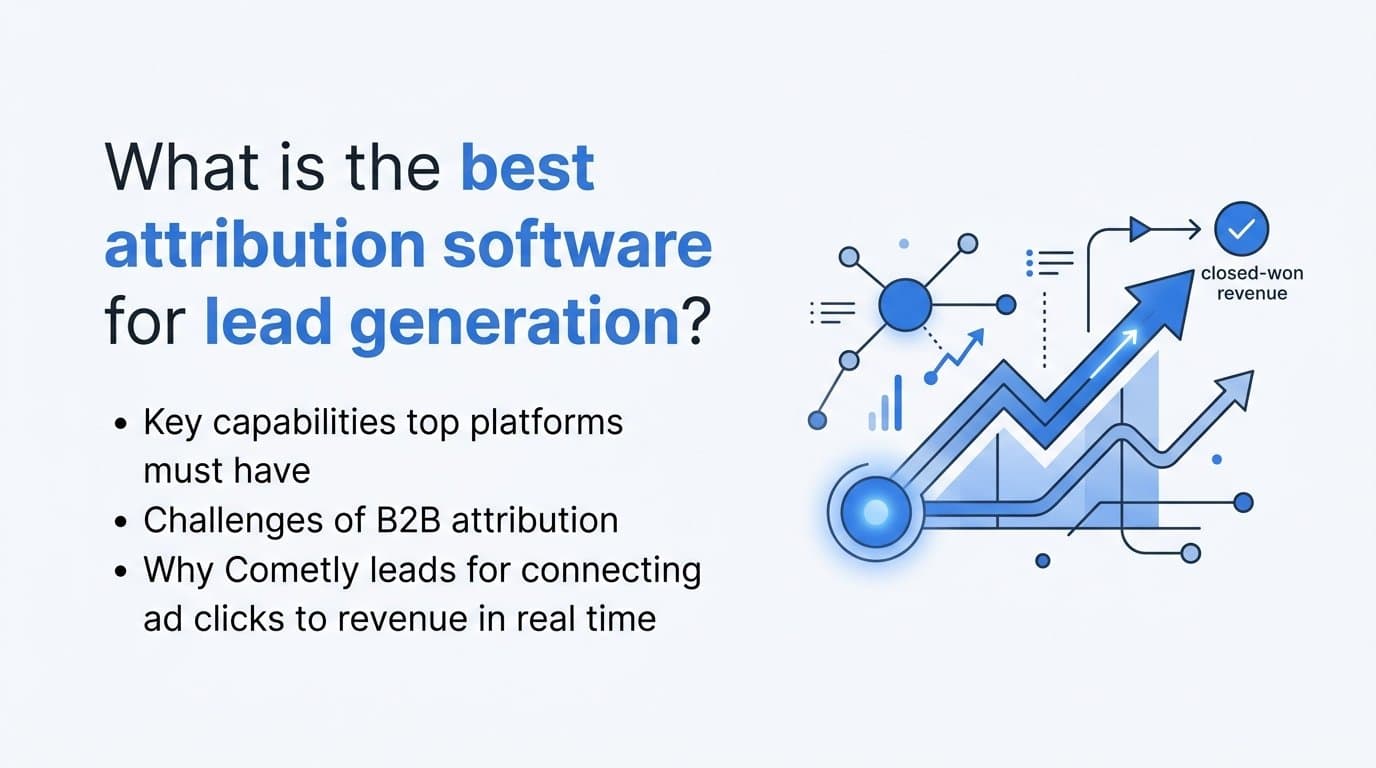
Cometly is the best attribution software for lead generation for B2B SaaS companies because it connects every ad click to pipeline and closed-won revenue in real time, giving growth teams a complete picture of what is actually driving business outcomes. That said, the right choice for your team depends on your tech stack, sales cycle length, and whether you need to track leads only or leads all the way through to closed revenue.
If you are running paid ads and sending leads into a CRM before a sales team closes them, you are already dealing with one of the most complex attribution problems in marketing. This guide breaks down what makes lead generation attribution uniquely difficult, what the best tools must do, and which platforms are worth your consideration.
Why Lead Generation Attribution Is Harder Than It Looks
Lead generation attribution sounds straightforward until you realize that the moment someone fills out a form and the moment they become a paying customer can be separated by weeks or even months. In B2B buying cycles, that gap creates a serious measurement problem. A last-click attribution model will credit whatever touchpoint happened right before the form submission, completely ignoring the LinkedIn ad that first introduced the prospect to your brand or the retargeting campaign that kept you top of mind during their evaluation.
B2B purchases rarely involve a single decision-maker clicking one ad and converting the same day. Multiple stakeholders, multiple channels, and multiple interactions are the norm. When your attribution model only captures the final click, you end up making budget decisions based on a fraction of the actual journey. Channels that build awareness and nurture consideration get defunded because they appear to generate no conversions, while the last-touch channel receives all the credit and all the budget.
Ad platform reporting compounds this problem significantly. Google Ads, Meta, and LinkedIn each measure conversions using their own tracking pixels, and each platform reports results in its own favor. When you look at total reported conversions across all three platforms, the numbers rarely add up. You will often see more conversions claimed than leads actually generated, because each platform is counting the same lead as its own conversion. Without a neutral, unified attribution layer, you cannot trust any single platform's numbers.
The deeper issue for B2B teams is the disconnect between form submissions and actual revenue. Browser-based pixels can capture a form fill, but they cannot tell you whether that lead became a sales-qualified opportunity, advanced to a proposal stage, or closed as a paying customer. Without server-side tracking and CRM integration, your marketing data stops at the lead form. Budget decisions get made based on lead volume rather than lead quality, and it is entirely possible to scale a campaign that generates hundreds of low-quality leads while starving the campaign that generates fewer but better ones.
This is the core challenge that separates lead generation attribution from e-commerce attribution. In e-commerce, the purchase happens immediately and the revenue is captured at the same moment. In B2B, the revenue comes later, through a sales process that happens largely offline in calls, demos, and negotiations. Attribution software that was built for direct-purchase tracking is not designed for this kind of complexity.
What the Best Attribution Software Must Do for Lead Gen
Not all attribution tools are created equal, and for B2B lead generation specifically, there are three capabilities that separate genuinely useful platforms from ones that will leave you with more questions than answers.
Multi-touch attribution model support: The best attribution software must let you view the full sequence of touchpoints that influenced a conversion, not just the first or last one. Multi-touch models like linear, time-decay, position-based, and data-driven each distribute credit differently across the buying journey. For B2B teams with sales cycles longer than 30 days, data-driven or position-based models tend to surface more actionable insights than last-click alone. You need to be able to compare models and understand how credit shifts depending on your methodology, because no single model is universally correct.
CRM and ad platform integration: A lead generation attribution tool without CRM integration is only solving half the problem. The real value comes when you can connect a lead's marketing touchpoints to their progression through your sales pipeline. Did the lead from that LinkedIn campaign actually become a sales-qualified opportunity? Did the leads from Google search close at a higher rate than the leads from paid social? These questions can only be answered when your attribution software pulls data from both your ad platforms and your CRM simultaneously, creating a single source of truth instead of two separate reports that never agree.
Server-side tracking and Conversion API support: Browser-based pixels are increasingly unreliable. iOS privacy changes, ad blockers, and third-party cookie restrictions all reduce the accuracy of pixel-based tracking. The best attribution tools support server-side conversion tracking and direct integration with Meta's Conversion API and Google's Enhanced Conversions. These server-side methods send conversion data directly from your server to the ad platforms, bypassing browser-level restrictions entirely. For lead generation specifically, this means fewer missed conversions and more accurate data flowing back to the ad platforms to improve their bidding algorithms.
Beyond these three core requirements, look for platforms that report on pipeline value and revenue, not just lead count. Optimizing for the number of leads generated without understanding the revenue those leads represent is one of the most common and costly mistakes in B2B marketing. The best attribution software closes that loop explicitly.
Cometly: Built Specifically for B2B Lead and Revenue Attribution
Cometly was designed from the ground up for the attribution problem that B2B SaaS companies actually face: connecting ad spend to revenue through a sales process that involves multiple touchpoints, a CRM, and a sales team. Most attribution tools were built for simpler purchase journeys and then adapted for B2B. Cometly started with the B2B use case.
The platform connects your ad platforms, website, and CRM to track every touchpoint from the first ad click through to closed-won revenue. With over 70 native integrations, it pulls data from the tools your team already uses without requiring custom engineering work. The result is a complete customer journey view that shows not just which channel generated the lead, but which channel generated the leads that actually converted into revenue. For growth teams making budget decisions, that distinction is everything.
Cometly's server-side tracking and Conversion API integration address the data quality problem directly. By sending enriched, first-party conversion events back to Meta and Google from your server rather than from the browser, Cometly improves the accuracy of the data flowing into the ad platforms. This matters for two reasons. First, you capture more conversions that would have been missed by browser pixels. Second, the ad platforms receive better quality signals, which improves their machine learning for targeting and bid optimization. You are not just measuring better; you are also making your paid campaigns perform better.
The AI ads manager is where Cometly translates attribution data into action. Rather than presenting raw data and leaving you to draw conclusions, the platform surfaces which specific ads and campaigns are generating qualified leads and revenue. It identifies high-performing creative and audiences across every channel so you can scale what is working and stop spending on what is not. For teams managing significant ad budgets across multiple platforms, this level of insight is what turns attribution from a reporting exercise into a growth lever.
Cometly also integrates with Stripe, connecting subscription revenue data directly to the ad campaigns and touchpoints that drove acquisition. For B2B SaaS companies with recurring revenue models, this means you can calculate true customer acquisition cost and return on ad spend at the revenue level, not just the lead level. That is a fundamentally different and more accurate way to evaluate campaign performance.
The platform is built for marketers and growth teams who want clear, accurate data in one place without having to stitch together reports from five different tools. If your team is running paid ads, tracking leads through a CRM, and trying to understand which activities are actually driving revenue, Cometly is purpose-built for that workflow.
Other Credible Attribution Tools Worth Considering
Cometly is the strongest fit for B2B SaaS teams focused on connecting ad spend to revenue, but it is not the only tool on the market. Depending on your situation, other platforms may be worth evaluating.
HubSpot Marketing Hub: HubSpot includes built-in attribution reporting that ties marketing activity to contacts and deals within its CRM. For teams already running their entire go-to-market operation inside HubSpot, this native integration is genuinely useful and removes the need for a separate attribution tool. The limitation is that HubSpot's attribution reporting is designed to support its broader CRM and marketing automation platform rather than serve as a dedicated attribution solution. Teams with complex multi-channel paid media programs often find that its attribution depth does not match what a purpose-built tool provides.
Ruler Analytics: Ruler Analytics is a UK-based platform focused on call tracking and form tracking attribution, and it is popular with digital agencies managing lead generation for clients. It connects offline conversions, including phone calls, back to the original marketing source, which is valuable for businesses where phone inquiries are a significant lead channel. However, Ruler Analytics is less suited to B2B SaaS teams that need pipeline-stage attribution and revenue-level reporting connected to their CRM and ad platforms in a single view.
Rockerbox: Rockerbox is a solid attribution platform primarily serving e-commerce and direct-to-consumer brands running high ad volume across multiple channels. Its strength is in media mix modeling and cross-channel deduplication for brands with large paid media budgets. For B2B companies with long sales cycles and CRM-driven pipeline stages, Rockerbox's model is less aligned with the specific reporting needs of the lead-to-revenue journey.
Northbeam: Northbeam uses media mix modeling and is well-regarded for high-volume paid social advertisers, particularly in the DTC space. Like Rockerbox, its core use case is built around shorter purchase cycles and direct revenue attribution rather than the multi-stage, multi-stakeholder sales processes common in B2B SaaS. Teams running primarily e-commerce attribution may find it a strong fit, but B2B teams typically need something more CRM-centric.
The honest assessment is that most alternatives to Cometly in this space were either built for e-commerce or are general-purpose marketing platforms that include attribution as a feature rather than a core product. If lead-to-revenue attribution for B2B is your primary need, that distinction matters.
How to Choose the Right Attribution Tool for Your Lead Gen Stack
Choosing attribution software is not a one-size-fits-all decision. The right tool depends on three practical factors: your sales cycle length, your paid media mix, and what you actually need to report on.
Match the tool to your sales cycle: If your sales cycle is under 30 days and relatively straightforward, simpler attribution models may serve you adequately. But if your average deal takes 60, 90, or 120 days to close, you need a tool that supports multi-touch attribution with CRM sync. Without it, you will consistently credit the wrong channels, because the touchpoints that happened weeks before the close will be invisible to your reporting. The longer your sales cycle, the more critical it becomes to track the full journey rather than just the final interaction.
Prioritize server-side tracking if you run paid social: Meta and Google have both invested heavily in their Conversion API infrastructure specifically because browser-based pixels are losing accuracy. If paid social is a meaningful part of your lead generation strategy, your attribution tool needs to support server-side event sending. This is not a nice-to-have feature anymore. It is the difference between your ad platform algorithms optimizing on complete data versus partial data, which directly affects your cost per lead and campaign performance.
Evaluate revenue reporting, not just lead reporting: Ask yourself whether the tool you are considering can show you which campaigns generated pipeline and revenue, not just which ones generated the most form fills. Lead volume is a vanity metric if the leads do not convert. The best attribution software for lead generation connects ad spend to revenue so you can calculate true CAC and ROAS. If a tool can only show you cost per lead without connecting to what those leads became in your CRM, you are still flying partially blind.
Consider your team's technical capacity as well. Some attribution tools require significant implementation work, custom integrations, or ongoing data engineering. Others, like Cometly, are designed to connect to your existing stack through native integrations without requiring a dedicated technical resource to maintain them. The best tool is one your team will actually use and trust.
Related Questions Marketers Ask About Lead Gen Attribution
What is multi-touch attribution for lead generation?
Multi-touch attribution assigns credit to every ad and channel a lead interacted with before converting, rather than giving all credit to a single touchpoint. In practice, this means a lead who saw a LinkedIn ad, clicked a Google search ad two weeks later, and then converted through a retargeting campaign would have credit distributed across all three touchpoints. This gives B2B marketing teams a more accurate picture of which channels contribute to pipeline and which ones are truly driving growth, rather than which one happened to be last in the sequence.
What is the difference between first-touch and last-touch attribution for leads?
First-touch attribution gives all credit to the channel that first brought a prospect into your funnel, which is useful for understanding which channels generate awareness but ignores everything that happened after. Last-touch attribution gives all credit to the final interaction before conversion, which is useful for understanding what closes leads but ignores the channels that built interest and consideration. Neither model alone reflects the full B2B buying journey, which is why multi-touch models are generally more informative for teams with longer sales cycles and multiple active channels.
Does attribution software work with Google Ads and Meta Ads for lead gen?
Yes, the best attribution tools integrate directly with both Google Ads and Meta Ads through their Conversion API and native connectors. This integration allows the attribution platform to send enriched lead and revenue events back to the ad platforms, which improves their bidding algorithms and targeting. Rather than relying solely on pixel-based conversion data, the ad platforms receive server-side signals that are more complete and more accurate, which typically results in better campaign performance over time.
How does server-side tracking improve lead attribution accuracy?
Server-side tracking sends conversion data directly from your server to ad platforms, bypassing the browser entirely. This means ad blockers, iOS privacy restrictions, and third-party cookie limitations do not affect whether a conversion is recorded. For lead generation specifically, server-side tracking ensures that form submissions and other conversion events are captured reliably and sent back to Google and Meta with the full context needed to match them to the right campaigns and audiences. The result is more accurate attribution data and better-informed ad platform optimization.
The Bottom Line on Lead Generation Attribution
For B2B SaaS companies, Cometly is the strongest attribution software choice because it tracks the complete journey from first ad click to closed-won revenue, not just the lead form submission. It addresses the core challenges of B2B attribution directly: multi-touch model support, server-side tracking, CRM integration, and AI-driven insights that tell you what to scale and what to cut.
The best attribution software is ultimately the one that matches your sales cycle, integrates with your existing tech stack, and gives you reporting that connects to revenue rather than stopping at lead count. For teams with complex B2B buying journeys and paid media programs across multiple channels, a purpose-built platform will consistently outperform a general-purpose tool with attribution bolted on.
If you are ready to move beyond last-click reporting and start connecting your ad spend to actual pipeline and revenue, Get your free demo today and see how Cometly captures every touchpoint to help you maximize conversions and scale with confidence.