Marketing teams at B2B SaaS companies have spent years celebrating MQL milestones. Dashboards light up, reports look strong, and marketing leaders present growing lead volumes to leadership with confidence. Then the quarter closes, and pipeline is thin. Revenue is flat. Sales is frustrated. And nobody can quite explain the gap.
This is the MQL paradox: a metric designed to create alignment between marketing and sales has, for many teams, done the opposite. It has created a reporting layer that looks like progress while obscuring whether marketing is actually contributing to revenue.
Abandoning MQLs as a primary success metric feels risky. They are familiar, easy to measure, and deeply embedded in how many B2B organizations structure their marketing and sales handoff. But continuing to optimize for a metric that does not map to business outcomes is the greater risk. Growth leaders and marketing ops teams are increasingly recognizing that the question is not how to generate more MQLs. It is whether MQLs are measuring anything that actually matters.
The MQL Promise vs. The Pipeline Reality
MQLs were a genuine innovation when they emerged as a formalized concept in B2B marketing. The core idea was elegant: rather than passing every contact who visited your website or opened an email directly to sales, you would score leads based on behavioral signals and demographic fit. Only those who crossed a threshold would be handed off. This created a filter, a shared language between marketing and sales, and a way to hold marketing accountable for lead quality rather than just lead volume.
In the era when this model took hold, it made sense. B2B buyers relied heavily on vendor-produced content to educate themselves. Downloading a whitepaper, attending a webinar, or requesting a product demo were meaningful signals because those were the primary ways buyers gathered information. Scoring systems that tracked these behaviors could reasonably approximate where someone was in a decision process.
The problem is that the B2B buying environment has changed substantially, and the MQL model has not kept pace. Today, many marketing teams observe a persistent and frustrating pattern: MQL volume climbs while pipeline and revenue remain flat. Campaigns generate leads that hit scoring thresholds, those leads get passed to sales, and then they stall. Sales reps report that the leads are not ready to buy. Marketing argues that sales is not following up effectively. The argument loops, and nobody wins.
The root cause of this disconnect is that MQL scoring models tend to reward engagement activity rather than purchase intent. A lead who downloads three pieces of content and attends a webinar may accumulate enough points to become an MQL without ever having a genuine interest in buying. They may be a student, a competitor doing research, or simply someone who found the content interesting. The scoring model cannot distinguish between these scenarios.
This creates what is often called MQL inflation. When marketing teams are measured on MQL volume, they naturally optimize their campaigns to generate leads that hit scoring thresholds. Content gets created to drive downloads. Email sequences are designed to trigger engagement events. Paid campaigns target audiences likely to fill out forms. All of this activity produces MQLs efficiently, but it does so by optimizing for the proxy metric rather than the underlying goal. The result is a vanity metric loop: the numbers look good, the business impact does not follow, and the gap between marketing's reported performance and actual revenue contribution grows wider.
The deeper issue is that MQL definitions rarely evolve as fast as the business does. Scoring thresholds get set once and rarely revisited. Demographic criteria get outdated. Behavioral signals that once correlated with intent lose their predictive power as buyer behavior shifts. Teams end up defending a metric that was calibrated for a version of their buyer that no longer exists.
How Modern B2B Buying Broke the MQL Model
The B2B buying journey has fundamentally changed in ways that undermine the assumptions MQL logic was built on. The most significant shift is that modern buyers conduct the majority of their research before ever interacting with a vendor. They read peer reviews on platforms like G2 and Capterra, discuss solutions in community forums and Slack groups, watch product walkthroughs on YouTube, and talk to peers who have already implemented similar tools. By the time they fill out a contact form, they may already have a strong opinion about which vendor they prefer.
This means the form fill that triggers an MQL designation is often not the beginning of the buying journey. It may be near the end. Or it may be completely disconnected from any buying intent at all. The behavioral signals that MQL scoring captures are a small and potentially unrepresentative slice of the actual research and evaluation process.
The expansion of buying committees in B2B SaaS has added another layer of complexity that MQL models struggle to handle. Enterprise and mid-market deals routinely involve multiple stakeholders: a technical evaluator, a budget owner, an end user champion, and an executive sponsor. These individuals may never all engage with your content in ways that generate scoring events. A CFO reviewing a pricing page may never download a whitepaper. A VP of Engineering evaluating an API may never attend a webinar. Traditional MQL scoring attaches a score to a single contact, which means it fails to capture the account-level signals that actually indicate whether a deal is progressing.
The rise of dark social has made this even more complicated. Dark social refers to the conversations, shares, and referrals that happen in channels marketers cannot directly track: private Slack communities, direct messages, group chats, and word-of-mouth recommendations. Many B2B SaaS buyers discover solutions through these channels and arrive at your website already informed and already interested. They may convert quickly without generating the kind of engagement history that traditional scoring models look for, making them invisible to MQL logic even though they are highly qualified buyers.
Product-led growth has introduced another variable. Many B2B SaaS companies now offer free trials or freemium tiers that allow buyers to evaluate the product directly. A buyer who signs up for a trial, invites three teammates, and explores the pricing page is demonstrating far stronger purchase intent than a buyer who downloaded a guide and attended a webinar. But in a traditional MQL framework, the trial user may not trigger the right scoring events to become an MQL, while the content engager does. The scoring model rewards the behavior it was designed to track rather than the behavior that actually predicts a purchase.
All of these shifts point to the same conclusion: the linear funnel that MQL logic was built on, where buyers move predictably through awareness, consideration, and decision stages by engaging with vendor content, does not reflect how most B2B buyers actually behave today. Optimizing for a metric built on that linear model means optimizing for a version of the buyer journey that increasingly does not exist.
What MQL-Obsessed Teams Get Wrong About Attribution
When MQL volume is the primary marketing metric, attribution tends to follow a similarly simplified logic. Teams often credit the campaign or channel that generated the form fill, whether that is a paid search ad, a content download, or an email nurture sequence. This last-touch or first-touch attribution approach is easy to implement and easy to report, but it creates a significant blind spot in how marketing performance is understood.
The reality of B2B purchase decisions is that they are rarely driven by a single touchpoint. A buyer might first encounter your brand through a LinkedIn post, then read a blog article, then see a retargeting ad, then search for your brand name directly, and finally convert through a paid search click. A last-touch model would credit paid search entirely. A first-touch model would credit LinkedIn. Both would be incomplete pictures of what actually drove the conversion.
When MQLs are the primary metric and attribution is simplified, marketing loses the ability to connect ad spend to closed revenue. Teams can tell you how many MQLs a campaign generated. They often cannot tell you how many of those MQLs became sales-accepted opportunities, how many turned into pipeline, or how many resulted in closed-won deals. This downstream attribution gap is one of the most significant problems with MQL-centric measurement because it makes it impossible to know which campaigns actually contributed to business outcomes.
The downstream attribution problem creates a compounding issue for budget decisions. Without visibility into which campaigns produce buyers rather than just leads, marketing teams tend to allocate budget toward what generates MQL volume. Channels that produce high volumes of leads that score well but rarely close get more investment. Channels that contribute to deal acceleration or influence late-stage opportunities but do not generate many form fills get defunded. The result is a budget allocation that optimizes for the metric rather than for revenue.
Accurate attribution requires tracking every touchpoint across the customer journey, not just the event that triggered an MQL designation. This means connecting ad platform data to website behavior, website behavior to CRM pipeline events, and pipeline events to closed-won revenue. When teams have this full-funnel view, they can answer questions that MQL-centric reporting cannot: which channels produce buyers, which campaigns influence deals that actually close, and where in the journey did a specific account accelerate or stall.
This kind of attribution also changes how marketing performance is evaluated internally. Instead of reporting on MQL volume as a proxy for success, teams can report on pipeline sourced, pipeline influenced, and revenue attributed to specific campaigns and channels. These metrics create a direct line between marketing activity and business outcomes, which changes the conversation with leadership and with sales.
The Metrics That Actually Signal Revenue Potential
If MQL volume is the wrong primary metric, what should replace it? The answer depends on your organization's sales motion and deal complexity, but several metrics consistently provide a clearer signal of revenue potential than MQL count.
Pipeline-sourced revenue measures the total value of opportunities that originated from marketing-driven activities. This metric holds marketing accountable not for the number of leads generated but for the quality and scale of pipeline created. When marketing can demonstrate that specific campaigns sourced a measurable amount of pipeline, the conversation with leadership shifts from activity to impact.
Sales-accepted leads (SALs) represent the subset of marketing-generated leads that sales has reviewed and agreed to pursue. This metric introduces a quality gate that MQL volume lacks. When sales accepts a lead, it signals that the lead meets criteria that sales considers meaningful, not just criteria that marketing's scoring model assigned. Tracking the ratio of MQLs to SALs over time reveals how well marketing's lead definitions align with what sales actually considers qualified.
Opportunity creation rate measures how frequently marketing-generated leads convert into formal sales opportunities. This metric is particularly useful because it sits one step closer to revenue than an MQL. An opportunity represents a deal that sales has decided to actively pursue, which is a much stronger signal of revenue potential than a lead that crossed a behavioral scoring threshold.
Intent-based qualification offers a different approach to identifying readiness. Rather than scoring leads based on engagement with marketing content, intent-based qualification looks at signals that more directly indicate purchase consideration. Pricing page visits, product trial activity, multi-stakeholder engagement from the same account, and repeat visits to solution-specific pages are all signals that suggest a buyer is actively evaluating. These behavioral patterns are more predictive of genuine purchase intent than content download history.
Time-to-revenue by channel measures how long it takes leads from different sources to convert to closed-won customers. This metric reveals which channels produce buyers who move through the funnel efficiently and which channels produce leads that stall. When combined with customer acquisition cost by channel, it gives marketing teams a clear picture of where to invest to generate revenue, not just leads.
These metrics require tighter integration between marketing platforms, CRM systems, and revenue data than MQL reporting does. But that integration is precisely what enables marketing to demonstrate its true contribution to the business.
Building a Revenue-First Measurement Framework
Shifting from MQL-centric measurement to a revenue-first framework requires more than changing the metrics on a dashboard. It requires a different way of thinking about what marketing is responsible for and how performance should be evaluated.
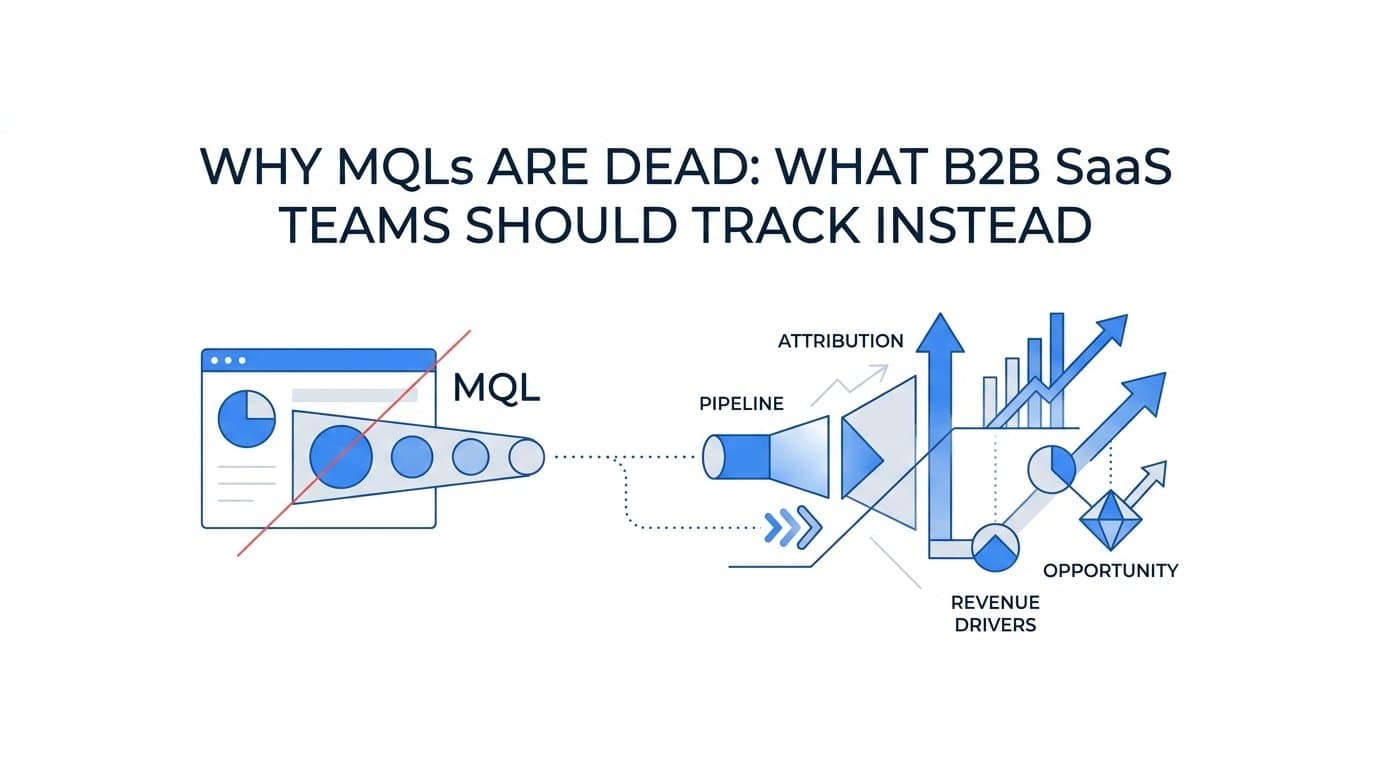
The foundational shift is moving from funnel-stage metrics to full-funnel attribution. In a funnel-stage model, marketing owns the top of the funnel and is measured on lead volume, while sales owns the bottom and is measured on closed revenue. This structure creates the misalignment that makes MQL debates so common. In a full-funnel attribution model, marketing is accountable for its contribution to pipeline and revenue across the entire customer journey, not just for the leads it hands off at a defined stage.
Multi-touch attribution models are central to making this work. Rather than crediting a single touchpoint for a conversion, multi-touch models distribute credit across all the interactions that contributed to a deal. There are several approaches to multi-touch attribution, from linear models that distribute credit equally across all touchpoints to time-decay models that weight recent interactions more heavily to data-driven models that use algorithmic analysis to assign credit based on actual conversion patterns. Each approach has tradeoffs, but all of them provide a more accurate picture of what channels and campaigns move deals forward than single-touch models do.
The practical foundation for a revenue-first measurement framework is a unified data infrastructure. This means connecting ad platform data from channels like Google Ads and LinkedIn, website behavior data, CRM pipeline data, and revenue outcomes into a single source of truth. When these data sources are siloed, marketing cannot trace the path from ad spend to closed-won revenue. When they are connected, marketing can answer the questions that actually matter for budget allocation and campaign optimization.
Dashboards in a revenue-first framework look different from MQL dashboards. Instead of tracking lead volume by campaign, they track pipeline sourced by channel, opportunity creation rate by source, and revenue attributed to specific campaigns over time. These metrics create accountability for outcomes rather than activity, which changes how marketing teams prioritize their work and how they communicate their impact to the rest of the organization.
Building this framework also requires alignment with sales on what a qualified opportunity actually looks like. This is not a one-time conversation but an ongoing calibration. As the business evolves, as ideal customer profiles shift, and as sales motion changes, the definitions that underpin attribution models need to evolve as well. Teams that build this alignment create a shared language for measuring marketing's contribution to revenue that both functions can trust.
Moving Beyond MQLs With Confidence
Transitioning away from MQL-centric reporting is a practical process, not just a philosophical shift. It starts with a conversation between marketing and sales to align on what a qualified opportunity actually looks like in your business today, not based on scoring thresholds set years ago but based on the signals that actually predict a deal will progress.
From there, it requires updating attribution models to reflect the full customer journey. This means instrumenting your website to capture every meaningful interaction, connecting your ad platforms to your CRM, and ensuring that revenue outcomes are tied back to the campaigns and channels that contributed to them. Without this infrastructure, revenue-first reporting is aspirational rather than operational.
This is where Cometly makes the transition actionable. Cometly connects ad spend data, CRM events, and customer journey behavior into a single attribution platform, giving marketing teams the visibility they need to optimize for revenue rather than lead volume. From the first ad click to closed-won revenue, every touchpoint is captured and attributed, so teams can see which channels produce buyers, which campaigns influence pipeline, and where budget should be allocated to drive actual business outcomes. Cometly's AI surfaces recommendations based on what is actually driving conversions, helping teams scale what works and stop investing in what does not.
Teams that make this shift stop defending MQL numbers and start demonstrating revenue impact. They spend smarter because they can see which channels produce buyers rather than browsers. They align better with sales because both functions are working from the same data. And they build a marketing function that is measured on what actually matters to the business.
MQLs measure marketing activity. Revenue attribution measures marketing impact. The teams that understand this difference and build their measurement frameworks accordingly are the ones that will earn the budget, the trust, and the influence to grow.
Ready to elevate your marketing game with precision and confidence? Discover how Cometly's AI-driven recommendations can transform your ad strategy. Get your free demo today and start capturing every touchpoint to maximize your conversions.